 Add to Chrome
 Add to Firefox
 Add to Edge
Autonomous CSI Prediction Framework for O-RAN-Enabled 5G mmWave Vehicular Networks
Jul 24, 2026
Establishing and maintaining 5G mmWave vehicular connectivity poses a challenge due to high user mobility, requiring the design of robust and efficient beam switching procedures. Unlike reactive beam switching based on channel state information (CSI) feedback received from vehicular users, proactive beam switching exploits CSI prediction to prepare in advance for upcoming beam switching decisions. In this paper, we develop a framework for autonomous and self-trainable CSI prediction for mmWave vehicular users. In the proposed framework, base stations (gNBs) collect and label data sets to train a CSI prediction model both independently and using federated learning (FL). The data set combines data extracted from the CSI feedback and cellular vehicle-to-everything (C-V2X) cooperative awareness messages (CAMs) of surrounding vehicles. The framework is placed in the context of machine learning and artificial intelligence (ML/AI)-based Open RAN (O-RAN) applications (rApps and xApps) fed by realistic real-world mobility and CSI data from the DeepMIMO simulator. Detailed evaluation results demonstrate feasibility, accuracy, and flexibility of the proposed CSI prediction framework

Sensing-Assisted Adaptive Beam Probing with Calibrated Multimodal Priors and Uncertainty-Aware Scheduling
Mar 25, 2026Highly directional mmWave/THz links require rapid beam alignment, yet exhaustive codebook sweeps incur prohibitive training overhead. This letter proposes a sensing-assisted adaptive probing policy that maps multimodal sensing (radar/LiDAR/camera) to a calibrated prior over beams, predicts per-beam reward with a deep Q-ensemble whose disagreement serves as a practical epistemic-uncertainty proxy, and schedules a small probe set using a Prior-Q upper-confidence score. The probing budget is adapted from prior entropy, explicitly coupling sensing confidence to communication overhead, while a margin-based safety rule prevents low signal-to-noise ratio (SNR) locks. Experiments on DeepSense-6G (train: scenarios 42 and 44; test:43) with a 21-beam discrete Fourier transform (DFT) codebook achieve Top-1/Top-3 of 0.81/0.99 with expected beam probe of 2 per sweep and zero observed outages at θ = 0 dB with margin Δ = 3 dB. The results show that multimodal priors with ensemble uncertainty match link quality and improve reliability compared to ablations while cutting overhead with better predictive model.
Autonomous Self-Trained Channel State Prediction Method for mmWave Vehicular Communications
Oct 03, 2024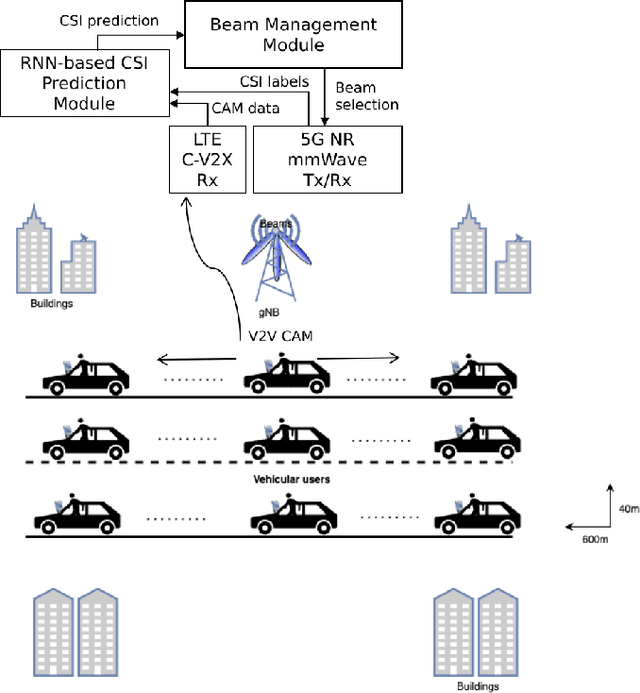
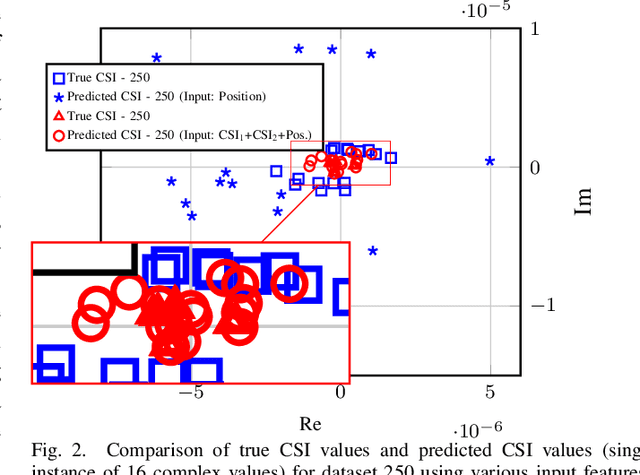
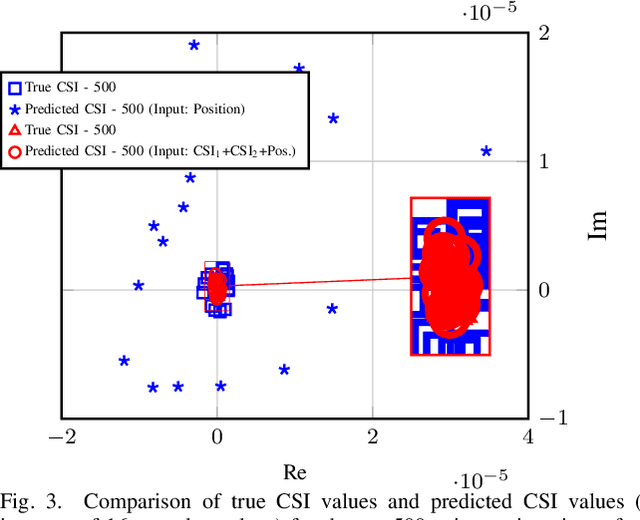
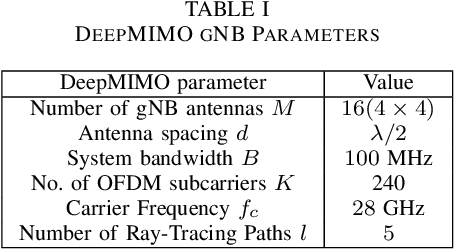
Establishing and maintaining 5G mmWave vehicular connectivity poses a significant challenge due to high user mobility that necessitates frequent triggering of beam switching procedures. Departing from reactive beam switching based on the user device channel state feedback, proactive beam switching prepares in advance for upcoming beam switching decisions by exploiting accurate channel state information (CSI) prediction. In this paper, we develop a framework for autonomous self-trained CSI prediction for mmWave vehicular users where a base station (gNB) collects and labels a dataset that it uses for training recurrent neural network (RNN)-based CSI prediction model. The proposed framework exploits the CSI feedback from vehicular users combined with overhearing the C-V2X cooperative awareness messages (CAMs) they broadcast. We implement and evaluate the proposed framework using deepMIMO dataset generation environment and demonstrate its capability to provide accurate CSI prediction for 5G mmWave vehicular users. CSI prediction model is trained and its capability to provide accurate CSI predictions from various input features are investigated.