 Add to Chrome
 Add to Firefox
 Add to Edge
Cholect50
Papers and Code
UniSurg: A Video-Native Foundation Model for Universal Understanding of Surgical Videos
Feb 05, 2026
While foundation models have advanced surgical video analysis, current approaches rely predominantly on pixel-level reconstruction objectives that waste model capacity on low-level visual details - such as smoke, specular reflections, and fluid motion - rather than semantic structures essential for surgical understanding. We present UniSurg, a video-native foundation model that shifts the learning paradigm from pixel-level reconstruction to latent motion prediction. Built on the Video Joint Embedding Predictive Architecture (V-JEPA), UniSurg introduces three key technical innovations tailored to surgical videos: 1) motion-guided latent prediction to prioritize semantically meaningful regions, 2) spatiotemporal affinity self-distillation to enforce relational consistency, and 3) feature diversity regularization to prevent representation collapse in texture-sparse surgical scenes. To enable large-scale pretraining, we curate UniSurg-15M, the largest surgical video dataset to date, comprising 3,658 hours of video from 50 sources across 13 anatomical regions. Extensive experiments across 17 benchmarks demonstrate that UniSurg significantly outperforms state-of-the-art methods on surgical workflow recognition (+14.6% F1 on EgoSurgery, +10.3% on PitVis), action triplet recognition (39.54% mAP-IVT on CholecT50), skill assessment, polyp segmentation, and depth estimation. These results establish UniSurg as a new standard for universal, motion-oriented surgical video understanding.

MEJO: MLLM-Engaged Surgical Triplet Recognition via Inter- and Intra-Task Joint Optimization
Sep 16, 2025Surgical triplet recognition, which involves identifying instrument, verb, target, and their combinations, is a complex surgical scene understanding challenge plagued by long-tailed data distribution. The mainstream multi-task learning paradigm benefiting from cross-task collaborative promotion has shown promising performance in identifying triples, but two key challenges remain: 1) inter-task optimization conflicts caused by entangling task-generic and task-specific representations; 2) intra-task optimization conflicts due to class-imbalanced training data. To overcome these difficulties, we propose the MLLM-Engaged Joint Optimization (MEJO) framework that empowers both inter- and intra-task optimization for surgical triplet recognition. For inter-task optimization, we introduce the Shared-Specific-Disentangled (S$^2$D) learning scheme that decomposes representations into task-shared and task-specific components. To enhance task-shared representations, we construct a Multimodal Large Language Model (MLLM) powered probabilistic prompt pool to dynamically augment visual features with expert-level semantic cues. Additionally, comprehensive task-specific cues are modeled via distinct task prompts covering the temporal-spatial dimensions, effectively mitigating inter-task ambiguities. To tackle intra-task optimization conflicts, we develop a Coordinated Gradient Learning (CGL) strategy, which dissects and rebalances the positive-negative gradients originating from head and tail classes for more coordinated learning behaviors. Extensive experiments on the CholecT45 and CholecT50 datasets demonstrate the superiority of our proposed framework, validating its effectiveness in handling optimization conflicts.
Enhancing Surgical Documentation through Multimodal Visual-Temporal Transformers and Generative AI
Apr 28, 2025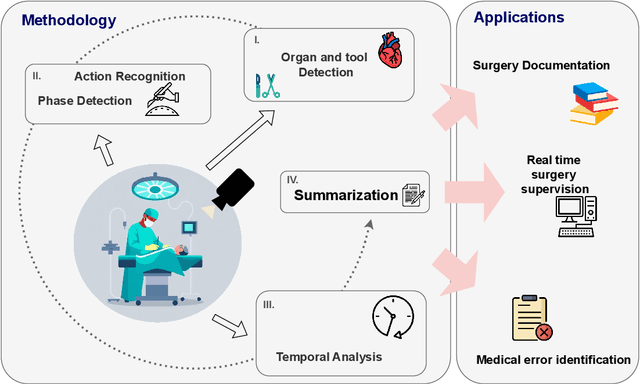
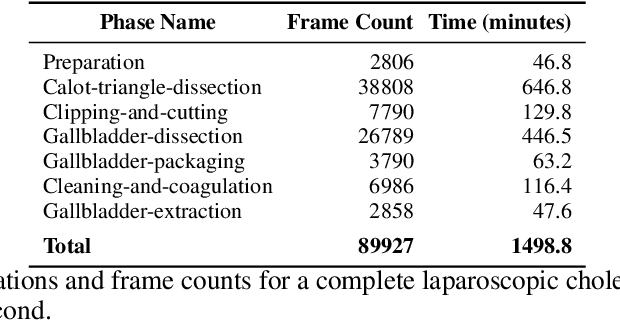
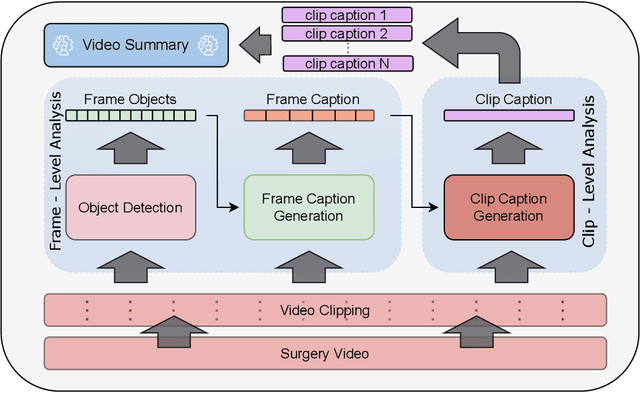
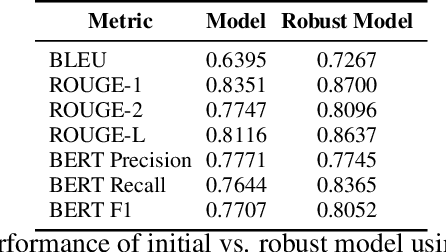
The automatic summarization of surgical videos is essential for enhancing procedural documentation, supporting surgical training, and facilitating post-operative analysis. This paper presents a novel method at the intersection of artificial intelligence and medicine, aiming to develop machine learning models with direct real-world applications in surgical contexts. We propose a multi-modal framework that leverages recent advancements in computer vision and large language models to generate comprehensive video summaries. % The approach is structured in three key stages. First, surgical videos are divided into clips, and visual features are extracted at the frame level using visual transformers. This step focuses on detecting tools, tissues, organs, and surgical actions. Second, the extracted features are transformed into frame-level captions via large language models. These are then combined with temporal features, captured using a ViViT-based encoder, to produce clip-level summaries that reflect the broader context of each video segment. Finally, the clip-level descriptions are aggregated into a full surgical report using a dedicated LLM tailored for the summarization task. % We evaluate our method on the CholecT50 dataset, using instrument and action annotations from 50 laparoscopic videos. The results show strong performance, achieving 96\% precision in tool detection and a BERT score of 0.74 for temporal context summarization. This work contributes to the advancement of AI-assisted tools for surgical reporting, offering a step toward more intelligent and reliable clinical documentation.
Can DeepSeek Reason Like a Surgeon? An Empirical Evaluation for Vision-Language Understanding in Robotic-Assisted Surgery
Apr 02, 2025DeepSeek series have demonstrated outstanding performance in general scene understanding, question-answering (QA), and text generation tasks, owing to its efficient training paradigm and strong reasoning capabilities. In this study, we investigate the dialogue capabilities of the DeepSeek model in robotic surgery scenarios, focusing on tasks such as Single Phrase QA, Visual QA, and Detailed Description. The Single Phrase QA tasks further include sub-tasks such as surgical instrument recognition, action understanding, and spatial position analysis. We conduct extensive evaluations using publicly available datasets, including EndoVis18 and CholecT50, along with their corresponding dialogue data. Our comprehensive evaluation results indicate that, when provided with specific prompts, DeepSeek-V3 performs well in surgical instrument and tissue recognition tasks However, DeepSeek-V3 exhibits significant limitations in spatial position analysis and struggles to understand surgical actions accurately. Additionally, our findings reveal that, under general prompts, DeepSeek-V3 lacks the ability to effectively analyze global surgical concepts and fails to provide detailed insights into surgical scenarios. Based on our observations, we argue that the DeepSeek-V3 is not ready for vision-language tasks in surgical contexts without fine-tuning on surgery-specific datasets.
fine-CLIP: Enhancing Zero-Shot Fine-Grained Surgical Action Recognition with Vision-Language Models
Mar 25, 2025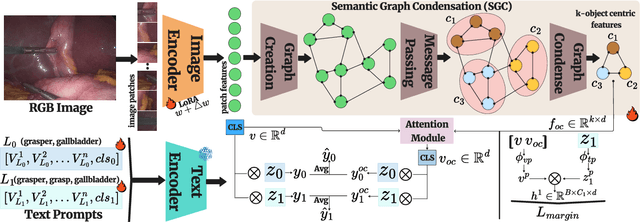
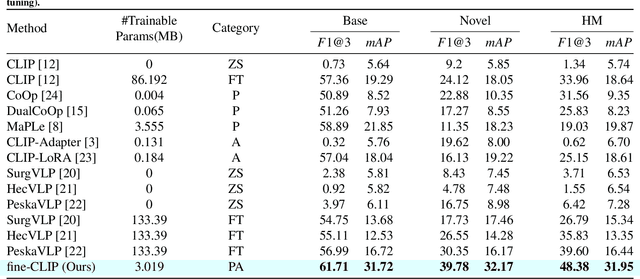
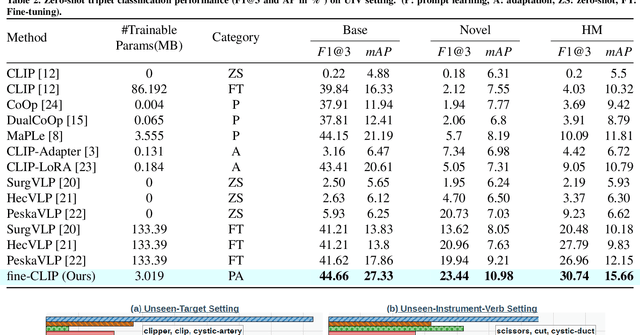
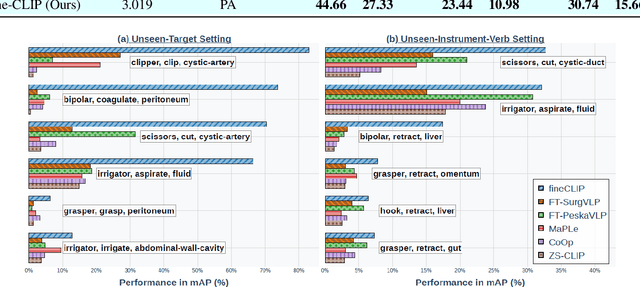
While vision-language models like CLIP have advanced zero-shot surgical phase recognition, they struggle with fine-grained surgical activities, especially action triplets. This limitation arises because current CLIP formulations rely on global image features, which overlook the fine-grained semantics and contextual details crucial for complex tasks like zero-shot triplet recognition. Furthermore, these models do not explore the hierarchical structure inherent in triplets, reducing their ability to generalize to novel triplets. To address these challenges, we propose fine-CLIP, which learns object-centric features and lever- ages the hierarchy in triplet formulation. Our approach integrates three components: hierarchical prompt modeling to capture shared semantics, LoRA-based vision backbone adaptation for enhanced feature extraction, and a graph-based condensation strategy that groups similar patch features into meaningful object clusters. Since triplet classification is a challenging task, we introduce an alternative yet meaningful base-to-novel generalization benchmark with two settings on the CholecT50 dataset: Unseen-Target, assessing adaptability to triplets with novel anatomical structures, and Unseen-Instrument-Verb, where models need to generalize to novel instrument-verb interactions. fine-CLIP shows significant improvements in F1 and mAP, enhancing zero-shot recognition of novel surgical triplets.
Surg-3M: A Dataset and Foundation Model for Perception in Surgical Settings
Mar 25, 2025Advancements in computer-assisted surgical procedures heavily rely on accurate visual data interpretation from camera systems used during surgeries. Traditional open-access datasets focusing on surgical procedures are often limited by their small size, typically consisting of fewer than 100 videos with less than 100K images. To address these constraints, a new dataset called Surg-3M has been compiled using a novel aggregation pipeline that collects high-resolution videos from online sources. Featuring an extensive collection of over 4K surgical videos and more than 3 million high-quality images from multiple procedure types, Surg-3M offers a comprehensive resource surpassing existing alternatives in size and scope, including two novel tasks. To demonstrate the effectiveness of this dataset, we present SurgFM, a self-supervised foundation model pretrained on Surg-3M that achieves impressive results in downstream tasks such as surgical phase recognition, action recognition, and tool presence detection. Combining key components from ConvNeXt, DINO, and an innovative augmented distillation method, SurgFM exhibits exceptional performance compared to specialist architectures across various benchmarks. Our experimental results show that SurgFM outperforms state-of-the-art models in multiple downstream tasks, including significant gains in surgical phase recognition (+8.9pp, +4.7pp, and +3.9pp of Jaccard in AutoLaparo, M2CAI16, and Cholec80), action recognition (+3.1pp of mAP in CholecT50) and tool presence detection (+4.6pp of mAP in Cholec80). Moreover, even when using only half of the data, SurgFM outperforms state-of-the-art models in AutoLaparo and achieves state-of-the-art performance in Cholec80. Both Surg-3M and SurgFM have significant potential to accelerate progress towards developing autonomous robotic surgery systems.
Surgical Text-to-Image Generation
Jul 12, 2024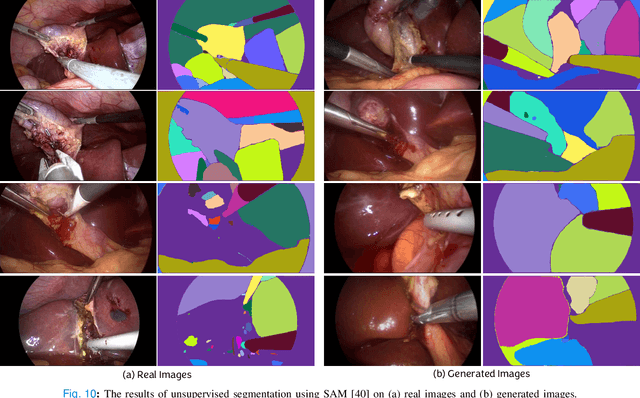
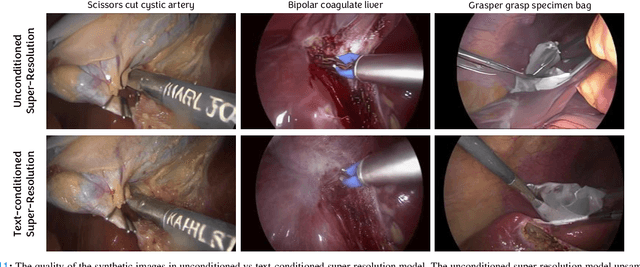
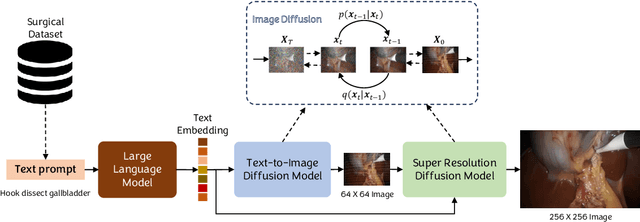
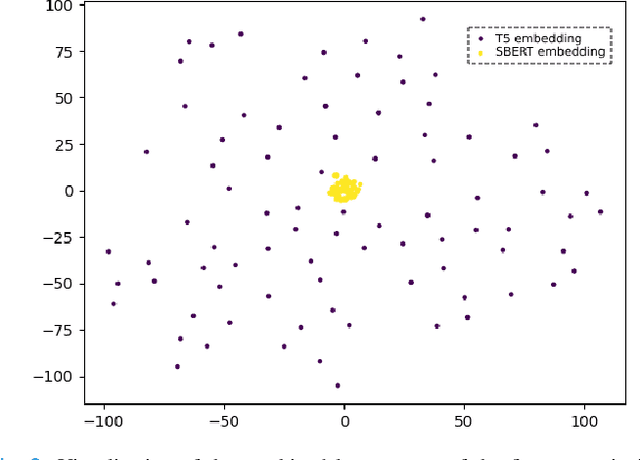
Acquiring surgical data for research and development is significantly hindered by high annotation costs and practical and ethical constraints. Utilizing synthetically generated images could offer a valuable alternative. In this work, we conduct an in-depth analysis on adapting text-to-image generative models for the surgical domain, leveraging the CholecT50 dataset, which provides surgical images annotated with surgical action triplets (instrument, verb, target). We investigate various language models and find T5 to offer more distinct features for differentiating surgical actions based on triplet-based textual inputs. Our analysis demonstrates strong alignment between long and triplet-based captions, supporting the use of triplet-based labels. We address the challenges in training text-to-image models on triplet-based captions without additional input signals by uncovering that triplet text embeddings are instrument-centric in the latent space and then, by designing an instrument-based class balancing technique to counteract the imbalance and skewness in the surgical data, improving training convergence. Extending Imagen, a diffusion-based generative model, we develop Surgical Imagen to generate photorealistic and activity-aligned surgical images from triplet-based textual prompts. We evaluate our model using diverse metrics, including human expert surveys and automated methods like FID and CLIP scores. We assess the model performance on key aspects: quality, alignment, reasoning, knowledge, and robustness, demonstrating the effectiveness of our approach in providing a realistic alternative to real data collection.
CholecInstanceSeg: A Tool Instance Segmentation Dataset for Laparoscopic Surgery
Jun 23, 2024In laparoscopic and robotic surgery, precise tool instance segmentation is an essential technology for advanced computer-assisted interventions. Although publicly available procedures of routine surgeries exist, they often lack comprehensive annotations for tool instance segmentation. Additionally, the majority of standard datasets for tool segmentation are derived from porcine(pig) surgeries. To address this gap, we introduce CholecInstanceSeg, the largest open-access tool instance segmentation dataset to date. Derived from the existing CholecT50 and Cholec80 datasets, CholecInstanceSeg provides novel annotations for laparoscopic cholecystectomy procedures in patients. Our dataset comprises 41.9k annotated frames extracted from 85 clinical procedures and 64.4k tool instances, each labelled with semantic masks and instance IDs. To ensure the reliability of our annotations, we perform extensive quality control, conduct label agreement statistics, and benchmark the segmentation results with various instance segmentation baselines. CholecInstanceSeg aims to advance the field by offering a comprehensive and high-quality open-access dataset for the development and evaluation of tool instance segmentation algorithms.
Surgical Triplet Recognition via Diffusion Model
Jun 19, 2024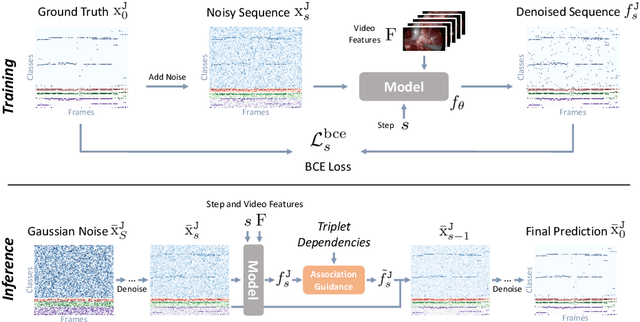
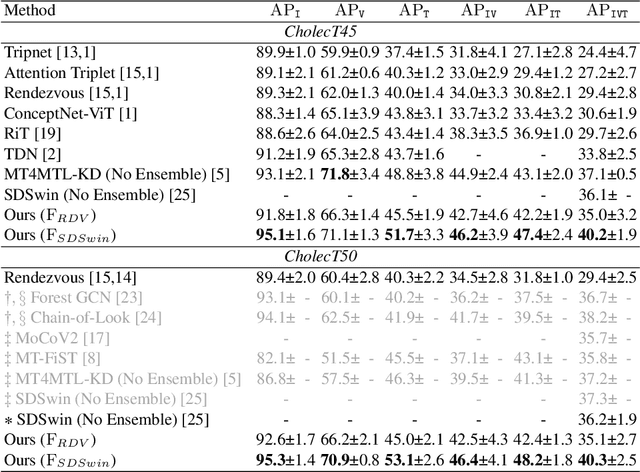
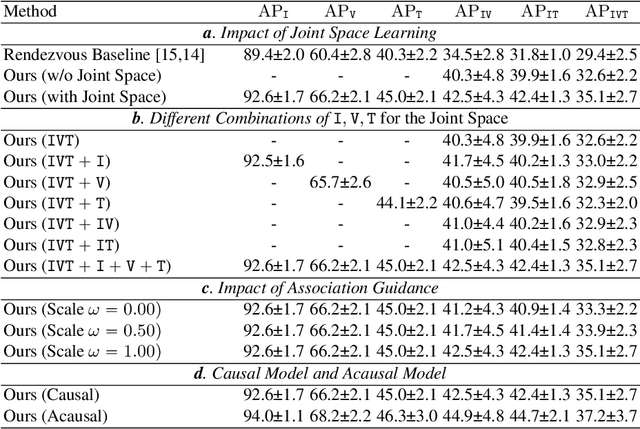
Surgical triplet recognition is an essential building block to enable next-generation context-aware operating rooms. The goal is to identify the combinations of instruments, verbs, and targets presented in surgical video frames. In this paper, we propose DiffTriplet, a new generative framework for surgical triplet recognition employing the diffusion model, which predicts surgical triplets via iterative denoising. To handle the challenge of triplet association, two unique designs are proposed in our diffusion framework, i.e., association learning and association guidance. During training, we optimize the model in the joint space of triplets and individual components to capture the dependencies among them. At inference, we integrate association constraints into each update of the iterative denoising process, which refines the triplet prediction using the information of individual components. Experiments on the CholecT45 and CholecT50 datasets show the superiority of the proposed method in achieving a new state-of-the-art performance for surgical triplet recognition. Our codes will be released.
Surgical Action Triplet Detection by Mixed Supervised Learning of Instrument-Tissue Interactions
Jul 18, 2023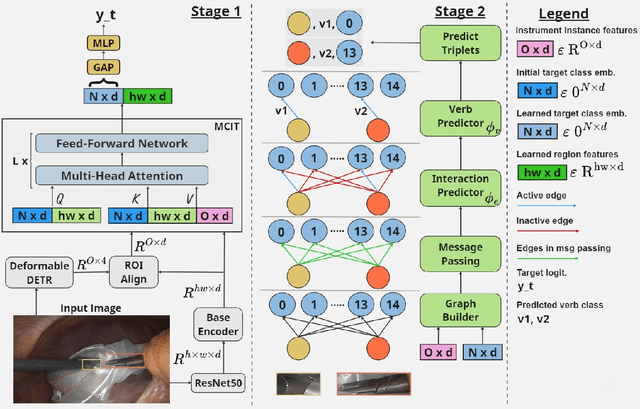

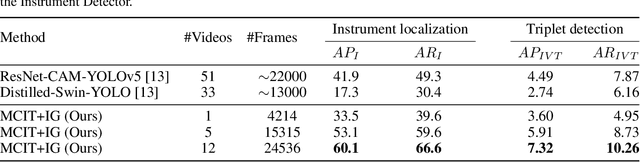
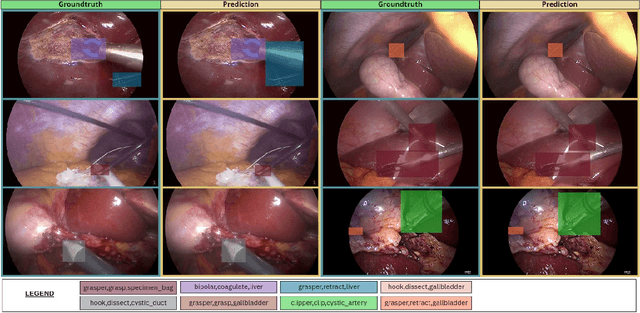
Surgical action triplets describe instrument-tissue interactions as (instrument, verb, target) combinations, thereby supporting a detailed analysis of surgical scene activities and workflow. This work focuses on surgical action triplet detection, which is challenging but more precise than the traditional triplet recognition task as it consists of joint (1) localization of surgical instruments and (2) recognition of the surgical action triplet associated with every localized instrument. Triplet detection is highly complex due to the lack of spatial triplet annotation. We analyze how the amount of instrument spatial annotations affects triplet detection and observe that accurate instrument localization does not guarantee better triplet detection due to the risk of erroneous associations with the verbs and targets. To solve the two tasks, we propose MCIT-IG, a two-stage network, that stands for Multi-Class Instrument-aware Transformer-Interaction Graph. The MCIT stage of our network models per class embedding of the targets as additional features to reduce the risk of misassociating triplets. Furthermore, the IG stage constructs a bipartite dynamic graph to model the interaction between the instruments and targets, cast as the verbs. We utilize a mixed-supervised learning strategy that combines weak target presence labels for MCIT and pseudo triplet labels for IG to train our network. We observed that complementing minimal instrument spatial annotations with target embeddings results in better triplet detection. We evaluate our model on the CholecT50 dataset and show improved performance on both instrument localization and triplet detection, topping the leaderboard of the CholecTriplet challenge in MICCAI 2022.