 Add to Chrome
 Add to Firefox
 Add to Edge
Camera Relocalization
Papers and Code
Learning to Evolve: Multi-modal Interactive Fields for Robust Humanoid Navigation in Dynamic Environments
May 21, 2026
Safe manipulation-oriented navigation for humanoid robots requires scene memory that remains reliable under locomotion-induced perceptual distortion, environmental changes, and interaction-level geometric safety constraints. Existing semantic mapping and scene-graph systems are difficult to deploy directly in this setting because they often assume stable camera trajectories, static environments, or coarse object geometry. We introduce the Multi-modal Interactive Field (MIF), a humanoid-oriented system that integrates confidence-aware semantic 3D Gaussian Splatting, discrepancy-triggered spatial memory updates, and task-driven geometric reconstruction within a closed-loop perception-adaptation pipeline. MIF couples three fields: an uncertainty-aware 3DGS Appearance Field that suppresses gait-induced blur, a Spatial Field that maintains topological memory, and a Geometry Field that supports Interaction Pose Safety (IPS) before manipulation. A discrepancy detection score is introduced to separate locomotion-induced false-positive changes from persistent changes and updates only locally inconsistent regions. On a Unitree-G1 humanoid in a real dynamic office, MIF improves relocation success in non-static environments from 12% to 94% compared with static scene-graph memory, while reducing semantic memory footprint by 91.4% through feature distillation for practical online operation. Project page and code: https://ziya-jiang.github.io/MIF-homepage/

PlanaReLoc: Camera Relocalization in 3D Planar Primitives via Region-Based Structure Matching
Mar 21, 2026While structure-based relocalizers have long strived for point correspondences when establishing or regressing query-map associations, in this paper, we pioneer the use of planar primitives and 3D planar maps for lightweight 6-DoF camera relocalization in structured environments. Planar primitives, beyond being fundamental entities in projective geometry, also serve as region-based representations that encapsulate both structural and semantic richness. This motivates us to introduce PlanaReLoc, a streamlined plane-centric paradigm where a deep matcher associates planar primitives across the query image and the map within a learned unified embedding space, after which the 6-DoF pose is solved and refined under a robust framework. Through comprehensive experiments on the ScanNet and 12Scenes datasets across hundreds of scenes, our method demonstrates the superiority of planar primitives in facilitating reliable cross-modal structural correspondences and achieving effective camera relocalization without requiring realistically textured/colored maps, pose priors, or per-scene training. The code and data are available at https://github.com/3dv-casia/PlanaReLoc .
Hierarchical Visual Relocalization with Nearest View Synthesis from Feature Gaussian Splatting
Mar 31, 2026Visual relocalization is a fundamental task in the field of 3D computer vision, estimating a camera's pose when it revisits a previously known scene. While point-based hierarchical relocalization methods have shown strong scalability and efficiency, they are often limited by sparse image observations and weak feature matching. In this work, we propose SplatHLoc, a novel hierarchical visual relocalization framework that uses Feature Gaussian Splatting as the scene representation. To address the sparsity of database images, we propose an adaptive viewpoint retrieval method that synthesizes virtual candidates with viewpoints more closely aligned with the query, thereby improving the accuracy of initial pose estimation. For feature matching, we observe that Gaussian-rendered features and those extracted directly from images exhibit different strengths across the two-stage matching process: the former performs better in the coarse stage, while the latter proves more effective in the fine stage. Therefore, we introduce a hybrid feature matching strategy, enabling more accurate and efficient pose estimation. Extensive experiments on both indoor and outdoor datasets show that SplatHLoc enhances the robustness of visual relocalization, setting a new state-of-the-art.
Search2Motion: Training-Free Object-Level Motion Control via Attention-Consensus Search
Mar 17, 2026We present Search2Motion, a training-free framework for object-level motion editing in image-to-video generation. Unlike prior methods requiring trajectories, bounding boxes, masks, or motion fields, Search2Motion adopts target-frame-based control, leveraging first-last-frame motion priors to realize object relocation while preserving scene stability without fine-tuning. Reliable target-frame construction is achieved through semantic-guided object insertion and robust background inpainting. We further show that early-step self-attention maps predict object and camera dynamics, offering interpretable user feedback and motivating ACE-Seed (Attention Consensus for Early-step Seed selection), a lightweight search strategy that improves motion fidelity without look-ahead sampling or external evaluators. Noting that existing benchmarks conflate object and camera motion, we introduce S2M-DAVIS and S2M-OMB for stable-camera, object-only evaluation, alongside FLF2V-obj metrics that isolate object artifacts without requiring ground-truth trajectories. Search2Motion consistently outperforms baselines on FLF2V-obj and VBench.
Rethinking Pose Refinement in 3D Gaussian Splatting under Pose Prior and Geometric Uncertainty
Mar 17, 20263D Gaussian Splatting (3DGS) has recently emerged as a powerful scene representation and is increasingly used for visual localization and pose refinement. However, despite its high-quality differentiable rendering, the robustness of 3DGS-based pose refinement remains highly sensitive to both the initial camera pose and the reconstructed geometry. In this work, we take a closer look at these limitations and identify two major sources of uncertainty: (i) pose prior uncertainty, which often arises from regression or retrieval models that output a single deterministic estimate, and (ii) geometric uncertainty, caused by imperfections in the 3DGS reconstruction that propagate errors into PnP solvers. Such uncertainties can distort reprojection geometry and destabilize optimization, even when the rendered appearance still looks plausible. To address these uncertainties, we introduce a relocalization framework that combines Monte Carlo pose sampling with Fisher Information-based PnP optimization. Our method explicitly accounts for both pose and geometric uncertainty and requires no retraining or additional supervision. Across diverse indoor and outdoor benchmarks, our approach consistently improves localization accuracy and significantly increases stability under pose and depth noise.
CogniMap3D: Cognitive 3D Mapping and Rapid Retrieval
Jan 13, 2026We present CogniMap3D, a bioinspired framework for dynamic 3D scene understanding and reconstruction that emulates human cognitive processes. Our approach maintains a persistent memory bank of static scenes, enabling efficient spatial knowledge storage and rapid retrieval. CogniMap3D integrates three core capabilities: a multi-stage motion cue framework for identifying dynamic objects, a cognitive mapping system for storing, recalling, and updating static scenes across multiple visits, and a factor graph optimization strategy for refining camera poses. Given an image stream, our model identifies dynamic regions through motion cues with depth and camera pose priors, then matches static elements against its memory bank. When revisiting familiar locations, CogniMap3D retrieves stored scenes, relocates cameras, and updates memory with new observations. Evaluations on video depth estimation, camera pose reconstruction, and 3D mapping tasks demonstrate its state-of-the-art performance, while effectively supporting continuous scene understanding across extended sequences and multiple visits.
Ctrl&Shift: High-Quality Geometry-Aware Object Manipulation in Visual Generation
Feb 11, 2026Object-level manipulation, relocating or reorienting objects in images or videos while preserving scene realism, is central to film post-production, AR, and creative editing. Yet existing methods struggle to jointly achieve three core goals: background preservation, geometric consistency under viewpoint shifts, and user-controllable transformations. Geometry-based approaches offer precise control but require explicit 3D reconstruction and generalize poorly; diffusion-based methods generalize better but lack fine-grained geometric control. We present Ctrl&Shift, an end-to-end diffusion framework to achieve geometry-consistent object manipulation without explicit 3D representations. Our key insight is to decompose manipulation into two stages, object removal and reference-guided inpainting under explicit camera pose control, and encode both within a unified diffusion process. To enable precise, disentangled control, we design a multi-task, multi-stage training strategy that separates background, identity, and pose signals across tasks. To improve generalization, we introduce a scalable real-world dataset construction pipeline that generates paired image and video samples with estimated relative camera poses. Extensive experiments demonstrate that Ctrl&Shift achieves state-of-the-art results in fidelity, viewpoint consistency, and controllability. To our knowledge, this is the first framework to unify fine-grained geometric control and real-world generalization for object manipulation, without relying on any explicit 3D modeling.
DroneVLA: VLA based Aerial Manipulation
Jan 21, 2026As aerial platforms evolve from passive observers to active manipulators, the challenge shifts toward designing intuitive interfaces that allow non-expert users to command these systems naturally. This work introduces a novel concept of autonomous aerial manipulation system capable of interpreting high-level natural language commands to retrieve objects and deliver them to a human user. The system is intended to integrate a MediaPipe based on Grounding DINO and a Vision-Language-Action (VLA) model with a custom-built drone equipped with a 1-DOF gripper and an Intel RealSense RGB-D camera. VLA performs semantic reasoning to interpret the intent of a user prompt and generates a prioritized task queue for grasping of relevant objects in the scene. Grounding DINO and dynamic A* planning algorithm are used to navigate and safely relocate the object. To ensure safe and natural interaction during the handover phase, the system employs a human-centric controller driven by MediaPipe. This module provides real-time human pose estimation, allowing the drone to employ visual servoing to maintain a stable, distinct position directly in front of the user, facilitating a comfortable handover. We demonstrate the system's efficacy through real-world experiments for localization and navigation, which resulted in a 0.164m, 0.070m, and 0.084m of max, mean euclidean, and root-mean squared errors, respectively, highlighting the feasibility of VLA for aerial manipulation operations.
Reloc-VGGT: Visual Re-localization with Geometry Grounded Transformer
Dec 26, 2025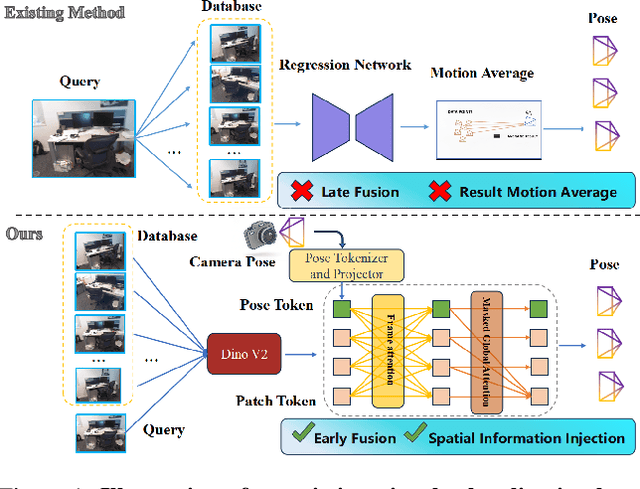
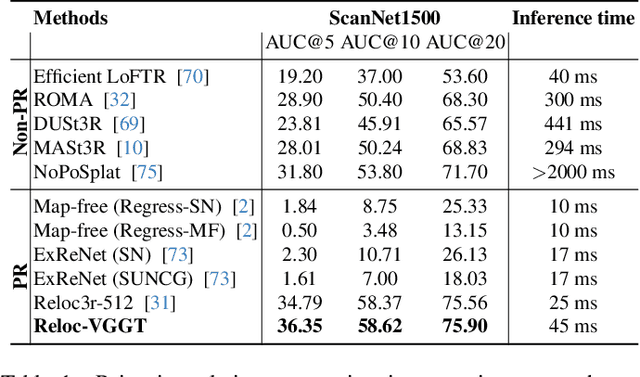
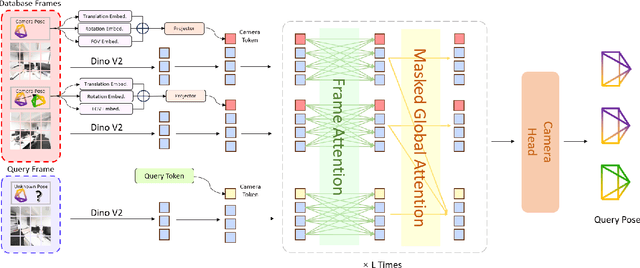
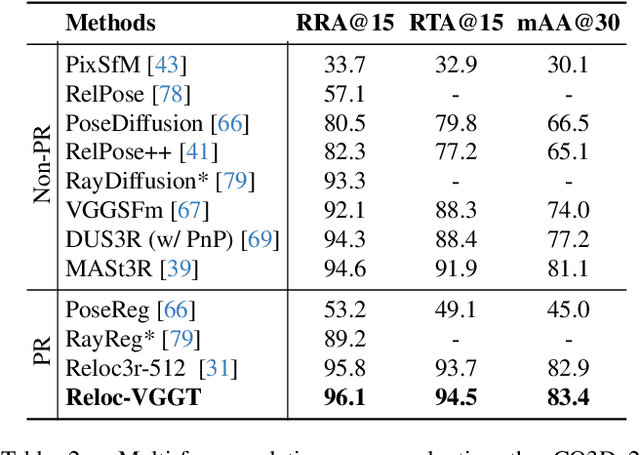
Visual localization has traditionally been formulated as a pair-wise pose regression problem. Existing approaches mainly estimate relative poses between two images and employ a late-fusion strategy to obtain absolute pose estimates. However, the late motion average is often insufficient for effectively integrating spatial information, and its accuracy degrades in complex environments. In this paper, we present the first visual localization framework that performs multi-view spatial integration through an early-fusion mechanism, enabling robust operation in both structured and unstructured environments. Our framework is built upon the VGGT backbone, which encodes multi-view 3D geometry, and we introduce a pose tokenizer and projection module to more effectively exploit spatial relationships from multiple database views. Furthermore, we propose a novel sparse mask attention strategy that reduces computational cost by avoiding the quadratic complexity of global attention, thereby enabling real-time performance at scale. Trained on approximately eight million posed image pairs, Reloc-VGGT demonstrates strong accuracy and remarkable generalization ability. Extensive experiments across diverse public datasets consistently validate the effectiveness and efficiency of our approach, delivering high-quality camera pose estimates in real time while maintaining robustness to unseen environments. Our code and models will be publicly released upon acceptance.https://github.com/dtc111111/Reloc-VGGT.
Scene Coordinate Reconstruction Priors
Oct 14, 2025Scene coordinate regression (SCR) models have proven to be powerful implicit scene representations for 3D vision, enabling visual relocalization and structure-from-motion. SCR models are trained specifically for one scene. If training images imply insufficient multi-view constraints SCR models degenerate. We present a probabilistic reinterpretation of training SCR models, which allows us to infuse high-level reconstruction priors. We investigate multiple such priors, ranging from simple priors over the distribution of reconstructed depth values to learned priors over plausible scene coordinate configurations. For the latter, we train a 3D point cloud diffusion model on a large corpus of indoor scans. Our priors push predicted 3D scene points towards plausible geometry at each training step to increase their likelihood. On three indoor datasets our priors help learning better scene representations, resulting in more coherent scene point clouds, higher registration rates and better camera poses, with a positive effect on down-stream tasks such as novel view synthesis and camera relocalization.