 Add to Chrome
 Add to Firefox
 Add to Edge
Ordinal Neural Collapse as a Representation Prior for Visual Navigation
Jun 25, 2026
Learning robust navigation policies directly from visual observations remains a fundamental challenge in vision-based robotic navigation. In end-to-end imitation learning approaches, the visual encoder and action decoder are jointly optimized using a single action loss, which provides only an indirect supervisory signal to the encoder. This indirect supervision frequently results in the encoder learning ambiguous, action-agnostic representations. The problem is further complicated by substantial variations in scene structure and appearance across diverse environments, as well as the prevalence of visual distractors inherent to real-world navigation settings. Such action-agnostic features cause the navigation policy to produce inconsistent actions at ambiguous decision points, leading to navigation failure. To overcome these limitations, we propose ORION (Ordinal Neural Collapse for Visual Navigation), a method that explicitly organizes the encoder's representation space according to the ordinal structure of navigation actions. In the context of goal-directed navigation, ego-centric control categories from Far Left to Far Right exhibit a natural ordinal relationship in which neighboring classes share similar visual contexts, while semantically opposing classes differ substantially in appearance. We encourage class representations to be arranged sequentially along a single discriminative axis, while suppressing off-axis variance within each class. The pretrained encoder is then integrated into a diffusion-based navigation framework, and the full pipeline is fine-tuned end-to-end. Extensive experiments in both simulation and real-world settings show that ORION consistently outperforms end-to-end and neural collapse baselines in navigation success rate and goal progress, with notable gains in visually challenging scenarios such as complex multi-way intersections.

FPAS: Frontier-Based Path Planning with Adaptive Sampling for Large-Scale Unknown Environments
Jun 22, 2026In this work, we propose Frontier-based Path Planning with Adaptive Sampling (FPAS), a novel framework designed for efficient goal-reaching in large-scale, unknown environments. While existing planners often struggle with computational bottlenecks or inefficient paths during long-range navigation, FPAS overcomes these challenges by reinterpreting the frontier concept for goal-directed tasks. Specifically, our method leverages frontiers to effectively guide forward progression into unobserved regions and to select promising subgoals for backtracking from dead-ends or inefficient paths. Furthermore, FPAS introduces an adaptive sampling mechanism based on a frontier-derived openness metric. This mechanism dynamically adjusts the global graph's density by employing sparse nodes in open areas to alleviate computational burdens, while preserving denser sampling in narrow passages to ensure connectivity. Extensive evaluations demonstrate that FPAS substantially improves computational efficiency over baseline methods while maintaining highly competitive goal-reaching performance.
CIPER: A Unified Framework for Cross-view Image-retrieval and Pose-estimation
Jun 03, 2026Cross-view geo-localization estimates the geographic location of a ground image by matching it against an aerial image database. Existing methods tackle this through either large-scale retrieval or precise pose estimation, but not both: retrieval-based methods enable wide-area search at the cost of localization accuracy, while pose estimation methods achieve high precision within only a narrow search space. Naively cascading these pipelines introduces error propagation and inconsistent feature representations. We formulate cross-view geo-localization as a unified problem requiring simultaneous city-scale retrieval and precise 3-DoF pose estimation. We propose CIPER (Cross-view Image-retrieval and Pose-estimation transformER), a single architecture that jointly performs both tasks through mutually beneficial feature learning. CIPER uses a shared transformer encoder with task-specific tokens to disentangle global retrieval features from spatial localization cues. To bridge the large domain gap between ground and aerial views, we introduce a two-way transformer pose decoder that uses ground features as spatial queries for bidirectional cross-attention. A set prediction strategy further enables stable 3-DoF regression under a unified multi-task objective. Experiments on VIGOR, KITTI, and Ford Multi-AV demonstrate competitive performance, especially under limited field-of-view and arbitrary orientation conditions. Code is available at https://github.com/yurimjeon1892/CIPER.
How to Relieve Distribution Shifts in Semantic Segmentation for Off-Road Environments
May 28, 2026Semantic segmentation is crucial for autonomous navigation in off-road environments, enabling precise classification of surroundings to identify traversable regions. However, distinctive factors inherent to off-road conditions, such as source-target domain discrepancies and sensor corruption from rough terrain, can result in distribution shifts that alter the data differently from the trained conditions. This often leads to inaccurate semantic label predictions and subsequent failures in navigation tasks. To address this, we propose ST-Seg, a novel framework that expands the source distribution through style expansion (SE) and texture regularization (TR). Unlike prior methods that implicitly apply generalization within a fixed source distribution, ST-Seg offers an intuitive approach for distribution shift. Specifically, SE broadens domain coverage by generating diverse realistic styles, augmenting the limited style information of the source domain. TR stabilizes local texture representation affected by style-augmented learning through a deep texture manifold. Experiments across various distribution-shifted target domains demonstrate the effectiveness of ST-Seg, with substantial improvements over existing methods. These results highlight the robustness of ST-Seg, enhancing the real-world applicability of semantic segmentation for off-road navigation.
* 8 pages, 6 figures. Accepted to IEEE Robotics and Automation Letters (RA-L). \c{opyright} 2025 IEEE. Personal use of this material is permitted. Permission from IEEE must be obtained for all other uses
From General Vision to Reliable Traversability Estimation: Adapting Vision Foundation Models for Unstructured Outdoor Environments
May 28, 2026Vision-based approaches have become the dominant paradigm for traversability estimation in unstructured outdoor environments, typically adapting vision foundation models (VFMs) via semantic segmentation supervision. However, this paradigm faces three fundamental challenges that undermine its reliability: the task-agnostic design of VFMs, the ambiguity of traversability annotations, and the discrepancy between semantic labels and physical safety. We propose Vision-to-Traversability Adaptation (ViTA), a framework that adapts VFMs for reliable traversability estimation, instantiated on SAM2. ViTA injects task-specific knowledge through learnable traversability prompts while preserving the VFM's cross-domain generalization. To handle annotation ambiguity, we introduce Perspective-Diversified Training, which estimates semantic uncertainty to suppress confident predictions at ambiguous boundaries. To bridge the semantic-traversability discrepancy, we distill geometric knowledge during training, enabling slope and elevation reasoning from RGB images alone at inference. The semantic and geometric outputs are fused into a continuous traversability score that reflects both semantic uncertainty and geometric risk. Evaluations across diverse domains, including challenging real-world off-road datasets, demonstrate that ViTA achieves state-of-the-art IoU and Precision with substantial false-positive reduction and strong cross-domain generalization.
How to Mitigate the Distribution Shift Problem in Robotics Control: A Robust and Adaptive Approach Based on Offline to Online Imitation Learning
May 25, 2026Distribution shift in imitation learning refers to the problem that the agent cannot plan proper actions for a state that has not been visited during the training. This problem can be largely attributed to the inherently narrow state-action coverage provided by expert demonstrations over the full environment. In this paper, we propose a robust offline to adaptive online imitation learning framework that handles the distribution shift problem in a lifelong, multi-phase scheme. In the offline learning phase, we leverage supplementary demonstrations to broaden the state-action coverage of the policy by utilizing a discriminator to effectively train the policy with supplementary demonstrations, thereby enhancing the robustness of the policy to distribution shift. In the subsequent online inference phase, our framework detects the occurrence of distribution shift and conducts self-supervised imitation learning from online experiences to adapt the policy to the online environments. Through extensive evaluations in MuJoCo environments, we demonstrate that our method exhibits better robustness to distribution shift and better adaptation performance to online environments than the baseline algorithms, which indicates superior performance of our framework against the distribution shift.
Chain-of-Goals Hierarchical Policy for Long-Horizon Offline Goal-Conditioned RL
Feb 03, 2026Offline goal-conditioned reinforcement learning remains challenging for long-horizon tasks. While hierarchical approaches mitigate this issue by decomposing tasks, most existing methods rely on separate high- and low-level networks and generate only a single intermediate subgoal, making them inadequate for complex tasks that require coordinating multiple intermediate decisions. To address this limitation, we draw inspiration from the chain-of-thought paradigm and propose the Chain-of-Goals Hierarchical Policy (CoGHP), a novel framework that reformulates hierarchical decision-making as autoregressive sequence modeling within a unified architecture. Given a state and a final goal, CoGHP autoregressively generates a sequence of latent subgoals followed by the primitive action, where each latent subgoal acts as a reasoning step that conditions subsequent predictions. To implement this efficiently, we pioneer the use of an MLP-Mixer backbone, which supports cross-token communication and captures structural relationships among state, goal, latent subgoals, and action. Across challenging navigation and manipulation benchmarks, CoGHP consistently outperforms strong offline baselines, demonstrating improved performance on long-horizon tasks.
Radar-Based NLoS Pedestrian Localization for Darting-Out Scenarios Near Parked Vehicles with Camera-Assisted Point Cloud Interpretation
Aug 06, 2025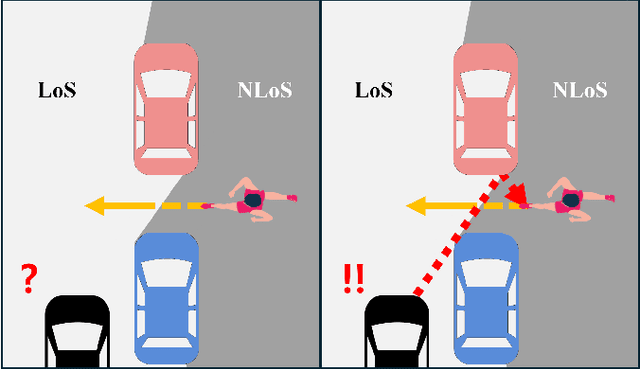
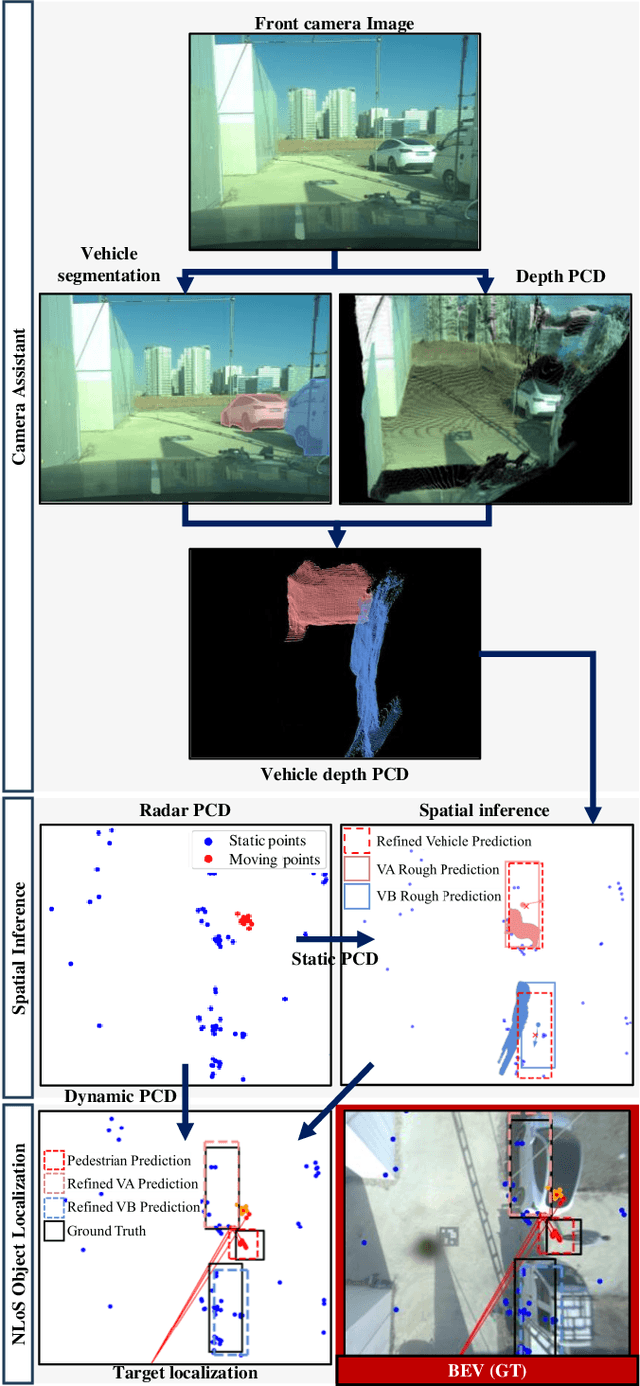
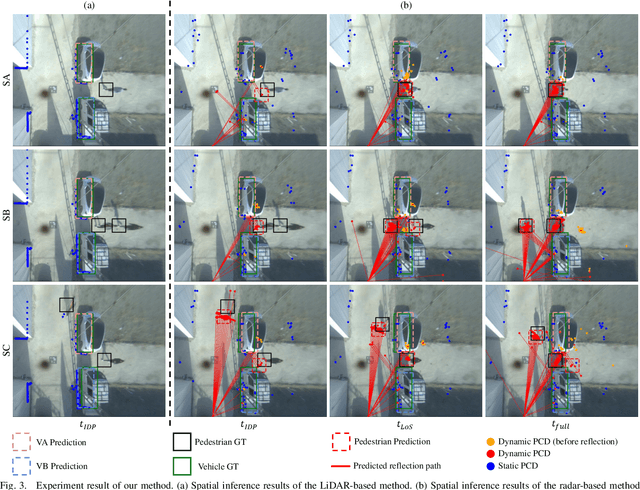
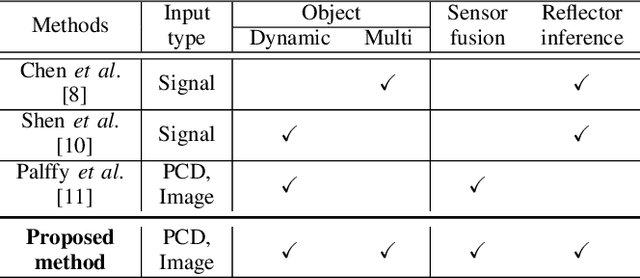
The presence of Non-Line-of-Sight (NLoS) blind spots resulting from roadside parking in urban environments poses a significant challenge to road safety, particularly due to the sudden emergence of pedestrians. mmWave technology leverages diffraction and reflection to observe NLoS regions, and recent studies have demonstrated its potential for detecting obscured objects. However, existing approaches predominantly rely on predefined spatial information or assume simple wall reflections, thereby limiting their generalizability and practical applicability. A particular challenge arises in scenarios where pedestrians suddenly appear from between parked vehicles, as these parked vehicles act as temporary spatial obstructions. Furthermore, since parked vehicles are dynamic and may relocate over time, spatial information obtained from satellite maps or other predefined sources may not accurately reflect real-time road conditions, leading to erroneous sensor interpretations. To address this limitation, we propose an NLoS pedestrian localization framework that integrates monocular camera image with 2D radar point cloud (PCD) data. The proposed method initially detects parked vehicles through image segmentation, estimates depth to infer approximate spatial characteristics, and subsequently refines this information using 2D radar PCD to achieve precise spatial inference. Experimental evaluations conducted in real-world urban road environments demonstrate that the proposed approach enhances early pedestrian detection and contributes to improved road safety. Supplementary materials are available at https://hiyeun.github.io/NLoS/.
Dynamic Contrastive Skill Learning with State-Transition Based Skill Clustering and Dynamic Length Adjustment
Apr 21, 2025Reinforcement learning (RL) has made significant progress in various domains, but scaling it to long-horizon tasks with complex decision-making remains challenging. Skill learning attempts to address this by abstracting actions into higher-level behaviors. However, current approaches often fail to recognize semantically similar behaviors as the same skill and use fixed skill lengths, limiting flexibility and generalization. To address this, we propose Dynamic Contrastive Skill Learning (DCSL), a novel framework that redefines skill representation and learning. DCSL introduces three key ideas: state-transition based skill representation, skill similarity function learning, and dynamic skill length adjustment. By focusing on state transitions and leveraging contrastive learning, DCSL effectively captures the semantic context of behaviors and adapts skill lengths to match the appropriate temporal extent of behaviors. Our approach enables more flexible and adaptive skill extraction, particularly in complex or noisy datasets, and demonstrates competitive performance compared to existing methods in task completion and efficiency.
Leveraging Language Models for Out-of-Distribution Recovery in Reinforcement Learning
Mar 21, 2025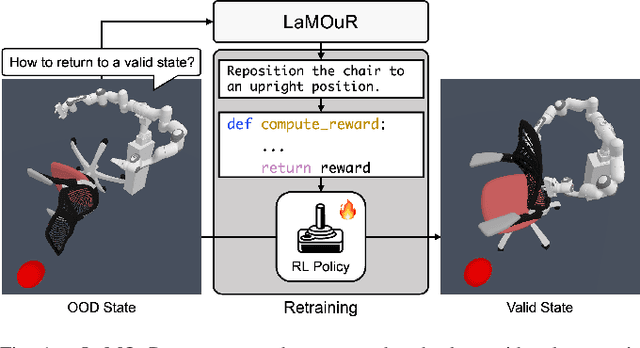
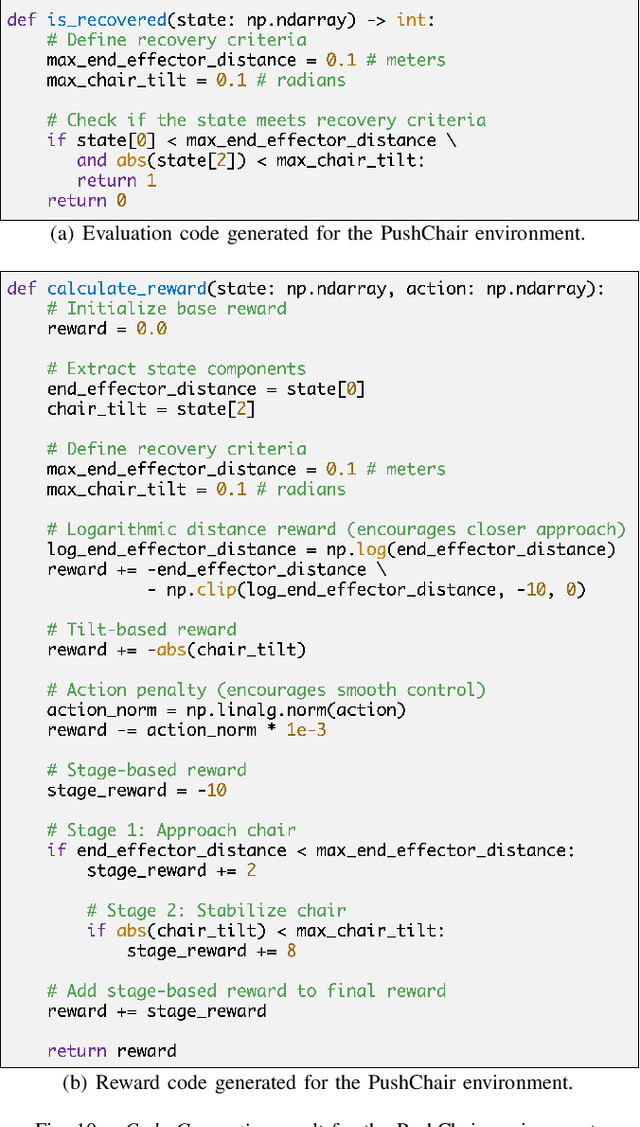
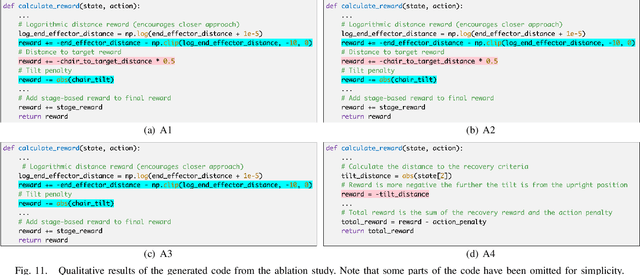
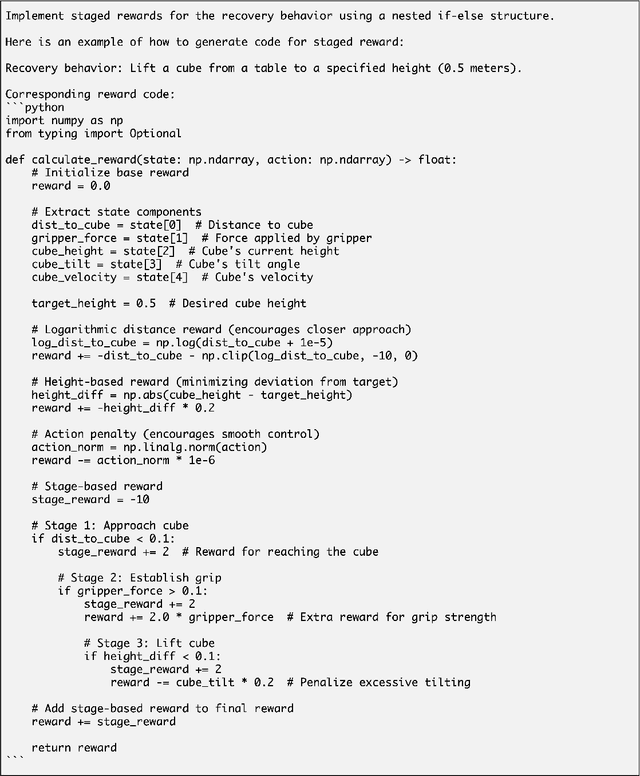
Deep Reinforcement Learning (DRL) has demonstrated strong performance in robotic control but remains susceptible to out-of-distribution (OOD) states, often resulting in unreliable actions and task failure. While previous methods have focused on minimizing or preventing OOD occurrences, they largely neglect recovery once an agent encounters such states. Although the latest research has attempted to address this by guiding agents back to in-distribution states, their reliance on uncertainty estimation hinders scalability in complex environments. To overcome this limitation, we introduce Language Models for Out-of-Distribution Recovery (LaMOuR), which enables recovery learning without relying on uncertainty estimation. LaMOuR generates dense reward codes that guide the agent back to a state where it can successfully perform its original task, leveraging the capabilities of LVLMs in image description, logical reasoning, and code generation. Experimental results show that LaMOuR substantially enhances recovery efficiency across diverse locomotion tasks and even generalizes effectively to complex environments, including humanoid locomotion and mobile manipulation, where existing methods struggle. The code and supplementary materials are available at \href{https://lamour-rl.github.io/}{https://lamour-rl.github.io/}.