 Add to Chrome
 Add to Firefox
 Add to Edge
CaC: Advancing Video Reward Models via Hierarchical Spatiotemporal Concentrating
May 12, 2026
In this paper, we propose Concentrate and Concentrate (CaC), a coarse-to-fine anomaly reward model based on Vision-Language Models. During inference, it first conducts a global temporal scan to anchor anomalous time windows, then performs fine-grained spatial grounding within the localized interval, and finally derives robust judgments via structured spatiotemporal Chain-of-Thought reasoning. To equip the model with these capabilities, we construct the first large-scale generated video anomaly dataset with per-frame bounding-box annotations, temporal anomaly windows, and fine-grained attribution labels. Building on this dataset, we design a three-stage progressive training paradigm. The model initially learns spatial and temporal anchoring through single- and multi-frame supervised fine-tuning, and then is optimized by a reinforcement learning strategy based on two-turn Group Relative Policy Optimization (GRPO). Beyond conventional accuracy rewards, we introduce Temporal and Spatial IoU rewards to supervise the intermediate localization process, effectively guiding the model toward more grounded and interpretable spatiotemporal reasoning. Extensive experiments demonstrate that CaC can stably concentrate on subtle anomalies, achieving a 25.7% accuracy improvement on fine-grained anomaly benchmarks and, when used as a reward signal, CaC reduces generated-video anomalies by 11.7% while improving overall video quality.

EVE: Verifiable Self-Evolution of MLLMs via Executable Visual Transformations
Apr 20, 2026Self-evolution of multimodal large language models (MLLMs) remains a critical challenge: pseudo-label-based methods suffer from progressive quality degradation as model predictions drift, while template-based methods are confined to a static set of transformations that cannot adapt in difficulty or diversity. We contend that robust, continuous self-improvement requires not only deterministic external feedback independent of the model's internal certainty, but also a mechanism to perpetually diversify the training distribution. To this end, we introduce EVE (Executable Visual transformation-based self-Evolution), a novel framework that entirely bypasses pseudo-labels by harnessing executable visual transformations continuously enriched in both variety and complexity. EVE adopts a Challenger-Solver dual-policy architecture. The Challenger maintains and progressively expands a queue of visual transformation code examples, from which it synthesizes novel Python scripts to perform dynamic visual transformations. Executing these scripts yields VQA problems with absolute, execution-verified ground-truth answers, eliminating any reliance on model-generated supervision. A multi-dimensional reward system integrating semantic diversity and dynamic difficulty calibration steers the Challenger to enrich its code example queue while posing progressively more challenging tasks, preventing mode collapse and fostering reciprocal co-evolution between the two policies. Extensive experiments demonstrate that EVE consistently surpasses existing self-evolution methods, establishing a robust and scalable paradigm for verifiable MLLM self-evolution. The code is available at https://github.com/0001Henry/EVE .
VLM-R$^3$: Region Recognition, Reasoning, and Refinement for Enhanced Multimodal Chain-of-Thought
May 22, 2025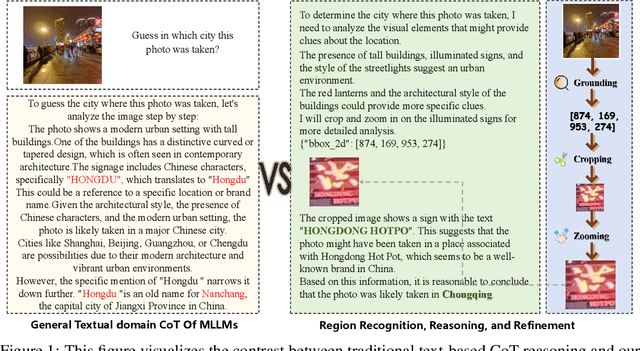
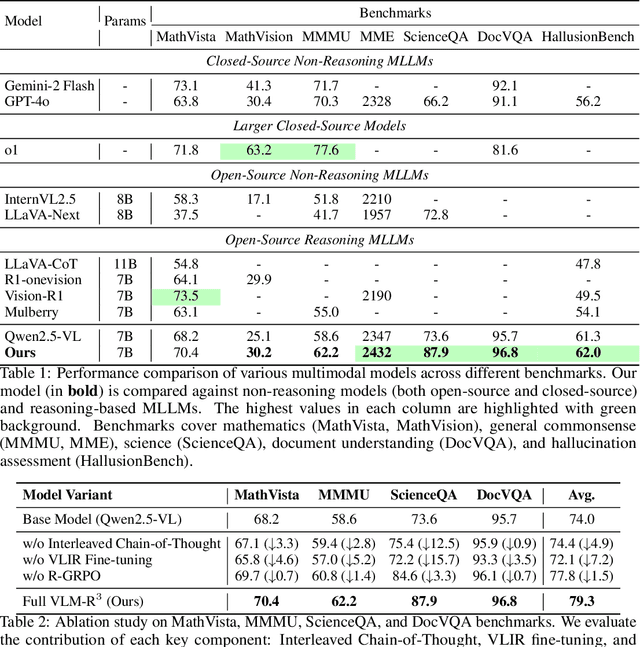
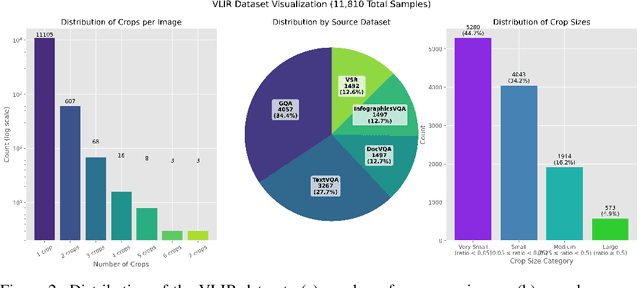
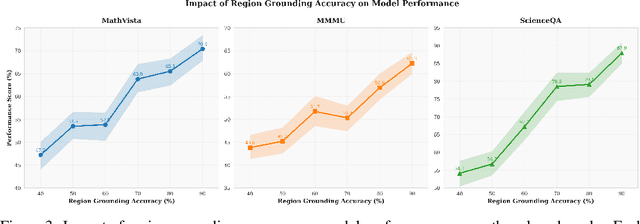
Recently, reasoning-based MLLMs have achieved a degree of success in generating long-form textual reasoning chains. However, they still struggle with complex tasks that necessitate dynamic and iterative focusing on and revisiting of visual regions to achieve precise grounding of textual reasoning in visual evidence. We introduce \textbf{VLM-R$^3$} (\textbf{V}isual \textbf{L}anguage \textbf{M}odel with \textbf{R}egion \textbf{R}ecognition and \textbf{R}easoning), a framework that equips an MLLM with the ability to (i) decide \emph{when} additional visual evidence is needed, (ii) determine \emph{where} to ground within the image, and (iii) seamlessly weave the relevant sub-image content back into an interleaved chain-of-thought. The core of our method is \textbf{Region-Conditioned Reinforcement Policy Optimization (R-GRPO)}, a training paradigm that rewards the model for selecting informative regions, formulating appropriate transformations (e.g.\ crop, zoom), and integrating the resulting visual context into subsequent reasoning steps. To bootstrap this policy, we compile a modest but carefully curated Visuo-Lingual Interleaved Rationale (VLIR) corpus that provides step-level supervision on region selection and textual justification. Extensive experiments on MathVista, ScienceQA, and other benchmarks show that VLM-R$^3$ sets a new state of the art in zero-shot and few-shot settings, with the largest gains appearing on questions demanding subtle spatial reasoning or fine-grained visual cue extraction.