 Add to Chrome
 Add to Firefox
 Add to Edge
TextRefine: Improving Textual Fidelity, Spatial Placement, and Glyph Rendering for Text Editing in Product Posters
Aug 20, 2026
Text editing in product posters entails inserting new text or replacing existing text while preserving product appearance, background content, and global composition. Despite recent progress in instruction-based image editing, general-purpose models remain unreliable in this setting: they often omit or incorrectly render the target text, place it over salient products or pre-existing content, and produce structurally distorted or visually inconsistent glyphs. We introduce \textbf{TextRefine}, a task-aligned post-training framework that combines supervised fine-tuning with operation-specific reward optimization to address these complementary failure modes. For text insertion, our text-span-level reward jointly assesses semantic fidelity and target-span coverage, penalizes spatial conflicts with products and existing text, and employs a gated structural constraint to preserve non-text regions. For text replacement, our glyph-level reward leverages the connectionist temporal classification (CTC) posterior of the target character to provide graded supervision for fine-grained defects, including missing strokes, structural deformations, and confusion among visually similar characters. We further introduce \textbf{OpenTextEdit}, a dataset comprising 100K images for text editing in product posters, with multi-text layouts, detailed text attributes, product masks, and challenging low-frequency characters. Extensive experiments on both insertion and replacement demonstrate that TextRefine consistently outperforms the evaluated image editing baselines in textual fidelity, placement reliability, and glyph quality while better preserving source-image content.

DetailAnywhere: Fashion Detail Generation via Cross-Modal Feature Alignment Distillation
Jul 02, 2026Diffusion-based generative AI has achieved remarkable success in e-commerce applications such as virtual try-on, poster generation, and product background synthesis. However, when making online purchasing decisions for apparel, consumers also desire the freedom to examine specific detail regions of interest, such as collars, cuffs, and fabric textures, yet existing methods have not explicitly studied this setting. We therefore formalize a new, non-template task: Fashion Detail Generation with focus conditioning, and release FDBench, the first benchmark comprising 40K+ human-verified reference-detail pairs across 41 different categories. This task poses a unique semantic gap challenge: the model must bridge the correspondence between a focus marker on a product reference image and a photorealistic close-up view of the indicated region, while faithfully preserving the garment's identity, without any precise prompt. To bridge this gap, we propose Cross-modal Feature Alignment Distillation (CFAD), which leverages a fine-tuned DINOv3 teacher to align both branches of a Multimodal Diffusion Transformer in a shared semantic space via dual-branch distillation. To further improve consistency between generated details and reference images, we introduce a consistency reward model that jointly scores image pairs along three quality axes and optimizes generation via reinforcement learning. Experiments show that our model DetailAnywhere significantly outperforms all state-of-the-art opensource methods across all metrics and human evaluations.
OmniDiT: Extending Diffusion Transformer to Omni-VTON Framework
Mar 20, 2026Despite the rapid advancement of Virtual Try-On (VTON) and Try-Off (VTOFF) technologies, existing VTON methods face challenges with fine-grained detail preservation, generalization to complex scenes, complicated pipeline, and efficient inference. To tackle these problems, we propose OmniDiT, an omni Virtual Try-On framework based on the Diffusion Transformer, which combines try-on and try-off tasks into one unified model. Specifically, we first establish a self-evolving data curation pipeline to continuously produce data, and construct a large VTON dataset Omni-TryOn, which contains over 380k diverse and high-quality garment-model-tryon image pairs and detailed text prompts. Then, we employ the token concatenation and design an adaptive position encoding to effectively incorporate multiple reference conditions. To relieve the bottleneck of long sequence computation, we are the first to introduce Shifted Window Attention into the diffusion model, thus achieving a linear complexity. To remedy the performance degradation caused by local window attention, we utilize multiple timestep prediction and an alignment loss to improve generation fidelity. Experiments reveal that, under various complex scenes, our method achieves the best performance in both the model-free VTON and VTOFF tasks and a performance comparable to current SOTA methods in the model-based VTON task.
Micro-Structures Graph-Based Point Cloud Registration for Balancing Efficiency and Accuracy
Oct 29, 2024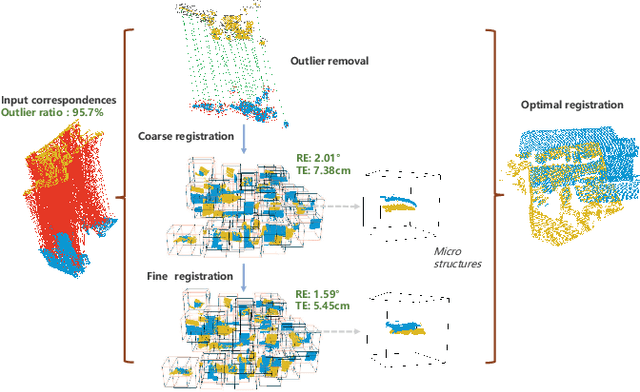
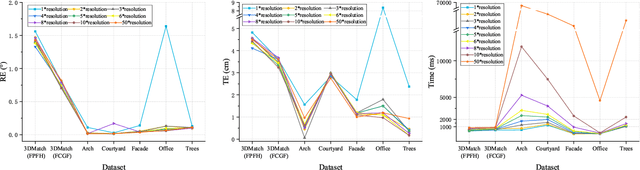

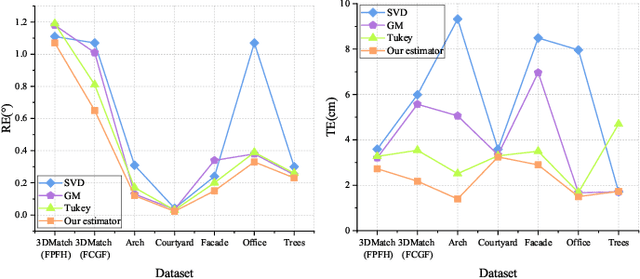
Point Cloud Registration (PCR) is a fundamental and significant issue in photogrammetry and remote sensing, aiming to seek the optimal rigid transformation between sets of points. Achieving efficient and precise PCR poses a considerable challenge. We propose a novel micro-structures graph-based global point cloud registration method. The overall method is comprised of two stages. 1) Coarse registration (CR): We develop a graph incorporating micro-structures, employing an efficient graph-based hierarchical strategy to remove outliers for obtaining the maximal consensus set. We propose a robust GNC-Welsch estimator for optimization derived from a robust estimator to the outlier process in the Lie algebra space, achieving fast and robust alignment. 2) Fine registration (FR): To refine local alignment further, we use the octree approach to adaptive search plane features in the micro-structures. By minimizing the distance from the point-to-plane, we can obtain a more precise local alignment, and the process will also be addressed effectively by being treated as a planar adjustment algorithm combined with Anderson accelerated optimization (PA-AA). After extensive experiments on real data, our proposed method performs well on the 3DMatch and ETH datasets compared to the most advanced methods, achieving higher accuracy metrics and reducing the time cost by at least one-third.
Autonomous Exploration Method for Fast Unknown Environment Mapping by Using UAV Equipped with Limited FOV Sensor
Feb 05, 2023Autonomous exploration is one of the important parts to achieve the fast autonomous mapping and target search. However, most of the existing methods are facing low-efficiency problems caused by low-quality trajectory or back-and-forth maneuvers. To improve the exploration efficiency in unknown environments, a fast autonomous exploration planner (FAEP) is proposed in this paper. Different from existing methods, we firstly design a novel frontiers exploration sequence generation method to obtain a more reasonable exploration path, which considers not only the flight-level but frontier-level factors in the asymmetric traveling salesman problem (ATSP). Then, according to the exploration sequence and the distribution of frontiers, an adaptive yaw planning method is proposed to cover more frontiers by yaw change during an exploration journey. In addition, to increase the speed and fluency of flight, a dynamic replanning strategy is also adopted. We present sufficient comparison and evaluation experiments in simulation environments. Experimental results show the proposed exploration planner has better performance in terms of flight time and flight distance compared to typical and state-of-the-art methods. Moreover, the effectiveness of the proposed method is further evaluated in real-world environments.
A New Outlier Removal Strategy Based on Reliability of Correspondence Graph for Fast Point Cloud Registration
May 16, 2022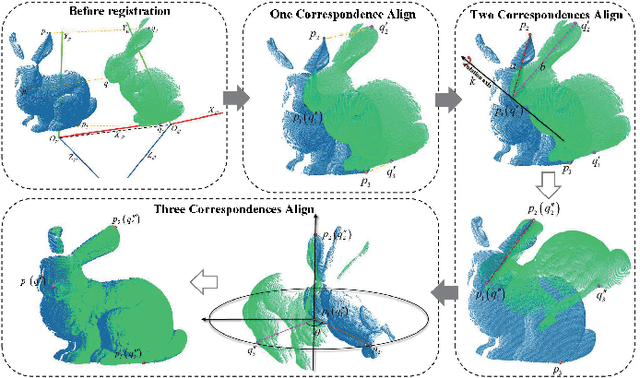
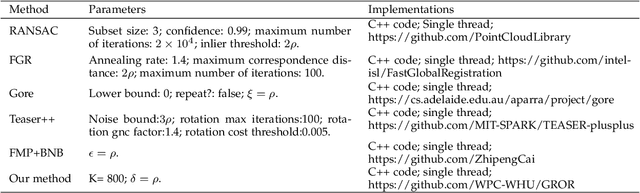
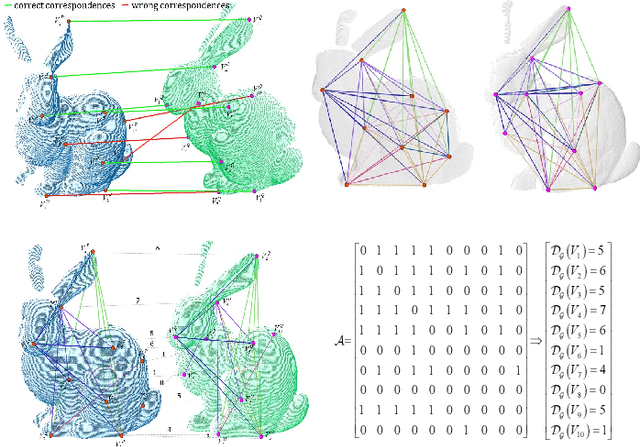
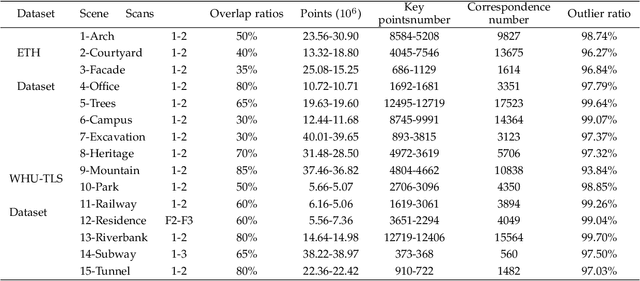
Registration is a basic yet crucial task in point cloud processing. In correspondence-based point cloud registration, matching correspondences by point feature techniques may lead to an extremely high outlier ratio. Current methods still suffer from low efficiency, accuracy, and recall rate. We use a simple and intuitive method to describe the 6-DOF (degree of freedom) curtailment process in point cloud registration and propose an outlier removal strategy based on the reliability of the correspondence graph. The method constructs the corresponding graph according to the given correspondences and designs the concept of the reliability degree of the graph node for optimal candidate selection and the reliability degree of the graph edge to obtain the global maximum consensus set. The presented method could achieve fast and accurate outliers removal along with gradual aligning parameters estimation. Extensive experiments on simulations and challenging real-world datasets demonstrate that the proposed method can still perform effective point cloud registration even the correspondence outlier ratio is over 99%, and the efficiency is better than the state-of-the-art. Code is available at https://github.com/WPC-WHU/GROR.