 Add to Chrome
 Add to Firefox
 Add to Edge
Native Video-Action Pretraining for Generalizable Robot Control
Jul 09, 2026
The advent of video-action models offers a promising path for robot control. Nevertheless, we argue that repurposing video generative models designed for digital content creation is inherently inadequate for physical environments. To bridge this gap, we present LingBot-VA 2.0, a video-action foundation model built from the ground up for embodiment. Four core design principles showcase its evolution from LingBot-VA. (1) Departing from traditional reconstruction-focused VAEs, we introduce a semantic visual-action tokenizer, which aligns visual representations with both semantics and actions, improving instruction following and action precision in subsequent policy learning. (2) Given the strictly causal nature of temporal dynamics, we adopt a causal pretraining paradigm, training from scratch to circumvent the catastrophic forgetting that frequently occurs when adapting bidirectional architectures. (3) To meet the demands of high-frequency inference, our model employs a sparse MoE backbone, expanding model capacity without compromising efficiency. (4) Real-time closed-loop control is realized through an enhanced asynchronous inference scheme, which predicts future latents in parallel with action execution while re-grounding each rollout on the latest observation via learned forward dynamics. Real-world deployment validates LingBot-VA 2.0 as a robust foundation model, as evidenced by its few-shot generalization across complex manipulation tasks.

Scaling Mixture-of-Experts Video Pretraining for Embodied Intelligence
Jul 08, 2026Despite the recent promise in robot control, video generative models suffer from a domain mismatch due to their primary focus on content creation. For example, their design inherently prioritizes visual fidelity and creativity over computational efficiency and physical realism. In this work, we present LingBot-Video, a DiT-based video pretraining paradigm specifically tailored for embodied intelligence. From the architecture perspective, we adopt the Mixture-of-Experts (MoE), instead of dense, framework to achieve a better trade-off between modeling capacity and inference efficiency, and manage to scale it up from scratch. From the data perspective, we construct a data profiling engine that augments standard internet videos with extensive robot-oriented footage, encompassing manipulation, navigation, and egocentric perspectives, to equip the base model with an intrinsic understanding of actions and world dynamics. From the training perspective, we develop a multi-dimensional reward system to enforce the alignment regarding physical rationality and task completion, going beyond standard criteria such as aesthetics, prompt-following, and motion consistency. Comprehensive evaluations validate its performance and efficiency as a video foundation model. We contribute LingBot-Video as the inaugural large-scale, open-source MoE video foundation model to the community, in a pioneering effort to bridge digital creativity and physical actuation.
OmniRoam: World Wandering via Long-Horizon Panoramic Video Generation
Mar 31, 2026Modeling scenes using video generation models has garnered growing research interest in recent years. However, most existing approaches rely on perspective video models that synthesize only limited observations of a scene, leading to issues of completeness and global consistency. We propose OmniRoam, a controllable panoramic video generation framework that exploits the rich per-frame scene coverage and inherent long-term spatial and temporal consistency of panoramic representation, enabling long-horizon scene wandering. Our framework begins with a preview stage, where a trajectory-controlled video generation model creates a quick overview of the scene from a given input image or video. Then, in the refine stage, this video is temporally extended and spatially upsampled to produce long-range, high-resolution videos, thus enabling high-fidelity world wandering. To train our model, we introduce two panoramic video datasets that incorporate both synthetic and real-world captured videos. Experiments show that our framework consistently outperforms state-of-the-art methods in terms of visual quality, controllability, and long-term scene consistency, both qualitatively and quantitatively. We further showcase several extensions of this framework, including real-time video generation and 3D reconstruction. Code is available at https://github.com/yuhengliu02/OmniRoam.
LoST: Level of Semantics Tokenization for 3D Shapes
Mar 18, 2026Tokenization is a fundamental technique in the generative modeling of various modalities. In particular, it plays a critical role in autoregressive (AR) models, which have recently emerged as a compelling option for 3D generation. However, optimal tokenization of 3D shapes remains an open question. State-of-the-art (SOTA) methods primarily rely on geometric level-of-detail (LoD) hierarchies, originally designed for rendering and compression. These spatial hierarchies are often token-inefficient and lack semantic coherence for AR modeling. We propose Level-of-Semantics Tokenization (LoST), which orders tokens by semantic salience, such that early prefixes decode into complete, plausible shapes that possess principal semantics, while subsequent tokens refine instance-specific geometric and semantic details. To train LoST, we introduce Relational Inter-Distance Alignment (RIDA), a novel 3D semantic alignment loss that aligns the relational structure of the 3D shape latent space with that of the semantic DINO feature space. Experiments show that LoST achieves SOTA reconstruction, surpassing previous LoD-based 3D shape tokenizers by large margins on both geometric and semantic reconstruction metrics. Moreover, LoST achieves efficient, high-quality AR 3D generation and enables downstream tasks like semantic retrieval, while using only 0.1%-10% of the tokens needed by prior AR models.
RigAnything: Template-Free Autoregressive Rigging for Diverse 3D Assets
Feb 13, 2025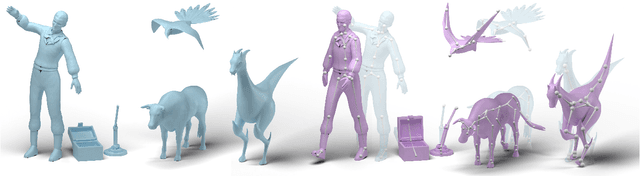
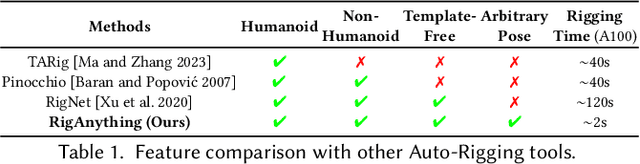

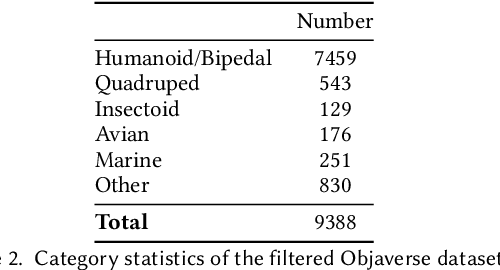
We present RigAnything, a novel autoregressive transformer-based model, which makes 3D assets rig-ready by probabilistically generating joints, skeleton topologies, and assigning skinning weights in a template-free manner. Unlike most existing auto-rigging methods, which rely on predefined skeleton template and are limited to specific categories like humanoid, RigAnything approaches the rigging problem in an autoregressive manner, iteratively predicting the next joint based on the global input shape and the previous prediction. While autoregressive models are typically used to generate sequential data, RigAnything extends their application to effectively learn and represent skeletons, which are inherently tree structures. To achieve this, we organize the joints in a breadth-first search (BFS) order, enabling the skeleton to be defined as a sequence of 3D locations and the parent index. Furthermore, our model improves the accuracy of position prediction by leveraging diffusion modeling, ensuring precise and consistent placement of joints within the hierarchy. This formulation allows the autoregressive model to efficiently capture both spatial and hierarchical relationships within the skeleton. Trained end-to-end on both RigNet and Objaverse datasets, RigAnything demonstrates state-of-the-art performance across diverse object types, including humanoids, quadrupeds, marine creatures, insects, and many more, surpassing prior methods in quality, robustness, generalizability, and efficiency. Please check our website for more details: https://www.liuisabella.com/RigAnything.
GRM: Large Gaussian Reconstruction Model for Efficient 3D Reconstruction and Generation
Mar 21, 2024
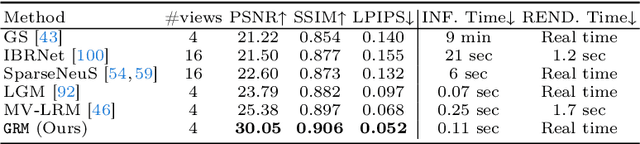
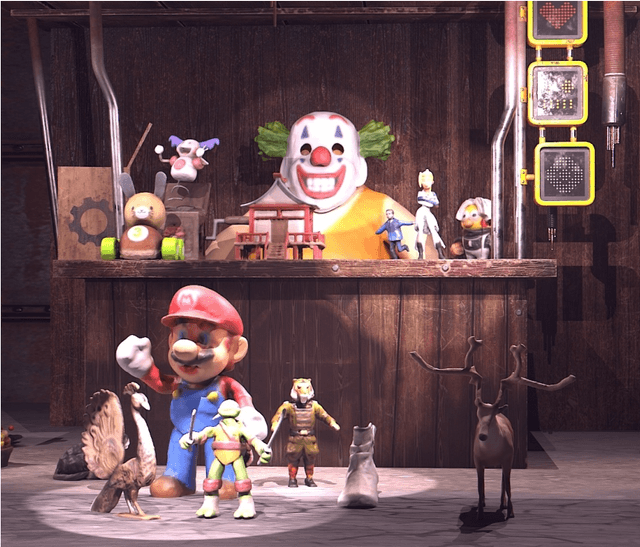

We introduce GRM, a large-scale reconstructor capable of recovering a 3D asset from sparse-view images in around 0.1s. GRM is a feed-forward transformer-based model that efficiently incorporates multi-view information to translate the input pixels into pixel-aligned Gaussians, which are unprojected to create a set of densely distributed 3D Gaussians representing a scene. Together, our transformer architecture and the use of 3D Gaussians unlock a scalable and efficient reconstruction framework. Extensive experimental results demonstrate the superiority of our method over alternatives regarding both reconstruction quality and efficiency. We also showcase the potential of GRM in generative tasks, i.e., text-to-3D and image-to-3D, by integrating it with existing multi-view diffusion models. Our project website is at: https://justimyhxu.github.io/projects/grm/.
Real-time 3D-aware Portrait Editing from a Single Image
Feb 21, 2024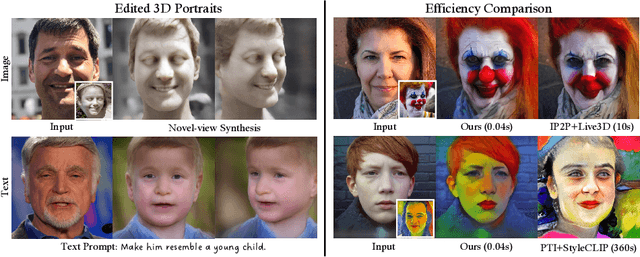
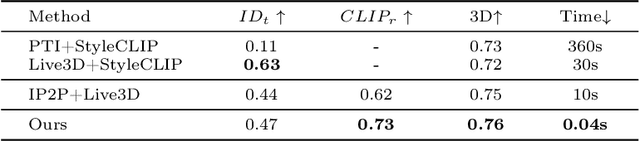
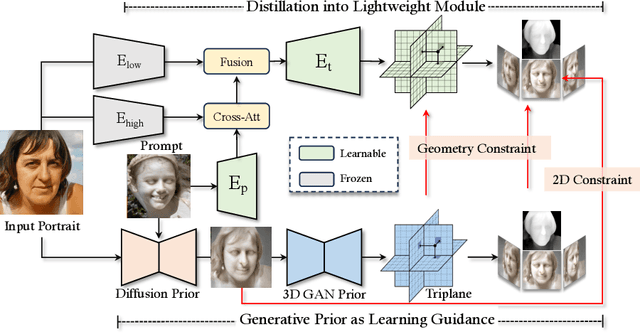

This work presents 3DPE, a practical tool that can efficiently edit a face image following given prompts, like reference images or text descriptions, in the 3D-aware manner. To this end, a lightweight module is distilled from a 3D portrait generator and a text-to-image model, which provide prior knowledge of face geometry and open-vocabulary editing capability, respectively. Such a design brings two compelling advantages over existing approaches. First, our system achieves real-time editing with a feedforward network (i.e., ~0.04s per image), over 100x faster than the second competitor. Second, thanks to the powerful priors, our module could focus on the learning of editing-related variations, such that it manages to handle various types of editing simultaneously in the training phase and further supports fast adaptation to user-specified novel types of editing during inference (e.g., with ~5min fine-tuning per case). The code, the model, and the interface will be made publicly available to facilitate future research.
Learning Naturally Aggregated Appearance for Efficient 3D Editing
Dec 11, 2023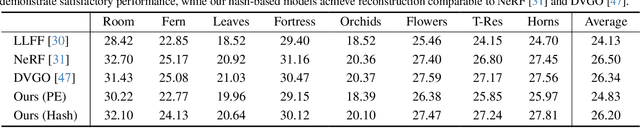
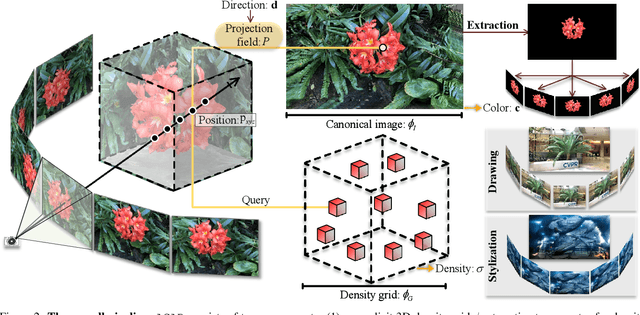
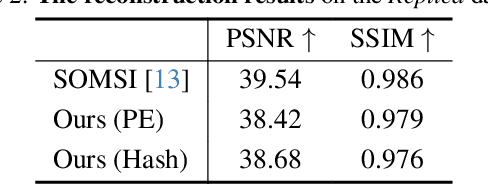
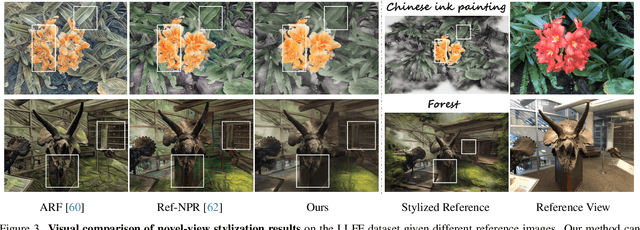
Neural radiance fields, which represent a 3D scene as a color field and a density field, have demonstrated great progress in novel view synthesis yet are unfavorable for editing due to the implicitness. In view of such a deficiency, we propose to replace the color field with an explicit 2D appearance aggregation, also called canonical image, with which users can easily customize their 3D editing via 2D image processing. To avoid the distortion effect and facilitate convenient editing, we complement the canonical image with a projection field that maps 3D points onto 2D pixels for texture lookup. This field is carefully initialized with a pseudo canonical camera model and optimized with offset regularity to ensure naturalness of the aggregated appearance. Extensive experimental results on three datasets suggest that our representation, dubbed AGAP, well supports various ways of 3D editing (e.g., stylization, interactive drawing, and content extraction) with no need of re-optimization for each case, demonstrating its generalizability and efficiency. Project page is available at https://felixcheng97.github.io/AGAP/.
GenDeF: Learning Generative Deformation Field for Video Generation
Dec 07, 2023

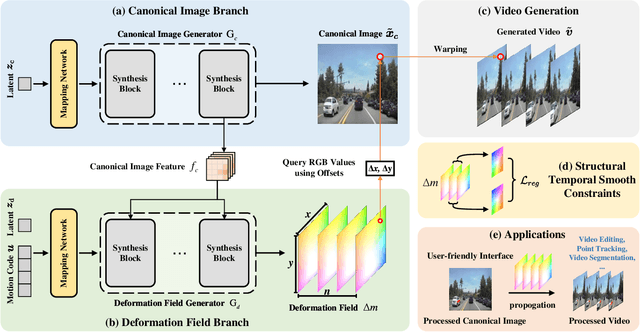

We offer a new perspective on approaching the task of video generation. Instead of directly synthesizing a sequence of frames, we propose to render a video by warping one static image with a generative deformation field (GenDeF). Such a pipeline enjoys three appealing advantages. First, we can sufficiently reuse a well-trained image generator to synthesize the static image (also called canonical image), alleviating the difficulty in producing a video and thereby resulting in better visual quality. Second, we can easily convert a deformation field to optical flows, making it possible to apply explicit structural regularizations for motion modeling, leading to temporally consistent results. Third, the disentanglement between content and motion allows users to process a synthesized video through processing its corresponding static image without any tuning, facilitating many applications like video editing, keypoint tracking, and video segmentation. Both qualitative and quantitative results on three common video generation benchmarks demonstrate the superiority of our GenDeF method.
Gaussian Shell Maps for Efficient 3D Human Generation
Nov 29, 2023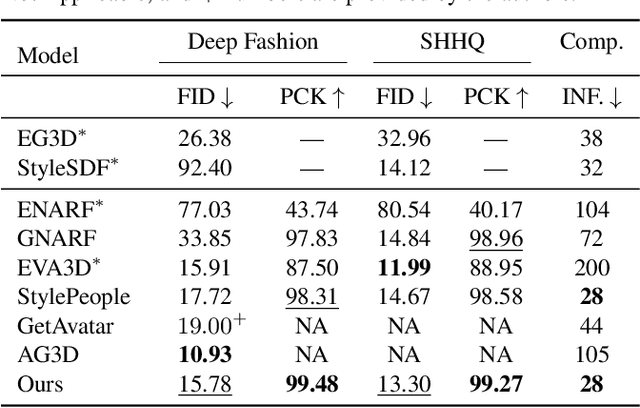



Efficient generation of 3D digital humans is important in several industries, including virtual reality, social media, and cinematic production. 3D generative adversarial networks (GANs) have demonstrated state-of-the-art (SOTA) quality and diversity for generated assets. Current 3D GAN architectures, however, typically rely on volume representations, which are slow to render, thereby hampering the GAN training and requiring multi-view-inconsistent 2D upsamplers. Here, we introduce Gaussian Shell Maps (GSMs) as a framework that connects SOTA generator network architectures with emerging 3D Gaussian rendering primitives using an articulable multi shell--based scaffold. In this setting, a CNN generates a 3D texture stack with features that are mapped to the shells. The latter represent inflated and deflated versions of a template surface of a digital human in a canonical body pose. Instead of rasterizing the shells directly, we sample 3D Gaussians on the shells whose attributes are encoded in the texture features. These Gaussians are efficiently and differentiably rendered. The ability to articulate the shells is important during GAN training and, at inference time, to deform a body into arbitrary user-defined poses. Our efficient rendering scheme bypasses the need for view-inconsistent upsamplers and achieves high-quality multi-view consistent renderings at a native resolution of $512 \times 512$ pixels. We demonstrate that GSMs successfully generate 3D humans when trained on single-view datasets, including SHHQ and DeepFashion.