 Add to Chrome
 Add to Firefox
 Add to Edge
Transforming External Knowledge into Triplets for Enhanced Retrieval in RAG of LLMs
Apr 14, 2026
Retrieval-Augmented Generation (RAG) mitigates hallucination in large language models (LLMs) by incorporating external knowledge during generation. However, the effectiveness of RAG depends not only on the design of the retriever and the capacity of the underlying model, but also on how retrieved evidence is structured and aligned with the query. Existing RAG approaches typically retrieve and concatenate unstructured text fragments as context, which often introduces redundant or weakly relevant information. This practice leads to excessive context accumulation, reduced semantic alignment, and fragmented reasoning chains, thereby degrading generation quality while increasing token consumption. To address these challenges, we propose Tri-RAG, a structured triplet-based retrieval framework that improves retrieval efficiency through reasoning-aligned context construction. Tri-RAG automatically transforms external knowledge from natural language into standardized structured triplets consisting of Condition, Proof, and Conclusion, explicitly capturing logical relations among knowledge fragments using lightweight prompt-based adaptation with frozen model parameters. Building on this representation, the triplet head Condition is treated as an explicit semantic anchor for retrieval and matching, enabling precise identification of query-relevant knowledge units without directly concatenating lengthy raw texts. As a result, Tri-RAG achieves a favorable balance between retrieval accuracy and context token efficiency. Experimental results across multiple benchmark datasets demonstrate that Tri-RAG significantly improves retrieval quality and reasoning efficiency, while producing more stable generation behavior and more efficient resource utilization in complex reasoning scenarios.

Efficient and Interpretable Multi-Agent LLM Routing via Ant Colony Optimization
Mar 13, 2026Large Language Model (LLM)-driven Multi-Agent Systems (MAS) have demonstrated strong capability in complex reasoning and tool use, and heterogeneous agent pools further broaden the quality--cost trade-off space. Despite these advances, real-world deployment is often constrained by high inference cost, latency, and limited transparency, which hinders scalable and efficient routing. Existing routing strategies typically rely on expensive LLM-based selectors or static policies, and offer limited controllability for semantic-aware routing under dynamic loads and mixed intents, often resulting in unstable performance and inefficient resource utilization. To address these limitations, we propose AMRO-S, an efficient and interpretable routing framework for Multi-Agent Systems (MAS). AMRO-S models MAS routing as a semantic-conditioned path selection problem, enhancing routing performance through three key mechanisms: First, it leverages a supervised fine-tuned (SFT) small language model for intent inference, providing a low-overhead semantic interface for each query; second, it decomposes routing memory into task-specific pheromone specialists, reducing cross-task interference and optimizing path selection under mixed workloads; finally, it employs a quality-gated asynchronous update mechanism to decouple inference from learning, optimizing routing without increasing latency. Extensive experiments on five public benchmarks and high-concurrency stress tests demonstrate that AMRO-S consistently improves the quality--cost trade-off over strong routing baselines, while providing traceable routing evidence through structured pheromone patterns.
Text summarization via global structure awareness
Feb 11, 2026Text summarization is a fundamental task in natural language processing (NLP), and the information explosion has made long-document processing increasingly demanding, making summarization essential. Existing research mainly focuses on model improvements and sentence-level pruning, but often overlooks global structure, leading to disrupted coherence and weakened downstream performance. Some studies employ large language models (LLMs), which achieve higher accuracy but incur substantial resource and time costs. To address these issues, we introduce GloSA-sum, the first summarization approach that achieves global structure awareness via topological data analysis (TDA). GloSA-sum summarizes text efficiently while preserving semantic cores and logical dependencies. Specifically, we construct a semantic-weighted graph from sentence embeddings, where persistent homology identifies core semantics and logical structures, preserved in a ``protection pool'' as the backbone for summarization. We design a topology-guided iterative strategy, where lightweight proxy metrics approximate sentence importance to avoid repeated high-cost computations, thus preserving structural integrity while improving efficiency. To further enhance long-text processing, we propose a hierarchical strategy that integrates segment-level and global summarization. Experiments on multiple datasets demonstrate that GloSA-sum reduces redundancy while preserving semantic and logical integrity, striking a balance between accuracy and efficiency, and further benefits LLM downstream tasks by shortening contexts while retaining essential reasoning chains.
GHS-TDA: A Synergistic Reasoning Framework Integrating Global Hypothesis Space with Topological Data Analysis
Feb 10, 2026Chain-of-Thought (CoT) has been shown to significantly improve the reasoning accuracy of large language models (LLMs) on complex tasks. However, due to the autoregressive, step-by-step generation paradigm, existing CoT methods suffer from two fundamental limitations. First, the reasoning process is highly sensitive to early decisions: once an initial error is introduced, it tends to propagate and amplify through subsequent steps, while the lack of a global coordination and revision mechanism makes such errors difficult to correct, ultimately leading to distorted reasoning chains. Second, current CoT approaches lack structured analysis techniques for filtering redundant reasoning and extracting key reasoning features, resulting in unstable reasoning processes and limited interpretability. To address these issues, we propose GHS-TDA. GHS-TDA first constructs a semantically enriched global hypothesis graph to aggregate, align, and coordinate multiple candidate reasoning paths, thereby providing alternative global correction routes when local reasoning fails. It then applies topological data analysis based on persistent homology to capture stable multi-scale structures, remove redundancy and inconsistencies, and extract a more reliable reasoning skeleton. By jointly leveraging reasoning diversity and topological stability, GHS-TDA achieves self-adaptive convergence, produces high-confidence and interpretable reasoning paths, and consistently outperforms strong baselines in terms of both accuracy and robustness across multiple reasoning benchmarks.
GRASP: Guided Region-Aware Sparse Prompting for Adapting MLLMs to Remote Sensing
Jan 23, 2026In recent years, Multimodal Large Language Models (MLLMs) have made significant progress in visual question answering tasks. However, directly applying existing fine-tuning methods to remote sensing (RS) images often leads to issues such as overfitting on background noise or neglecting target details. This is primarily due to the large-scale variations, sparse target distributions, and complex regional semantic features inherent in RS images. These challenges limit the effectiveness of MLLMs in RS tasks. To address these challenges, we propose a parameter-efficient fine-tuning (PEFT) strategy called Guided Region-Aware Sparse Prompting (GRASP). GRASP introduces spatially structured soft prompts associated with spatial blocks extracted from a frozen visual token grid. Through a question-guided sparse fusion mechanism, GRASP dynamically aggregates task-specific context into a compact global prompt, enabling the model to focus on relevant regions while filtering out background noise. Extensive experiments on multiple RSVQA benchmarks show that GRASP achieves competitive performance compared to existing fine-tuning and prompt-based methods while maintaining high parameter efficiency.
Syzygy of Thoughts: Improving LLM CoT with the Minimal Free Resolution
Apr 16, 2025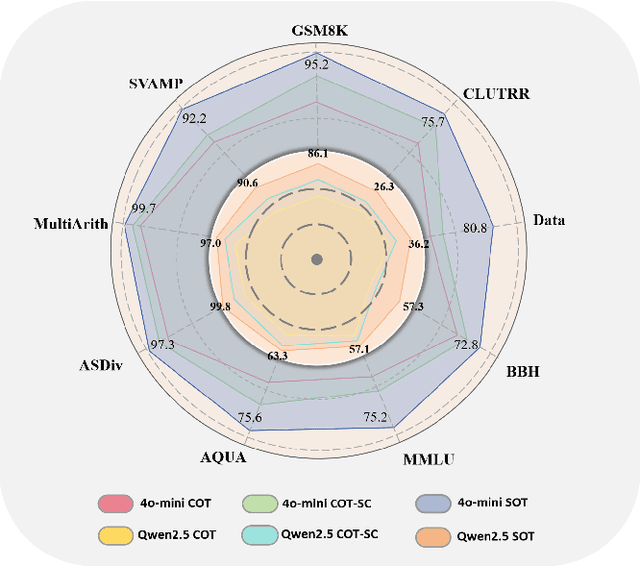
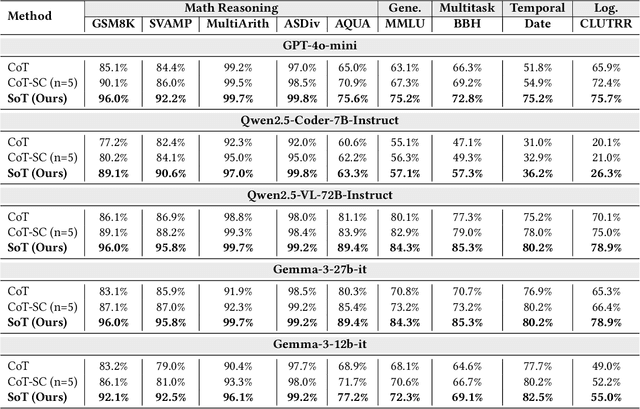
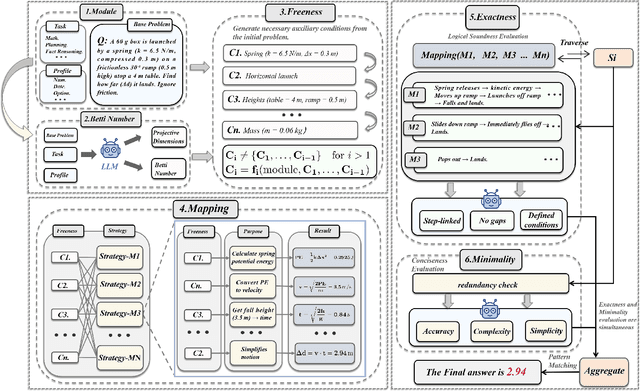
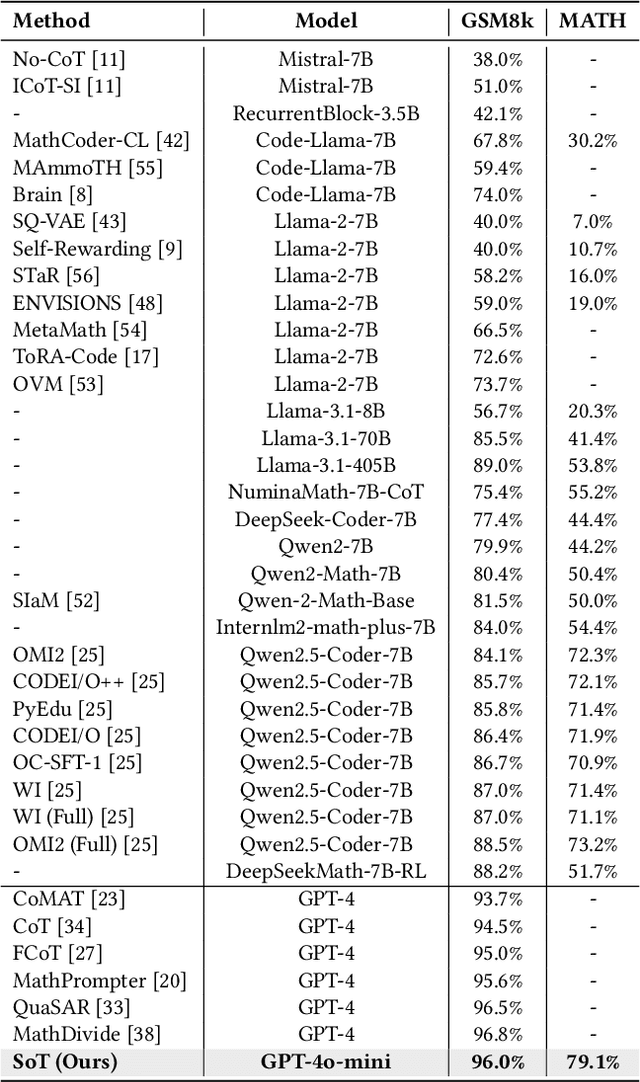
Chain-of-Thought (CoT) prompting enhances the reasoning of large language models (LLMs) by decomposing problems into sequential steps, mimicking human logic and reducing errors. However, complex tasks with vast solution spaces and vague constraints often exceed the capacity of a single reasoning chain. Inspired by Minimal Free Resolution (MFR) in commutative algebra and algebraic geometry, we propose Syzygy of Thoughts (SoT)-a novel framework that extends CoT by introducing auxiliary, interrelated reasoning paths. SoT captures deeper logical dependencies, enabling more robust and structured problem-solving. MFR decomposes a module into a sequence of free modules with minimal rank, providing a structured analytical approach to complex systems. This method introduces the concepts of "Module", "Betti numbers","Freeness", "Mapping", "Exactness" and "Minimality", enabling the systematic decomposition of the original complex problem into logically complete minimal subproblems while preserving key problem features and reducing reasoning length. We tested SoT across diverse datasets (e.g., GSM8K, MATH) and models (e.g., GPT-4o-mini, Qwen2.5), achieving inference accuracy that matches or surpasses mainstream CoTs standards. Additionally, by aligning the sampling process with algebraic constraints, our approach enhances the scalability of inference time in LLMs, ensuring both transparent reasoning and high performance. Our code will be publicly available at https://github.com/dlMARiA/Syzygy-of-thoughts.