 Add to Chrome
 Add to Firefox
 Add to Edge
CS3: Efficient Online Capability Synergy for Two-Tower Recommendation
Apr 21, 2026
To balance effectiveness and efficiency in recommender systems, multi-stage pipelines commonly use lightweight two-tower models for large-scale candidate retrieval. However, the isolated two-tower architecture restricts representation capacity, embedding-space alignment, and cross-feature interactions. Existing solutions such as late interaction and knowledge distillation can mitigate these issues, but often increase latency or are difficult to deploy in online learning settings. We propose Capability Synergy (CS3), an efficient online framework that strengthens two-tower retrievers while preserving real-time constraints. CS3 introduces three mechanisms: (1) Cycle-Adaptive Structure for self-revision via adaptive feature denoising within each tower; (2) Cross-Tower Synchronization to improve alignment through lightweight mutual awareness between towers; and (3) Cascade-Model Sharing to enhance cross-stage consistency by reusing knowledge from downstream models. CS3 is plug-and-play with diverse two-tower backbones and compatible with online learning. Experiments on three public datasets show consistent gains over strong baselines, and deployment in a largescale advertising system yields up to 8.36% revenue improvement across three scenarios while maintaining ms-level latency.

Generative Recommendation for Large-Scale Advertising
Feb 26, 2026Generative recommendation has recently attracted widespread attention in industry due to its potential for scaling and stronger model capacity. However, deploying real-time generative recommendation in large-scale advertising requires designs beyond large-language-model (LLM)-style training and serving recipes. We present a production-oriented generative recommender co-designed across architecture, learning, and serving, named GR4AD (Generative Recommendation for ADdvertising). As for tokenization, GR4AD proposes UA-SID (Unified Advertisement Semantic ID) to capture complicated business information. Furthermore, GR4AD introduces LazyAR, a lazy autoregressive decoder that relaxes layer-wise dependencies for short, multi-candidate generation, preserving effectiveness while reducing inference cost, which facilitates scaling under fixed serving budgets. To align optimization with business value, GR4AD employs VSL (Value-Aware Supervised Learning) and proposes RSPO (Ranking-Guided Softmax Preference Optimization), a ranking-aware, list-wise reinforcement learning algorithm that optimizes value-based rewards under list-level metrics for continual online updates. For online inference, we further propose dynamic beam serving, which adapts beam width across generation levels and online load to control compute. Large-scale online A/B tests show up to 4.2% ad revenue improvement over an existing DLRM-based stack, with consistent gains from both model scaling and inference-time scaling. GR4AD has been fully deployed in Kuaishou advertising system with over 400 million users and achieves high-throughput real-time serving.
Jointly Optimizing Debiased CTR and Uplift for Coupons Marketing: A Unified Causal Framework
Feb 13, 2026In online advertising, marketing interventions such as coupons introduce significant confounding bias into Click-Through Rate (CTR) prediction. Observed clicks reflect a mixture of users' intrinsic preferences and the uplift induced by these interventions. This causes conventional models to miscalibrate base CTRs, which distorts downstream ranking and billing decisions. Furthermore, marketing interventions often operate as multi-valued treatments with varying magnitudes, introducing additional complexity to CTR prediction. To address these issues, we propose the \textbf{Uni}fied \textbf{M}ulti-\textbf{V}alued \textbf{T}reatment Network (UniMVT). Specifically, UniMVT disentangles confounding factors from treatment-sensitive representations, enabling a full-space counterfactual inference module to jointly reconstruct the debiased base CTR and intensity-response curves. To handle the complexity of multi-valued treatments, UniMVT employs an auxiliary intensity estimation task to capture treatment propensities and devise a unit uplift objective that normalizes the intervention effect. This ensures comparable estimation across the continuous coupon-value spectrum. UniMVT simultaneously achieves debiased CTR prediction for accurate system calibration and precise uplift estimation for incentive allocation. Extensive experiments on synthetic and industrial datasets demonstrate UniMVT's superiority in both predictive accuracy and calibration. Furthermore, real-world A/B tests confirm that UniMVT significantly improves business metrics through more effective coupon distribution.
Align$^3$GR: Unified Multi-Level Alignment for LLM-based Generative Recommendation
Nov 14, 2025Large Language Models (LLMs) demonstrate significant advantages in leveraging structured world knowledge and multi-step reasoning capabilities. However, fundamental challenges arise when transforming LLMs into real-world recommender systems due to semantic and behavioral misalignment. To bridge this gap, we propose Align$^3$GR, a novel framework that unifies token-level, behavior modeling-level, and preference-level alignment. Our approach introduces: Dual tokenization fusing user-item semantic and collaborative signals. Enhanced behavior modeling with bidirectional semantic alignment. Progressive DPO strategy combining self-play (SP-DPO) and real-world feedback (RF-DPO) for dynamic preference adaptation. Experiments show Align$^3$GR outperforms the SOTA baseline by +17.8% in Recall@10 and +20.2% in NDCG@10 on the public dataset, with significant gains in online A/B tests and full-scale deployment on an industrial large-scale recommendation platform.
SweetTokenizer: Semantic-Aware Spatial-Temporal Tokenizer for Compact Visual Discretization
Dec 17, 2024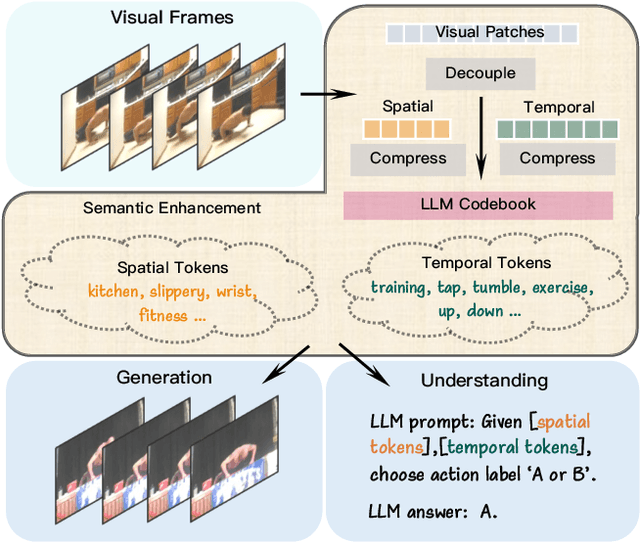


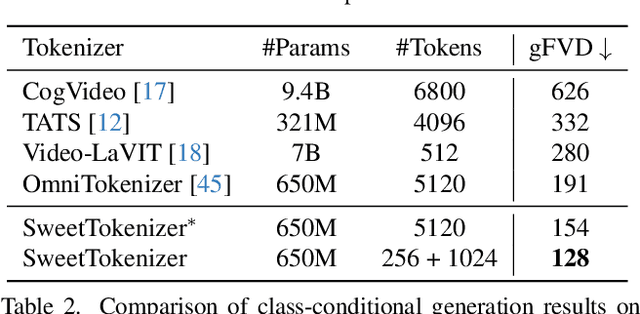
This paper presents the \textbf{S}emantic-a\textbf{W}ar\textbf{E} spatial-t\textbf{E}mporal \textbf{T}okenizer (SweetTokenizer), a compact yet effective discretization approach for vision data. Our goal is to boost tokenizers' compression ratio while maintaining reconstruction fidelity in the VQ-VAE paradigm. Firstly, to obtain compact latent representations, we decouple images or videos into spatial-temporal dimensions, translating visual information into learnable querying spatial and temporal tokens through a \textbf{C}ross-attention \textbf{Q}uery \textbf{A}uto\textbf{E}ncoder (CQAE). Secondly, to complement visual information during compression, we quantize these tokens via a specialized codebook derived from off-the-shelf LLM embeddings to leverage the rich semantics from language modality. Finally, to enhance training stability and convergence, we also introduce a curriculum learning strategy, which proves critical for effective discrete visual representation learning. SweetTokenizer achieves comparable video reconstruction fidelity with only \textbf{25\%} of the tokens used in previous state-of-the-art video tokenizers, and boost video generation results by \textbf{32.9\%} w.r.t gFVD. When using the same token number, we significantly improves video and image reconstruction results by \textbf{57.1\%} w.r.t rFVD on UCF-101 and \textbf{37.2\%} w.r.t rFID on ImageNet-1K. Additionally, the compressed tokens are imbued with semantic information, enabling few-shot recognition capabilities powered by LLMs in downstream applications.
DPF-Nutrition: Food Nutrition Estimation via Depth Prediction and Fusion
Oct 18, 2023
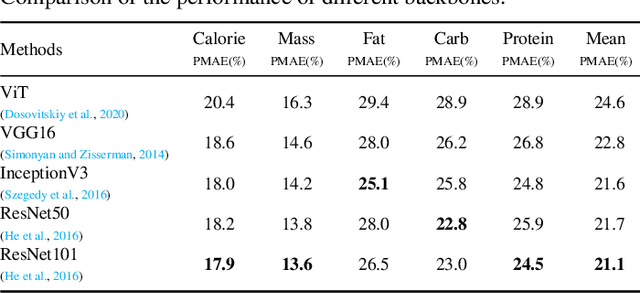
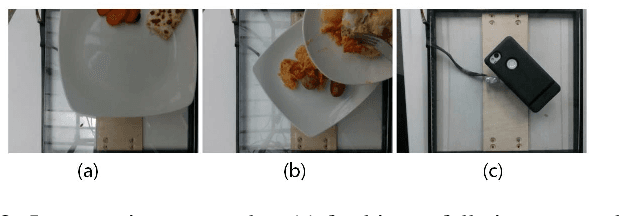
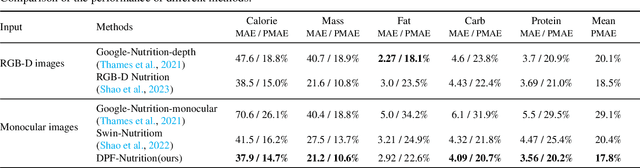
A reasonable and balanced diet is essential for maintaining good health. With the advancements in deep learning, automated nutrition estimation method based on food images offers a promising solution for monitoring daily nutritional intake and promoting dietary health. While monocular image-based nutrition estimation is convenient, efficient, and economical, the challenge of limited accuracy remains a significant concern. To tackle this issue, we proposed DPF-Nutrition, an end-to-end nutrition estimation method using monocular images. In DPF-Nutrition, we introduced a depth prediction module to generate depth maps, thereby improving the accuracy of food portion estimation. Additionally, we designed an RGB-D fusion module that combined monocular images with the predicted depth information, resulting in better performance for nutrition estimation. To the best of our knowledge, this was the pioneering effort that integrated depth prediction and RGB-D fusion techniques in food nutrition estimation. Comprehensive experiments performed on Nutrition5k evaluated the effectiveness and efficiency of DPF-Nutrition.
EENMF: An End-to-End Neural Matching Framework for E-Commerce Sponsored Search
Dec 09, 2018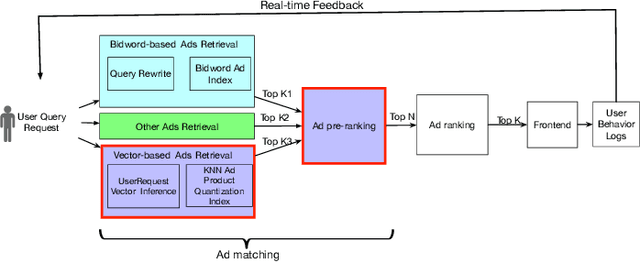
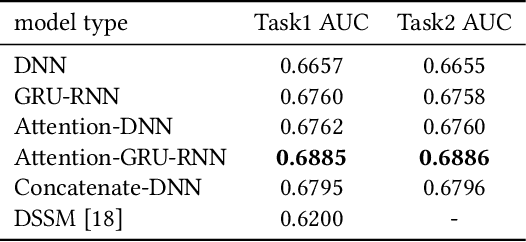
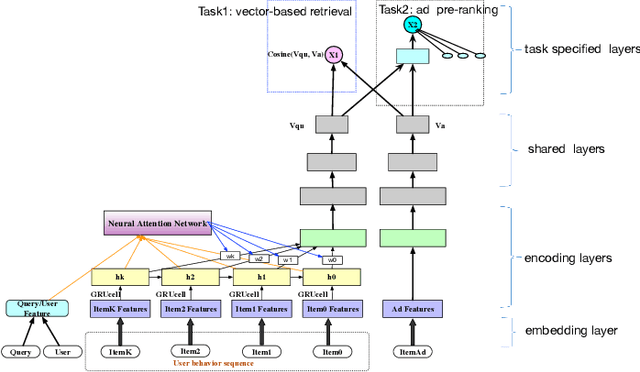
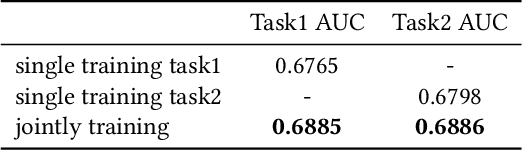
E-commerce sponsored search contributes an important part of revenue for the e-commerce company. In consideration of effectiveness and efficiency, a large-scale sponsored search system commonly adopts a multi-stage architecture. We name these stages as ad retrieval, ad pre-ranking and ad ranking. Ad retrieval and ad pre-ranking are collectively referred to as ad matching in this paper. We propose an end-to-end neural matching framework (EENMF) to model two tasks---vector-based ad retrieval and neural networks based ad pre-ranking. Under the deep matching framework, vector-based ad retrieval harnesses user recent behavior sequence to retrieve relevant ad candidates without the constraint of keyword bidding. Simultaneously, the deep model is employed to perform the global pre-ranking of ad candidates from multiple retrieval paths effectively and efficiently. Besides, the proposed model tries to optimize the pointwise cross-entropy loss which is consistent with the objective of predict models in the ranking stage. We conduct extensive evaluation to validate the performance of the proposed framework. In the real traffic of a large-scale e-commerce sponsored search, the proposed approach significantly outperforms the baseline.