 Add to Chrome
 Add to Firefox
 Add to Edge
LLaDA2.0-Uni: Unifying Multimodal Understanding and Generation with Diffusion Large Language Model
Apr 22, 2026
We present LLaDA2.0-Uni, a unified discrete diffusion large language model (dLLM) that supports multimodal understanding and generation within a natively integrated framework. Its architecture combines a fully semantic discrete tokenizer, a MoE-based dLLM backbone, and a diffusion decoder. By discretizing continuous visual inputs via SigLIP-VQ, the model enables block-level masked diffusion for both text and vision inputs within the backbone, while the decoder reconstructs visual tokens into high-fidelity images. Inference efficiency is enhanced beyond parallel decoding through prefix-aware optimizations in the backbone and few-step distillation in the decoder. Supported by carefully curated large-scale data and a tailored multi-stage training pipeline, LLaDA2.0-Uni matches specialized VLMs in multimodal understanding while delivering strong performance in image generation and editing. Its native support for interleaved generation and reasoning establishes a promising and scalable paradigm for next-generation unified foundation models. Codes and models are available at https://github.com/inclusionAI/LLaDA2.0-Uni.

The best performance in the CARE 2025 -- Liver Task (LiSeg-Contrast): Contrast-Aware Semi-Supervised Segmentation with Domain Generalization and Test-Time Adaptation
Oct 05, 2025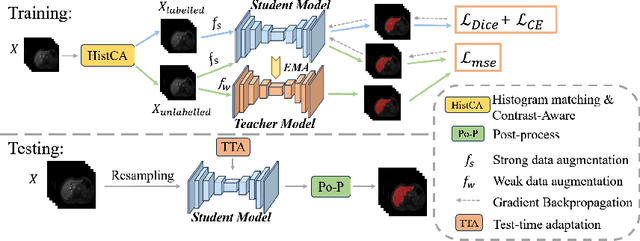

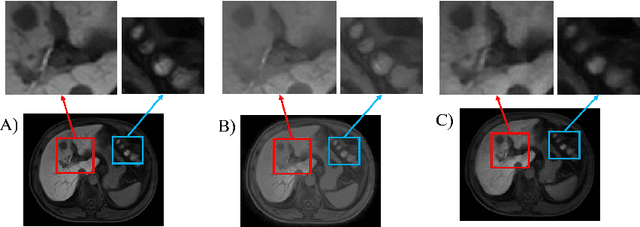
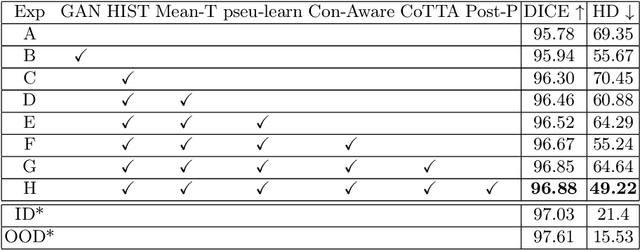
Accurate liver segmentation from contrast-enhanced MRI is essential for diagnosis, treatment planning, and disease monitoring. However, it remains challenging due to limited annotated data, heterogeneous enhancement protocols, and significant domain shifts across scanners and institutions. Traditional image-to-image translation frameworks have made great progress in domain generalization, but their application is not straightforward. For example, Pix2Pix requires image registration, and cycle-GAN cannot be integrated seamlessly into segmentation pipelines. Meanwhile, these methods are originally used to deal with cross-modality scenarios, and often introduce structural distortions and suffer from unstable training, which may pose drawbacks in our single-modality scenario. To address these challenges, we propose CoSSeg-TTA, a compact segmentation framework for the GED4 (Gd-EOB-DTPA enhanced hepatobiliary phase MRI) modality built upon nnU-Netv2 and enhanced with a semi-supervised mean teacher scheme to exploit large amounts of unlabeled volumes. A domain adaptation module, incorporating a randomized histogram-based style appearance transfer function and a trainable contrast-aware network, enriches domain diversity and mitigates cross-center variability. Furthermore, a continual test-time adaptation strategy is employed to improve robustness during inference. Extensive experiments demonstrate that our framework consistently outperforms the nnU-Netv2 baseline, achieving superior Dice score and Hausdorff Distance while exhibiting strong generalization to unseen domains under low-annotation conditions.
Rethinking Alignment and Uniformity in Unsupervised Image Semantic Segmentation
Nov 26, 2022Unsupervised image semantic segmentation(UISS) aims to match low-level visual features with semantic-level representations without outer supervision. In this paper, we address the critical properties from the view of feature alignments and feature uniformity for UISS models. We also make a comparison between UISS and image-wise representation learning. Based on the analysis, we argue that the existing MI-based methods in UISS suffer from representation collapse. By this, we proposed a robust network called Semantic Attention Network(SAN), in which a new module Semantic Attention(SEAT) is proposed to generate pixel-wise and semantic features dynamically. Experimental results on multiple semantic segmentation benchmarks show that our unsupervised segmentation framework specializes in catching semantic representations, which outperforms all the unpretrained and even several pretrained methods.