 Add to Chrome
 Add to Firefox
 Add to Edge
LLaDA2.0-Uni: Unifying Multimodal Understanding and Generation with Diffusion Large Language Model
Apr 22, 2026
We present LLaDA2.0-Uni, a unified discrete diffusion large language model (dLLM) that supports multimodal understanding and generation within a natively integrated framework. Its architecture combines a fully semantic discrete tokenizer, a MoE-based dLLM backbone, and a diffusion decoder. By discretizing continuous visual inputs via SigLIP-VQ, the model enables block-level masked diffusion for both text and vision inputs within the backbone, while the decoder reconstructs visual tokens into high-fidelity images. Inference efficiency is enhanced beyond parallel decoding through prefix-aware optimizations in the backbone and few-step distillation in the decoder. Supported by carefully curated large-scale data and a tailored multi-stage training pipeline, LLaDA2.0-Uni matches specialized VLMs in multimodal understanding while delivering strong performance in image generation and editing. Its native support for interleaved generation and reasoning establishes a promising and scalable paradigm for next-generation unified foundation models. Codes and models are available at https://github.com/inclusionAI/LLaDA2.0-Uni.

Ming-Omni: A Unified Multimodal Model for Perception and Generation
Jun 11, 2025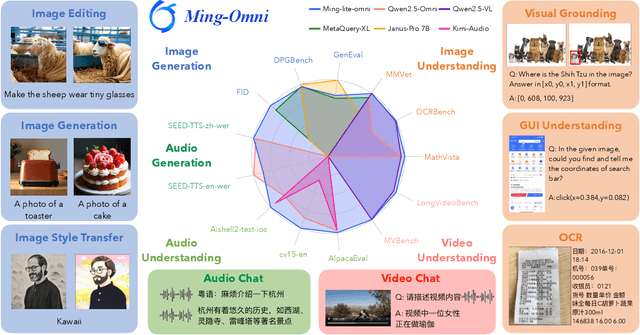
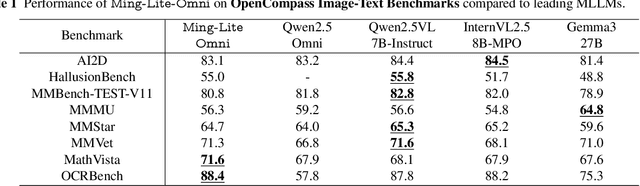
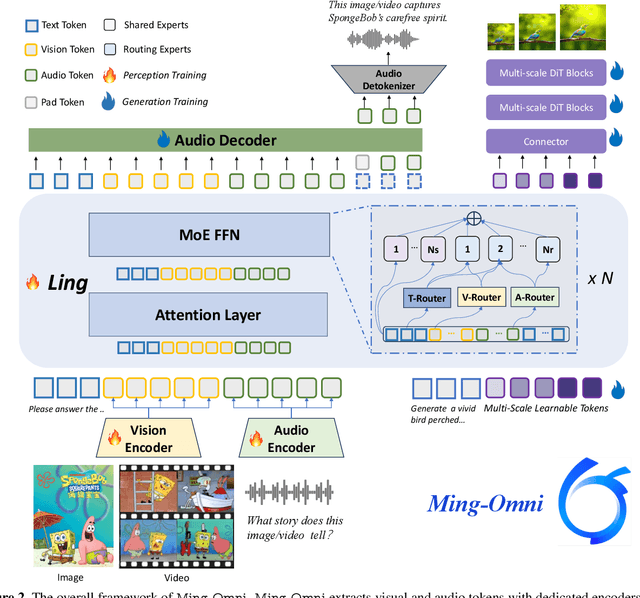
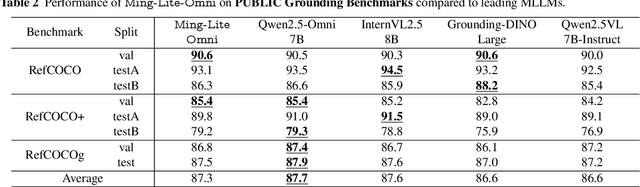
We propose Ming-Omni, a unified multimodal model capable of processing images, text, audio, and video, while demonstrating strong proficiency in both speech and image generation. Ming-Omni employs dedicated encoders to extract tokens from different modalities, which are then processed by Ling, an MoE architecture equipped with newly proposed modality-specific routers. This design enables a single model to efficiently process and fuse multimodal inputs within a unified framework, thereby facilitating diverse tasks without requiring separate models, task-specific fine-tuning, or structural redesign. Importantly, Ming-Omni extends beyond conventional multimodal models by supporting audio and image generation. This is achieved through the integration of an advanced audio decoder for natural-sounding speech and Ming-Lite-Uni for high-quality image generation, which also allow the model to engage in context-aware chatting, perform text-to-speech conversion, and conduct versatile image editing. Our experimental results showcase Ming-Omni offers a powerful solution for unified perception and generation across all modalities. Notably, our proposed Ming-Omni is the first open-source model we are aware of to match GPT-4o in modality support, and we release all code and model weights to encourage further research and development in the community.