 Add to Chrome
 Add to Firefox
 Add to Edge
CMuon: Accelerating and Stabilizing Diffusion Transformer Training via Chunked Momentum Orthogonalization
Aug 03, 2026
Diffusion Transformers (DiTs) have achieved state-of-the-art (SOTA) performance in visual generative modeling, yet their training remains computationally prohibitive. While the recently proposed Momentum Orthogonalization (Muon) optimizer offers a promising alternative to AdamW, its direct application to DiTs yields suboptimal late-stage convergence. In this paper, we identify the root cause of this bottleneck: standard DiT architectures fuse functionally distinct weights (e.g., within AdaLN and QKV layers) into unified tensors for computational efficiency. Applying Muon to these fused tensors inadvertently induces implicit subspace coupling, which distorts update directions and degrades global optimization. To address this, we introduce Chunked Muon (CMuon), a simple yet highly effective strategy that partitions these matrices into independent sub-components prior to orthogonalization. Extensive experiments demonstrate that a 675M-parameter DiT trained with CMuon achieves a FID of 1.18 on ImageNet 256 in just 200 epochs. This represents more than a 2x training speedup over AdamW, while effectively overcoming the late-stage convergence plateaus of vanilla Muon.

dRAE: Representation Autoencoder with Hyper-Spherical Codes
Jul 24, 2026In this work, we aim to discretize the high-dimensional visual representations to bridge the gap with language models - a non-trivial challenge, as existing quantization methods suffer from codebook collapse, failing to scale while preserving semantic coherence. We identify the root cause as metric mismatch: standard Euclidean codebook objectives are fundamentally misaligned with the anisotropic geometry of representation space, leading to codebook embeddings with high-variance magnitude scales and uneven angular distributions that hinder scalability. To address this, we propose Hyper-Spherical Quantization (HSQ), which decouples semantic content from feature magnitude via angular routing, preventing code assignment from being dominated by scale rather than meaning. The resulting discrete Representation Autoencoder (dRAE) achieves high-fidelity reconstruction while preserving semantic integrity and supporting scalable codebook budget. Extensive experiments demonstrate consistent performance gains as the vocabulary size scales to 131{,}072, along with 100\% codebook utilization, simplified training pipeline, and strong performance across understanding and generation tasks.
Self-Adversarial One Step Generation via Condition Shifting
Apr 14, 2026The push for efficient text to image synthesis has moved the field toward one step sampling, yet existing methods still face a three way tradeoff among fidelity, inference speed, and training efficiency. Approaches that rely on external discriminators can sharpen one step performance, but they often introduce training instability, high GPU memory overhead, and slow convergence, which complicates scaling and parameter efficient tuning. In contrast, regression based distillation and consistency objectives are easier to optimize, but they typically lose fine details when constrained to a single step. We present APEX, built on a key theoretical insight: adversarial correction signals can be extracted endogenously from a flow model through condition shifting. Using a transformation creates a shifted condition branch whose velocity field serves as an independent estimator of the model's current generation distribution, yielding a gradient that is provably GAN aligned, replacing the sample dependent discriminator terms that cause gradient vanishing. This discriminator free design is architecture preserving, making APEX a plug and play framework compatible with both full parameter and LoRA based tuning. Empirically, our 0.6B model surpasses FLUX-Schnell 12B (20$\times$ more parameters) in one step quality. With LoRA tuning on Qwen-Image 20B, APEX reaches a GenEval score of 0.89 at NFE=1 in 6 hours, surpassing the original 50-step teacher (0.87) and providing a 15.33$\times$ inference speedup. Code is available https://github.com/LINs-lab/APEX.
An All-Reduce Compatible Top-K Compressor for Communication-Efficient Distributed Learning
Oct 30, 2025Communication remains a central bottleneck in large-scale distributed machine learning, and gradient sparsification has emerged as a promising strategy to alleviate this challenge. However, existing gradient compressors face notable limitations: Rand-$K$\ discards structural information and performs poorly in practice, while Top-$K$\ preserves informative entries but loses the contraction property and requires costly All-Gather operations. In this paper, we propose ARC-Top-$K$, an {All-Reduce}-Compatible Top-$K$ compressor that aligns sparsity patterns across nodes using a lightweight sketch of the gradient, enabling index-free All-Reduce while preserving globally significant information. ARC-Top-$K$\ is provably contractive and, when combined with momentum error feedback (EF21M), achieves linear speedup and sharper convergence rates than the original EF21M under standard assumptions. Empirically, ARC-Top-$K$\ matches the accuracy of Top-$K$\ while reducing wall-clock training time by up to 60.7\%, offering an efficient and scalable solution that combines the robustness of Rand-$K$\ with the strong performance of Top-$K$.
Subspace Optimization for Large Language Models with Convergence Guarantees
Oct 15, 2024

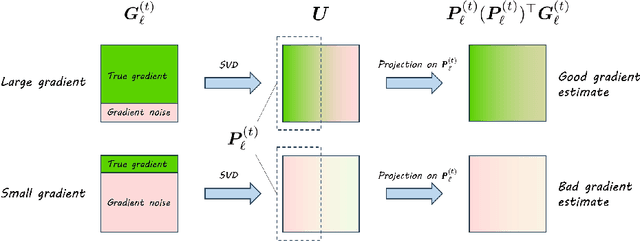

Subspace optimization algorithms, with GaLore (Zhao et al., 2024) as a representative method, have gained popularity for pre-training or fine-tuning large language models (LLMs) due to their memory efficiency. However, their convergence guarantees remain unclear, particularly in stochastic settings. In this paper, we unexpectedly discover that GaLore does not always converge to the optimal solution and substantiate this finding with an explicit counterexample. We then investigate the conditions under which GaLore can achieve convergence, demonstrating that it does so either in deterministic scenarios or when using a sufficiently large mini-batch size. More significantly, we introduce GoLore (Gradient random Low-rank projection), a novel variant of GaLore that provably converges in stochastic settings, even with standard batch sizes. Our convergence analysis can be readily extended to other sparse subspace optimization algorithms. Finally, we conduct numerical experiments to validate our theoretical results and empirically explore the proposed mechanisms. Codes are available at https://github.com/pkumelon/Golore.