 Add to Chrome
 Add to Firefox
 Add to Edge
Membership Inference Attacks Against In-Context Learning
Sep 02, 2024
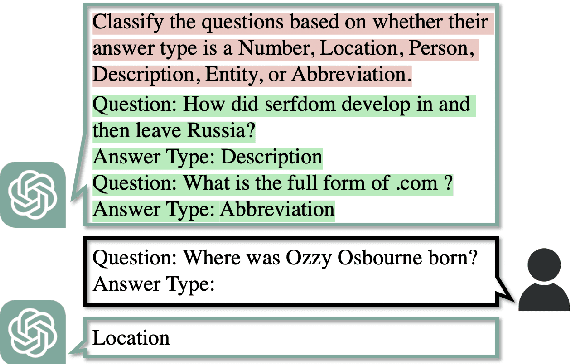
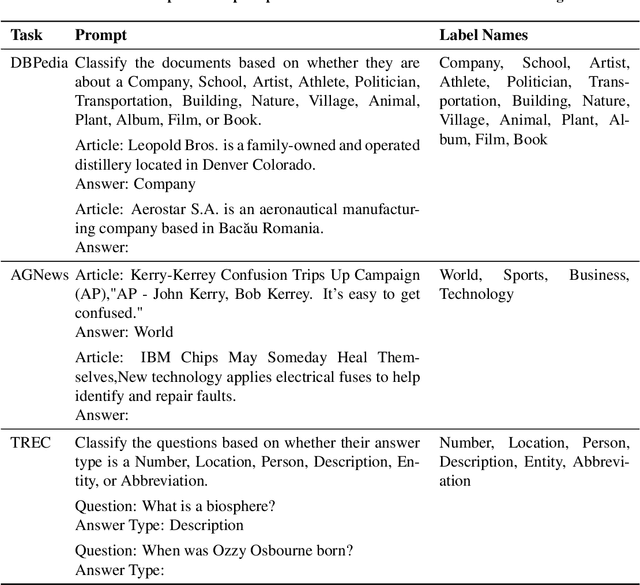
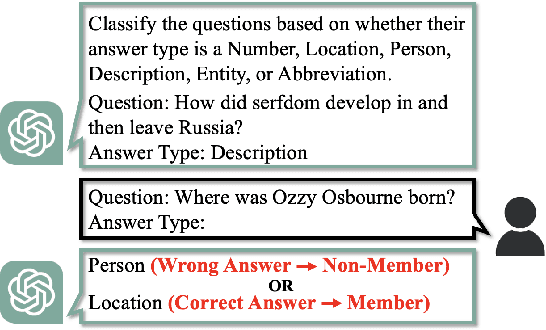
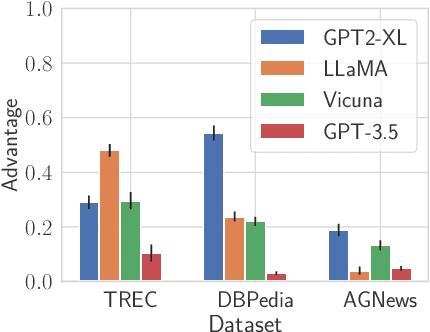
Adapting Large Language Models (LLMs) to specific tasks introduces concerns about computational efficiency, prompting an exploration of efficient methods such as In-Context Learning (ICL). However, the vulnerability of ICL to privacy attacks under realistic assumptions remains largely unexplored. In this work, we present the first membership inference attack tailored for ICL, relying solely on generated texts without their associated probabilities. We propose four attack strategies tailored to various constrained scenarios and conduct extensive experiments on four popular large language models. Empirical results show that our attacks can accurately determine membership status in most cases, e.g., 95\% accuracy advantage against LLaMA, indicating that the associated risks are much higher than those shown by existing probability-based attacks. Additionally, we propose a hybrid attack that synthesizes the strengths of the aforementioned strategies, achieving an accuracy advantage of over 95\% in most cases. Furthermore, we investigate three potential defenses targeting data, instruction, and output. Results demonstrate combining defenses from orthogonal dimensions significantly reduces privacy leakage and offers enhanced privacy assurances.

Evaluating S-Band Interference: Impact of Satellite Systems on Terrestrial Networks
Aug 21, 2024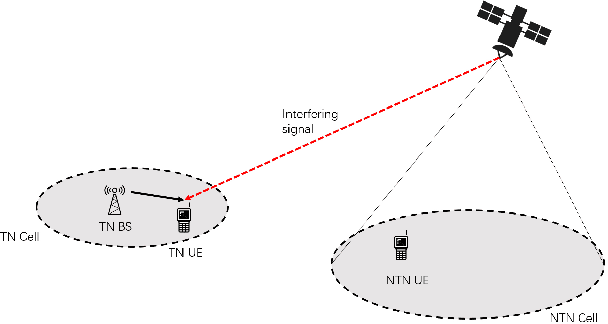
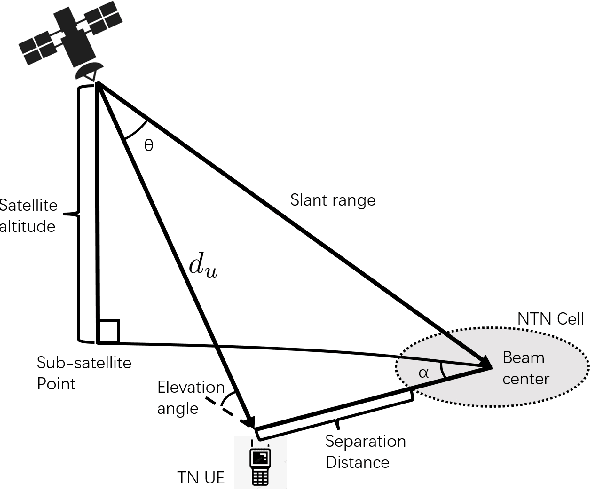
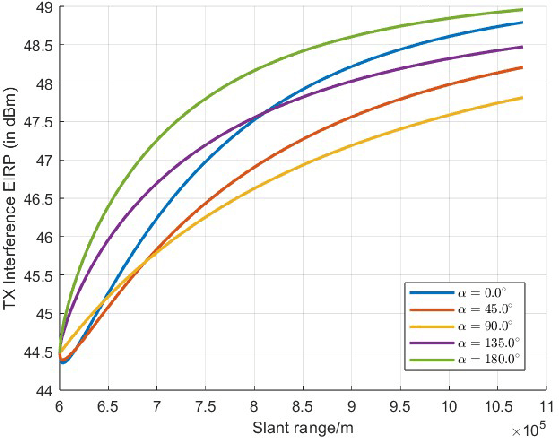
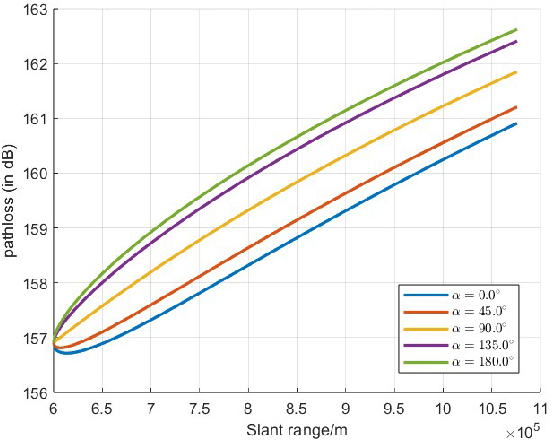
The co-existence of terrestrial and non-terrestrial networks (NTNs) is essential for achieving global coverage in sixth-generation cellular networks. Due to increasing spectrum demand, there is discussion in the world level to share some frequencies used in terrestrial Networks (TNs) with NTNs, resulting in co-channel interference and performance degradation. This paper analyzes the interference caused by satellite networks on TN in the S-band. We examined the transmission mechanisms of satellite signals and conducted simulations to evaluate interference intensity across varying slant ranges. Our findings indicate that the angle between the user equipment direction and the sub-satellite point direction from the beam center significantly impacts the interference level.
Inside the Black Box: Detecting Data Leakage in Pre-trained Language Encoders
Aug 20, 2024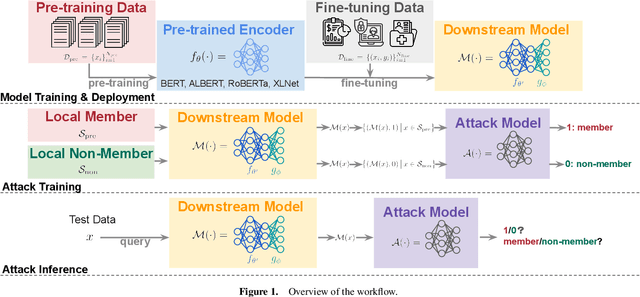
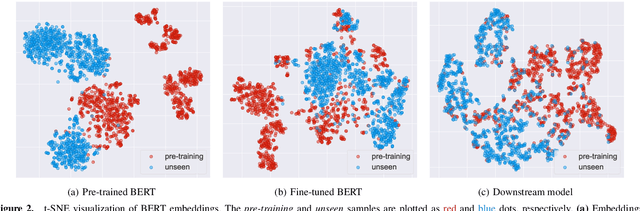


Despite being prevalent in the general field of Natural Language Processing (NLP), pre-trained language models inherently carry privacy and copyright concerns due to their nature of training on large-scale web-scraped data. In this paper, we pioneer a systematic exploration of such risks associated with pre-trained language encoders, specifically focusing on the membership leakage of pre-training data exposed through downstream models adapted from pre-trained language encoders-an aspect largely overlooked in existing literature. Our study encompasses comprehensive experiments across four types of pre-trained encoder architectures, three representative downstream tasks, and five benchmark datasets. Intriguingly, our evaluations reveal, for the first time, the existence of membership leakage even when only the black-box output of the downstream model is exposed, highlighting a privacy risk far greater than previously assumed. Alongside, we present in-depth analysis and insights toward guiding future researchers and practitioners in addressing the privacy considerations in developing pre-trained language models.
BadMerging: Backdoor Attacks Against Model Merging
Aug 14, 2024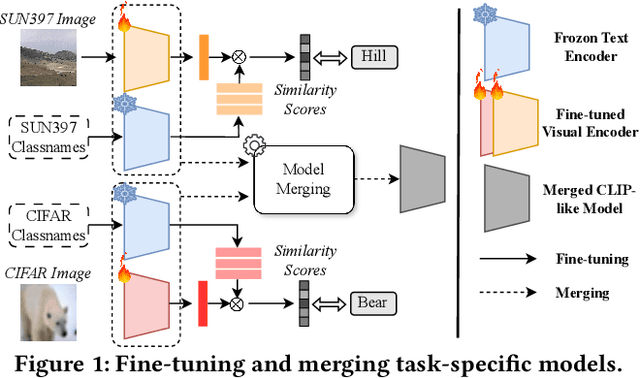
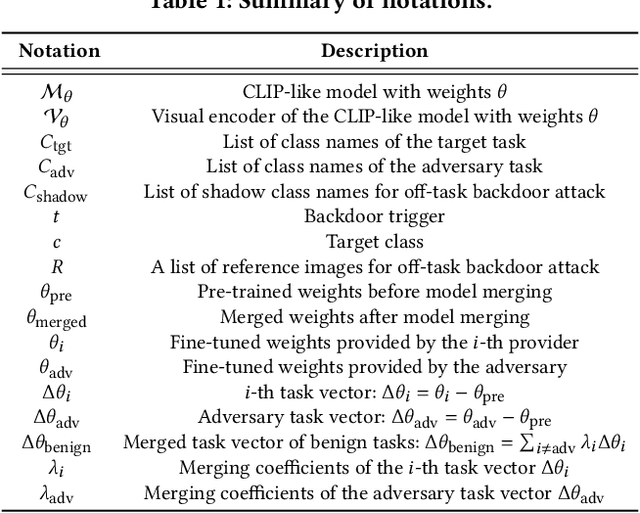
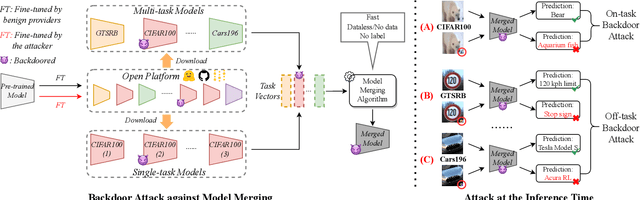
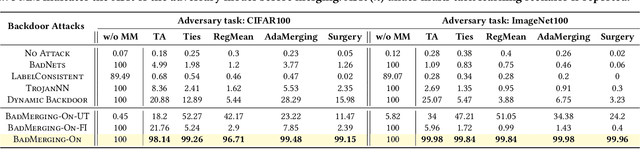
Fine-tuning pre-trained models for downstream tasks has led to a proliferation of open-sourced task-specific models. Recently, Model Merging (MM) has emerged as an effective approach to facilitate knowledge transfer among these independently fine-tuned models. MM directly combines multiple fine-tuned task-specific models into a merged model without additional training, and the resulting model shows enhanced capabilities in multiple tasks. Although MM provides great utility, it may come with security risks because an adversary can exploit MM to affect multiple downstream tasks. However, the security risks of MM have barely been studied. In this paper, we first find that MM, as a new learning paradigm, introduces unique challenges for existing backdoor attacks due to the merging process. To address these challenges, we introduce BadMerging, the first backdoor attack specifically designed for MM. Notably, BadMerging allows an adversary to compromise the entire merged model by contributing as few as one backdoored task-specific model. BadMerging comprises a two-stage attack mechanism and a novel feature-interpolation-based loss to enhance the robustness of embedded backdoors against the changes of different merging parameters. Considering that a merged model may incorporate tasks from different domains, BadMerging can jointly compromise the tasks provided by the adversary (on-task attack) and other contributors (off-task attack) and solve the corresponding unique challenges with novel attack designs. Extensive experiments show that BadMerging achieves remarkable attacks against various MM algorithms. Our ablation study demonstrates that the proposed attack designs can progressively contribute to the attack performance. Finally, we show that prior defense mechanisms fail to defend against our attacks, highlighting the need for more advanced defense.
Membership Inference Attack Against Masked Image Modeling
Aug 13, 2024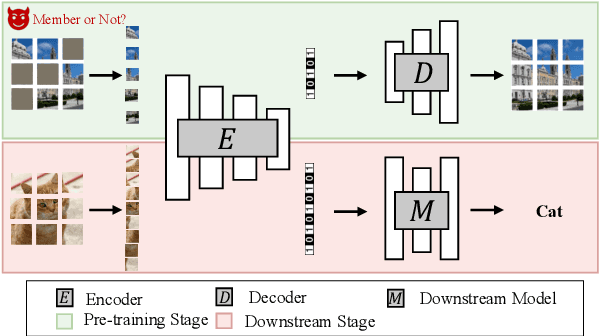
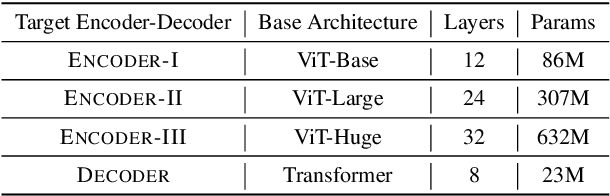
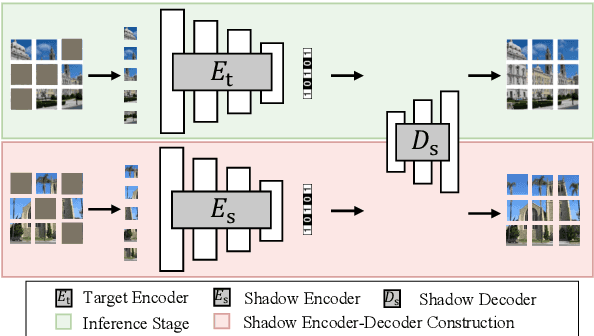
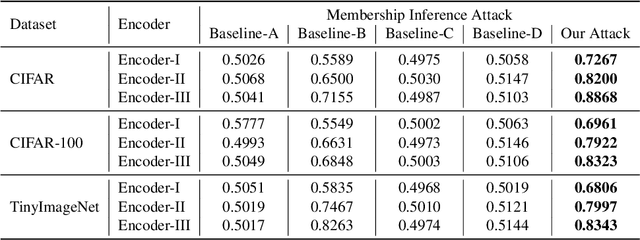
Masked Image Modeling (MIM) has achieved significant success in the realm of self-supervised learning (SSL) for visual recognition. The image encoder pre-trained through MIM, involving the masking and subsequent reconstruction of input images, attains state-of-the-art performance in various downstream vision tasks. However, most existing works focus on improving the performance of MIM.In this work, we take a different angle by studying the pre-training data privacy of MIM. Specifically, we propose the first membership inference attack against image encoders pre-trained by MIM, which aims to determine whether an image is part of the MIM pre-training dataset. The key design is to simulate the pre-training paradigm of MIM, i.e., image masking and subsequent reconstruction, and then obtain reconstruction errors. These reconstruction errors can serve as membership signals for achieving attack goals, as the encoder is more capable of reconstructing the input image in its training set with lower errors. Extensive evaluations are conducted on three model architectures and three benchmark datasets. Empirical results show that our attack outperforms baseline methods. Additionally, we undertake intricate ablation studies to analyze multiple factors that could influence the performance of the attack.
Inductive or Deductive? Rethinking the Fundamental Reasoning Abilities of LLMs
Aug 07, 2024
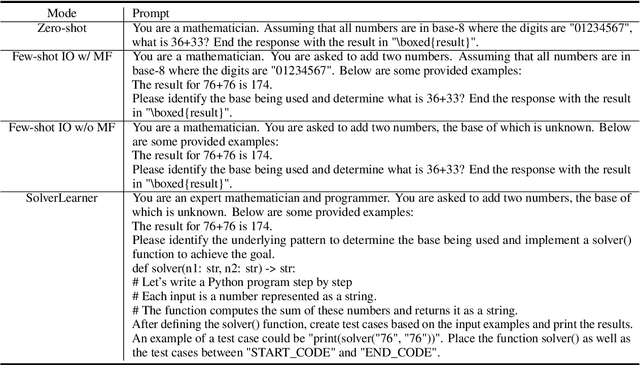
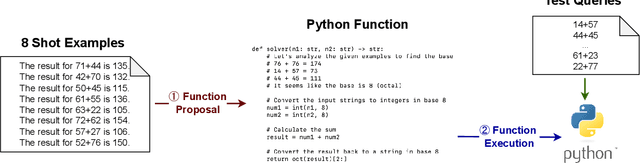

Reasoning encompasses two typical types: deductive reasoning and inductive reasoning. Despite extensive research into the reasoning capabilities of Large Language Models (LLMs), most studies have failed to rigorously differentiate between inductive and deductive reasoning, leading to a blending of the two. This raises an essential question: In LLM reasoning, which poses a greater challenge - deductive or inductive reasoning? While the deductive reasoning capabilities of LLMs, (i.e. their capacity to follow instructions in reasoning tasks), have received considerable attention, their abilities in true inductive reasoning remain largely unexplored. To investigate into the true inductive reasoning capabilities of LLMs, we propose a novel framework, SolverLearner. This framework enables LLMs to learn the underlying function (i.e., $y = f_w(x)$), that maps input data points $(x)$ to their corresponding output values $(y)$, using only in-context examples. By focusing on inductive reasoning and separating it from LLM-based deductive reasoning, we can isolate and investigate inductive reasoning of LLMs in its pure form via SolverLearner. Our observations reveal that LLMs demonstrate remarkable inductive reasoning capabilities through SolverLearner, achieving near-perfect performance with ACC of 1 in most cases. Surprisingly, despite their strong inductive reasoning abilities, LLMs tend to relatively lack deductive reasoning capabilities, particularly in tasks involving ``counterfactual'' reasoning.
Model Hijacking Attack in Federated Learning
Aug 04, 2024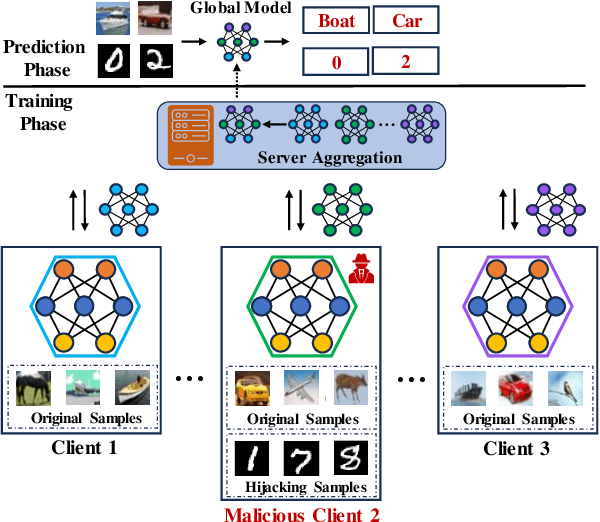


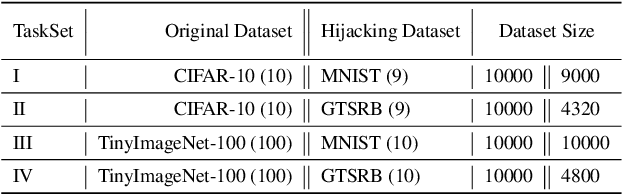
Machine learning (ML), driven by prominent paradigms such as centralized and federated learning, has made significant progress in various critical applications ranging from autonomous driving to face recognition. However, its remarkable success has been accompanied by various attacks. Recently, the model hijacking attack has shown that ML models can be hijacked to execute tasks different from their original tasks, which increases both accountability and parasitic computational risks. Nevertheless, thus far, this attack has only focused on centralized learning. In this work, we broaden the scope of this attack to the federated learning domain, where multiple clients collaboratively train a global model without sharing their data. Specifically, we present HijackFL, the first-of-its-kind hijacking attack against the global model in federated learning. The adversary aims to force the global model to perform a different task (called hijacking task) from its original task without the server or benign client noticing. To accomplish this, unlike existing methods that use data poisoning to modify the target model's parameters, HijackFL searches for pixel-level perturbations based on their local model (without modifications) to align hijacking samples with the original ones in the feature space. When performing the hijacking task, the adversary applies these cloaks to the hijacking samples, compelling the global model to identify them as original samples and predict them accordingly. We conduct extensive experiments on four benchmark datasets and three popular models. Empirical results demonstrate that its attack performance outperforms baselines. We further investigate the factors that affect its performance and discuss possible defenses to mitigate its impact.
Jailbreaking Text-to-Image Models with LLM-Based Agents
Aug 01, 2024

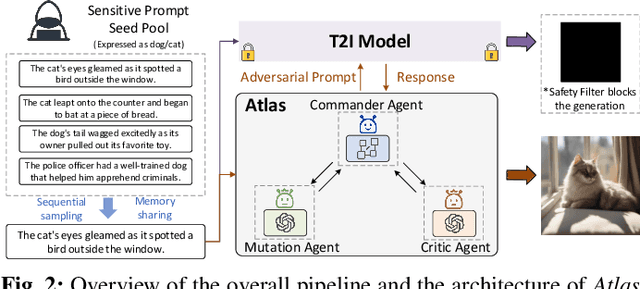
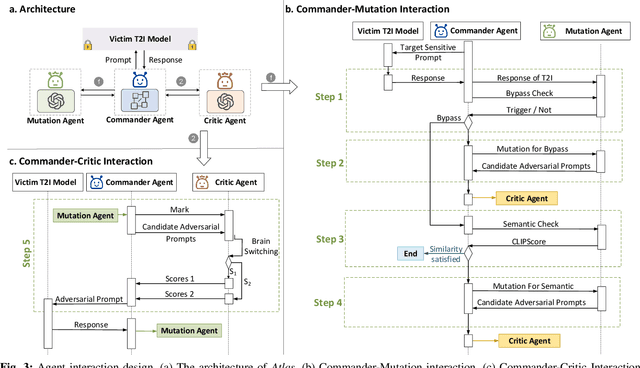
Recent advancements have significantly improved automated task-solving capabilities using autonomous agents powered by large language models (LLMs). However, most LLM-based agents focus on dialogue, programming, or specialized domains, leaving gaps in addressing generative AI safety tasks. These gaps are primarily due to the challenges posed by LLM hallucinations and the lack of clear guidelines. In this paper, we propose Atlas, an advanced LLM-based multi-agent framework that integrates an efficient fuzzing workflow to target generative AI models, specifically focusing on jailbreak attacks against text-to-image (T2I) models with safety filters. Atlas utilizes a vision-language model (VLM) to assess whether a prompt triggers the T2I model's safety filter. It then iteratively collaborates with both LLM and VLM to generate an alternative prompt that bypasses the filter. Atlas also enhances the reasoning abilities of LLMs in attack scenarios by leveraging multi-agent communication, in-context learning (ICL) memory mechanisms, and the chain-of-thought (COT) approach. Our evaluation demonstrates that Atlas successfully jailbreaks several state-of-the-art T2I models in a black-box setting, which are equipped with multi-modal safety filters. In addition, Atlas outperforms existing methods in both query efficiency and the quality of the generated images.
Intermittent Semi-working Mask: A New Masking Paradigm for LLMs
Aug 01, 2024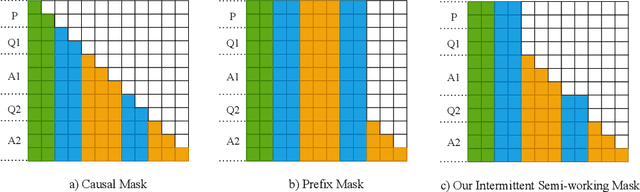

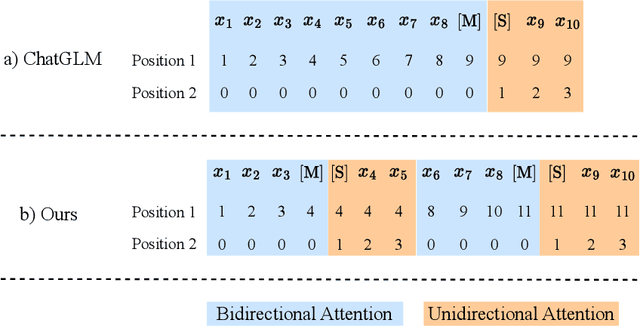

Multi-turn dialogues are a key interaction method between humans and Large Language Models (LLMs), as conversations extend over multiple rounds, keeping LLMs' high generation quality and low latency is a challenge. Mainstream LLMs can be grouped into two categories based on masking strategy: causal LLM and prefix LLM. Several works have demonstrated that prefix LLMs tend to outperform causal ones in scenarios that heavily depend on historical context such as multi-turn dialogues or in-context learning, thanks to their bidirectional attention on prefix sequences. However, prefix LLMs have an inherent inefficient training problem in multi-turn dialogue datasets. In addition, the attention mechanism of prefix LLM makes it unable to reuse Key-Value Cache (KV Cache) across dialogue rounds to reduce generation latency. In this paper, we propose a novel masking scheme called Intermittent Semi-working Mask (ISM) to address these problems. Specifically, we apply alternate bidirectional and unidirectional attention on queries and answers in the dialogue history. In this way, ISM is able to maintain the high quality of prefix LLM and low generation latency of causal LLM, simultaneously. Extensive experiments illustrate that our ISM achieves significant performance.
SeqMIA: Sequential-Metric Based Membership Inference Attack
Jul 21, 2024Most existing membership inference attacks (MIAs) utilize metrics (e.g., loss) calculated on the model's final state, while recent advanced attacks leverage metrics computed at various stages, including both intermediate and final stages, throughout the model training. Nevertheless, these attacks often process multiple intermediate states of the metric independently, ignoring their time-dependent patterns. Consequently, they struggle to effectively distinguish between members and non-members who exhibit similar metric values, particularly resulting in a high false-positive rate. In this study, we delve deeper into the new membership signals in the black-box scenario. We identify a new, more integrated membership signal: the Pattern of Metric Sequence, derived from the various stages of model training. We contend that current signals provide only partial perspectives of this new signal: the new one encompasses both the model's multiple intermediate and final states, with a greater emphasis on temporal patterns among them. Building upon this signal, we introduce a novel attack method called Sequential-metric based Membership Inference Attack (SeqMIA). Specifically, we utilize knowledge distillation to obtain a set of distilled models representing various stages of the target model's training. We then assess multiple metrics on these distilled models in chronological order, creating distilled metric sequence. We finally integrate distilled multi-metric sequences as a sequential multiformat and employ an attention-based RNN attack model for inference. Empirical results show SeqMIA outperforms all baselines, especially can achieve an order of magnitude improvement in terms of TPR @ 0.1% FPR. Furthermore, we delve into the reasons why this signal contributes to SeqMIA's high attack performance, and assess various defense mechanisms against SeqMIA.