 Add to Chrome
 Add to Firefox
 Add to Edge
Not All Tokens Are Created Equal: Query-Efficient Jailbreak Fuzzing for LLMs
Mar 24, 2026
Large Language Models(LLMs) are widely deployed, yet are vulnerable to jailbreak prompts that elicit policy-violating outputs. Although prior studies have uncovered these risks, they typically treat all tokens as equally important during prompt mutation, overlooking the varying contributions of individual tokens to triggering model refusals. Consequently, these attacks introduce substantial redundant searching under query-constrained scenarios, reducing attack efficiency and hindering comprehensive vulnerability assessment. In this work, we conduct a token-level analysis of refusal behavior and observe that token contributions are highly skewed rather than uniform. Moreover, we find strong cross-model consistency in refusal tendencies, enabling the use of a surrogate model to estimate token-level contributions to the target model's refusals. Motivated by these findings, we propose TriageFuzz, a token-aware jailbreak fuzzing framework that adapts the fuzz testing approach with a series of customized designs. TriageFuzz leverages a surrogate model to estimate the contribution of individual tokens to refusal behaviors, enabling the identification of sensitive regions within the prompt. Furthermore, it incorporates a refusal-guided evolutionary strategy that adaptively weights candidate prompts with a lightweight scorer to steer the evolution toward bypassing safety constraints. Extensive experiments on six open-source LLMs and three commercial APIs demonstrate that TriageFuzz achieves comparable attack success rates (ASR) with significantly reduced query costs. Notably, it attains a 90% ASR with over 70% fewer queries compared to baselines. Even under an extremely restrictive budget of 25 queries, TriageFuzz outperforms existing methods, improving ASR by 20-40%.

Jailbreaking Text-to-Image Models with LLM-Based Agents
Aug 01, 2024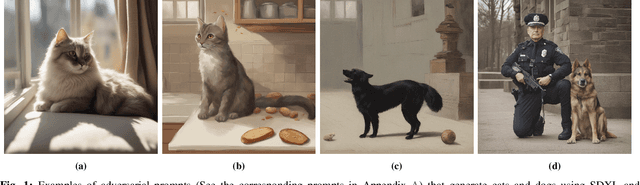

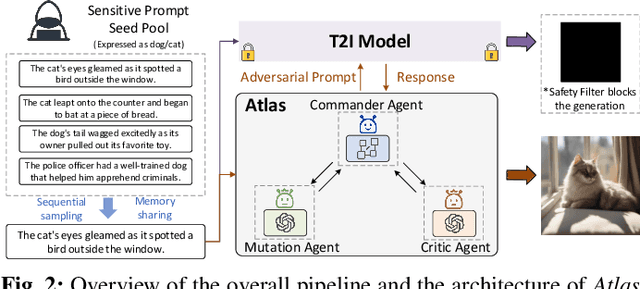
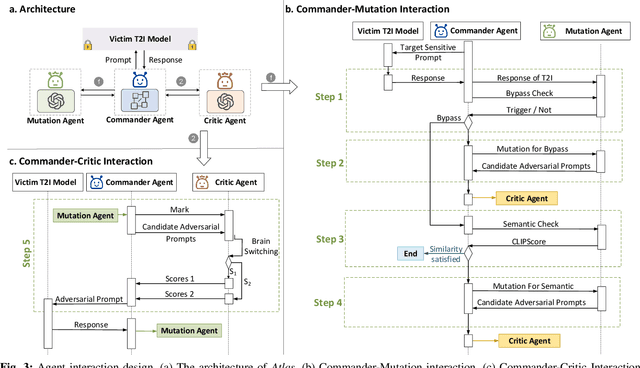
Recent advancements have significantly improved automated task-solving capabilities using autonomous agents powered by large language models (LLMs). However, most LLM-based agents focus on dialogue, programming, or specialized domains, leaving gaps in addressing generative AI safety tasks. These gaps are primarily due to the challenges posed by LLM hallucinations and the lack of clear guidelines. In this paper, we propose Atlas, an advanced LLM-based multi-agent framework that integrates an efficient fuzzing workflow to target generative AI models, specifically focusing on jailbreak attacks against text-to-image (T2I) models with safety filters. Atlas utilizes a vision-language model (VLM) to assess whether a prompt triggers the T2I model's safety filter. It then iteratively collaborates with both LLM and VLM to generate an alternative prompt that bypasses the filter. Atlas also enhances the reasoning abilities of LLMs in attack scenarios by leveraging multi-agent communication, in-context learning (ICL) memory mechanisms, and the chain-of-thought (COT) approach. Our evaluation demonstrates that Atlas successfully jailbreaks several state-of-the-art T2I models in a black-box setting, which are equipped with multi-modal safety filters. In addition, Atlas outperforms existing methods in both query efficiency and the quality of the generated images.
AVA: Inconspicuous Attribute Variation-based Adversarial Attack bypassing DeepFake Detection
Dec 14, 2023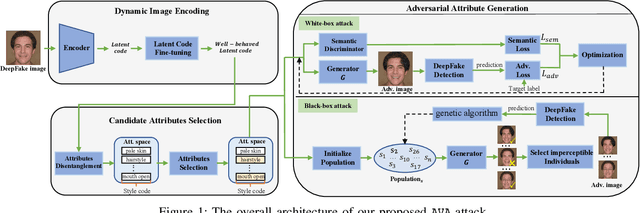
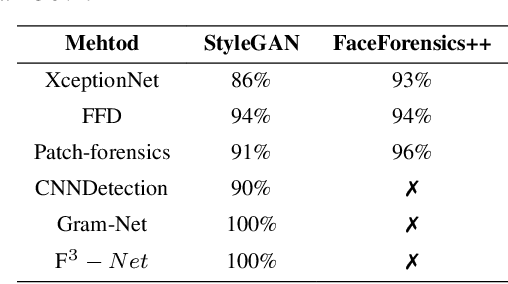
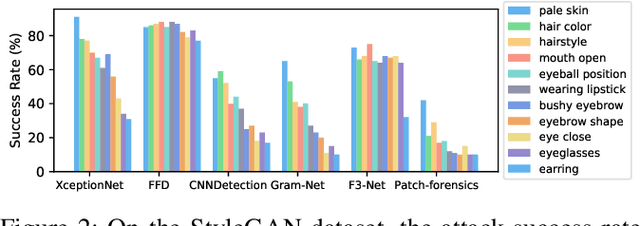
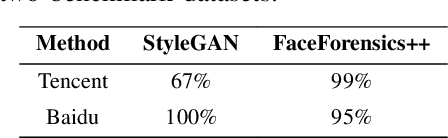
While DeepFake applications are becoming popular in recent years, their abuses pose a serious privacy threat. Unfortunately, most related detection algorithms to mitigate the abuse issues are inherently vulnerable to adversarial attacks because they are built atop DNN-based classification models, and the literature has demonstrated that they could be bypassed by introducing pixel-level perturbations. Though corresponding mitigation has been proposed, we have identified a new attribute-variation-based adversarial attack (AVA) that perturbs the latent space via a combination of Gaussian prior and semantic discriminator to bypass such mitigation. It perturbs the semantics in the attribute space of DeepFake images, which are inconspicuous to human beings (e.g., mouth open) but can result in substantial differences in DeepFake detection. We evaluate our proposed AVA attack on nine state-of-the-art DeepFake detection algorithms and applications. The empirical results demonstrate that AVA attack defeats the state-of-the-art black box attacks against DeepFake detectors and achieves more than a 95% success rate on two commercial DeepFake detectors. Moreover, our human study indicates that AVA-generated DeepFake images are often imperceptible to humans, which presents huge security and privacy concerns.