 Add to Chrome
 Add to Firefox
 Add to Edge
Anticipating Future with Large Language Model for Simultaneous Machine Translation
Oct 29, 2024
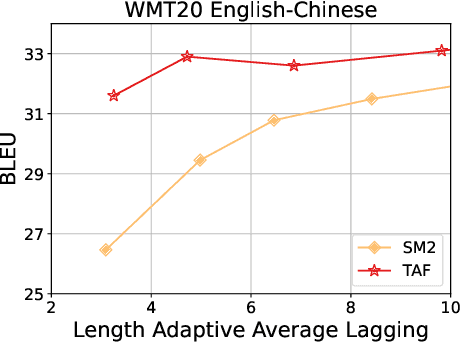
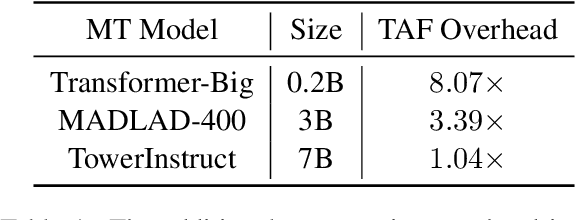
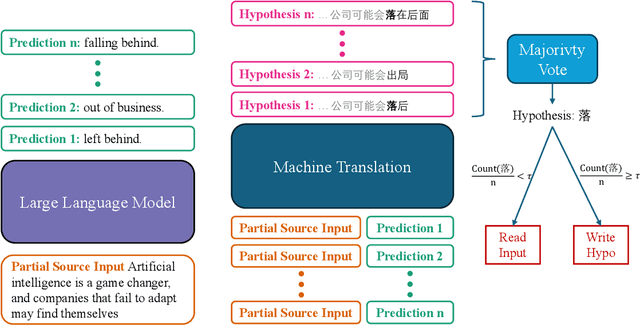
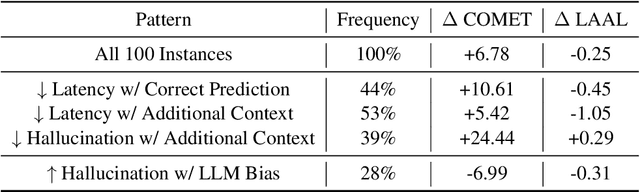
Simultaneous machine translation (SMT) takes streaming input utterances and incrementally produces target text. Existing SMT methods only use the partial utterance that has already arrived at the input and the generated hypothesis. Motivated by human interpreters' technique to forecast future words before hearing them, we propose $\textbf{T}$ranslation by $\textbf{A}$nticipating $\textbf{F}$uture (TAF), a method to improve translation quality while retraining low latency. Its core idea is to use a large language model (LLM) to predict future source words and opportunistically translate without introducing too much risk. We evaluate our TAF and multiple baselines of SMT on four language directions. Experiments show that TAF achieves the best translation quality-latency trade-off and outperforms the baselines by up to 5 BLEU points at the same latency (three words).

VoiceTextBlender: Augmenting Large Language Models with Speech Capabilities via Single-Stage Joint Speech-Text Supervised Fine-Tuning
Oct 23, 2024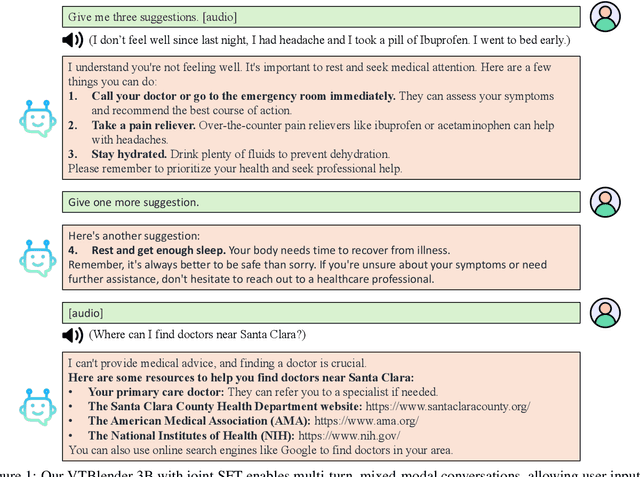
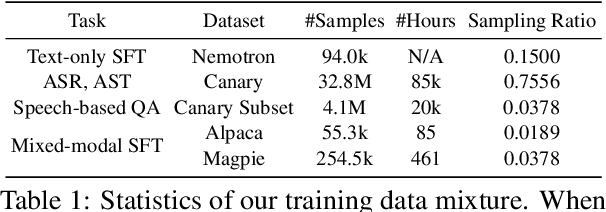
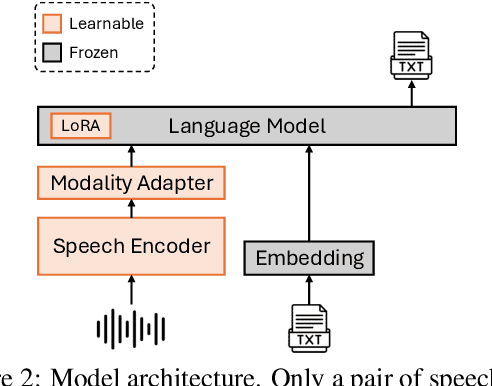
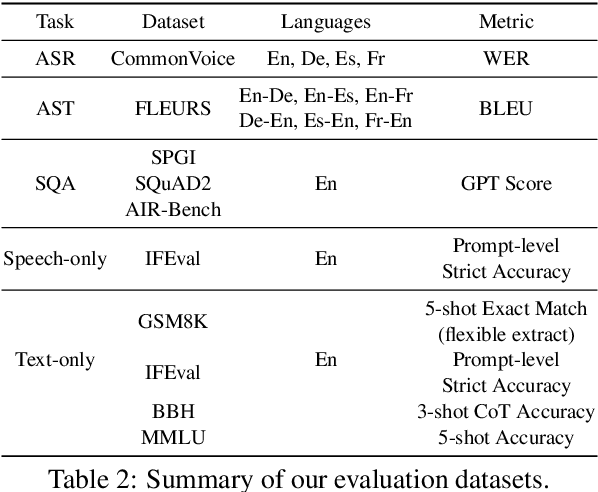
Recent studies have augmented large language models (LLMs) with speech capabilities, leading to the development of speech language models (SpeechLMs). Earlier SpeechLMs focused on single-turn speech-based question answering (QA), where user input comprised a speech context and a text question. More recent studies have extended this to multi-turn conversations, though they often require complex, multi-stage supervised fine-tuning (SFT) with diverse data. Another critical challenge with SpeechLMs is catastrophic forgetting-where models optimized for speech tasks suffer significant degradation in text-only performance. To mitigate these issues, we propose a novel single-stage joint speech-text SFT approach on the low-rank adaptation (LoRA) of the LLM backbone. Our joint SFT combines text-only SFT data with three types of speech-related data: speech recognition and translation, speech-based QA, and mixed-modal SFT. Compared to previous SpeechLMs with 7B or 13B parameters, our 3B model demonstrates superior performance across various speech benchmarks while preserving the original capabilities on text-only tasks. Furthermore, our model shows emergent abilities of effectively handling previously unseen prompts and tasks, including multi-turn, mixed-modal inputs.
Developing Instruction-Following Speech Language Model Without Speech Instruction-Tuning Data
Sep 30, 2024


Recent end-to-end speech language models (SLMs) have expanded upon the capabilities of large language models (LLMs) by incorporating pre-trained speech models. However, these SLMs often undergo extensive speech instruction-tuning to bridge the gap between speech and text modalities. This requires significant annotation efforts and risks catastrophic forgetting of the original language capabilities. In this work, we present a simple yet effective automatic process for creating speech-text pair data that carefully injects speech paralinguistic understanding abilities into SLMs while preserving the inherent language capabilities of the text-based LLM. Our model demonstrates general capabilities for speech-related tasks without the need for speech instruction-tuning data, achieving impressive performance on Dynamic-SUPERB and AIR-Bench-Chat benchmarks. Furthermore, our model exhibits the ability to follow complex instructions derived from LLMs, such as specific output formatting and chain-of-thought reasoning. Our approach not only enhances the versatility and effectiveness of SLMs but also reduces reliance on extensive annotated datasets, paving the way for more efficient and capable speech understanding systems.
Large Language Model Based Generative Error Correction: A Challenge and Baselines for Speech Recognition, Speaker Tagging, and Emotion Recognition
Sep 17, 2024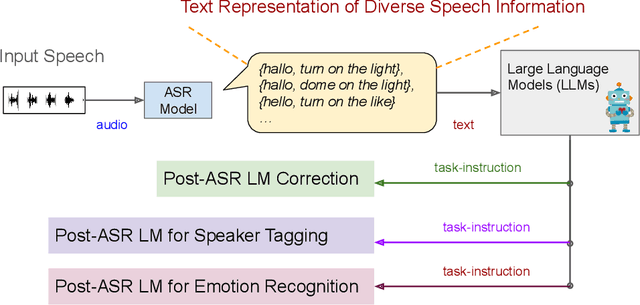
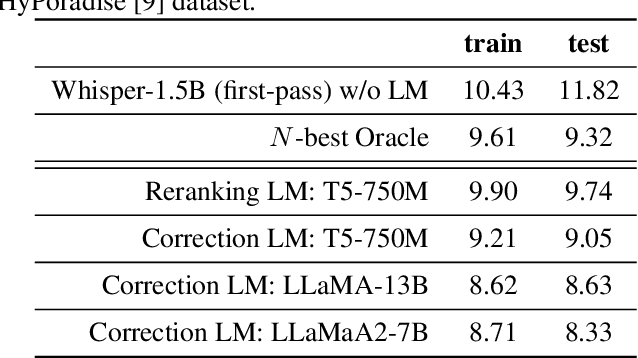
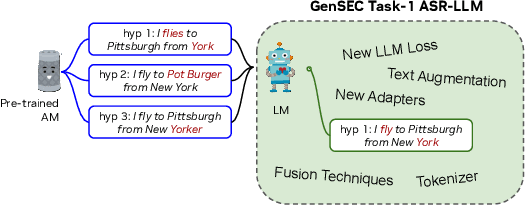
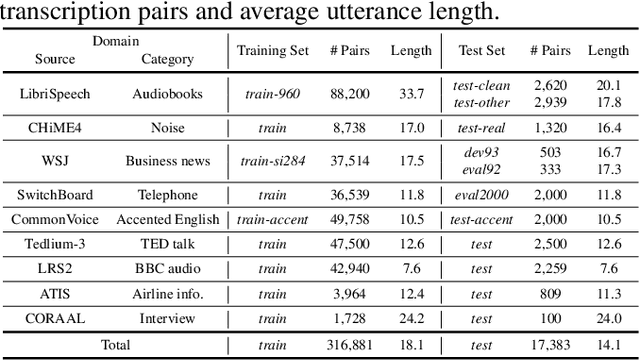
Given recent advances in generative AI technology, a key question is how large language models (LLMs) can enhance acoustic modeling tasks using text decoding results from a frozen, pretrained automatic speech recognition (ASR) model. To explore new capabilities in language modeling for speech processing, we introduce the generative speech transcription error correction (GenSEC) challenge. This challenge comprises three post-ASR language modeling tasks: (i) post-ASR transcription correction, (ii) speaker tagging, and (iii) emotion recognition. These tasks aim to emulate future LLM-based agents handling voice-based interfaces while remaining accessible to a broad audience by utilizing open pretrained language models or agent-based APIs. We also discuss insights from baseline evaluations, as well as lessons learned for designing future evaluations.
Chain-of-Thought Prompting for Speech Translation
Sep 17, 2024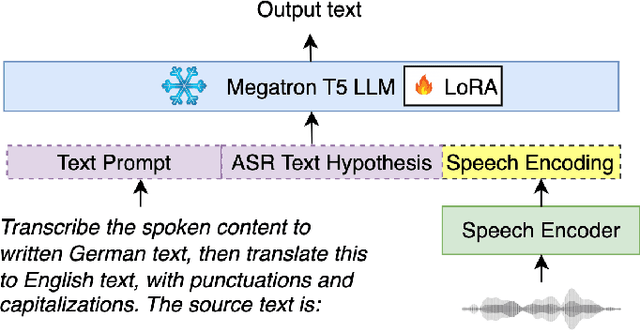
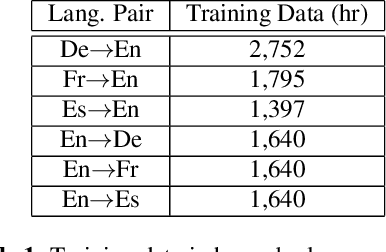
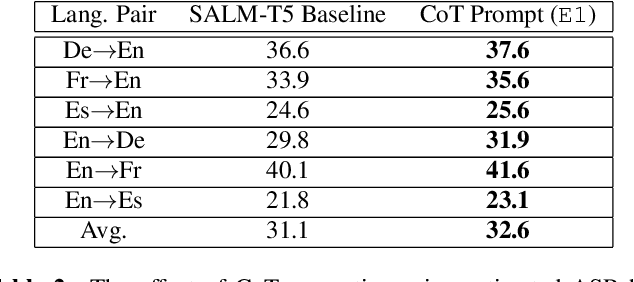
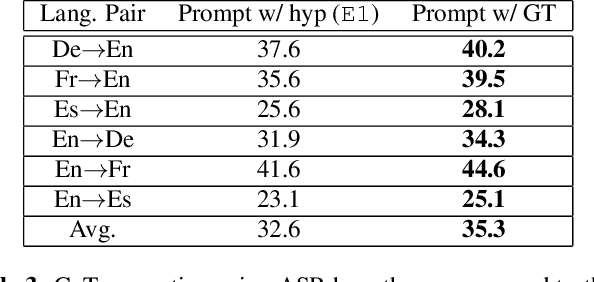
Large language models (LLMs) have demonstrated remarkable advancements in language understanding and generation. Building on the success of text-based LLMs, recent research has adapted these models to use speech embeddings for prompting, resulting in Speech-LLM models that exhibit strong performance in automatic speech recognition (ASR) and automatic speech translation (AST). In this work, we propose a novel approach to leverage ASR transcripts as prompts for AST in a Speech-LLM built on an encoder-decoder text LLM. The Speech-LLM model consists of a speech encoder and an encoder-decoder structure Megatron-T5. By first decoding speech to generate ASR transcripts and subsequently using these transcripts along with encoded speech for prompting, we guide the speech translation in a two-step process like chain-of-thought (CoT) prompting. Low-rank adaptation (LoRA) is used for the T5 LLM for model adaptation and shows superior performance to full model fine-tuning. Experimental results show that the proposed CoT prompting significantly improves AST performance, achieving an average increase of 2.4 BLEU points across 6 En->X or X->En AST tasks compared to speech prompting alone. Additionally, compared to a related CoT prediction method that predicts a concatenated sequence of ASR and AST transcripts, our method performs better by an average of 2 BLEU points.
BESTOW: Efficient and Streamable Speech Language Model with the Best of Two Worlds in GPT and T5
Jun 28, 2024



Incorporating speech understanding capabilities into pretrained large-language models has become a vital research direction (SpeechLLM). The previous architectures can be categorized as: i) GPT-style, prepend speech prompts to the text prompts as a sequence of LLM inputs like a decoder-only model; ii) T5-style, introduce speech cross-attention to each layer of the pretrained LLMs. We propose BESTOW architecture to bring the BESt features from TwO Worlds into a single model that is highly efficient and has strong multitask capabilities. Moreover, there is no clear streaming solution for either style, especially considering the solution should generalize to speech multitask. We reformulate streamable SpeechLLM as a read-write policy problem and unifies the offline and streaming research with BESTOW architecture. Hence we demonstrate the first open-source SpeechLLM solution that enables Streaming and Multitask at scale (beyond ASR) at the same time. This streamable solution achieves very strong performance on a wide range of speech tasks (ASR, AST, SQA, unseen DynamicSuperb). It is end-to-end optimizable, with lower training/inference cost, and demonstrates LLM knowledge transferability to speech.
Less is More: Accurate Speech Recognition & Translation without Web-Scale Data
Jun 28, 2024Recent advances in speech recognition and translation rely on hundreds of thousands of hours of Internet speech data. We argue that state-of-the art accuracy can be reached without relying on web-scale data. Canary - multilingual ASR and speech translation model, outperforms current state-of-the-art models - Whisper, OWSM, and Seamless-M4T on English, French, Spanish, and German languages, while being trained on an order of magnitude less data than these models. Three key factors enables such data-efficient model: (1) a FastConformer-based attention encoder-decoder architecture (2) training on synthetic data generated with machine translation and (3) advanced training techniques: data-balancing, dynamic data blending, dynamic bucketing and noise-robust fine-tuning. The model, weights, and training code will be open-sourced.
DeSTA: Enhancing Speech Language Models through Descriptive Speech-Text Alignment
Jun 27, 2024Recent speech language models (SLMs) typically incorporate pre-trained speech models to extend the capabilities from large language models (LLMs). In this paper, we propose a Descriptive Speech-Text Alignment approach that leverages speech captioning to bridge the gap between speech and text modalities, enabling SLMs to interpret and generate comprehensive natural language descriptions, thereby facilitating the capability to understand both linguistic and non-linguistic features in speech. Enhanced with the proposed approach, our model demonstrates superior performance on the Dynamic-SUPERB benchmark, particularly in generalizing to unseen tasks. Moreover, we discover that the aligned model exhibits a zero-shot instruction-following capability without explicit speech instruction tuning. These findings highlight the potential to reshape instruction-following SLMs by incorporating rich, descriptive speech captions.
Instruction Data Generation and Unsupervised Adaptation for Speech Language Models
Jun 18, 2024
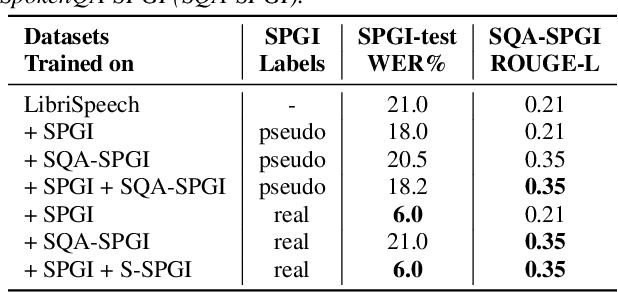
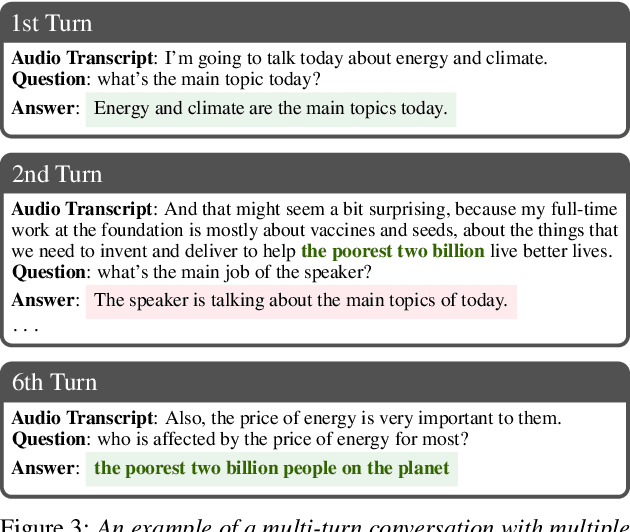
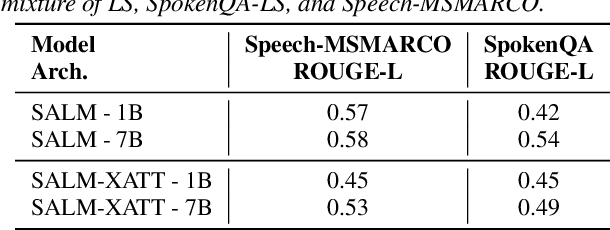
In this paper, we propose three methods for generating synthetic samples to train and evaluate multimodal large language models capable of processing both text and speech inputs. Addressing the scarcity of samples containing both modalities, synthetic data generation emerges as a crucial strategy to enhance the performance of such systems and facilitate the modeling of cross-modal relationships between the speech and text domains. Our process employs large language models to generate textual components and text-to-speech systems to generate speech components. The proposed methods offer a practical and effective means to expand the training dataset for these models. Experimental results show progress in achieving an integrated understanding of text and speech. We also highlight the potential of using unlabeled speech data to generate synthetic samples comparable in quality to those with available transcriptions, enabling the expansion of these models to more languages.
Transducers with Pronunciation-aware Embeddings for Automatic Speech Recognition
Apr 04, 2024
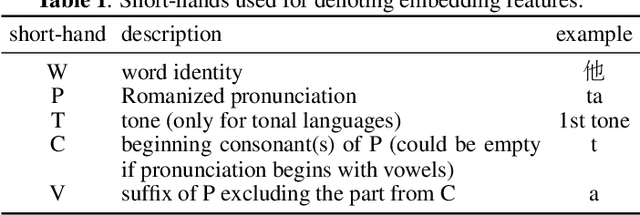

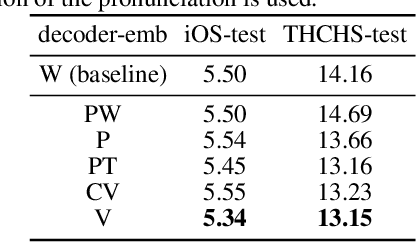
This paper proposes Transducers with Pronunciation-aware Embeddings (PET). Unlike conventional Transducers where the decoder embeddings for different tokens are trained independently, the PET model's decoder embedding incorporates shared components for text tokens with the same or similar pronunciations. With experiments conducted in multiple datasets in Mandarin Chinese and Korean, we show that PET models consistently improve speech recognition accuracy compared to conventional Transducers. Our investigation also uncovers a phenomenon that we call error chain reactions. Instead of recognition errors being evenly spread throughout an utterance, they tend to group together, with subsequent errors often following earlier ones. Our analysis shows that PET models effectively mitigate this issue by substantially reducing the likelihood of the model generating additional errors following a prior one. Our implementation will be open-sourced with the NeMo toolkit.