 Add to Chrome
 Add to Firefox
 Add to Edge
Symbolic Learning to Optimize: Towards Interpretability and Scalability
Apr 02, 2022
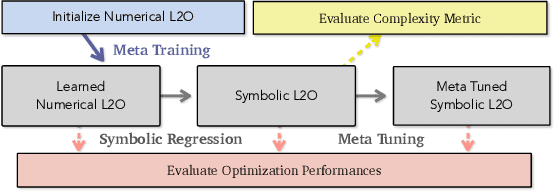

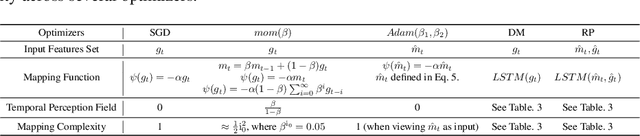
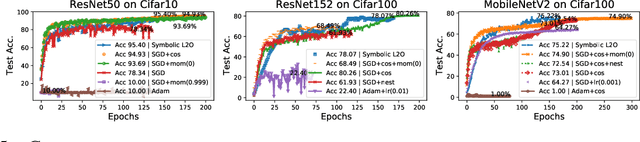
Recent studies on Learning to Optimize (L2O) suggest a promising path to automating and accelerating the optimization procedure for complicated tasks. Existing L2O models parameterize optimization rules by neural networks, and learn those numerical rules via meta-training. However, they face two common pitfalls: (1) scalability: the numerical rules represented by neural networks create extra memory overhead for applying L2O models, and limit their applicability to optimizing larger tasks; (2) interpretability: it is unclear what an L2O model has learned in its black-box optimization rule, nor is it straightforward to compare different L2O models in an explainable way. To avoid both pitfalls, this paper proves the concept that we can "kill two birds by one stone", by introducing the powerful tool of symbolic regression to L2O. In this paper, we establish a holistic symbolic representation and analysis framework for L2O, which yields a series of insights for learnable optimizers. Leveraging our findings, we further propose a lightweight L2O model that can be meta-trained on large-scale problems and outperformed human-designed and tuned optimizers. Our work is set to supply a brand-new perspective to L2O research. Codes are available at: https://github.com/VITA-Group/Symbolic-Learning-To-Optimize.

SinNeRF: Training Neural Radiance Fields on Complex Scenes from a Single Image
Apr 02, 2022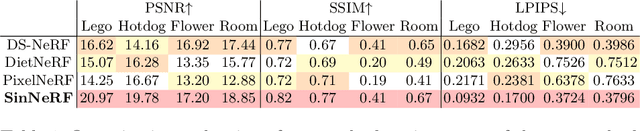
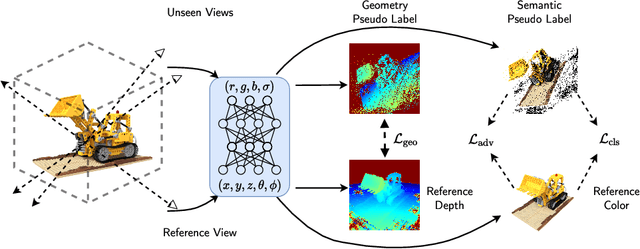


Despite the rapid development of Neural Radiance Field (NeRF), the necessity of dense covers largely prohibits its wider applications. While several recent works have attempted to address this issue, they either operate with sparse views (yet still, a few of them) or on simple objects/scenes. In this work, we consider a more ambitious task: training neural radiance field, over realistically complex visual scenes, by "looking only once", i.e., using only a single view. To attain this goal, we present a Single View NeRF (SinNeRF) framework consisting of thoughtfully designed semantic and geometry regularizations. Specifically, SinNeRF constructs a semi-supervised learning process, where we introduce and propagate geometry pseudo labels and semantic pseudo labels to guide the progressive training process. Extensive experiments are conducted on complex scene benchmarks, including NeRF synthetic dataset, Local Light Field Fusion dataset, and DTU dataset. We show that even without pre-training on multi-view datasets, SinNeRF can yield photo-realistic novel-view synthesis results. Under the single image setting, SinNeRF significantly outperforms the current state-of-the-art NeRF baselines in all cases. Project page: https://vita-group.github.io/SinNeRF/
VFDS: Variational Foresight Dynamic Selection in Bayesian Neural Networks for Efficient Human Activity Recognition
Mar 31, 2022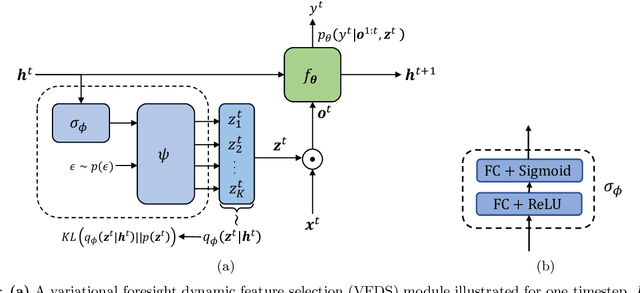
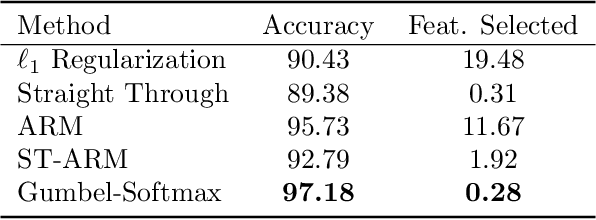
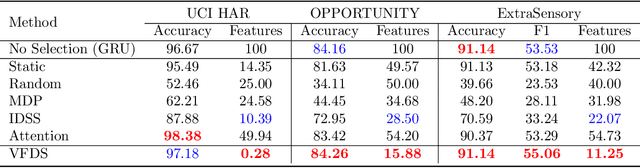
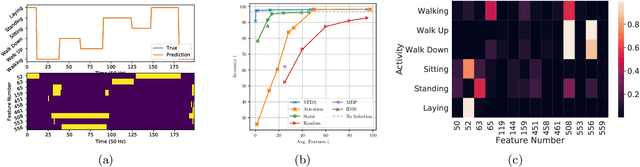
In many machine learning tasks, input features with varying degrees of predictive capability are acquired at varying costs. In order to optimize the performance-cost trade-off, one would select features to observe a priori. However, given the changing context with previous observations, the subset of predictive features to select may change dynamically. Therefore, we face the challenging new problem of foresight dynamic selection (FDS): finding a dynamic and light-weight policy to decide which features to observe next, before actually observing them, for overall performance-cost trade-offs. To tackle FDS, this paper proposes a Bayesian learning framework of Variational Foresight Dynamic Selection (VFDS). VFDS learns a policy that selects the next feature subset to observe, by optimizing a variational Bayesian objective that characterizes the trade-off between model performance and feature cost. At its core is an implicit variational distribution on binary gates that are dependent on previous observations, which will select the next subset of features to observe. We apply VFDS on the Human Activity Recognition (HAR) task where the performance-cost trade-off is critical in its practice. Extensive results demonstrate that VFDS selects different features under changing contexts, notably saving sensory costs while maintaining or improving the HAR accuracy. Moreover, the features that VFDS dynamically select are shown to be interpretable and associated with the different activity types. We will release the code.
Efficient Split-Mix Federated Learning for On-Demand and In-Situ Customization
Mar 18, 2022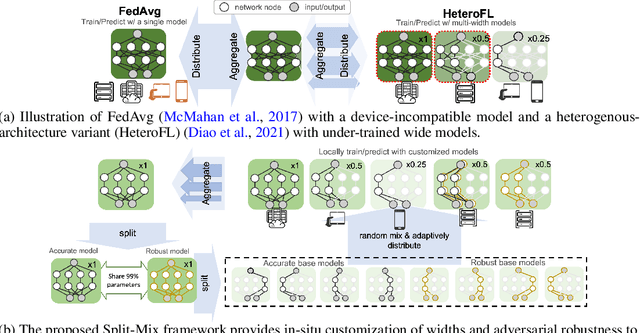
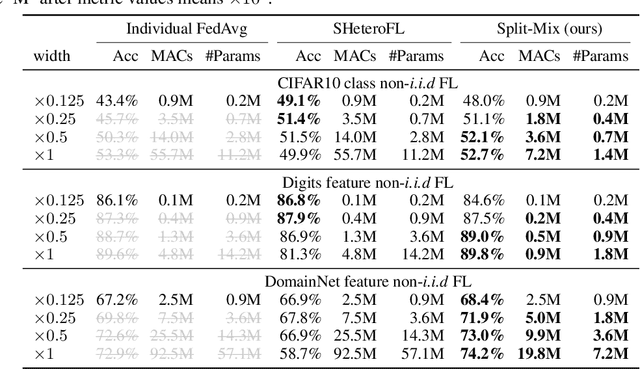
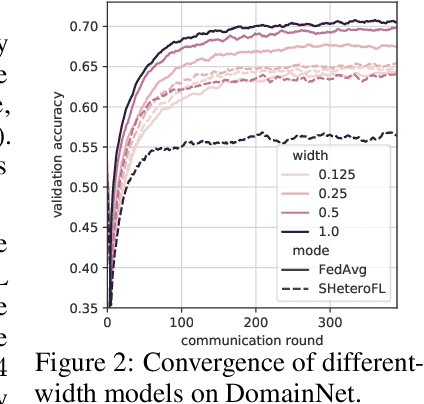
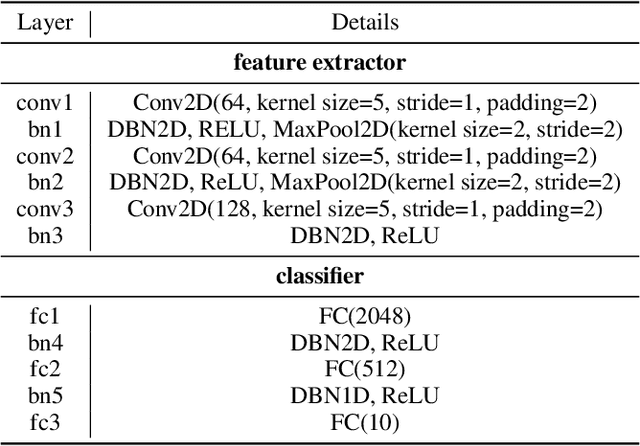
Federated learning (FL) provides a distributed learning framework for multiple participants to collaborate learning without sharing raw data. In many practical FL scenarios, participants have heterogeneous resources due to disparities in hardware and inference dynamics that require quickly loading models of different sizes and levels of robustness. The heterogeneity and dynamics together impose significant challenges to existing FL approaches and thus greatly limit FL's applicability. In this paper, we propose a novel Split-Mix FL strategy for heterogeneous participants that, once training is done, provides in-situ customization of model sizes and robustness. Specifically, we achieve customization by learning a set of base sub-networks of different sizes and robustness levels, which are later aggregated on-demand according to inference requirements. This split-mix strategy achieves customization with high efficiency in communication, storage, and inference. Extensive experiments demonstrate that our method provides better in-situ customization than the existing heterogeneous-architecture FL methods. Codes and pre-trained models are available: https://github.com/illidanlab/SplitMix.
Unified Visual Transformer Compression
Mar 15, 2022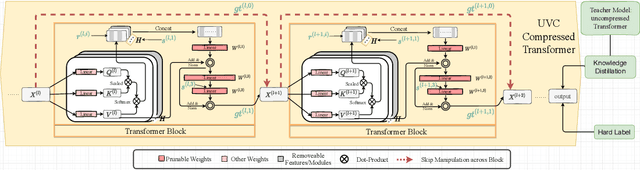
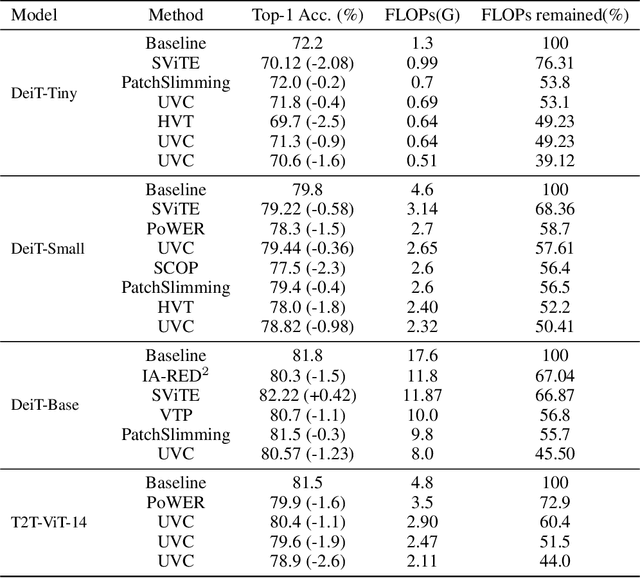
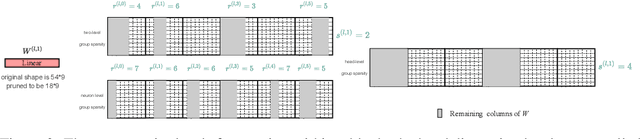
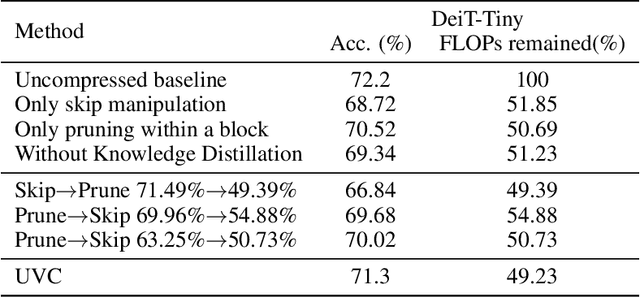
Vision transformers (ViTs) have gained popularity recently. Even without customized image operators such as convolutions, ViTs can yield competitive performance when properly trained on massive data. However, the computational overhead of ViTs remains prohibitive, due to stacking multi-head self-attention modules and else. Compared to the vast literature and prevailing success in compressing convolutional neural networks, the study of Vision Transformer compression has also just emerged, and existing works focused on one or two aspects of compression. This paper proposes a unified ViT compression framework that seamlessly assembles three effective techniques: pruning, layer skipping, and knowledge distillation. We formulate a budget-constrained, end-to-end optimization framework, targeting jointly learning model weights, layer-wise pruning ratios/masks, and skip configurations, under a distillation loss. The optimization problem is then solved using the primal-dual algorithm. Experiments are conducted with several ViT variants, e.g. DeiT and T2T-ViT backbones on the ImageNet dataset, and our approach consistently outperforms recent competitors. For example, DeiT-Tiny can be trimmed down to 50\% of the original FLOPs almost without losing accuracy. Codes are available online:~\url{https://github.com/VITA-Group/UVC}.
Optimizer Amalgamation
Mar 15, 2022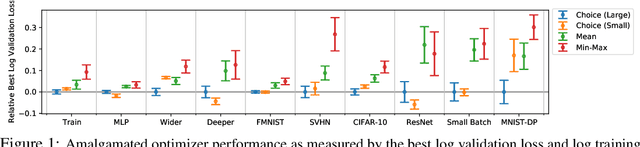
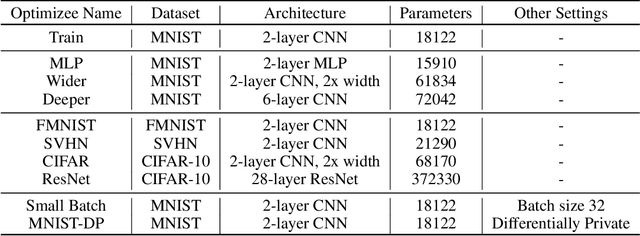
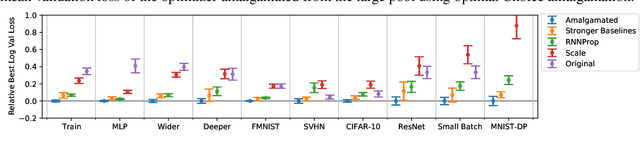
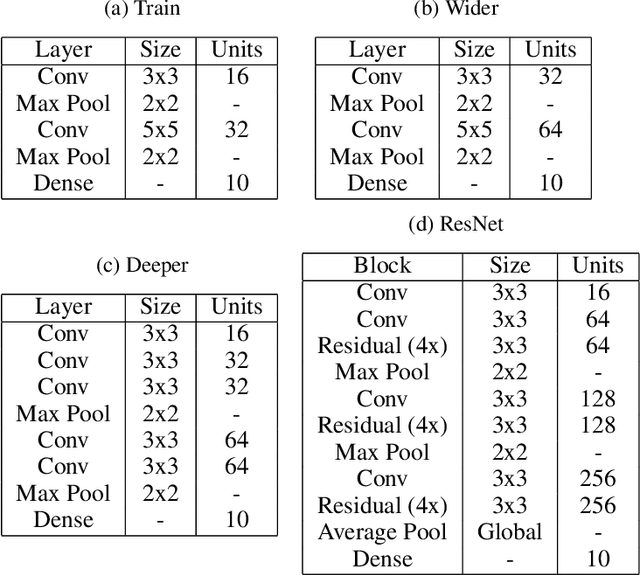
Selecting an appropriate optimizer for a given problem is of major interest for researchers and practitioners. Many analytical optimizers have been proposed using a variety of theoretical and empirical approaches; however, none can offer a universal advantage over other competitive optimizers. We are thus motivated to study a new problem named Optimizer Amalgamation: how can we best combine a pool of "teacher" optimizers into a single "student" optimizer that can have stronger problem-specific performance? In this paper, we draw inspiration from the field of "learning to optimize" to use a learnable amalgamation target. First, we define three differentiable amalgamation mechanisms to amalgamate a pool of analytical optimizers by gradient descent. Then, in order to reduce variance of the amalgamation process, we also explore methods to stabilize the amalgamation process by perturbing the amalgamation target. Finally, we present experiments showing the superiority of our amalgamated optimizer compared to its amalgamated components and learning to optimize baselines, and the efficacy of our variance reducing perturbations. Our code and pre-trained models are publicly available at http://github.com/VITA-Group/OptimizerAmalgamation.
The Principle of Diversity: Training Stronger Vision Transformers Calls for Reducing All Levels of Redundancy
Mar 12, 2022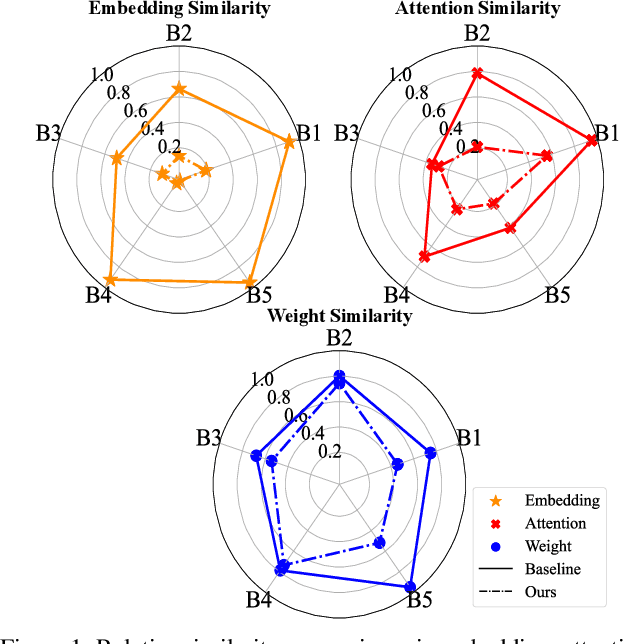
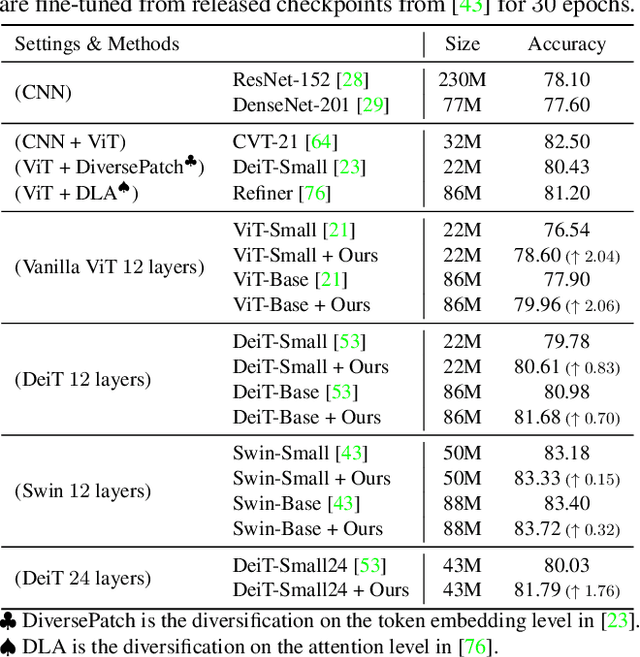
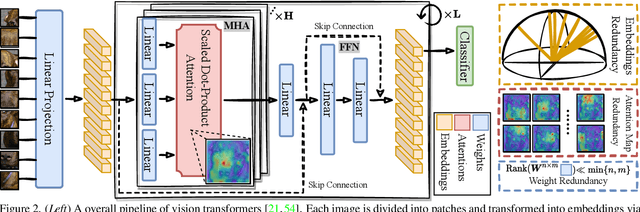
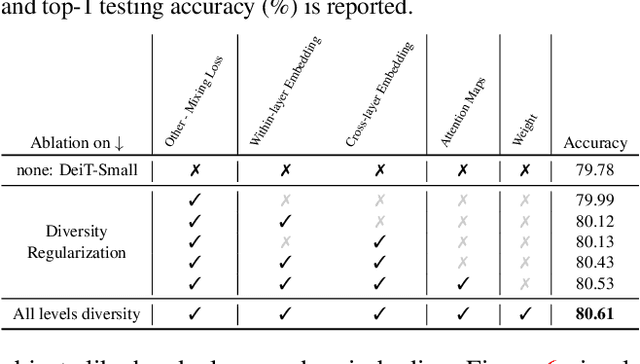
Vision transformers (ViTs) have gained increasing popularity as they are commonly believed to own higher modeling capacity and representation flexibility, than traditional convolutional networks. However, it is questionable whether such potential has been fully unleashed in practice, as the learned ViTs often suffer from over-smoothening, yielding likely redundant models. Recent works made preliminary attempts to identify and alleviate such redundancy, e.g., via regularizing embedding similarity or re-injecting convolution-like structures. However, a "head-to-toe assessment" regarding the extent of redundancy in ViTs, and how much we could gain by thoroughly mitigating such, has been absent for this field. This paper, for the first time, systematically studies the ubiquitous existence of redundancy at all three levels: patch embedding, attention map, and weight space. In view of them, we advocate a principle of diversity for training ViTs, by presenting corresponding regularizers that encourage the representation diversity and coverage at each of those levels, that enabling capturing more discriminative information. Extensive experiments on ImageNet with a number of ViT backbones validate the effectiveness of our proposals, largely eliminating the observed ViT redundancy and significantly boosting the model generalization. For example, our diversified DeiT obtains 0.70%~1.76% accuracy boosts on ImageNet with highly reduced similarity. Our codes are fully available in https://github.com/VITA-Group/Diverse-ViT.
Anti-Oversmoothing in Deep Vision Transformers via the Fourier Domain Analysis: From Theory to Practice
Mar 09, 2022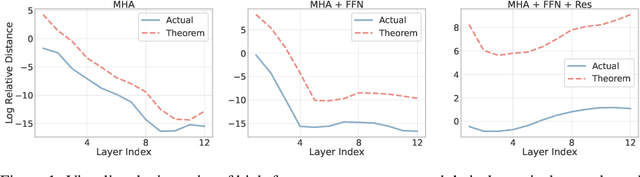
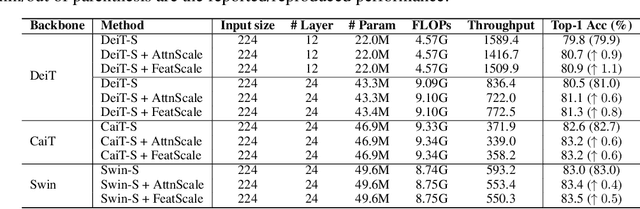
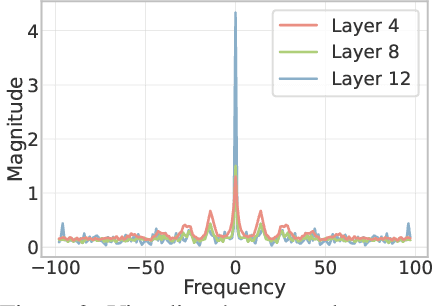
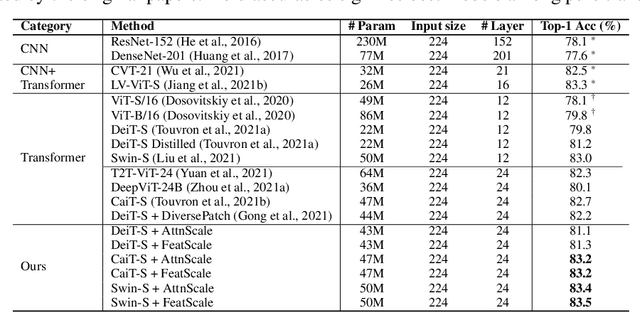
Vision Transformer (ViT) has recently demonstrated promise in computer vision problems. However, unlike Convolutional Neural Networks (CNN), it is known that the performance of ViT saturates quickly with depth increasing, due to the observed attention collapse or patch uniformity. Despite a couple of empirical solutions, a rigorous framework studying on this scalability issue remains elusive. In this paper, we first establish a rigorous theory framework to analyze ViT features from the Fourier spectrum domain. We show that the self-attention mechanism inherently amounts to a low-pass filter, which indicates when ViT scales up its depth, excessive low-pass filtering will cause feature maps to only preserve their Direct-Current (DC) component. We then propose two straightforward yet effective techniques to mitigate the undesirable low-pass limitation. The first technique, termed AttnScale, decomposes a self-attention block into low-pass and high-pass components, then rescales and combines these two filters to produce an all-pass self-attention matrix. The second technique, termed FeatScale, re-weights feature maps on separate frequency bands to amplify the high-frequency signals. Both techniques are efficient and hyperparameter-free, while effectively overcoming relevant ViT training artifacts such as attention collapse and patch uniformity. By seamlessly plugging in our techniques to multiple ViT variants, we demonstrate that they consistently help ViTs benefit from deeper architectures, bringing up to 1.1% performance gains "for free" (e.g., with little parameter overhead). We publicly release our codes and pre-trained models at https://github.com/VITA-Group/ViT-Anti-Oversmoothing.
Auto-scaling Vision Transformers without Training
Feb 27, 2022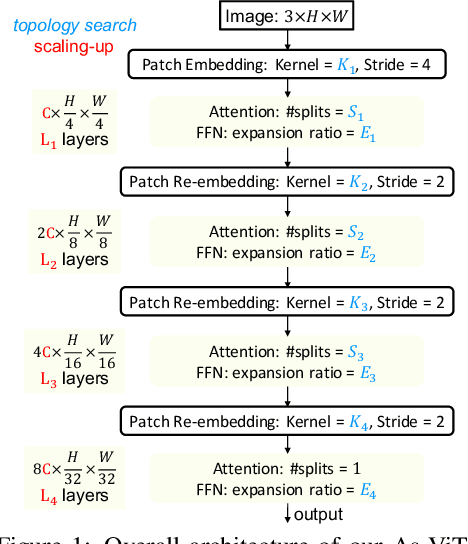
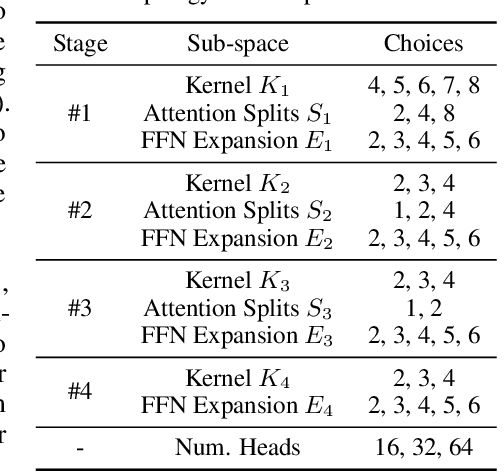
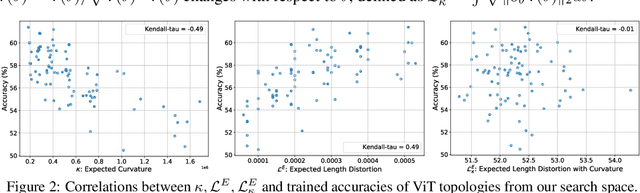
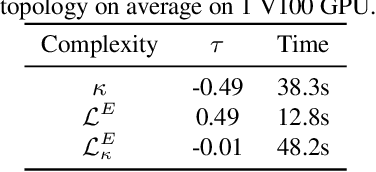
This work targets automated designing and scaling of Vision Transformers (ViTs). The motivation comes from two pain spots: 1) the lack of efficient and principled methods for designing and scaling ViTs; 2) the tremendous computational cost of training ViT that is much heavier than its convolution counterpart. To tackle these issues, we propose As-ViT, an auto-scaling framework for ViTs without training, which automatically discovers and scales up ViTs in an efficient and principled manner. Specifically, we first design a "seed" ViT topology by leveraging a training-free search process. This extremely fast search is fulfilled by a comprehensive study of ViT's network complexity, yielding a strong Kendall-tau correlation with ground-truth accuracies. Second, starting from the "seed" topology, we automate the scaling rule for ViTs by growing widths/depths to different ViT layers. This results in a series of architectures with different numbers of parameters in a single run. Finally, based on the observation that ViTs can tolerate coarse tokenization in early training stages, we propose a progressive tokenization strategy to train ViTs faster and cheaper. As a unified framework, As-ViT achieves strong performance on classification (83.5% top1 on ImageNet-1k) and detection (52.7% mAP on COCO) without any manual crafting nor scaling of ViT architectures: the end-to-end model design and scaling process cost only 12 hours on one V100 GPU. Our code is available at https://github.com/VITA-Group/AsViT.
Sparsity Winning Twice: Better Robust Generalization from More Efficient Training
Feb 27, 2022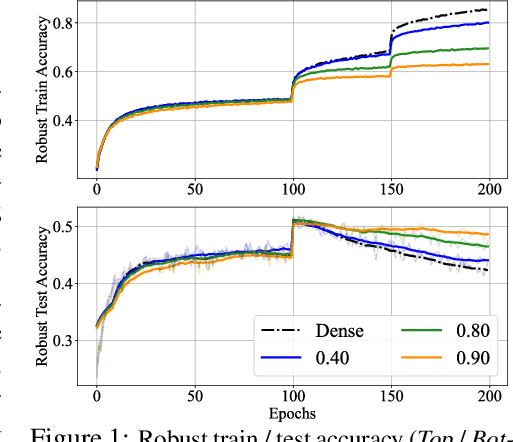
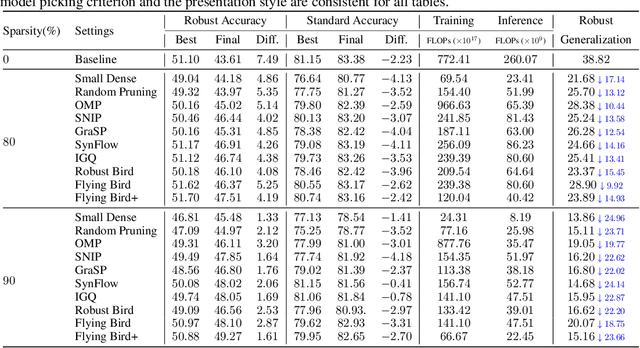
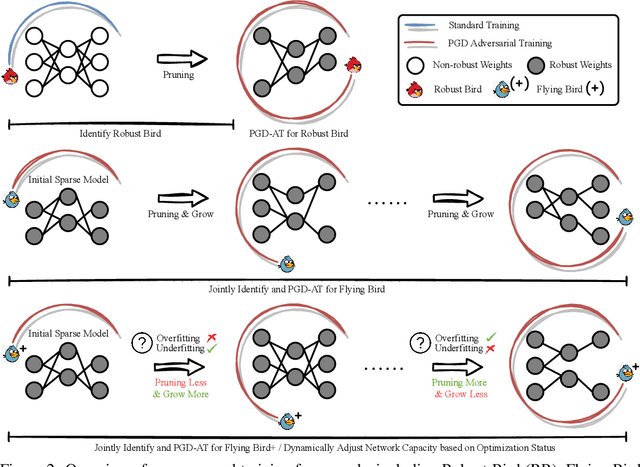
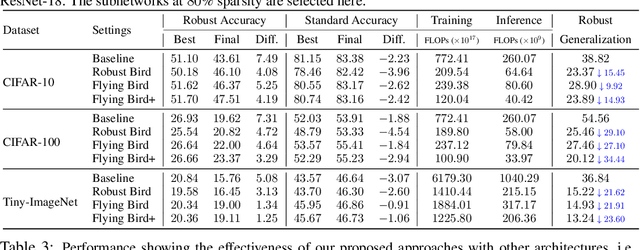
Recent studies demonstrate that deep networks, even robustified by the state-of-the-art adversarial training (AT), still suffer from large robust generalization gaps, in addition to the much more expensive training costs than standard training. In this paper, we investigate this intriguing problem from a new perspective, i.e., injecting appropriate forms of sparsity during adversarial training. We introduce two alternatives for sparse adversarial training: (i) static sparsity, by leveraging recent results from the lottery ticket hypothesis to identify critical sparse subnetworks arising from the early training; (ii) dynamic sparsity, by allowing the sparse subnetwork to adaptively adjust its connectivity pattern (while sticking to the same sparsity ratio) throughout training. We find both static and dynamic sparse methods to yield win-win: substantially shrinking the robust generalization gap and alleviating the robust overfitting, meanwhile significantly saving training and inference FLOPs. Extensive experiments validate our proposals with multiple network architectures on diverse datasets, including CIFAR-10/100 and Tiny-ImageNet. For example, our methods reduce robust generalization gap and overfitting by 34.44% and 4.02%, with comparable robust/standard accuracy boosts and 87.83%/87.82% training/inference FLOPs savings on CIFAR-100 with ResNet-18. Besides, our approaches can be organically combined with existing regularizers, establishing new state-of-the-art results in AT. Codes are available in https://github.com/VITA-Group/Sparsity-Win-Robust-Generalization.