 Add to Chrome
 Add to Firefox
 Add to Edge
Surface Keypoint Representation for Multi-Object and Articulated Human-Object Interaction Generation
Aug 04, 2026
Daily activities require humans to coordinate whole-body motion with the motion of surrounding objects. Despite recent progress in human-object interaction (HOI) generation, most existing methods assume interactions with a single rigid object and do not extend well to scenarios involving a variable number of objects or articulated objects with diverse joint mechanisms. We propose surface keypoint trajectories as an object motion representation: for each rigid component, whether a standalone object or one part of an articulated assembly, we track a small set of non-collinear surface points over time. This representation handles multi-object coordination and diverse articulation mechanisms directly from point dynamics without requiring explicit joint-type specification. To model when and where each body region contacts each object, we introduce a spatio-temporal contact distance field that extends distance-based contact modeling to whole-body, multi-object, and articulated settings. We factorize HOI generation into three stages: generating object motions from text or waypoints, predicting the contact distance field, and synthesizing whole-body motion with contact-guided optimization. Experiments on ParaHome, HIMO, ARCTIC, and OMOMO demonstrate better or comparable performance to existing methods across single-object, multi-object, and articulated interaction settings.

NavVerse: Benchmarking Indoor-to-Outdoor Embodied Navigation in Continuous Robot Simulation
Jul 22, 2026Robots deployed in delivery, campus, and emergency-response settings often need to navigate from buildings to streets within a single continuous episode. Existing benchmarks usually evaluate indoor and outdoor navigation separately, and many abstract away robot execution, leaving exit finding, boundary traversal, adaptation, and kinodynamic failures underexplored. We introduce NavVerse, a physics-enabled benchmark for indoor-to-outdoor embodied navigation. NavVerse contains 100 indoor scenes, 50 urban outdoor scenes, and 50 indoor-to-outdoor scenes, and 10,000 episodes spanning Object Navigation, Vision-and-Language Navigation, and Place Navigation tasks, where agents search for semantic points of interest such as restaurants or banks. Agents are evaluated through executable robot interfaces using task-success, path-efficiency, and safety metrics. Zero-shot experiments with RL, VLA, and modular baselines show that current agents remain far from solving cross-context navigation: end-to-end VLAs obtain the highest zero-shot success, while the modular method provides the strongest safety profile. PlaceNav further reveals a clear drop from outdoor to indoor-to-outdoor scenes, indicating that adaptation remains major bottleneck.
Evidence Absence Is Not Evidence Insufficiency: Diagnosing NEI Construction Artifacts in Fact Verification
May 26, 2026Evidence absence is not evidence insufficiency, but fact verification benchmarks can make them observationally similar. The Not Enough Information (NEI) label is often operationalized through different evidence conditions, and that choice silently determines what a verifier learns and what its score can hide. We introduce NEI-CAP, a construction-aware diagnostic protocol for insufficient-evidence evaluation. Each NEI example carries the construction family that produced it; NEI-CAP audits shortcut cues, validates hard cases through human adjudication, and tests whether competence transfers across constructions. We instantiate the protocol in SciFact-style scientific verification, with FEVER and HoVer as bounded external controls. Across these settings, NEI competence does not transfer reliably: models trained on shortcut-prone constructions fail to recognize semantically related insufficient evidence, and mixed-construction training narrows but does not close the gap. Fixed-claim diagnostics further show that the evidence condition shifts confidence in the reference Support/Refute label, not only NEI recall, so an aggregate NEI score can hide which problem a model has actually solved.
SURE-RAG: Sufficiency and Uncertainty-Aware Evidence Verification for Selective Retrieval-Augmented Generation
May 05, 2026Retrieval-augmented generation (RAG) grounds answers in retrieved passages, but retrieval is not verification: a passage can be topical and still fail to justify the answer. We frame this gap as evidence sufficiency verification for selective RAG answering: given a question, a candidate answer, and retrieved evidence, predict whether the evidence supports, refutes, or is insufficient, and abstain unless support is established. We present SURE-RAG, a transparent aggregation protocol built on the observation that evidence sufficiency is a set-level property: missing hops and unresolved conflicts cannot be detected by independent passage scoring. A shared pair-level claim-evidence verifier produces local relation distributions, which SURE-RAG aggregates into interpretable answer-level signals -- coverage, relation strength, disagreement, conflict, and retrieval uncertainty -- yielding a three-way decision and an auditable selective score. We evaluate on HotpotQA-RAG v3, a controlled multi-hop benchmark, under an artifact-aware protocol (shortcut baselines, counterfactual swaps, no-oracle checks, GPT-4o audits). Calibrated SURE-RAG reaches 0.9075 Macro-F1 (0.8951 +/- 0.0069), substantially above DeBERTa mean-pooling (0.6516) and a GPT-4o judge (0.7284), while matching a strong but opaque concat cross-encoder (0.8888 +/- 0.0109) with full auditability. Risk at 30% coverage drops from 0.2588 to 0.1642, a 37% reduction in unsafe answers. To deliberately probe the task boundary, we further contrast SURE-RAG with GPT-4o on HaluBench unsafe detection: the ranking reverses (0.3343 vs 0.7389 unsafe-F1), establishing that controlled sufficiency verification and natural hallucination detection are distinct problems.
Absolute Coordinates Make Motion Generation Easy
May 26, 2025State-of-the-art text-to-motion generation models rely on the kinematic-aware, local-relative motion representation popularized by HumanML3D, which encodes motion relative to the pelvis and to the previous frame with built-in redundancy. While this design simplifies training for earlier generation models, it introduces critical limitations for diffusion models and hinders applicability to downstream tasks. In this work, we revisit the motion representation and propose a radically simplified and long-abandoned alternative for text-to-motion generation: absolute joint coordinates in global space. Through systematic analysis of design choices, we show that this formulation achieves significantly higher motion fidelity, improved text alignment, and strong scalability, even with a simple Transformer backbone and no auxiliary kinematic-aware losses. Moreover, our formulation naturally supports downstream tasks such as text-driven motion control and temporal/spatial editing without additional task-specific reengineering and costly classifier guidance generation from control signals. Finally, we demonstrate promising generalization to directly generate SMPL-H mesh vertices in motion from text, laying a strong foundation for future research and motion-related applications.
Rethinking Diffusion for Text-Driven Human Motion Generation
Nov 25, 2024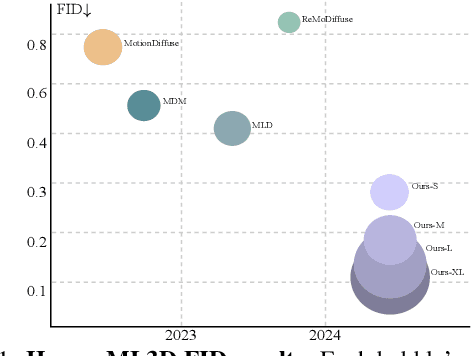
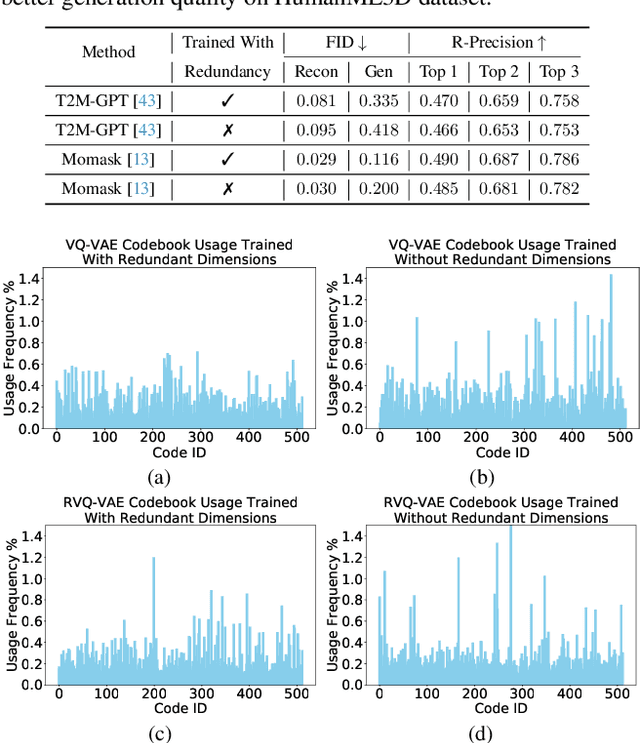
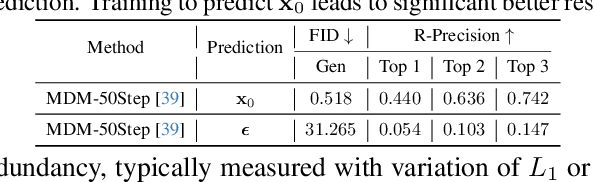
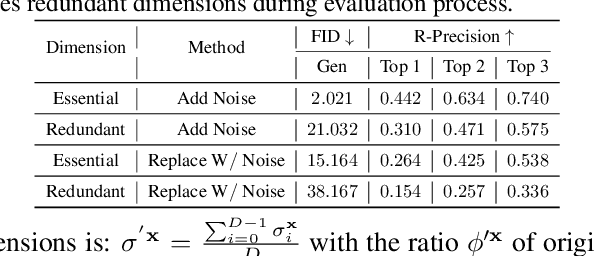
Since 2023, Vector Quantization (VQ)-based discrete generation methods have rapidly dominated human motion generation, primarily surpassing diffusion-based continuous generation methods in standard performance metrics. However, VQ-based methods have inherent limitations. Representing continuous motion data as limited discrete tokens leads to inevitable information loss, reduces the diversity of generated motions, and restricts their ability to function effectively as motion priors or generation guidance. In contrast, the continuous space generation nature of diffusion-based methods makes them well-suited to address these limitations and with even potential for model scalability. In this work, we systematically investigate why current VQ-based methods perform well and explore the limitations of existing diffusion-based methods from the perspective of motion data representation and distribution. Drawing on these insights, we preserve the inherent strengths of a diffusion-based human motion generation model and gradually optimize it with inspiration from VQ-based approaches. Our approach introduces a human motion diffusion model enabled to perform bidirectional masked autoregression, optimized with a reformed data representation and distribution. Additionally, we also propose more robust evaluation methods to fairly assess different-based methods. Extensive experiments on benchmark human motion generation datasets demonstrate that our method excels previous methods and achieves state-of-the-art performances.
DenserRadar: A 4D millimeter-wave radar point cloud detector based on dense LiDAR point clouds
May 08, 2024
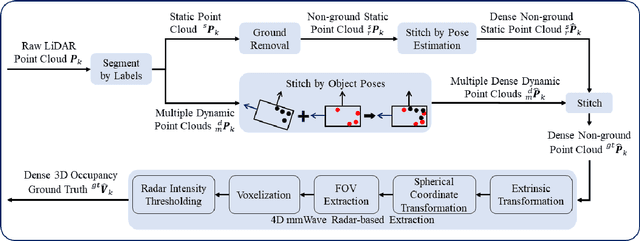


The 4D millimeter-wave (mmWave) radar, with its robustness in extreme environments, extensive detection range, and capabilities for measuring velocity and elevation, has demonstrated significant potential for enhancing the perception abilities of autonomous driving systems in corner-case scenarios. Nevertheless, the inherent sparsity and noise of 4D mmWave radar point clouds restrict its further development and practical application. In this paper, we introduce a novel 4D mmWave radar point cloud detector, which leverages high-resolution dense LiDAR point clouds. Our approach constructs dense 3D occupancy ground truth from stitched LiDAR point clouds, and employs a specially designed network named DenserRadar. The proposed method surpasses existing probability-based and learning-based radar point cloud detectors in terms of both point cloud density and accuracy on the K-Radar dataset.
Neural Radiance Field in Autonomous Driving: A Survey
Apr 26, 2024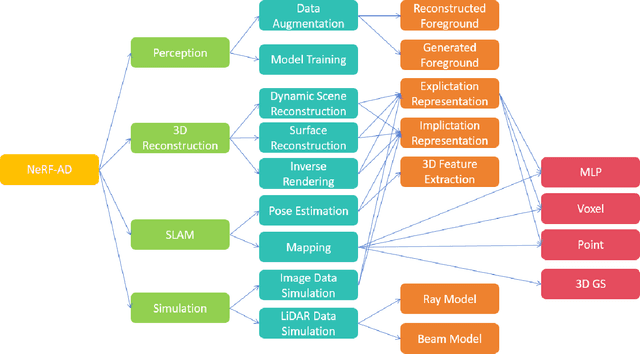
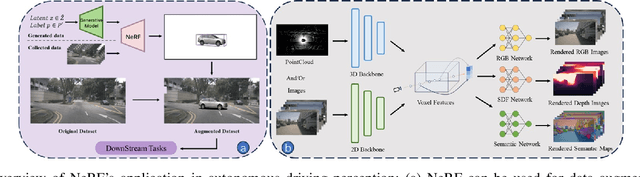
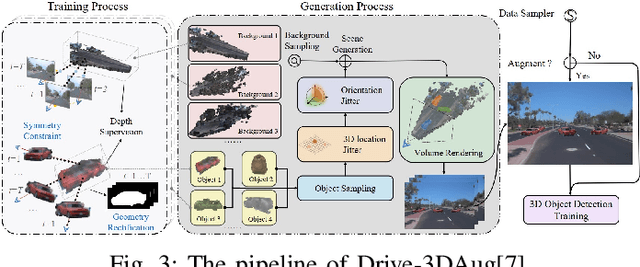
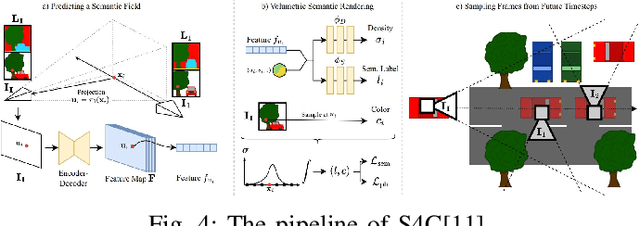
Neural Radiance Field (NeRF) has garnered significant attention from both academia and industry due to its intrinsic advantages, particularly its implicit representation and novel view synthesis capabilities. With the rapid advancements in deep learning, a multitude of methods have emerged to explore the potential applications of NeRF in the domain of Autonomous Driving (AD). However, a conspicuous void is apparent within the current literature. To bridge this gap, this paper conducts a comprehensive survey of NeRF's applications in the context of AD. Our survey is structured to categorize NeRF's applications in Autonomous Driving (AD), specifically encompassing perception, 3D reconstruction, simultaneous localization and mapping (SLAM), and simulation. We delve into in-depth analysis and summarize the findings for each application category, and conclude by providing insights and discussions on future directions in this field. We hope this paper serves as a comprehensive reference for researchers in this domain. To the best of our knowledge, this is the first survey specifically focused on the applications of NeRF in the Autonomous Driving domain.
The Ninth NTIRE 2024 Efficient Super-Resolution Challenge Report
Apr 16, 2024

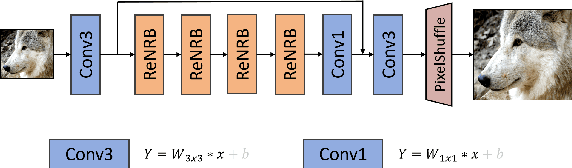

This paper provides a comprehensive review of the NTIRE 2024 challenge, focusing on efficient single-image super-resolution (ESR) solutions and their outcomes. The task of this challenge is to super-resolve an input image with a magnification factor of x4 based on pairs of low and corresponding high-resolution images. The primary objective is to develop networks that optimize various aspects such as runtime, parameters, and FLOPs, while still maintaining a peak signal-to-noise ratio (PSNR) of approximately 26.90 dB on the DIV2K_LSDIR_valid dataset and 26.99 dB on the DIV2K_LSDIR_test dataset. In addition, this challenge has 4 tracks including the main track (overall performance), sub-track 1 (runtime), sub-track 2 (FLOPs), and sub-track 3 (parameters). In the main track, all three metrics (ie runtime, FLOPs, and parameter count) were considered. The ranking of the main track is calculated based on a weighted sum-up of the scores of all other sub-tracks. In sub-track 1, the practical runtime performance of the submissions was evaluated, and the corresponding score was used to determine the ranking. In sub-track 2, the number of FLOPs was considered. The score calculated based on the corresponding FLOPs was used to determine the ranking. In sub-track 3, the number of parameters was considered. The score calculated based on the corresponding parameters was used to determine the ranking. RLFN is set as the baseline for efficiency measurement. The challenge had 262 registered participants, and 34 teams made valid submissions. They gauge the state-of-the-art in efficient single-image super-resolution. To facilitate the reproducibility of the challenge and enable other researchers to build upon these findings, the code and the pre-trained model of validated solutions are made publicly available at https://github.com/Amazingren/NTIRE2024_ESR/.
Parameter-Efficient Fine-Tuning for Large Models: A Comprehensive Survey
Mar 21, 2024


Large models represent a groundbreaking advancement in multiple application fields, enabling remarkable achievements across various tasks. However, their unprecedented scale comes with significant computational costs. These models, often consisting of billions of parameters, require vast amounts of computational resources for execution. Especially, the expansive scale and computational demands pose considerable challenges when customizing them for particular downstream tasks, particularly over the hardware platforms constrained by computational capabilities. Parameter Efficient Fine-Tuning (PEFT) provides a practical solution by efficiently adapt the large models over the various downstream tasks. In particular, PEFT refers to the process of adjusting the parameters of a pre-trained large models to adapt it to a specific task while minimizing the number of additional parameters introduced or computational resources required. This approach is particularly important when dealing with large language models with high parameter counts, as fine-tuning these models from scratch can be computationally expensive and resource-intensive, posing considerable challenges in the supporting system platform design. In this survey, we present comprehensive studies of various PEFT algorithms, examining their performance and computational overhead. Moreover, we provide an overview of applications developed using different PEFT algorithms and discuss common techniques employed to mitigate computation costs for PEFT. In addition to the algorithmic perspective, we overview various real-world system designs to investigate the implementation costs associated with different PEFT algorithms. This survey serves as an indispensable resource for researchers aiming to understand both the PEFT algorithm and its system implementation, offering detailed insights into recent advancements and practical applications.