 Add to Chrome
 Add to Firefox
 Add to Edge
Evidence Absence Is Not Evidence Insufficiency: Diagnosing NEI Construction Artifacts in Fact Verification
May 26, 2026
Evidence absence is not evidence insufficiency, but fact verification benchmarks can make them observationally similar. The Not Enough Information (NEI) label is often operationalized through different evidence conditions, and that choice silently determines what a verifier learns and what its score can hide. We introduce NEI-CAP, a construction-aware diagnostic protocol for insufficient-evidence evaluation. Each NEI example carries the construction family that produced it; NEI-CAP audits shortcut cues, validates hard cases through human adjudication, and tests whether competence transfers across constructions. We instantiate the protocol in SciFact-style scientific verification, with FEVER and HoVer as bounded external controls. Across these settings, NEI competence does not transfer reliably: models trained on shortcut-prone constructions fail to recognize semantically related insufficient evidence, and mixed-construction training narrows but does not close the gap. Fixed-claim diagnostics further show that the evidence condition shifts confidence in the reference Support/Refute label, not only NEI recall, so an aggregate NEI score can hide which problem a model has actually solved.

SURE-RAG: Sufficiency and Uncertainty-Aware Evidence Verification for Selective Retrieval-Augmented Generation
May 05, 2026Retrieval-augmented generation (RAG) grounds answers in retrieved passages, but retrieval is not verification: a passage can be topical and still fail to justify the answer. We frame this gap as evidence sufficiency verification for selective RAG answering: given a question, a candidate answer, and retrieved evidence, predict whether the evidence supports, refutes, or is insufficient, and abstain unless support is established. We present SURE-RAG, a transparent aggregation protocol built on the observation that evidence sufficiency is a set-level property: missing hops and unresolved conflicts cannot be detected by independent passage scoring. A shared pair-level claim-evidence verifier produces local relation distributions, which SURE-RAG aggregates into interpretable answer-level signals -- coverage, relation strength, disagreement, conflict, and retrieval uncertainty -- yielding a three-way decision and an auditable selective score. We evaluate on HotpotQA-RAG v3, a controlled multi-hop benchmark, under an artifact-aware protocol (shortcut baselines, counterfactual swaps, no-oracle checks, GPT-4o audits). Calibrated SURE-RAG reaches 0.9075 Macro-F1 (0.8951 +/- 0.0069), substantially above DeBERTa mean-pooling (0.6516) and a GPT-4o judge (0.7284), while matching a strong but opaque concat cross-encoder (0.8888 +/- 0.0109) with full auditability. Risk at 30% coverage drops from 0.2588 to 0.1642, a 37% reduction in unsafe answers. To deliberately probe the task boundary, we further contrast SURE-RAG with GPT-4o on HaluBench unsafe detection: the ranking reverses (0.3343 vs 0.7389 unsafe-F1), establishing that controlled sufficiency verification and natural hallucination detection are distinct problems.
ProtSi: Prototypical Siamese Network with Data Augmentation for Few-Shot Subjective Answer Evaluation
Nov 17, 2022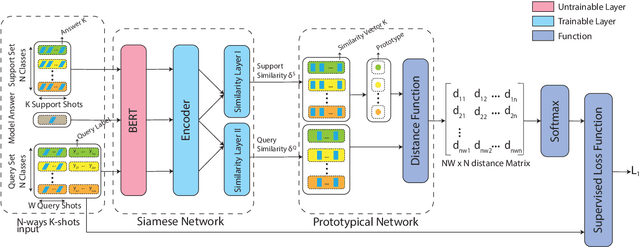
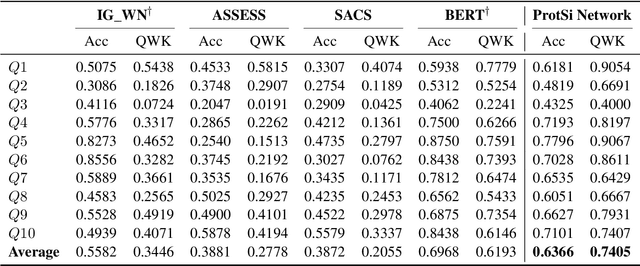
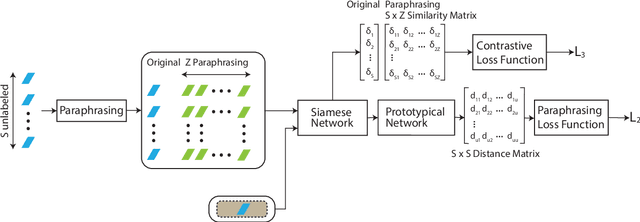
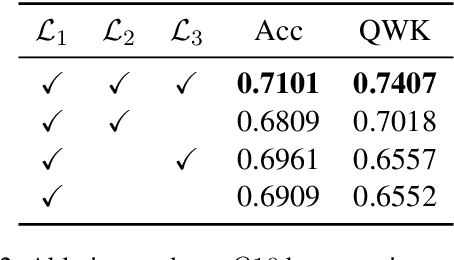
Subjective answer evaluation is a time-consuming and tedious task, and the quality of the evaluation is heavily influenced by a variety of subjective personal characteristics. Instead, machine evaluation can effectively assist educators in saving time while also ensuring that evaluations are fair and realistic. However, most existing methods using regular machine learning and natural language processing techniques are generally hampered by a lack of annotated answers and poor model interpretability, making them unsuitable for real-world use. To solve these challenges, we propose ProtSi Network, a unique semi-supervised architecture that for the first time uses few-shot learning to subjective answer evaluation. To evaluate students' answers by similarity prototypes, ProtSi Network simulates the natural process of evaluator scoring answers by combining Siamese Network which consists of BERT and encoder layers with Prototypical Network. We employed an unsupervised diverse paraphrasing model ProtAugment, in order to prevent overfitting for effective few-shot text classification. By integrating contrastive learning, the discriminative text issue can be mitigated. Experiments on the Kaggle Short Scoring Dataset demonstrate that the ProtSi Network outperforms the most recent baseline models in terms of accuracy and quadratic weighted kappa.