 Add to Chrome
 Add to Firefox
 Add to Edge
Topology-Aware Query Selection for Surgical Instrument Instance Segmentation
Aug 12, 2026
Accurate foreground masks can still form an incorrect surgical-instrument instance set: duplicate, fragmented, merged, missed, or empty-frame predictions may preserve favorable pixel overlap while violating object identity and count. Final query selection is therefore a relational, variable-cardinality problem rather than a collection of independent candidate decisions. We evaluate topology-aware query selection, which represents the nonempty candidates of a fixed Mask2Former as a complete graph, learns relational candidate and pair representations, predicts set cardinality, and solves an exact structured subset problem. The formal comparison is the complete relational path versus a node-feature-matched path; it evaluates the combined effect of pairwise geometry, message passing, and the additional relational-path capacity, not an isolated component. On the sealed 22-case source test, all three discovery seeds supported instance-set performance improvement with segmentation fidelity and predefined technical-safety preservation: instance F1 increased by 0.0504--0.0612 and positive-frame set-failure rate decreased by 0.0848--0.1060. Direct ROBUST-MIPS transfer reproduced the complete result in all three seeds. Endoscapes supported only one of three seeds and therefore did not establish stable direct transfer. Taken together, the results support a bounded conclusion: the evaluated complete path improved coherent instance-set construction from fixed Mask2Former candidates in specified native-instance contracts, while stable cross-domain transfer and component-specific effects remain unestablished.

Local Gains and Fixed-Assignment Set Losses in Shared Set Decoders
Aug 12, 2026A query-relation deletion can improve the edited slot while reducing the utility of the prediction set that contains it. We study this tension in two related ResNet-50 DETR-family checkpoints using recorded, selection-conditional evidence from 710 paired image-relation units per checkpoint. The primary comparison subtracts a matched active control, which deletes the same leader source at a different recorded recipient, from the selected target deletion. It is therefore a composite contrast rather than a same-recipient placebo. The target-minus-control contrast is locally positive and fixed-assignment negative in both checkpoints. The opposite-sign pattern occurs within 302/710 DETR units and 460/710 DINO units. After rematching, the corresponding counts are 285/710 and 433/710. Rematching and native selection absorb enough of the mean loss for DETR intervals to cross zero, whereas DINO intervals remain negative, so persistence across readouts differs by checkpoint. A fixed-map comparison between hard deletion and a mass-preserving edit also differs before rematching. That comparison is conditional on the outcome-blind map and does not establish same-dose transport. Local intervention success therefore does not determine the consequence for a jointly decoded set. The supported conclusion is selection-conditional deletion sensitivity whose persistence depends on the readout and intervention operator. We do not identify an intervention-invariant edge mechanism, detector-level degradation, population prevalence, or the value of a training-time regularizer.
PHKT:Personalized Dynamic Hypergraph-enhanced KAN-Transformer for Multi-behavior Sequential Recommendation
Jun 04, 2026In multi-behavior recommendation, auxiliary behaviors such as clicks, add-to-cart, and purchases can provide richer supervisory information for predicting target behaviors. Although existing graph and hypergraph methods are capable of modeling high-order relationships among users, items, and behaviors, they still have limitations in heterogeneous semantics, user-specific weighting, and sequence dependency modeling. While standard Transformers excel at sequence modeling, their shared feedforward mapping struggles to accommodate the differentiated requirements of heterogeneous latent patterns in multi-behavior scenarios. To address this, this paper proposes the Personalized Hypergraph-enhanced Kolmogorov-Arnold Network Transformer (PHKT). Specifically, we design a personalized dynamic hypergraph module that performs behavior-aware weighting of item similarities based on users' historical behavior sequences to capture user-specific heterogeneous high-order relationships. Meanwhile, a Transformer is used as the temporal backbone to model the evolution of short- and long-term preferences, and KAN is introduced to replace the traditional MLP in the feedforward network to enhance fine-grained modeling capability for nonlinear responses to different latent patterns. Experiments on three real datasets, Tmall, RetailRocket, and IJCAI, show that PHKT consistently outperforms nine strong baseline models across multiple evaluation metrics, demonstrating its effectiveness in multi-behavior preference modeling and target behavior prediction.
Dynamic Resilient Spatio-Semantic Memory with Hybrid Localization for Mobile Manipulation
May 30, 2026Reliable mobile manipulation in dynamic indoor environments requires a scene representation that remains geometrically consistent, semantically queryable, and computationally bounded as the environment changes. Existing systems often rely on pre-built maps, static-scene assumptions, or highly accurate camera poses, which can lead to stale or misaligned scene information when target objects are relocated or pose estimates are corrected. This paper presents DREAM, a real-robot mobile manipulation framework that integrates perception, memory, localization, navigation, and manipulation in previously unseen indoor environments without a pre-built map. DREAM constructs an online spatio-semantic voxel memory from RGB-D observations registered by a LiDAR-inertial-visual SLAM backend. It further introduces pose-graph-aware Redundancy-Aware Memory Pruning (RMP) to update historical observations after pose corrections while keeping long-horizon observation history bounded. For target localization and reacquisition, DREAM combines language-conditioned 3D retrieval, open-vocabulary image detection, and multimodal large language model based semantic verification. Real-robot experiments in four dynamic indoor laboratory scenes show that DREAM improves long-horizon task success rates from 40%-60% with DynaMem to 55%-70%, while maintaining a memory footprint of 0.37-0.63 GB and an online memory-update time of 0.43-0.53 s across scenes.
Proactive Local-Minima-Free Robot Navigation: Blending Motion Prediction with Safe Control
Jan 15, 2026This work addresses the challenge of safe and efficient mobile robot navigation in complex dynamic environments with concave moving obstacles. Reactive safe controllers like Control Barrier Functions (CBFs) design obstacle avoidance strategies based only on the current states of the obstacles, risking future collisions. To alleviate this problem, we use Gaussian processes to learn barrier functions online from multimodal motion predictions of obstacles generated by neural networks trained with energy-based learning. The learned barrier functions are then fed into quadratic programs using modulated CBFs (MCBFs), a local-minimum-free version of CBFs, to achieve safe and efficient navigation. The proposed framework makes two key contributions. First, it develops a prediction-to-barrier function online learning pipeline. Second, it introduces an autonomous parameter tuning algorithm that adapts MCBFs to deforming, prediction-based barrier functions. The framework is evaluated in both simulations and real-world experiments, consistently outperforming baselines and demonstrating superior safety and efficiency in crowded dynamic environments.
Infrastructure-based Autonomous Mobile Robots for Internal Logistics -- Challenges and Future Perspectives
Dec 17, 2025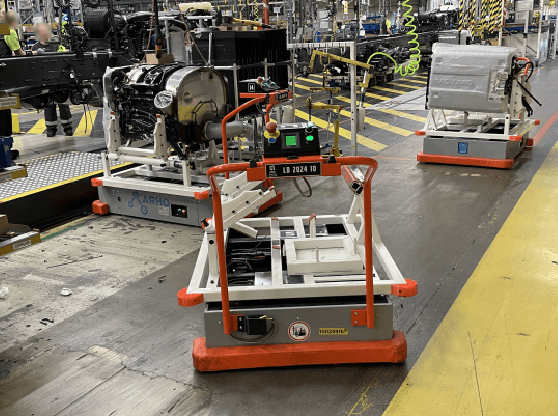
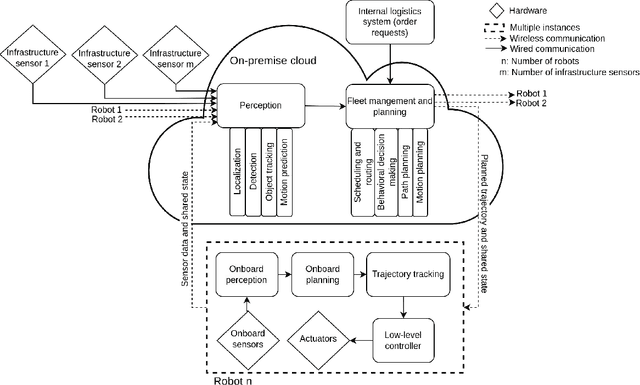
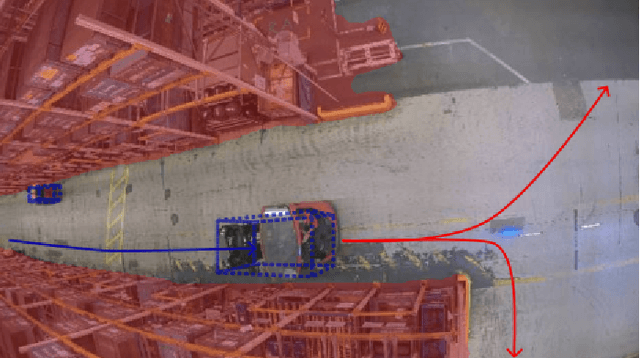
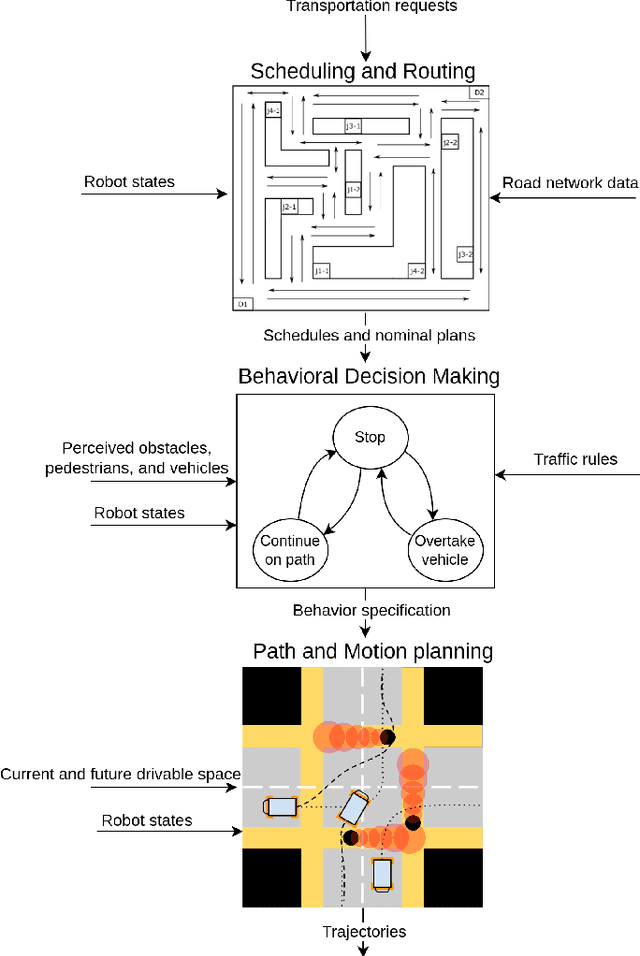
The adoption of Autonomous Mobile Robots (AMRs) for internal logistics is accelerating, with most solutions emphasizing decentralized, onboard intelligence. While AMRs in indoor environments like factories can be supported by infrastructure, involving external sensors and computational resources, such systems remain underexplored in the literature. This paper presents a comprehensive overview of infrastructure-based AMR systems, outlining key opportunities and challenges. To support this, we introduce a reference architecture combining infrastructure-based sensing, on-premise cloud computing, and onboard autonomy. Based on the architecture, we review core technologies for localization, perception, and planning. We demonstrate the approach in a real-world deployment in a heavy-vehicle manufacturing environment and summarize findings from a user experience (UX) evaluation. Our aim is to provide a holistic foundation for future development of scalable, robust, and human-compatible AMR systems in complex industrial environments.
Collision-Free Navigation of Mobile Robots via Quadtree-Based Model Predictive Control
Nov 17, 2025This paper presents an integrated navigation framework for Autonomous Mobile Robots (AMRs) that unifies environment representation, trajectory generation, and Model Predictive Control (MPC). The proposed approach incorporates a quadtree-based method to generate structured, axis-aligned collision-free regions from occupancy maps. These regions serve as both a basis for developing safe corridors and as linear constraints within the MPC formulation, enabling efficient and reliable navigation without requiring direct obstacle encoding. The complete pipeline combines safe-area extraction, connectivity graph construction, trajectory generation, and B-spline smoothing into one coherent system. Experimental results demonstrate consistent success and superior performance compared to baseline approaches across complex environments.
AdapSCA-PSO: An Adaptive Localization Algorithm with AI-Based Hybrid SCA-PSO for IoT WSNs
Jul 30, 2025The accurate localization of sensor nodes is a fundamental requirement for the practical application of the Internet of Things (IoT). To enable robust localization across diverse environments, this paper proposes a hybrid meta-heuristic localization algorithm. Specifically, the algorithm integrates the Sine Cosine Algorithm (SCA), which is effective in global search, with Particle Swarm Optimization (PSO), which excels at local search. An adaptive switching module is introduced to dynamically select between the two algorithms. Furthermore, the initialization, fitness evaluation, and parameter settings of the algorithm have been specifically redesigned and optimized to address the characteristics of the node localization problem. Simulation results across varying numbers of sensor nodes demonstrate that, compared to standalone PSO and the unoptimized SCAPSO algorithm, the proposed method significantly reduces the number of required iterations and achieves an average localization error reduction of 84.97%.
AMSbench: A Comprehensive Benchmark for Evaluating MLLM Capabilities in AMS Circuits
May 30, 2025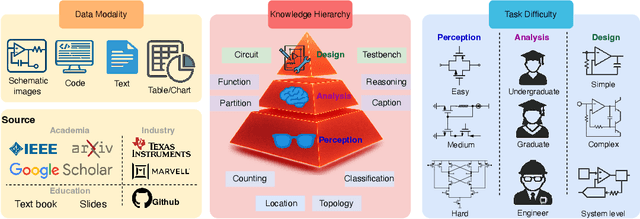



Analog/Mixed-Signal (AMS) circuits play a critical role in the integrated circuit (IC) industry. However, automating Analog/Mixed-Signal (AMS) circuit design has remained a longstanding challenge due to its difficulty and complexity. Recent advances in Multi-modal Large Language Models (MLLMs) offer promising potential for supporting AMS circuit analysis and design. However, current research typically evaluates MLLMs on isolated tasks within the domain, lacking a comprehensive benchmark that systematically assesses model capabilities across diverse AMS-related challenges. To address this gap, we introduce AMSbench, a benchmark suite designed to evaluate MLLM performance across critical tasks including circuit schematic perception, circuit analysis, and circuit design. AMSbench comprises approximately 8000 test questions spanning multiple difficulty levels and assesses eight prominent models, encompassing both open-source and proprietary solutions such as Qwen 2.5-VL and Gemini 2.5 Pro. Our evaluation highlights significant limitations in current MLLMs, particularly in complex multi-modal reasoning and sophisticated circuit design tasks. These results underscore the necessity of advancing MLLMs' understanding and effective application of circuit-specific knowledge, thereby narrowing the existing performance gap relative to human expertise and moving toward fully automated AMS circuit design workflows. Our data is released at https://huggingface.co/datasets/wwhhyy/AMSBench
Future-Oriented Navigation: Dynamic Obstacle Avoidance with One-Shot Energy-Based Multimodal Motion Prediction
May 01, 2025This paper proposes an integrated approach for the safe and efficient control of mobile robots in dynamic and uncertain environments. The approach consists of two key steps: one-shot multimodal motion prediction to anticipate motions of dynamic obstacles and model predictive control to incorporate these predictions into the motion planning process. Motion prediction is driven by an energy-based neural network that generates high-resolution, multi-step predictions in a single operation. The prediction outcomes are further utilized to create geometric shapes formulated as mathematical constraints. Instead of treating each dynamic obstacle individually, predicted obstacles are grouped by proximity in an unsupervised way to improve performance and efficiency. The overall collision-free navigation is handled by model predictive control with a specific design for proactive dynamic obstacle avoidance. The proposed approach allows mobile robots to navigate effectively in dynamic environments. Its performance is accessed across various scenarios that represent typical warehouse settings. The results demonstrate that the proposed approach outperforms other existing dynamic obstacle avoidance methods.