 Add to Chrome
 Add to Firefox
 Add to Edge
Can Causal Models Enhance Robot Navigation? Online Causal Adaptation for Real-Robot Navigation
Jun 14, 2026
Causality in robotics aims to produce more interpretable and flexible robot behaviours by enabling robots to predict the consequences of their actions; however, deploying causal models with existing systems (e.g., navigation) operating in real environments remains understudied. This paper addresses the challenging problem of transferring causal models in real-robot experiments for a navigation scenario. We study this problem in two ways: (i) using the causal model as an offline evaluation module that predicts the competence of recorded real-robot navigation trajectories and relates it to quantitative navigation performance, and (ii) using the causal model as an online adaptation module that intervenes when the predicted competence of the default navigation is low. We validate our approach in a physical service robot that patrols around corridors. We show that the predicted competence correlates positively with path efficiency, and negatively with path irregularities (suboptimal behaviour). The model predictions also show strong agreement with human annotations (Cohen's kappa value of 0.88). In online experiments, the proposed method improves navigation performance in complex scenarios such as cornering and obstacle avoidance, yielding higher predicted competence and better navigation metrics than the default navigation baseline. In simpler scenarios, where the baseline already performs near-optimally, the causal adaptation provides limited benefit. These results indicate that causal models are particularly effective in enhancing navigation under increased task complexity. Overall, our results demonstrate that causal models developed for behavioural interpretation can be successfully integrated into real-robot navigation systems.

Infrastructure-based Autonomous Mobile Robots for Internal Logistics -- Challenges and Future Perspectives
Dec 17, 2025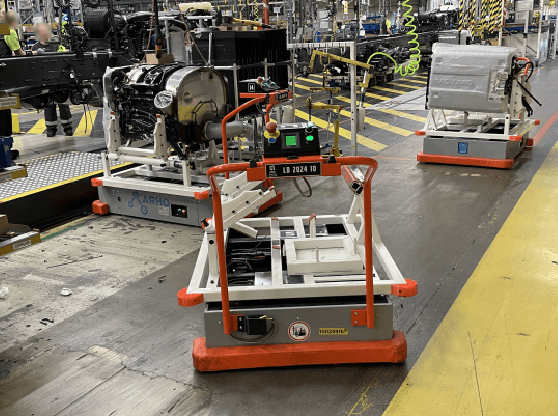
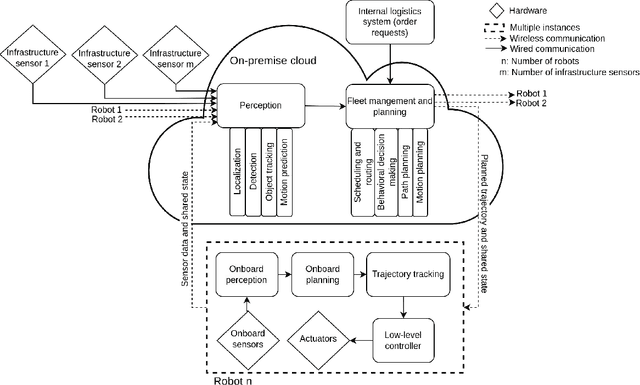
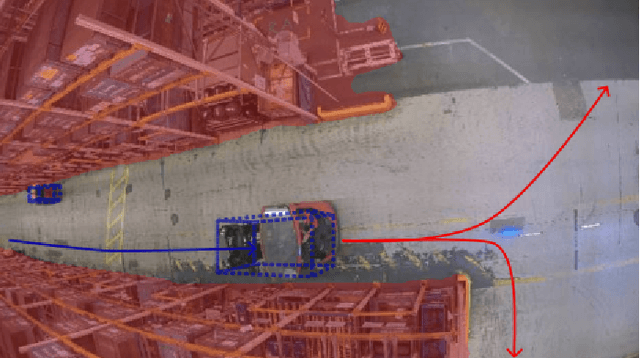
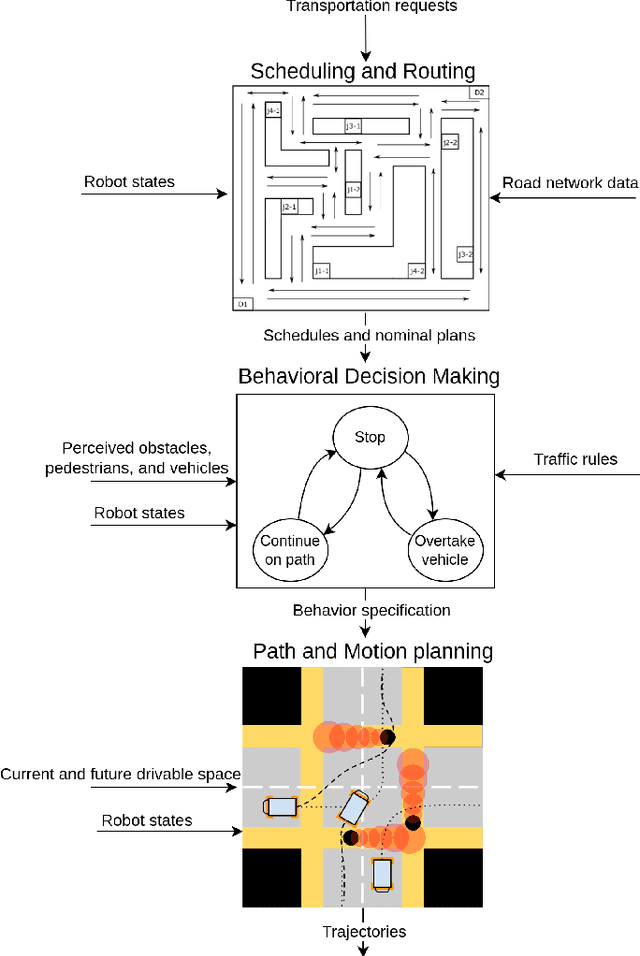
The adoption of Autonomous Mobile Robots (AMRs) for internal logistics is accelerating, with most solutions emphasizing decentralized, onboard intelligence. While AMRs in indoor environments like factories can be supported by infrastructure, involving external sensors and computational resources, such systems remain underexplored in the literature. This paper presents a comprehensive overview of infrastructure-based AMR systems, outlining key opportunities and challenges. To support this, we introduce a reference architecture combining infrastructure-based sensing, on-premise cloud computing, and onboard autonomy. Based on the architecture, we review core technologies for localization, perception, and planning. We demonstrate the approach in a real-world deployment in a heavy-vehicle manufacturing environment and summarize findings from a user experience (UX) evaluation. Our aim is to provide a holistic foundation for future development of scalable, robust, and human-compatible AMR systems in complex industrial environments.
Collision-Free Navigation of Mobile Robots via Quadtree-Based Model Predictive Control
Nov 17, 2025This paper presents an integrated navigation framework for Autonomous Mobile Robots (AMRs) that unifies environment representation, trajectory generation, and Model Predictive Control (MPC). The proposed approach incorporates a quadtree-based method to generate structured, axis-aligned collision-free regions from occupancy maps. These regions serve as both a basis for developing safe corridors and as linear constraints within the MPC formulation, enabling efficient and reliable navigation without requiring direct obstacle encoding. The complete pipeline combines safe-area extraction, connectivity graph construction, trajectory generation, and B-spline smoothing into one coherent system. Experimental results demonstrate consistent success and superior performance compared to baseline approaches across complex environments.
Future-Oriented Navigation: Dynamic Obstacle Avoidance with One-Shot Energy-Based Multimodal Motion Prediction
May 01, 2025This paper proposes an integrated approach for the safe and efficient control of mobile robots in dynamic and uncertain environments. The approach consists of two key steps: one-shot multimodal motion prediction to anticipate motions of dynamic obstacles and model predictive control to incorporate these predictions into the motion planning process. Motion prediction is driven by an energy-based neural network that generates high-resolution, multi-step predictions in a single operation. The prediction outcomes are further utilized to create geometric shapes formulated as mathematical constraints. Instead of treating each dynamic obstacle individually, predicted obstacles are grouped by proximity in an unsupervised way to improve performance and efficiency. The overall collision-free navigation is handled by model predictive control with a specific design for proactive dynamic obstacle avoidance. The proposed approach allows mobile robots to navigate effectively in dynamic environments. Its performance is accessed across various scenarios that represent typical warehouse settings. The results demonstrate that the proposed approach outperforms other existing dynamic obstacle avoidance methods.