 Add to Chrome
 Add to Firefox
 Add to Edge
Infrastructure-based Autonomous Mobile Robots for Internal Logistics -- Challenges and Future Perspectives
Dec 17, 2025
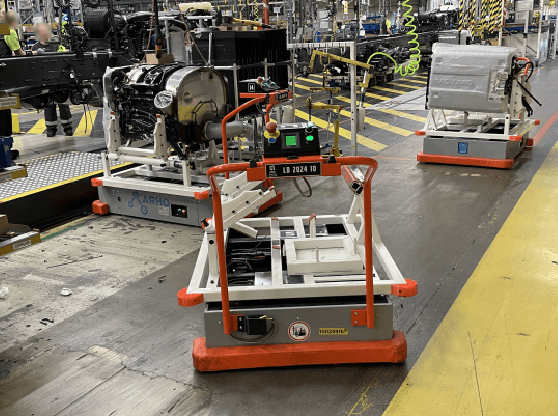
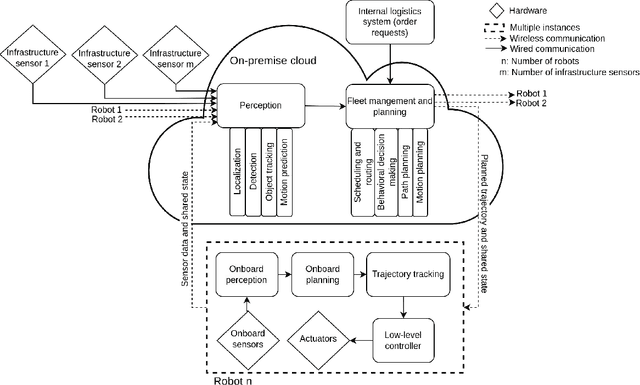
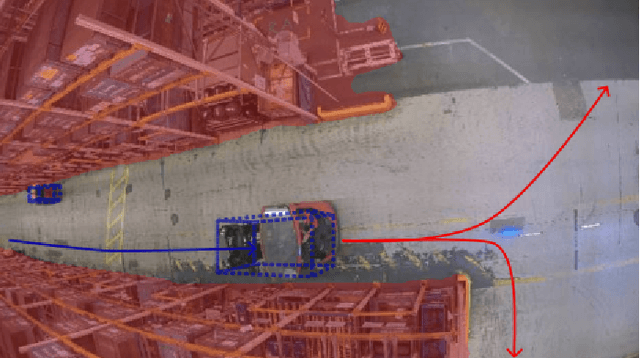
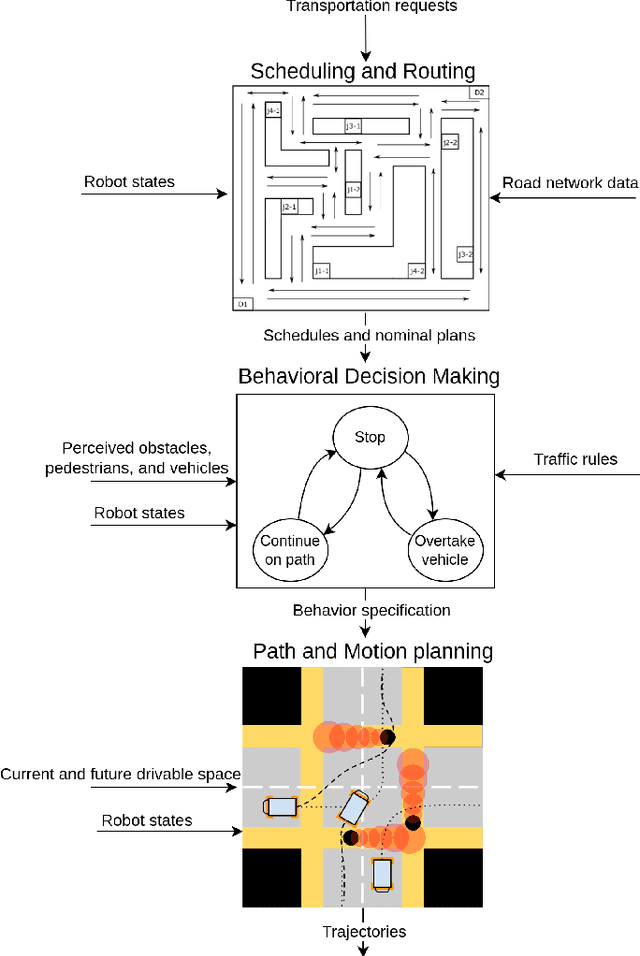
The adoption of Autonomous Mobile Robots (AMRs) for internal logistics is accelerating, with most solutions emphasizing decentralized, onboard intelligence. While AMRs in indoor environments like factories can be supported by infrastructure, involving external sensors and computational resources, such systems remain underexplored in the literature. This paper presents a comprehensive overview of infrastructure-based AMR systems, outlining key opportunities and challenges. To support this, we introduce a reference architecture combining infrastructure-based sensing, on-premise cloud computing, and onboard autonomy. Based on the architecture, we review core technologies for localization, perception, and planning. We demonstrate the approach in a real-world deployment in a heavy-vehicle manufacturing environment and summarize findings from a user experience (UX) evaluation. Our aim is to provide a holistic foundation for future development of scalable, robust, and human-compatible AMR systems in complex industrial environments.

A ROS2 based communication architecture for control in collaborative and intelligent automation systems
May 23, 2019


Collaborative robots are becoming part of intelligent automation systems in modern industry. Development and control of such systems differs from traditional automation methods and consequently leads to new challenges. Thankfully, Robot Operating System (ROS) provides a communication platform and a vast variety of tools and utilities that can aid that development. However, it is hard to use ROS in large-scale automation systems due to communication issues in a distributed setup, hence the development of ROS2. In this paper, a ROS2 based communication architecture is presented together with an industrial use-case of a collaborative and intelligent automation system.