 Add to Chrome
 Add to Firefox
 Add to Edge
Infrastructure-based Autonomous Mobile Robots for Internal Logistics -- Challenges and Future Perspectives
Dec 17, 2025
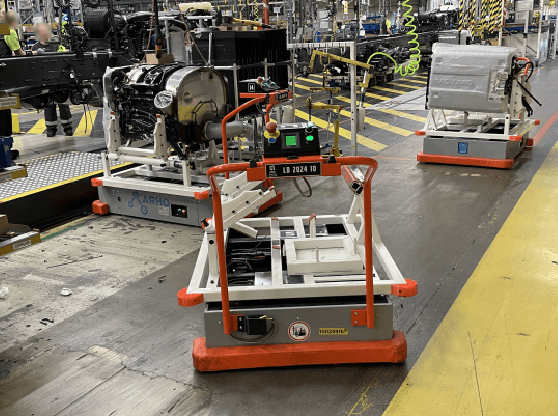
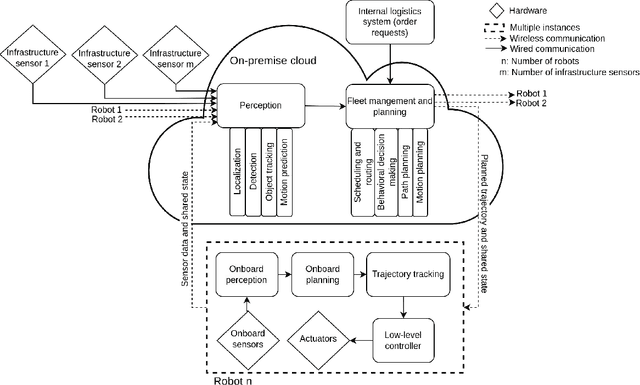
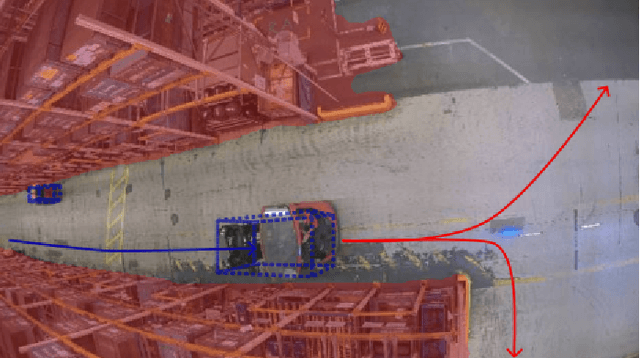
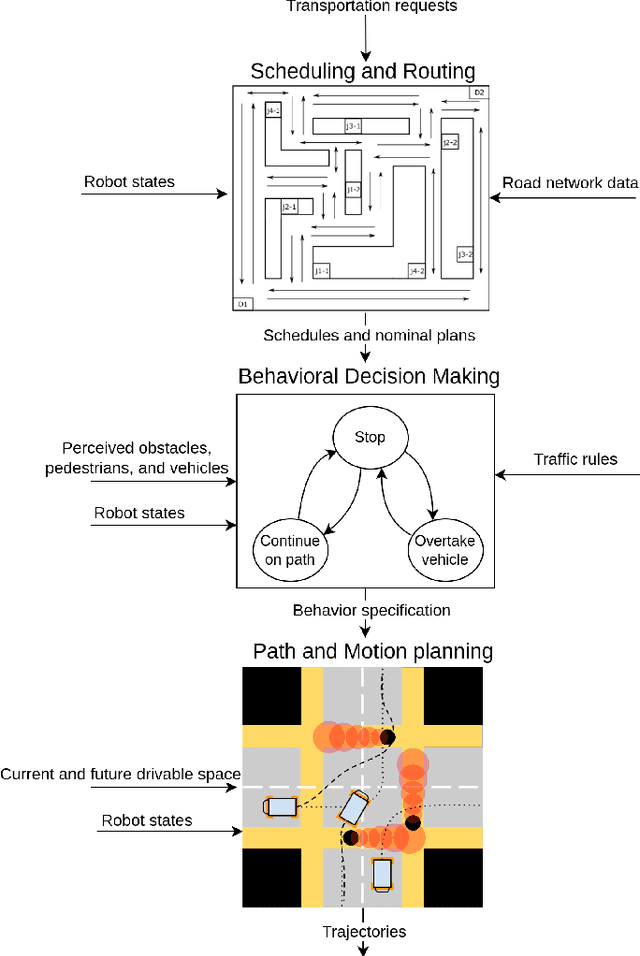
The adoption of Autonomous Mobile Robots (AMRs) for internal logistics is accelerating, with most solutions emphasizing decentralized, onboard intelligence. While AMRs in indoor environments like factories can be supported by infrastructure, involving external sensors and computational resources, such systems remain underexplored in the literature. This paper presents a comprehensive overview of infrastructure-based AMR systems, outlining key opportunities and challenges. To support this, we introduce a reference architecture combining infrastructure-based sensing, on-premise cloud computing, and onboard autonomy. Based on the architecture, we review core technologies for localization, perception, and planning. We demonstrate the approach in a real-world deployment in a heavy-vehicle manufacturing environment and summarize findings from a user experience (UX) evaluation. Our aim is to provide a holistic foundation for future development of scalable, robust, and human-compatible AMR systems in complex industrial environments.

Ethical Challenges in the Human-Robot Interaction Field
Apr 15, 2021The aim of this extended abstract is to introduce five examples of ethical issues in HRI that could have potential ethical implications, particularly on HRI participants. We consider these examples important to discuss in order to reach a consensus on how to handle them. Due to space limitations, this list is far from exhaustive and we hope that it can lead to a wider discussion that stimulates HRI researchers to think ethically. Previous work has shown a trend of underreporting ethical conduct in the HRI field; in this extended abstract we consider some of the ethical issues that could arise in HRI research.