 Add to Chrome
 Add to Firefox
 Add to Edge
The CIFAR Synthetic Evidence Corpus for Detecting AI-Generated Evidence
Jun 06, 2026
The growing ability of generative models to produce realistic documents poses a direct challenge to evidentiary workflows in the justice system and the courts, where decisions increasingly depend on the authenticity of evidence such as receipts, communications, and administrative records. Unlike social media or academic settings, evidentiary documents are often only subtly altered, with small, localized edits that preserve overall plausibility while changing legal meaning. Yet progress on automated detection remains limited, largely due to the absence of suitable training and evaluation data especially suited for the justice system requirements. Existing resources are either focused on photos of human faces or natural scenery or on narrowly scoped academic or social media document types, and do not capture the structure, diversity, or manipulation patterns characteristic of real-world evidentiary data. As a result, current detection systems do not necessarily learn meaningful signals appropriate for the justice system. We introduce the CIFAR Synthetic Evidence Corpus, a dataset designed to enable rigorous evaluation of evidence verification under realistic and controlled conditions. The corpus spans multiple document families and a spectrum of manipulation strategies, from small field-level edits to complete document fabrication, and is constructed using a diverse set of state-of-the-art generative tools. It is organized to systematically vary both manipulation complexity and generation method, while enforcing source-level separation between training and test data to reflect real-world generalization challenges.

Code2LoRA: Hypernetwork-Generated Adapters for Code Language Models under Software Evolution
Jun 04, 2026Code language models need repository-level context to resolve imports, APIs, and project conventions. Existing methods inject this knowledge as long inputs (retrieved through RAG or dependency analysis) or through per-repository fine-tuning and LoRA -- costly at repository scale and brittle to evolving codebases. We introduce Code2LoRA, a hypernetwork framework that generates repository-specific LoRA adapters, effectively injecting repository knowledge with zero inference-time token overhead. Code2LoRA supports two usage scenarios: Code2LoRA-Static converts a single repository snapshot into an adapter, suitable for comprehension of stable codebases; while Code2LoRA-Evo maintains an adapter backed by a GRU hidden state updated per code diff, suitable for active development of evolving codebases. To evaluate Code2LoRA against parameter-efficient fine-tuning baselines, we build RepoPeftBench, a benchmark of 604 Python repositories with two tracks: a static track with 40K training and 12K test assertion-completion tasks, and an evolution track with 215K commit-derived training and 87K commit-derived test tasks. On the static track, Code2LoRA-Static achieves 63.8% cross-repo and 66.2% in-repo exact match, matching the per-repository LoRA upper bound; on the evolution track, Code2LoRA-Evo achieves 60.3% cross-repo exact match (+5.2 pp over a single shared LoRA). Code2LoRA's code can be found at https://anonymous.4open.science/r/code2lora-6857; the model checkpoints and RepoPeftBench datasets can be found at https://huggingface.co/code2lora.
DetectZoo: A Unified Toolkit for AI-Generated Content Detection Across Text, Audio, and Image Modalities
Jun 02, 2026The growing popularity and capacity of generative models have eroded the distinction between human and machine-generated content, motivating a growing body of work on detection across text, images, and audio. Most available detectors are either commercial software or, if open-source, come with incompatible codebases with bespoke preprocessing, evaluation protocols, and evaluation metrics, which make their adoption, fair comparison, and reproduction quite difficult. To address this critical gap, we introduce DetectZoo, a first-of-its-kind, extensible toolkit designed to provide a unified interface for AI-generated content detection across text, audio, and image modalities. DetectZoo standardizes the complete empirical pipeline, from data ingestion and preprocessing to model assessment, offering researchers a cohesive framework to benchmark state-of-the-art detectors systematically. By integrating diverse public datasets and baseline detection algorithms under a single, unified API, our toolkit facilitates rigorous and reproducible evaluation. DetectZoo provides reference implementations of 61 detectors, native loaders for 22 benchmark datasets, and a standardized evaluation pipeline that reports multiple metrics through a common interface. Each detector is self-contained yet accessible through the same interface, automatically caches pretrained weights, and reproduces the original published results. DetectZoo lowers the barrier to entry for multi-modal AI forensics, enabling researchers to identify performance gaps across domains and accelerating the development of robust, generalizable detection techniques. The open-source repository and comprehensive documentation are publicly available at https://github.com/sadjadeb/DetectZoo, and the package can be installed via pip install detectzoo.
Emerging Extrinsic Dexterity in Cluttered Scenes via Dynamics-aware Policy Learning
Mar 10, 2026Extrinsic dexterity leverages environmental contact to overcome the limitations of prehensile manipulation. However, achieving such dexterity in cluttered scenes remains challenging and underexplored, as it requires selectively exploiting contact among multiple interacting objects with inherently coupled dynamics. Existing approaches lack explicit modeling of such complex dynamics and therefore fall short in non-prehensile manipulation in cluttered environments, which in turn limits their practical applicability in real-world environments. In this paper, we introduce a Dynamics-Aware Policy Learning (DAPL) framework that can facilitate policy learning with a learned representation of contact-induced object dynamics in cluttered environments. This representation is learned through explicit world modeling and used to condition reinforcement learning, enabling extrinsic dexterity to emerge without hand-crafted contact heuristics or complex reward shaping. We evaluate our approach in both simulation and the real world. Our method outperforms prehensile manipulation, human teleoperation, and prior representation-based policies by over 25% in success rate on unseen simulated cluttered scenes with varying densities. The real-world success rate reaches around 50% across 10 cluttered scenes, while a practical grocery deployment further demonstrates robust sim-to-real transfer and applicability.
Long Grounded Thoughts: Distilling Compositional Visual Reasoning Chains at Scale
Nov 07, 2025Recent progress in multimodal reasoning has been driven largely by undisclosed datasets and proprietary data synthesis recipes, leaving open questions about how to systematically build large-scale, vision-centric reasoning datasets, particularly for tasks that go beyond visual math. In this work, we introduce a new reasoning data generation framework spanning diverse skills and levels of complexity with over 1M high-quality synthetic vision-centric questions. The dataset also includes preference data and instruction prompts supporting both offline and online RL. Our synthesis framework proceeds in two stages: (1) scale; and (2) complexity. Reasoning traces are then synthesized through a two-stage process that leverages VLMs and reasoning LLMs, producing CoT traces for VLMs that capture the richness and diverse cognitive behaviors found in frontier reasoning models. Remarkably, we show that finetuning Qwen2.5-VL-7B on our data outperforms all open-data baselines across all evaluated vision-centric benchmarks, and even surpasses strong closed-data models such as MiMo-VL-7B-RL on V* Bench, CV-Bench and MMStar-V. Perhaps most surprising, despite being entirely vision-centric, our data transfers positively to text-only reasoning (MMLU-Pro) and audio reasoning (MMAU), demonstrating its effectiveness. Similarly, despite not containing videos or embodied visual data, we observe notable gains when evaluating on a single-evidence embodied QA benchmark (NiEH). Finally, we use our data to analyze the entire VLM post-training pipeline. Our empirical analysis highlights that (i) SFT on high-quality data with non-linear reasoning traces is essential for effective online RL, (ii) staged offline RL matches online RL's performance while reducing compute demands, and (iii) careful SFT on high quality data can substantially improve out-of-domain, cross-modality transfer.
TokDrift: When LLM Speaks in Subwords but Code Speaks in Grammar
Oct 16, 2025Large language models (LLMs) for code rely on subword tokenizers, such as byte-pair encoding (BPE), learned from mixed natural language text and programming language code but driven by statistics rather than grammar. As a result, semantically identical code snippets can be tokenized differently depending on superficial factors such as whitespace or identifier naming. To measure the impact of this misalignment, we introduce TokDrift, a framework that applies semantic-preserving rewrite rules to create code variants differing only in tokenization. Across nine code LLMs, including large ones with over 30B parameters, even minor formatting changes can cause substantial shifts in model behavior. Layer-wise analysis shows that the issue originates in early embeddings, where subword segmentation fails to capture grammar token boundaries. Our findings identify misaligned tokenization as a hidden obstacle to reliable code understanding and generation, highlighting the need for grammar-aware tokenization for future code LLMs.
Interactive Training: Feedback-Driven Neural Network Optimization
Oct 02, 2025Traditional neural network training typically follows fixed, predefined optimization recipes, lacking the flexibility to dynamically respond to instabilities or emerging training issues. In this paper, we introduce Interactive Training, an open-source framework that enables real-time, feedback-driven intervention during neural network training by human experts or automated AI agents. At its core, Interactive Training uses a control server to mediate communication between users or agents and the ongoing training process, allowing users to dynamically adjust optimizer hyperparameters, training data, and model checkpoints. Through three case studies, we demonstrate that Interactive Training achieves superior training stability, reduced sensitivity to initial hyperparameters, and improved adaptability to evolving user needs, paving the way toward a future training paradigm where AI agents autonomously monitor training logs, proactively resolve instabilities, and optimize training dynamics.
From Chat Logs to Collective Insights: Aggregative Question Answering
May 29, 2025Conversational agents powered by large language models (LLMs) are rapidly becoming integral to our daily interactions, generating unprecedented amounts of conversational data. Such datasets offer a powerful lens into societal interests, trending topics, and collective concerns. Yet, existing approaches typically treat these interactions as independent and miss critical insights that could emerge from aggregating and reasoning across large-scale conversation logs. In this paper, we introduce Aggregative Question Answering, a novel task requiring models to reason explicitly over thousands of user-chatbot interactions to answer aggregative queries, such as identifying emerging concerns among specific demographics. To enable research in this direction, we construct a benchmark, WildChat-AQA, comprising 6,027 aggregative questions derived from 182,330 real-world chatbot conversations. Experiments show that existing methods either struggle to reason effectively or incur prohibitive computational costs, underscoring the need for new approaches capable of extracting collective insights from large-scale conversational data.
Learn to Reason Efficiently with Adaptive Length-based Reward Shaping
May 21, 2025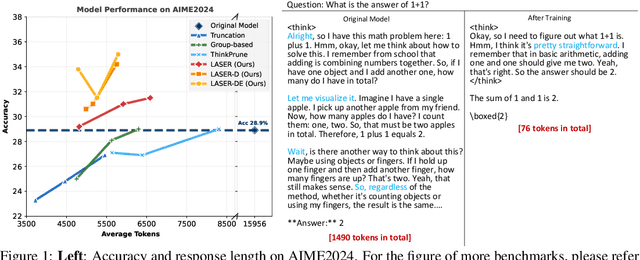
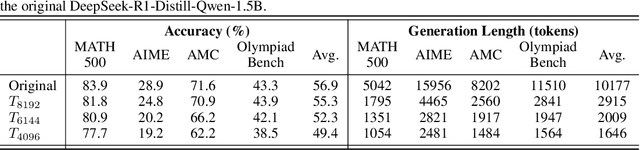
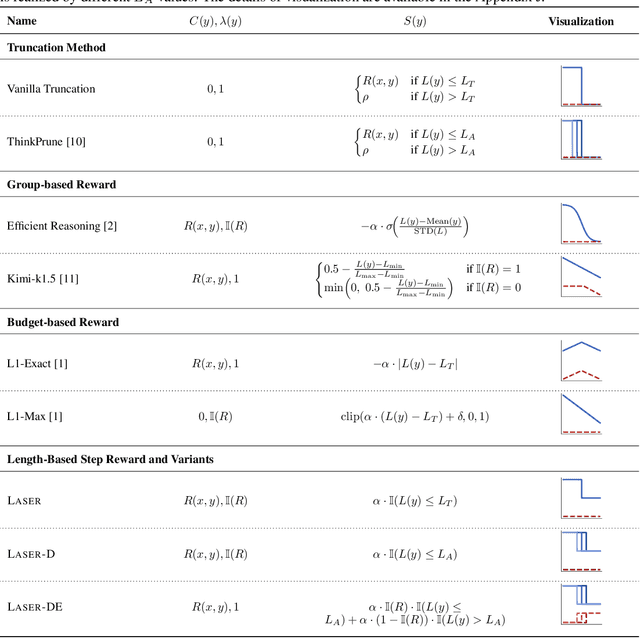
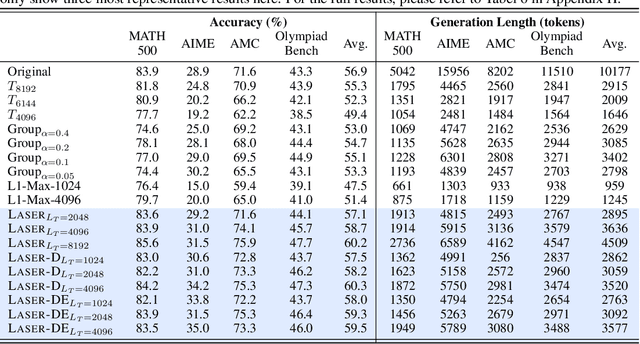
Large Reasoning Models (LRMs) have shown remarkable capabilities in solving complex problems through reinforcement learning (RL), particularly by generating long reasoning traces. However, these extended outputs often exhibit substantial redundancy, which limits the efficiency of LRMs. In this paper, we investigate RL-based approaches to promote reasoning efficiency. Specifically, we first present a unified framework that formulates various efficient reasoning methods through the lens of length-based reward shaping. Building on this perspective, we propose a novel Length-bAsed StEp Reward shaping method (LASER), which employs a step function as the reward, controlled by a target length. LASER surpasses previous methods, achieving a superior Pareto-optimal balance between performance and efficiency. Next, we further extend LASER based on two key intuitions: (1) The reasoning behavior of the model evolves during training, necessitating reward specifications that are also adaptive and dynamic; (2) Rather than uniformly encouraging shorter or longer chains of thought (CoT), we posit that length-based reward shaping should be difficulty-aware i.e., it should penalize lengthy CoTs more for easy queries. This approach is expected to facilitate a combination of fast and slow thinking, leading to a better overall tradeoff. The resulting method is termed LASER-D (Dynamic and Difficulty-aware). Experiments on DeepSeek-R1-Distill-Qwen-1.5B, DeepSeek-R1-Distill-Qwen-7B, and DeepSeek-R1-Distill-Qwen-32B show that our approach significantly enhances both reasoning performance and response length efficiency. For instance, LASER-D and its variant achieve a +6.1 improvement on AIME2024 while reducing token usage by 63%. Further analysis reveals our RL-based compression produces more concise reasoning patterns with less redundant "self-reflections". Resources are at https://github.com/hkust-nlp/Laser.
The Leaderboard Illusion
Apr 29, 2025Measuring progress is fundamental to the advancement of any scientific field. As benchmarks play an increasingly central role, they also grow more susceptible to distortion. Chatbot Arena has emerged as the go-to leaderboard for ranking the most capable AI systems. Yet, in this work we identify systematic issues that have resulted in a distorted playing field. We find that undisclosed private testing practices benefit a handful of providers who are able to test multiple variants before public release and retract scores if desired. We establish that the ability of these providers to choose the best score leads to biased Arena scores due to selective disclosure of performance results. At an extreme, we identify 27 private LLM variants tested by Meta in the lead-up to the Llama-4 release. We also establish that proprietary closed models are sampled at higher rates (number of battles) and have fewer models removed from the arena than open-weight and open-source alternatives. Both these policies lead to large data access asymmetries over time. Providers like Google and OpenAI have received an estimated 19.2% and 20.4% of all data on the arena, respectively. In contrast, a combined 83 open-weight models have only received an estimated 29.7% of the total data. We show that access to Chatbot Arena data yields substantial benefits; even limited additional data can result in relative performance gains of up to 112% on the arena distribution, based on our conservative estimates. Together, these dynamics result in overfitting to Arena-specific dynamics rather than general model quality. The Arena builds on the substantial efforts of both the organizers and an open community that maintains this valuable evaluation platform. We offer actionable recommendations to reform the Chatbot Arena's evaluation framework and promote fairer, more transparent benchmarking for the field