 Add to Chrome
 Add to Firefox
 Add to Edge
A Unified Issue Resolution Benchmark for Requirement Clarification, Planning, and Code Generation for Coding Agents
Aug 10, 2026
Large language model-powered coding agents are increasingly used to modify existing code repositories, for example, by adding features or fixing bugs. Yet existing repository-level benchmarks typically evaluate only whether the final patch passes tests. Satisfying a user request requires a long chain of interdependent reasoning and decisions: an agent must recover explicit and implicit requirements, formulate a repository-grounded implementation plan, and translate it into correct code. A pass/fail outcome cannot characterize how an unsuccessful trajectory diverges from the requirements and implementation process needed for a correct patch. To address this gap, we introduce SWE-RPG, a repository-level benchmark that combines executable patch evaluation with validated ground-truth references (GTs) for (1) Requirement Clarification and (2) Implementation Planning. These intermediate GTs support retrospective, GT-aligned diagnosis of complete coding-agent trajectories across clarification, planning, code generation, and artifact submission. SWE-RPG comprises 163 tasks from 31 Python and Java repositories, including 113 bug fixes and 50 feature additions. We evaluate 3 coding agents, including Claude Code, Codex, and OpenCode, with 6 large language model backends, including Claude-Sonnet-5 and GPT-5.6-Terra. Results show that the evaluated popular coding agents still struggle to implement user requests in existing repositories, achieving an average resolved rate of only 31.5% on SWE-RPG. Intermediate-GT diagnosis further identifies implicit requirement recovery as the main bottleneck, accounting for 24.5%--46.0% of agent runs. This result suggests implicit-requirement recovery as a key candidate direction for improving coding agents. The benchmark data and evaluation code are available at https://github.com/Xin-Zhou-smu/SWE-RPG-Bench.

SignDPO: Multi-level Direct Preference Optimisation for Skeleton-based Gloss-free Sign Language Translation
Apr 20, 2026We present SignDPO, a novel multi-level Direct Preference Optimisation (DPO) framework designed to enhance the alignment of skeleton-based Sign Language Translation. While current skeleton-based models have made significant progress using Maximum Likelihood Estimation, they are primarily constrained by an imitation-based paradigm that lacks discriminative sensitivity to the fine-grained spatio-temporal nuances of sign language, often leading to semantic drift. To address this, SignDPO shifts the optimisation goal from simple sequence mimicry to structured preference alignment across spatial, temporal, and linguistic dimensions. Our framework involves three key designs. First, we introduce a hierarchical perturbation strategy to construct spatial and temporal non-preferred samples at both global and local granularities automatically. Second, we propose a self-guiding mechanism that leverages decoder cross-attention scores to identify and perturb semantically salient skeletal regions, forcing the model to distinguish genuine sign signals from structural distortions. Third, we establish an automated language-level preference generator by fine-tuning a dedicated perturbation model, capturing complex output-level failure modes without manual annotation. Extensive experiments on three widely adopted benchmarks, CSL-Daily, How2Sign, and OpenASL, demonstrate that SignDPO consistently outperforms state-of-the-art gloss-free methods and even rivals established gloss-based ones. Our results suggest that multi-level preference alignment is a powerful paradigm for bridging the gap between high-entropy skeletal trajectories and discrete linguistic semantics.
CodePivot: Bootstrapping Multilingual Transpilation in LLMs via Reinforcement Learning without Parallel Corpora
Apr 20, 2026Transpilation, or code translation, aims to convert source code from one programming language (PL) to another. It is beneficial for many downstream applications, from modernizing large legacy codebases to augmenting data for low-resource PLs. Recent large language model (LLM)-based approaches have demonstrated immense potential for code translation. Among these approaches, training-based methods are particularly important because LLMs currently do not effectively adapt to domain-specific settings that suffer from a lack of knowledge without targeted training. This limitation is evident in transpilation tasks involving low-resource PLs. However, existing training-based approaches rely on a pairwise transpilation paradigm, making it impractical to support a diverse range of PLs. This limitation is particularly prominent for low-resource PLs due to a scarcity of training data. Furthermore, these methods suffer from suboptimal reinforcement learning (RL) reward formulations. To address these limitations, we propose CodePivot, a training framework that leverages Python as an intermediate representation (IR), augmented by a novel RL reward mechanism, Aggressive-Partial-Functional reward, to bootstrap the model's multilingual transpilation ability without requiring parallel corpora. Experiments involving 10 PLs show that the resulting 7B model, trained on Python-to-Others tasks, consistently improves performance across both general and low-resource PL-related transpilation tasks. It outperforms substantially larger mainstream models with hundreds of billions more parameters, such as Deepseek-R1 and Qwen3-235B-A22B-Instruct-2507, on Python-to-Others tasks and Others-to-All tasks, respectively. In addition, it outperforms its counterpart trained directly on Any-to-Any tasks on general transpilation tasks. The code and data are available at https://github.com/lishangyu-hkust/CodePivot.
LA-Sign: Looped Transformers with Geometry-aware Alignment for Skeleton-based Sign Language Recognition
Mar 30, 2026Skeleton-based isolated sign language recognition (ISLR) demands fine-grained understanding of articulated motion across multiple spatial scales, from subtle finger movements to global body dynamics. Existing approaches typically rely on deep feed-forward architectures, which increase model capacity but lack mechanisms for recurrent refinement and structured representation. We propose LA-Sign, a looped transformer framework with geometry-aware alignment for ISLR. Instead of stacking deeper layers, LA-Sign derives its depth from recurrence, repeatedly revisiting latent representations to progressively refine motion understanding under shared parameters. To further regularise this refinement process, we present a geometry-aware contrastive objective that projects skeletal and textual features into an adaptive hyperbolic space, encouraging multi-scale semantic organisation. We study three looping designs and multiple geometric manifolds, demonstrating that encoder-decoder looping combined with adaptive Poincare alignment yields the strongest performance. Extensive experiments on WLASL and MSASL benchmarks show that LA-Sign achieves state-of-the-art results while using fewer unique layers, highlighting the effectiveness of recurrent latent refinement and geometry-aware representation learning for sign language recognition.
MulVul: Retrieval-augmented Multi-Agent Code Vulnerability Detection via Cross-Model Prompt Evolution
Jan 26, 2026Large Language Models (LLMs) struggle to automate real-world vulnerability detection due to two key limitations: the heterogeneity of vulnerability patterns undermines the effectiveness of a single unified model, and manual prompt engineering for massive weakness categories is unscalable. To address these challenges, we propose \textbf{MulVul}, a retrieval-augmented multi-agent framework designed for precise and broad-coverage vulnerability detection. MulVul adopts a coarse-to-fine strategy: a \emph{Router} agent first predicts the top-$k$ coarse categories and then forwards the input to specialized \emph{Detector} agents, which identify the exact vulnerability types. Both agents are equipped with retrieval tools to actively source evidence from vulnerability knowledge bases to mitigate hallucinations. Crucially, to automate the generation of specialized prompts, we design \emph{Cross-Model Prompt Evolution}, a prompt optimization mechanism where a generator LLM iteratively refines candidate prompts while a distinct executor LLM validates their effectiveness. This decoupling mitigates the self-correction bias inherent in single-model optimization. Evaluated on 130 CWE types, MulVul achieves 34.79\% Macro-F1, outperforming the best baseline by 41.5\%. Ablation studies validate cross-model prompt evolution, which boosts performance by 51.6\% over manual prompts by effectively handling diverse vulnerability patterns.
AXIOM: Benchmarking LLM-as-a-Judge for Code via Rule-Based Perturbation and Multisource Quality Calibration
Dec 23, 2025Large language models (LLMs) have been increasingly deployed in real-world software engineering, fostering the development of code evaluation metrics to study the quality of LLM-generated code. Conventional rule-based metrics merely score programs based on their surface-level similarities with reference programs instead of analyzing functionality and code quality in depth. To address this limitation, researchers have developed LLM-as-a-judge metrics, prompting LLMs to evaluate and score code, and curated various code evaluation benchmarks to validate their effectiveness. However, these benchmarks suffer from critical limitations, hindering reliable assessments of evaluation capability: Some feature coarse-grained binary labels, which reduce rich code behavior to a single bit of information, obscuring subtle errors. Others propose fine-grained but subjective, vaguely-defined evaluation criteria, introducing unreliability in manually-annotated scores, which is the ground-truth they rely on. Furthermore, they often use uncontrolled data synthesis methods, leading to unbalanced score distributions that poorly represent real-world code generation scenarios. To curate a diverse benchmark with programs of well-balanced distributions across various quality levels and streamline the manual annotation procedure, we propose AXIOM, a novel perturbation-based framework for synthesizing code evaluation benchmarks at scale. It reframes program scores as the refinement effort needed for deployment, consisting of two stages: (1) Rule-guided perturbation, which prompts LLMs to apply sequences of predefined perturbation rules to existing high-quality programs to modify their functionality and code quality, enabling us to precisely control each program's target score to achieve balanced score distributions. (2) Multisource quality calibration, which first selects a subset of...
Siformer: Feature-isolated Transformer for Efficient Skeleton-based Sign Language Recognition
Mar 26, 2025Sign language recognition (SLR) refers to interpreting sign language glosses from given videos automatically. This research area presents a complex challenge in computer vision because of the rapid and intricate movements inherent in sign languages, which encompass hand gestures, body postures, and even facial expressions. Recently, skeleton-based action recognition has attracted increasing attention due to its ability to handle variations in subjects and backgrounds independently. However, current skeleton-based SLR methods exhibit three limitations: 1) they often neglect the importance of realistic hand poses, where most studies train SLR models on non-realistic skeletal representations; 2) they tend to assume complete data availability in both training or inference phases, and capture intricate relationships among different body parts collectively; 3) these methods treat all sign glosses uniformly, failing to account for differences in complexity levels regarding skeletal representations. To enhance the realism of hand skeletal representations, we present a kinematic hand pose rectification method for enforcing constraints. Mitigating the impact of missing data, we propose a feature-isolated mechanism to focus on capturing local spatial-temporal context. This method captures the context concurrently and independently from individual features, thus enhancing the robustness of the SLR model. Additionally, to adapt to varying complexity levels of sign glosses, we develop an input-adaptive inference approach to optimise computational efficiency and accuracy. Experimental results demonstrate the effectiveness of our approach, as evidenced by achieving a new state-of-the-art (SOTA) performance on WLASL100 and LSA64. For WLASL100, we achieve a top-1 accuracy of 86.50\%, marking a relative improvement of 2.39% over the previous SOTA. For LSA64, we achieve a top-1 accuracy of 99.84%.
Can LLMs Replace Human Evaluators? An Empirical Study of LLM-as-a-Judge in Software Engineering
Feb 10, 2025Recently, large language models (LLMs) have been deployed to tackle various software engineering (SE) tasks like code generation, significantly advancing the automation of SE tasks. However, assessing the quality of these LLM-generated code and text remains challenging. The commonly used Pass@k metric necessitates extensive unit tests and configured environments, demands a high labor cost, and is not suitable for evaluating LLM-generated text. Conventional metrics like BLEU, which measure only lexical rather than semantic similarity, have also come under scrutiny. In response, a new trend has emerged to employ LLMs for automated evaluation, known as LLM-as-a-judge. These LLM-as-a-judge methods are claimed to better mimic human assessment than conventional metrics without relying on high-quality reference answers. Nevertheless, their exact human alignment in SE tasks remains unexplored. In this paper, we empirically explore LLM-as-a-judge methods for evaluating SE tasks, focusing on their alignment with human judgments. We select seven LLM-as-a-judge methods that utilize general-purpose LLMs, alongside two LLMs specifically fine-tuned for evaluation. After generating and manually scoring LLM responses on three recent SE datasets of code translation, code generation, and code summarization, we then prompt these methods to evaluate each response. Finally, we compare the scores generated by these methods with human evaluation. The results indicate that output-based methods reach the highest Pearson correlation of 81.32 and 68.51 with human scores in code translation and generation, achieving near-human evaluation, noticeably outperforming ChrF++, one of the best conventional metrics, at 34.23 and 64.92. Such output-based methods prompt LLMs to output judgments directly, and exhibit more balanced score distributions that resemble human score patterns. Finally, we provide...
The Prompt Alchemist: Automated LLM-Tailored Prompt Optimization for Test Case Generation
Jan 02, 2025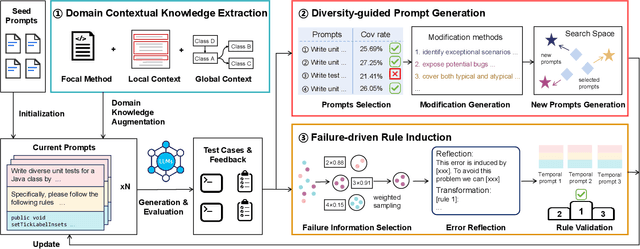
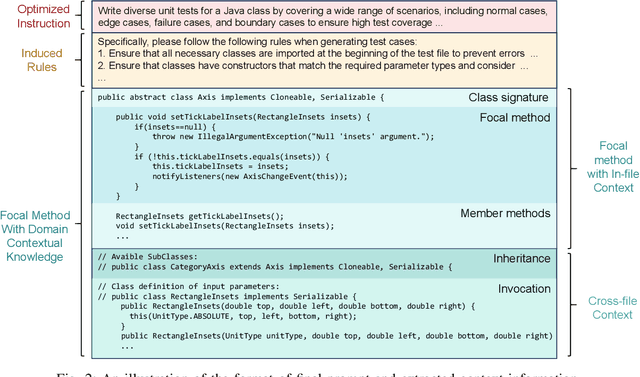
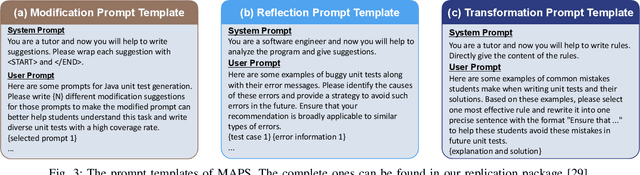
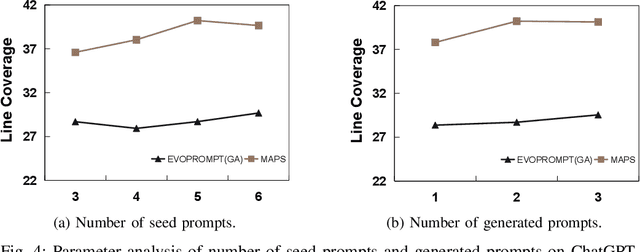
Test cases are essential for validating the reliability and quality of software applications. Recent studies have demonstrated the capability of Large Language Models (LLMs) to generate useful test cases for given source code. However, the existing work primarily relies on human-written plain prompts, which often leads to suboptimal results since the performance of LLMs can be highly influenced by the prompts. Moreover, these approaches use the same prompt for all LLMs, overlooking the fact that different LLMs might be best suited to different prompts. Given the wide variety of possible prompt formulations, automatically discovering the optimal prompt for each LLM presents a significant challenge. Although there are methods on automated prompt optimization in the natural language processing field, they are hard to produce effective prompts for the test case generation task. First, the methods iteratively optimize prompts by simply combining and mutating existing ones without proper guidance, resulting in prompts that lack diversity and tend to repeat the same errors in the generated test cases. Second, the prompts are generally lack of domain contextual knowledge, limiting LLMs' performance in the task.
Assessing AI Detectors in Identifying AI-Generated Code: Implications for Education
Jan 08, 2024


Educators are increasingly concerned about the usage of Large Language Models (LLMs) such as ChatGPT in programming education, particularly regarding the potential exploitation of imperfections in Artificial Intelligence Generated Content (AIGC) Detectors for academic misconduct. In this paper, we present an empirical study where the LLM is examined for its attempts to bypass detection by AIGC Detectors. This is achieved by generating code in response to a given question using different variants. We collected a dataset comprising 5,069 samples, with each sample consisting of a textual description of a coding problem and its corresponding human-written Python solution codes. These samples were obtained from various sources, including 80 from Quescol, 3,264 from Kaggle, and 1,725 from LeetCode. From the dataset, we created 13 sets of code problem variant prompts, which were used to instruct ChatGPT to generate the outputs. Subsequently, we assessed the performance of five AIGC detectors. Our results demonstrate that existing AIGC Detectors perform poorly in distinguishing between human-written code and AI-generated code.