 Add to Chrome
 Add to Firefox
 Add to Edge
GDPevo: Evaluating Agent Self-Evolution on Real Business Tasks
Aug 04, 2026
Agent self-evolution updates an agent's persistent state from prior experience and reuses it to solve related tasks more effectively. Evaluating self-evolution is difficult: existing benchmarks provide limited coverage of economically valuable task domains, do not always design training and test tasks such that test-time gains can be attributed to training experience, and remain vulnerable to data contamination. We present GDPevo, an evolution-native benchmark grounded in GDP-related enterprise workflows, together with the fully automated data pipeline that generates it. Its core mechanism, rule hybridization, decomposes each enterprise workflow into atomic business rules, distributes subsets of these rules across training tasks, and recombines them in held-out test tasks so that test-time gains are attributable. GDPevo spans CRM, ERP, finance, healthcare, legal, and data-centric workflows. Its V1 release contains 120 tasks in 12 groups, with five training and five held-out test tasks per group. Full automation enables the pipeline to expand the suite to 240 tasks in 24 groups (V2) within two days, providing a practical response to contamination. Using GDPevo, we evaluate four agents, each comprising a harness and a model, under four supervision types. Self-evolution consistently improves held-out accuracy by up to 16.44 percentage points. But the best evolved agents remain far below the fully informed oracle ceiling of 91.6%, indicating that the self-evolution ability of current agents remains far from fully realized. We publicly release the pipeline, benchmark, and full evaluation results at https://github.com/Prism-Shadow/GDPevo.

When Does Recurrence Become an Algorithm? Convergence Selection in Weight-Tied Looped Transformers
Jul 22, 2026When does a weight-tied looped transformer -- one block applied T times -- implement an actual algorithm? We answer with four findings from controlled populations on group word problems. (1) The budget law: free training installs a linear computation frontier, a mechanism that solves v positions per loop, whose speed is priced by the training contract: v ~ n_train/T_train (exponent 0.98 +/- 0.04, R^2=0.99), exactly unity under T=n training. SGD selects a frontier matching the minimum the contract demands; granting more test-time loops than ever trained rescues late positions at fixed input length, yielding a principled halting rule T* = ceil(n / v-hat). (2) Architecture prior, not expressivity, picks the algorithm: standard-depth transformers learn parallel scans on this family; weight tying flips the selection to the serial frontier, even when positional addressing for a log-depth scan is supplied. At matched depth and parameters, untied models extrapolate worst and fail to learn A5 at all. (3) The walls are not where circuit complexity says: NC1-completeness costs nothing (A5 generalizes fully), while group order does (S5's 120x120 operator deadlocks joint learning) -- and an operator-first curriculum dissolves the wall in every seed. (4) Mechanisms are portable, not mandatable: warm-starting across budget contracts transfers the algorithm in every seed, re-pricing its speed, while imposing seriality through the input schedule fails where free training succeeds. These results are invisible to standard instruments, which provably saturate at the fixed points trained loops converge to. We introduce a head instrument, the convergence-time scaling tau(n,i), validate it causally via damage cones whose slope reproduces v, and show in-distribution head measurements predict out-of-distribution fate where tail metrics do not. Results replicate on the public easy-to-hard benchmark.
Akashic: A Low-Overhead LLM Inference Service with MemAttention
Jul 07, 2026Recent LLM-based agent systems continuously accumulate context across multi-turn interactions, tool invocations, and cross-session workflows. Replaying the full history for every request quickly becomes impractical: long contexts increase prefill cost, may exceed context limits, and often bury task-relevant evidence in irrelevant content, degrading both serving efficiency and output quality. We propose Akashic, a low-overhead memory system built around MemAttention, which organizes context into bounded chunks and models semantic relationships across chunks, preserving cross-chunk evidence without repeatedly rewriting the full history. Akashic further applies hardware-software co-designed memory placement to co-locate likely co-retrieved chunks, reducing retrieval fragmentation and I/O overhead. Across four representative workloads and three model sizes, Akashic improves task accuracy by up to 10.2 points, throughput by up to 1.21x, and sustainable request rate by up to 1.88x over strong prior memory baselines.
RedKnot: Efficient Long-Context LLM Serving with Head-Aware KV Reuse and SegPagedAttention
Jun 04, 2026As the input length of large language model (LLM) serving continues to grow, the KV cache has become a dominant bottleneck in AI infrastructure. It limits GPU memory capacity, serving concurrency, cache reuse, and distributed scalability. Several important problems, including position-independent KV cache, prefix KV cache compression, hot/cold KV cache separation, and distributed KV cache management, all depend on how the KV cache is represented and managed. However, existing serving systems largely rely on a monolithic KV cache abstraction, where the KV cache is treated as a homogeneous sequence of token-level memory blocks and managed with similar policies across attention heads and serving scenarios. We observe that KV cache utility is highly structured across KV heads: different heads exhibit different functional roles, attention distances, and runtime importance. Therefore, a full KV cache is not always necessary for every head, token range, or serving scenario. We present RedKnot, a head-aware KV cache management system for LLM serving. RedKnot breaks the conventional monolithic KV cache abstraction by decomposing the KV cache along KV heads, whose importance and effective attention ranges vary significantly across serving scenarios. This head-level decomposition turns the KV cache from a monolithic tensor abstraction into a structured memory object, enabling RedKnot to uniformly support position-independent KV reuse, prefix KV compression, hot/cold KV separation, and distributed KV placement while preserving output fidelity and improving resource efficiency, without requiring model retraining or fine-tuning. RedKnot establishes a new foundation for AI infrastructure by transforming the KV cache from a monolithic, passive runtime artifact into a dynamic, model-aware runtime substrate for scalable LLM serving.
Tessera: Unlocking Heterogeneous GPUs through Kernel-Granularity Disaggregation
Apr 11, 2026Disaggregation maps parts of an AI workload to different types of GPUs, offering a path to utilize modern heterogeneous GPU clusters. However, existing solutions operate at a coarse granularity and are tightly coupled to specific model architectures, leaving much room for performance improvement. This paper presents Tessera, the first kernel disaggregation system to improve performance and cost efficiency on heterogeneous GPUs for large model inference. Our key insight is that kernels within a single application exhibit diverse resource demands, making them the most suitable granularity for aligning computation with hardware capabilities. Tessera integrates offline analysis with online adaptation by extracting precise inter-kernel dependencies from PTX to ensure correctness, overlapping communication with computation through a pipelined execution model, and employing workload-aware scheduling with lightweight runtime adaptation. Extensive evaluations across five heterogeneous GPUs and four model architectures, scaling up to 16 GPUs, show that Tessera improves serving throughput and cost efficiency by up to 2.3x and 1.6x, respectively, compared to existing disaggregation methods, while generalizing to model architectures where prior approaches do not apply. Surprisingly, a heterogeneous GPU pair under Tessera can even exceed the throughput of two homogeneous high-end GPUs at a lower cost.
You Need an Encoder for Native Position-Independent Caching
Feb 02, 2026The Key-Value (KV) cache of Large Language Models (LLMs) is prefix-based, making it highly inefficient for processing contexts retrieved in arbitrary order. Position-Independent Caching (PIC) has been proposed to enable KV reuse without positional constraints; however, existing approaches often incur substantial accuracy degradation, limiting their practical adoption. To address this issue, we propose native PIC by reintroducing the encoder to prevalent decoder-only LLMs and explicitly training it to support PIC. We further develop COMB, a PIC-aware caching system that integrates seamlessly with existing inference frameworks. Experimental results show that COMB reduces Time-to-First-Token (TTFT) by 51-94% and increases throughput by 3$\times$ with comparable accuracy. Furthermore, the quality improvement when using DeepSeek-V2-Lite-Chat demonstrates the applicability of COMB to other types of decoder-only LLMs. Our code is available at https://github.com/shijuzhao/Comb.
MiMo-V2-Flash Technical Report
Jan 08, 2026We present MiMo-V2-Flash, a Mixture-of-Experts (MoE) model with 309B total parameters and 15B active parameters, designed for fast, strong reasoning and agentic capabilities. MiMo-V2-Flash adopts a hybrid attention architecture that interleaves Sliding Window Attention (SWA) with global attention, with a 128-token sliding window under a 5:1 hybrid ratio. The model is pre-trained on 27 trillion tokens with Multi-Token Prediction (MTP), employing a native 32k context length and subsequently extended to 256k. To efficiently scale post-training compute, MiMo-V2-Flash introduces a novel Multi-Teacher On-Policy Distillation (MOPD) paradigm. In this framework, domain-specialized teachers (e.g., trained via large-scale reinforcement learning) provide dense and token-level reward, enabling the student model to perfectly master teacher expertise. MiMo-V2-Flash rivals top-tier open-weight models such as DeepSeek-V3.2 and Kimi-K2, despite using only 1/2 and 1/3 of their total parameters, respectively. During inference, by repurposing MTP as a draft model for speculative decoding, MiMo-V2-Flash achieves up to 3.6 acceptance length and 2.6x decoding speedup with three MTP layers. We open-source both the model weights and the three-layer MTP weights to foster open research and community collaboration.
Lil: Less is Less When Applying Post-Training Sparse-Attention Algorithms in Long-Decode Stage
Jan 06, 2026Large language models (LLMs) demonstrate strong capabilities across a wide range of complex tasks and are increasingly deployed at scale, placing significant demands on inference efficiency. Prior work typically decomposes inference into prefill and decode stages, with the decode stage dominating total latency. To reduce time and memory complexity in the decode stage, a line of work introduces sparse-attention algorithms. In this paper, we show, both empirically and theoretically, that sparse attention can paradoxically increase end-to-end complexity: information loss often induces significantly longer sequences, a phenomenon we term ``Less is Less'' (Lil). To mitigate the Lil problem, we propose an early-stopping algorithm that detects the threshold where information loss exceeds information gain during sparse decoding. Our early-stopping algorithm reduces token consumption by up to 90% with a marginal accuracy degradation of less than 2% across reasoning-intensive benchmarks.
MiMo-Audio: Audio Language Models are Few-Shot Learners
Dec 29, 2025Existing audio language models typically rely on task-specific fine-tuning to accomplish particular audio tasks. In contrast, humans are able to generalize to new audio tasks with only a few examples or simple instructions. GPT-3 has shown that scaling next-token prediction pretraining enables strong generalization capabilities in text, and we believe this paradigm is equally applicable to the audio domain. By scaling MiMo-Audio's pretraining data to over one hundred million of hours, we observe the emergence of few-shot learning capabilities across a diverse set of audio tasks. We develop a systematic evaluation of these capabilities and find that MiMo-Audio-7B-Base achieves SOTA performance on both speech intelligence and audio understanding benchmarks among open-source models. Beyond standard metrics, MiMo-Audio-7B-Base generalizes to tasks absent from its training data, such as voice conversion, style transfer, and speech editing. MiMo-Audio-7B-Base also demonstrates powerful speech continuation capabilities, capable of generating highly realistic talk shows, recitations, livestreaming and debates. At the post-training stage, we curate a diverse instruction-tuning corpus and introduce thinking mechanisms into both audio understanding and generation. MiMo-Audio-7B-Instruct achieves open-source SOTA on audio understanding benchmarks (MMSU, MMAU, MMAR, MMAU-Pro), spoken dialogue benchmarks (Big Bench Audio, MultiChallenge Audio) and instruct-TTS evaluations, approaching or surpassing closed-source models. Model checkpoints and full evaluation suite are available at https://github.com/XiaomiMiMo/MiMo-Audio.
RLinf: Flexible and Efficient Large-scale Reinforcement Learning via Macro-to-Micro Flow Transformation
Sep 19, 2025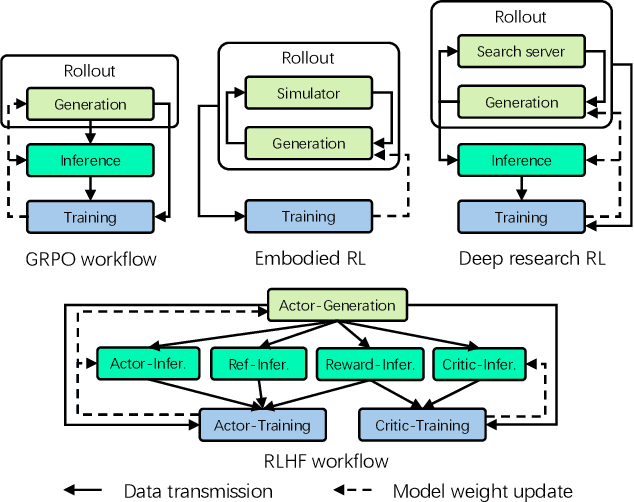
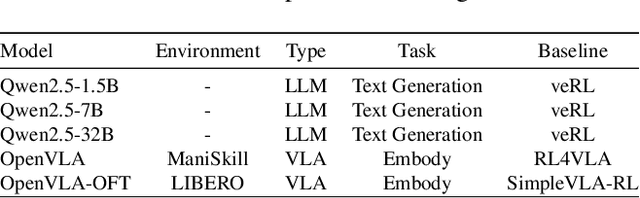
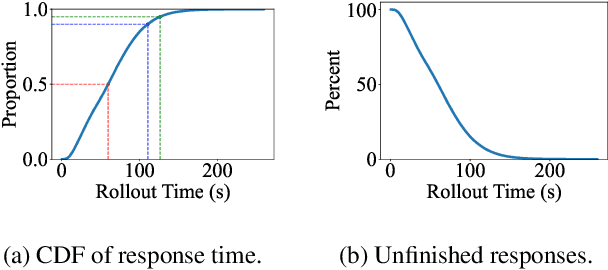
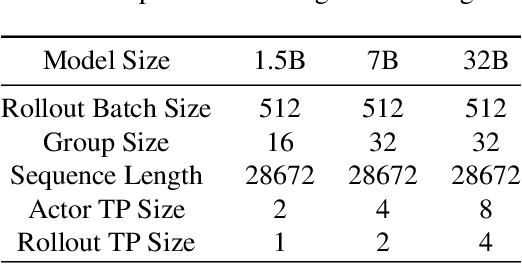
Reinforcement learning (RL) has demonstrated immense potential in advancing artificial general intelligence, agentic intelligence, and embodied intelligence. However, the inherent heterogeneity and dynamicity of RL workflows often lead to low hardware utilization and slow training on existing systems. In this paper, we present RLinf, a high-performance RL training system based on our key observation that the major roadblock to efficient RL training lies in system flexibility. To maximize flexibility and efficiency, RLinf is built atop a novel RL system design paradigm called macro-to-micro flow transformation (M2Flow), which automatically breaks down high-level, easy-to-compose RL workflows at both the temporal and spatial dimensions, and recomposes them into optimized execution flows. Supported by RLinf worker's adaptive communication capability, we devise context switching and elastic pipelining to realize M2Flow transformation, and a profiling-guided scheduling policy to generate optimal execution plans. Extensive evaluations on both reasoning RL and embodied RL tasks demonstrate that RLinf consistently outperforms state-of-the-art systems, achieving 1.1x-2.13x speedup in end-to-end training throughput.