 Add to Chrome
 Add to Firefox
 Add to Edge
Dual-branch Robust Unlearnable Examples
May 03, 2026
Unlearnable examples (UEs) aim to compromise model training by injecting imperceptible perturbations to clean samples. However, existing UE schemes exhibit limited robustness against advanced defenses due to their heuristic design or narrowly scoped domain perturbations. To address this, we propose \texttt{DUNE}, a \underline{\textbf{D}}ual-branch \underline{\textbf{UN}}learnable \underline{\textbf{E}}nsemble perturbation optimization approach. Specifically, \texttt{DUNE} separately optimizes perturbations in the spatial and color domains to establish the mapping between perturbations and shift-induced labels. This design extends the perturbation domain to increase noise intensity for improving robustness and drives the models to learn perturbation-oriented features with degraded generalization, thereby achieving unlearnability. To strengthen \texttt{DUNE}'s performance, we further propose an unlearnability-enhancing ensemble strategy that aggregates diverse pre-trained models during the dual-branch optimization. Extensive experiments on benchmark datasets CIFAR-10 and ImageNet verify that \texttt{DUNE}'s robustness outperforms 12 SOTA UE schemes under 7 mainstream defenses, yielding a lower average test accuracy of 14.95\% to 50.82\%.

Toward Efficient Membership Inference Attacks against Federated Large Language Models: A Projection Residual Approach
Apr 23, 2026Federated Large Language Models (FedLLMs) enable multiple parties to collaboratively fine-tune LLMs without sharing raw data, addressing challenges of limited resources and privacy concerns. Despite data localization, shared gradients can still expose sensitive information through membership inference attacks (MIAs). However, FedLLMs' unique properties, i.e. massive parameter scales, rapid convergence, and sparse, non-orthogonal gradients, render existing MIAs ineffective. To address this gap, we propose ProjRes, the first projection residuals-based passive MIA tailored for FedLLMs. ProjRes leverages hidden embedding vectors as sample representations and analyzes their projection residuals on the gradient subspace to uncover the intrinsic link between gradients and inputs. It requires no shadow models, auxiliary classifiers, or historical updates, ensuring efficiency and robustness. Experiments on four benchmarks and four LLMs show that ProjRes achieves near 100% accuracy, outperforming prior methods by up to 75.75%, and remains effective even under strong differential privacy defenses. Our findings reveal a previously overlooked privacy vulnerability in FedLLMs and call for a re-examination of their security assumptions. Our code and data are available at $\href{https://anonymous.4open.science/r/Passive-MIA-5268}{link}$.
M$^\star$: Every Task Deserves Its Own Memory Harness
Apr 10, 2026Large language model agents rely on specialized memory systems to accumulate and reuse knowledge during extended interactions. Recent architectures typically adopt a fixed memory design tailored to specific domains, such as semantic retrieval for conversations or skills reused for coding. However, a memory system optimized for one purpose frequently fails to transfer to others. To address this limitation, we introduce M$^\star$, a method that automatically discovers task-optimized memory harnesses through executable program evolution. Specifically, M$^\star$ models an agent memory system as a memory program written in Python. This program encapsulates the data Schema, the storage Logic, and the agent workflow Instructions. We optimize these components jointly using a reflective code evolution method; this approach employs a population-based search strategy and analyzes evaluation failures to iteratively refine the candidate programs. We evaluate M$^\star$ on four distinct benchmarks spanning conversation, embodied planning, and expert reasoning. Our results demonstrate that M$^\star$ improves performance over existing fixed-memory baselines robustly across all evaluated tasks. Furthermore, the evolved memory programs exhibit structurally distinct processing mechanisms for each domain. This finding indicates that specializing the memory mechanism for a given task explores a broad design space and provides a superior solution compared to general-purpose memory paradigms.
$p^2$RAG: Privacy-Preserving RAG Service Supporting Arbitrary Top-$k$ Retrieval
Mar 16, 2026Retrieval-Augmented Generation (RAG) enables large language models to use external knowledge, but outsourcing the RAG service raises privacy concerns for both data owners and users. Privacy-preserving RAG systems address these concerns by performing secure top-$k$ retrieval, which typically is secure sorting to identify relevant documents. However, existing systems face challenges supporting arbitrary $k$ due to their inability to change $k$, new security issues, or efficiency degradation with large $k$. This is a significant limitation because modern long-context models generally achieve higher accuracy with larger retrieval sets. We propose $p^2$RAG, a privacy-preserving RAG service that supports arbitrary top-$k$ retrieval. Unlike existing systems, $p^2$RAG avoids sorting candidate documents. Instead, it uses an interactive bisection method to determine the set of top-$k$ documents. For security, $p^2$RAG uses secret sharing on two semi-honest non-colluding servers to protect the data owner's database and the user's prompt. It enforces restrictions and verification to defend against malicious users and tightly bound the information leakage of the database. The experiments show that $p^2$RAG is 3--300$\times$ faster than the state-of-the-art PRAG for $k = 16$--$1024$.
PlugSI: Plug-and-Play Test-Time Graph Adaptation for Spatial Interpolation
Feb 10, 2026With the rapid advancement of IoT and edge computing, sensor networks have become indispensable, driving the need for large-scale sensor deployment. However, the high deployment cost hinders their scalability. To tackle the issues, Spatial Interpolation (SI) introduces virtual sensors to infer readings from observed sensors, leveraging graph structure. However, current graph-based SI methods rely on pre-trained models, lack adaptation to larger and unseen graphs at test-time, and overlook test data utilization. To address these issues, we propose PlugSI, a plug-and-play framework that refines test-time graph through two key innovations. First, we design an Unknown Topology Adapter (UTA) that adapts to the new graph structure of each small-batch at test-time, enhancing the generalization of SI pre-trained models. Second, we introduce a Temporal Balance Adapter (TBA) that maintains a stable historical consensus to guide UTA adaptation and prevent drifting caused by noise in the current batch. Empirically, extensive experiments demonstrate PlugSI can be seamlessly integrated into existing graph-based SI methods and provide significant improvement (e.g., a 10.81% reduction in MAE).
Towards Long-Horizon Interpretability: Efficient and Faithful Multi-Token Attribution for Reasoning LLMs
Feb 02, 2026Token attribution methods provide intuitive explanations for language model outputs by identifying causally important input tokens. However, as modern LLMs increasingly rely on extended reasoning chains, existing schemes face two critical challenges: (1) efficiency bottleneck, where attributing a target span of M tokens within a context of length N requires O(M*N) operations, making long-context attribution prohibitively slow; and (2) faithfulness drop, where intermediate reasoning tokens absorb attribution mass, preventing importance from propagating back to the original input. To address these, we introduce FlashTrace, an efficient multi-token attribution method that employs span-wise aggregation to compute attribution over multi-token targets in a single pass, while maintaining faithfulness. Moreover, we design a recursive attribution mechanism that traces importance through intermediate reasoning chains back to source inputs. Extensive experiments on long-context retrieval (RULER) and multi-step reasoning (MATH, MorehopQA) tasks demonstrate that FlashTrace achieves over 130x speedup over existing baselines while maintaining superior faithfulness. We further analyze the dynamics of recursive attribution, showing that even a single recursive hop improves faithfulness by tracing importance through the reasoning chain.
MulVul: Retrieval-augmented Multi-Agent Code Vulnerability Detection via Cross-Model Prompt Evolution
Jan 26, 2026Large Language Models (LLMs) struggle to automate real-world vulnerability detection due to two key limitations: the heterogeneity of vulnerability patterns undermines the effectiveness of a single unified model, and manual prompt engineering for massive weakness categories is unscalable. To address these challenges, we propose \textbf{MulVul}, a retrieval-augmented multi-agent framework designed for precise and broad-coverage vulnerability detection. MulVul adopts a coarse-to-fine strategy: a \emph{Router} agent first predicts the top-$k$ coarse categories and then forwards the input to specialized \emph{Detector} agents, which identify the exact vulnerability types. Both agents are equipped with retrieval tools to actively source evidence from vulnerability knowledge bases to mitigate hallucinations. Crucially, to automate the generation of specialized prompts, we design \emph{Cross-Model Prompt Evolution}, a prompt optimization mechanism where a generator LLM iteratively refines candidate prompts while a distinct executor LLM validates their effectiveness. This decoupling mitigates the self-correction bias inherent in single-model optimization. Evaluated on 130 CWE types, MulVul achieves 34.79\% Macro-F1, outperforming the best baseline by 41.5\%. Ablation studies validate cross-model prompt evolution, which boosts performance by 51.6\% over manual prompts by effectively handling diverse vulnerability patterns.
Reconstructing Training Data from Adapter-based Federated Large Language Models
Jan 24, 2026Adapter-based Federated Large Language Models (FedLLMs) are widely adopted to reduce the computational, storage, and communication overhead of full-parameter fine-tuning for web-scale applications while preserving user privacy. By freezing the backbone and training only compact low-rank adapters, these methods appear to limit gradient leakage and thwart existing Gradient Inversion Attacks (GIAs). Contrary to this assumption, we show that low-rank adapters create new, exploitable leakage channels. We propose the Unordered-word-bag-based Text Reconstruction (UTR) attack, a novel GIA tailored to the unique structure of adapter-based FedLLMs. UTR overcomes three core challenges: low-dimensional gradients, frozen backbones, and combinatorially large reconstruction spaces by: (i) inferring token presence from attention patterns in frozen layers, (ii) performing sentence-level inversion within the low-rank subspace of adapter gradients, and (iii) enforcing semantic coherence through constrained greedy decoding guided by language priors. Extensive experiments across diverse models (GPT2-Large, BERT, Qwen2.5-7B) and datasets (CoLA, SST-2, Rotten Tomatoes) demonstrate that UTR achieves near-perfect reconstruction accuracy (ROUGE-1/2 > 99), even with large batch size settings where prior GIAs fail completely. Our results reveal a fundamental tension between parameter efficiency and privacy in FedLLMs, challenging the prevailing belief that lightweight adaptation inherently enhances security. Our code and data are available at https://github.com/shwksnshwowk-wq/GIA.
Can LLMs Refuse Questions They Do Not Know? Measuring Knowledge-Aware Refusal in Factual Tasks
Oct 02, 2025Large Language Models (LLMs) should refuse to answer questions beyond their knowledge. This capability, which we term knowledge-aware refusal, is crucial for factual reliability. However, existing metrics fail to faithfully measure this ability. On the one hand, simple refusal-based metrics are biased by refusal rates and yield inconsistent scores when models exhibit different refusal tendencies. On the other hand, existing calibration metrics are proxy-based, capturing the performance of auxiliary calibration processes rather than the model's actual refusal behavior. In this work, we propose the Refusal Index (RI), a principled metric that measures how accurately LLMs refuse questions they do not know. We define RI as Spearman's rank correlation between refusal probability and error probability. To make RI practically measurable, we design a lightweight two-pass evaluation method that efficiently estimates RI from observed refusal rates across two standard evaluation runs. Extensive experiments across 16 models and 5 datasets demonstrate that RI accurately quantifies a model's intrinsic knowledge-aware refusal capability in factual tasks. Notably, RI remains stable across different refusal rates and provides consistent model rankings independent of a model's overall accuracy and refusal rates. More importantly, RI provides insight into an important but previously overlooked aspect of LLM factuality: while LLMs achieve high accuracy on factual tasks, their refusal behavior can be unreliable and fragile. This finding highlights the need to complement traditional accuracy metrics with the Refusal Index for comprehensive factuality evaluation.
Exploring Incremental Unlearning: Techniques, Challenges, and Future Directions
Feb 23, 2025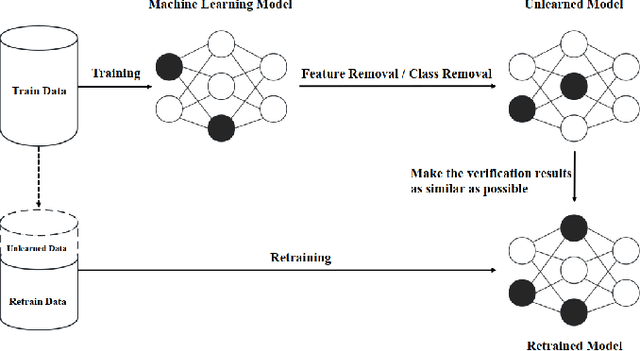
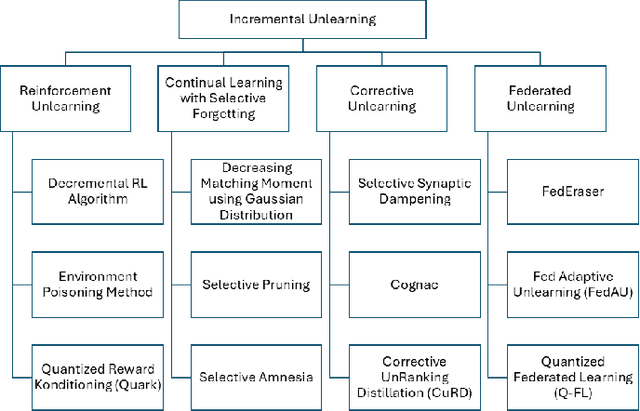
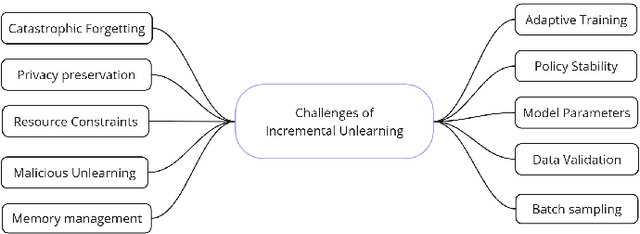
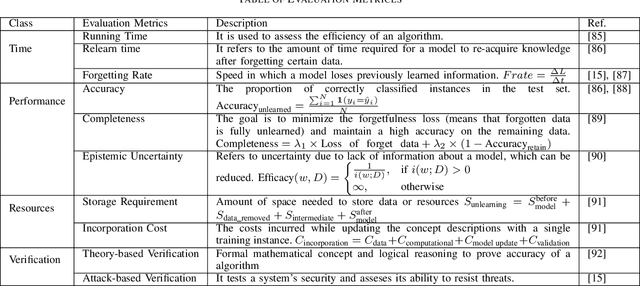
The growing demand for data privacy in Machine Learning (ML) applications has seen Machine Unlearning (MU) emerge as a critical area of research. As the `right to be forgotten' becomes regulated globally, it is increasingly important to develop mechanisms that delete user data from AI systems while maintaining performance and scalability of these systems. Incremental Unlearning (IU) is a promising MU solution to address the challenges of efficiently removing specific data from ML models without the need for expensive and time-consuming full retraining. This paper presents the various techniques and approaches to IU. It explores the challenges faced in designing and implementing IU mechanisms. Datasets and metrics for evaluating the performance of unlearning techniques are discussed as well. Finally, potential solutions to the IU challenges alongside future research directions are offered. This survey provides valuable insights for researchers and practitioners seeking to understand the current landscape of IU and its potential for enhancing privacy-preserving intelligent systems.