 Add to Chrome
 Add to Firefox
 Add to Edge
AMAGO: Scalable In-Context Reinforcement Learning for Adaptive Agents
Nov 05, 2023
We introduce AMAGO, an in-context Reinforcement Learning (RL) agent that uses sequence models to tackle the challenges of generalization, long-term memory, and meta-learning. Recent works have shown that off-policy learning can make in-context RL with recurrent policies viable. Nonetheless, these approaches require extensive tuning and limit scalability by creating key bottlenecks in agents' memory capacity, planning horizon, and model size. AMAGO revisits and redesigns the off-policy in-context approach to successfully train long-sequence Transformers over entire rollouts in parallel with end-to-end RL. Our agent is uniquely scalable and applicable to a wide range of problems. We demonstrate its strong performance empirically in meta-RL and long-term memory domains. AMAGO's focus on sparse rewards and off-policy data also allows in-context learning to extend to goal-conditioned problems with challenging exploration. When combined with a novel hindsight relabeling scheme, AMAGO can solve a previously difficult category of open-world domains, where agents complete many possible instructions in procedurally generated environments. We evaluate our agent on three goal-conditioned domains and study how its individual improvements connect to create a generalist policy.

Interactive Robot Learning from Verbal Correction
Oct 26, 2023The ability to learn and refine behavior after deployment has become ever more important for robots as we design them to operate in unstructured environments like households. In this work, we design a new learning system based on large language model (LLM), OLAF, that allows everyday users to teach a robot using verbal corrections when the robot makes mistakes, e.g., by saying "Stop what you're doing. You should move closer to the cup." A key feature of OLAF is its ability to update the robot's visuomotor neural policy based on the verbal feedback to avoid repeating mistakes in the future. This is in contrast to existing LLM-based robotic systems, which only follow verbal commands or corrections but not learn from them. We demonstrate the efficacy of our design in experiments where a user teaches a robot to perform long-horizon manipulation tasks both in simulation and on physical hardware, achieving on average 20.0% improvement in policy success rate. Videos and more results are at https://ut-austin-rpl.github.io/olaf/
MimicGen: A Data Generation System for Scalable Robot Learning using Human Demonstrations
Oct 26, 2023


Imitation learning from a large set of human demonstrations has proved to be an effective paradigm for building capable robot agents. However, the demonstrations can be extremely costly and time-consuming to collect. We introduce MimicGen, a system for automatically synthesizing large-scale, rich datasets from only a small number of human demonstrations by adapting them to new contexts. We use MimicGen to generate over 50K demonstrations across 18 tasks with diverse scene configurations, object instances, and robot arms from just ~200 human demonstrations. We show that robot agents can be effectively trained on this generated dataset by imitation learning to achieve strong performance in long-horizon and high-precision tasks, such as multi-part assembly and coffee preparation, across broad initial state distributions. We further demonstrate that the effectiveness and utility of MimicGen data compare favorably to collecting additional human demonstrations, making it a powerful and economical approach towards scaling up robot learning. Datasets, simulation environments, videos, and more at https://mimicgen.github.io .
Model-Based Runtime Monitoring with Interactive Imitation Learning
Oct 26, 2023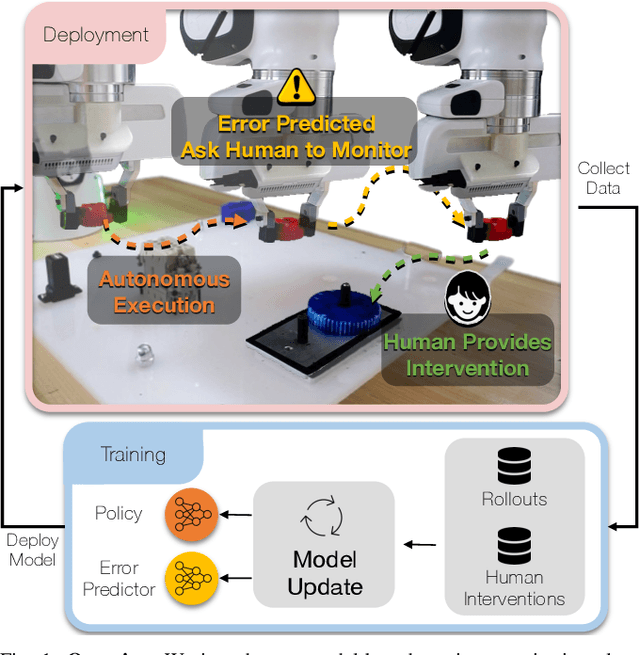
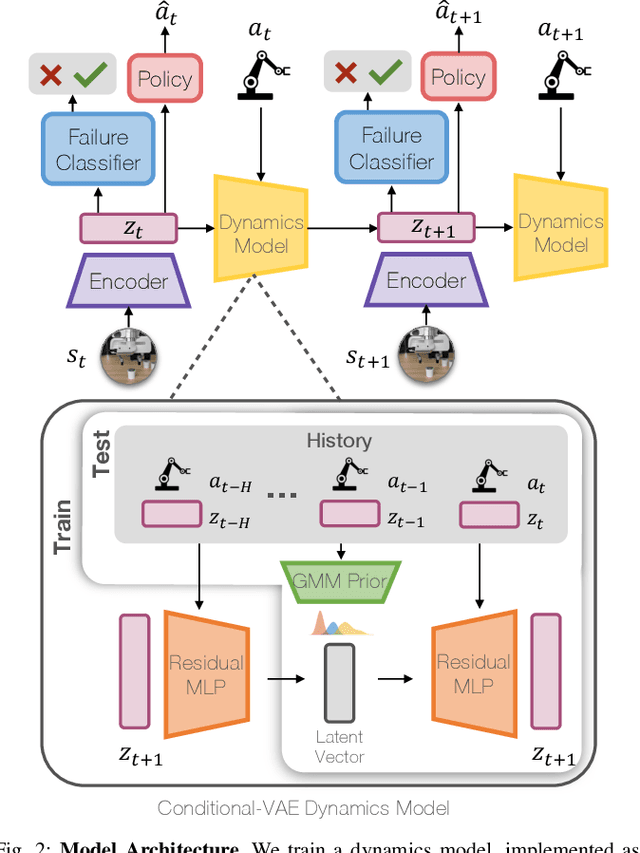
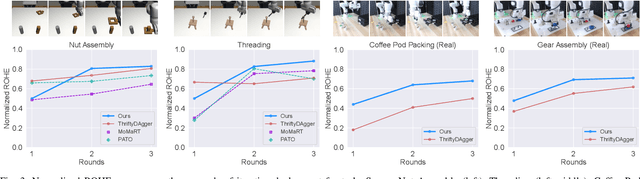
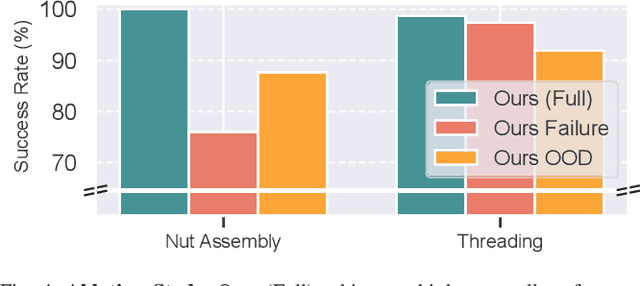
Robot learning methods have recently made great strides, but generalization and robustness challenges still hinder their widespread deployment. Failing to detect and address potential failures renders state-of-the-art learning systems not combat-ready for high-stakes tasks. Recent advances in interactive imitation learning have presented a promising framework for human-robot teaming, enabling the robots to operate safely and continually improve their performances over long-term deployments. Nonetheless, existing methods typically require constant human supervision and preemptive feedback, limiting their practicality in realistic domains. This work aims to endow a robot with the ability to monitor and detect errors during task execution. We introduce a model-based runtime monitoring algorithm that learns from deployment data to detect system anomalies and anticipate failures. Unlike prior work that cannot foresee future failures or requires failure experiences for training, our method learns a latent-space dynamics model and a failure classifier, enabling our method to simulate future action outcomes and detect out-of-distribution and high-risk states preemptively. We train our method within an interactive imitation learning framework, where it continually updates the model from the experiences of the human-robot team collected using trustworthy deployments. Consequently, our method reduces the human workload needed over time while ensuring reliable task execution. Our method outperforms the baselines across system-level and unit-test metrics, with 23% and 40% higher success rates in simulation and on physical hardware, respectively. More information at https://ut-austin-rpl.github.io/sirius-runtime-monitor/
Learning Generalizable Manipulation Policies with Object-Centric 3D Representations
Oct 22, 2023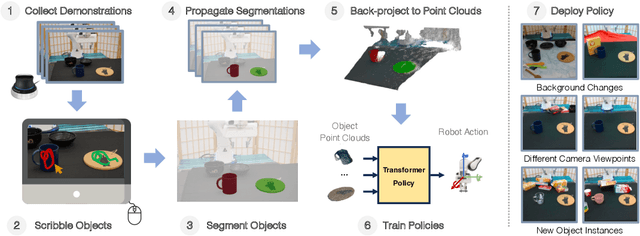
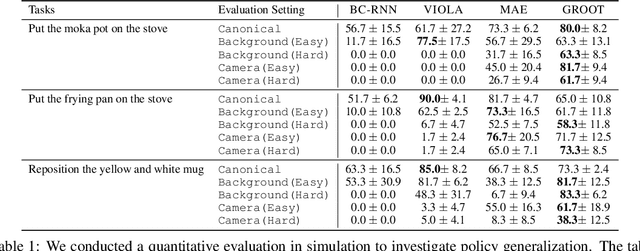
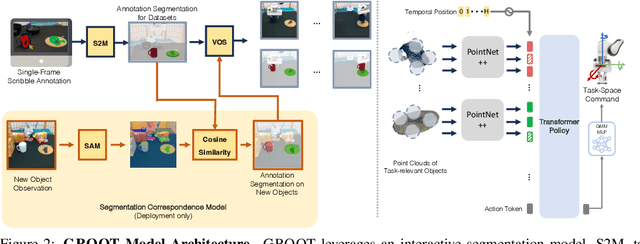
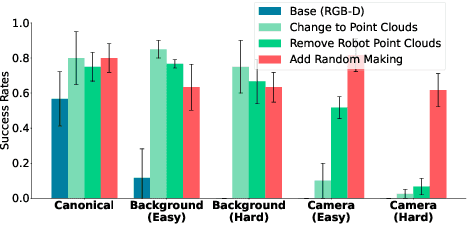
We introduce GROOT, an imitation learning method for learning robust policies with object-centric and 3D priors. GROOT builds policies that generalize beyond their initial training conditions for vision-based manipulation. It constructs object-centric 3D representations that are robust toward background changes and camera views and reason over these representations using a transformer-based policy. Furthermore, we introduce a segmentation correspondence model that allows policies to generalize to new objects at test time. Through comprehensive experiments, we validate the robustness of GROOT policies against perceptual variations in simulated and real-world environments. GROOT's performance excels in generalization over background changes, camera viewpoint shifts, and the presence of new object instances, whereas both state-of-the-art end-to-end learning methods and object proposal-based approaches fall short. We also extensively evaluate GROOT policies on real robots, where we demonstrate the efficacy under very wild changes in setup. More videos and model details can be found in the appendix and the project website: https://ut-austin-rpl.github.io/GROOT .
Eureka: Human-Level Reward Design via Coding Large Language Models
Oct 19, 2023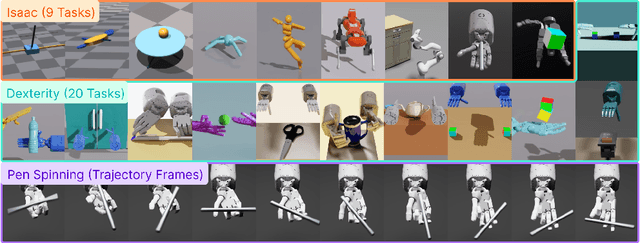
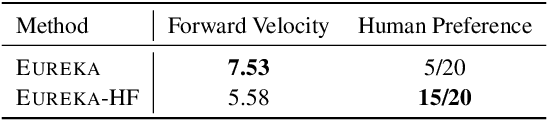
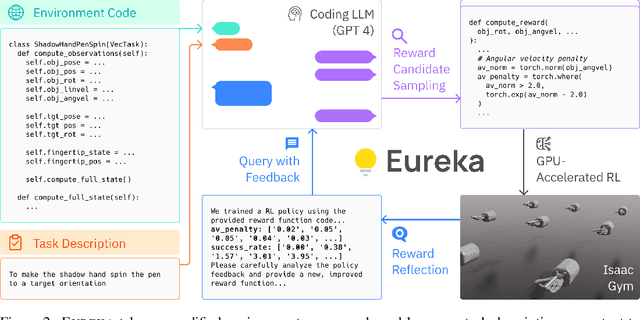
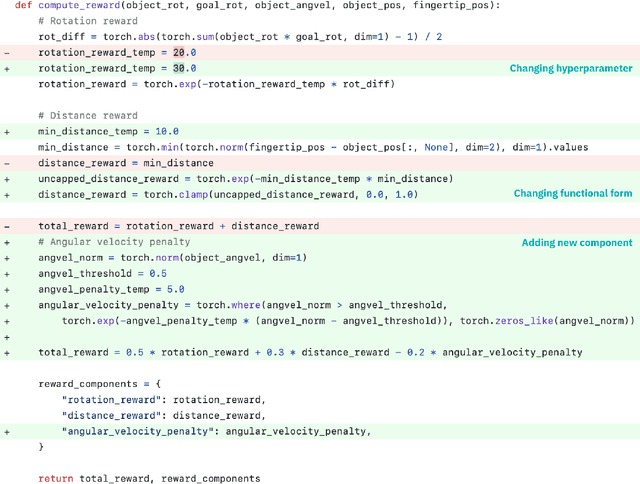
Large Language Models (LLMs) have excelled as high-level semantic planners for sequential decision-making tasks. However, harnessing them to learn complex low-level manipulation tasks, such as dexterous pen spinning, remains an open problem. We bridge this fundamental gap and present Eureka, a human-level reward design algorithm powered by LLMs. Eureka exploits the remarkable zero-shot generation, code-writing, and in-context improvement capabilities of state-of-the-art LLMs, such as GPT-4, to perform evolutionary optimization over reward code. The resulting rewards can then be used to acquire complex skills via reinforcement learning. Without any task-specific prompting or pre-defined reward templates, Eureka generates reward functions that outperform expert human-engineered rewards. In a diverse suite of 29 open-source RL environments that include 10 distinct robot morphologies, Eureka outperforms human experts on 83% of the tasks, leading to an average normalized improvement of 52%. The generality of Eureka also enables a new gradient-free in-context learning approach to reinforcement learning from human feedback (RLHF), readily incorporating human inputs to improve the quality and the safety of the generated rewards without model updating. Finally, using Eureka rewards in a curriculum learning setting, we demonstrate for the first time, a simulated Shadow Hand capable of performing pen spinning tricks, adeptly manipulating a pen in circles at rapid speed.
Open X-Embodiment: Robotic Learning Datasets and RT-X Models
Oct 17, 2023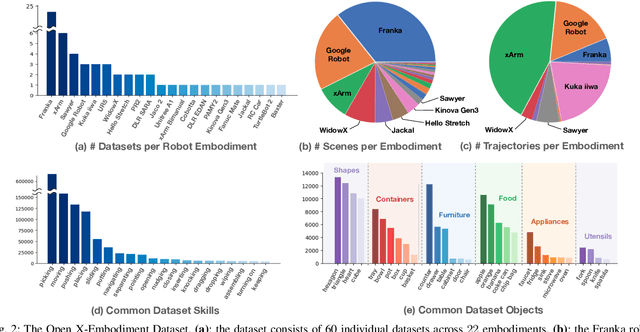
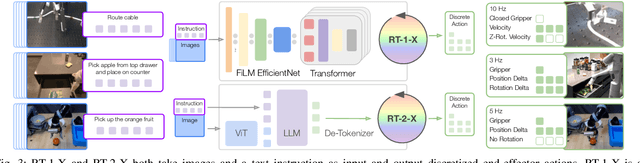


Large, high-capacity models trained on diverse datasets have shown remarkable successes on efficiently tackling downstream applications. In domains from NLP to Computer Vision, this has led to a consolidation of pretrained models, with general pretrained backbones serving as a starting point for many applications. Can such a consolidation happen in robotics? Conventionally, robotic learning methods train a separate model for every application, every robot, and even every environment. Can we instead train generalist X-robot policy that can be adapted efficiently to new robots, tasks, and environments? In this paper, we provide datasets in standardized data formats and models to make it possible to explore this possibility in the context of robotic manipulation, alongside experimental results that provide an example of effective X-robot policies. We assemble a dataset from 22 different robots collected through a collaboration between 21 institutions, demonstrating 527 skills (160266 tasks). We show that a high-capacity model trained on this data, which we call RT-X, exhibits positive transfer and improves the capabilities of multiple robots by leveraging experience from other platforms. More details can be found on the project website $\href{https://robotics-transformer-x.github.io}{\text{robotics-transformer-x.github.io}}$.
Cross-Episodic Curriculum for Transformer Agents
Oct 12, 2023We present a new algorithm, Cross-Episodic Curriculum (CEC), to boost the learning efficiency and generalization of Transformer agents. Central to CEC is the placement of cross-episodic experiences into a Transformer's context, which forms the basis of a curriculum. By sequentially structuring online learning trials and mixed-quality demonstrations, CEC constructs curricula that encapsulate learning progression and proficiency increase across episodes. Such synergy combined with the potent pattern recognition capabilities of Transformer models delivers a powerful cross-episodic attention mechanism. The effectiveness of CEC is demonstrated under two representative scenarios: one involving multi-task reinforcement learning with discrete control, such as in DeepMind Lab, where the curriculum captures the learning progression in both individual and progressively complex settings; and the other involving imitation learning with mixed-quality data for continuous control, as seen in RoboMimic, where the curriculum captures the improvement in demonstrators' expertise. In all instances, policies resulting from CEC exhibit superior performance and strong generalization. Code is open-sourced at https://cec-agent.github.io/ to facilitate research on Transformer agent learning.
Doduo: Learning Dense Visual Correspondence from Unsupervised Semantic-Aware Flow
Sep 26, 2023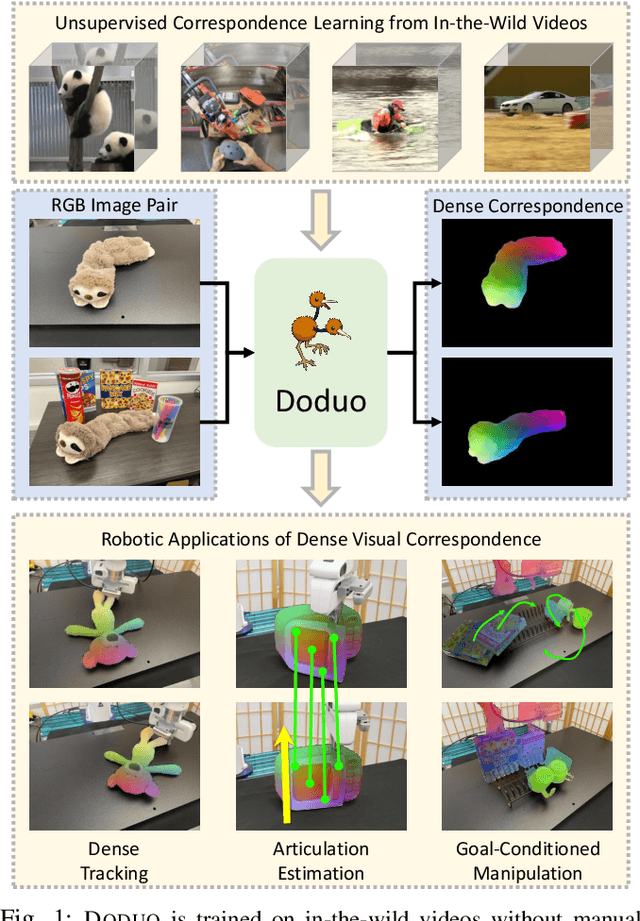
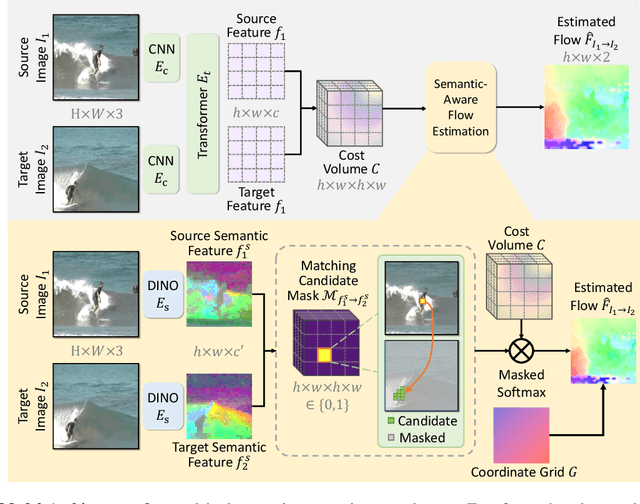
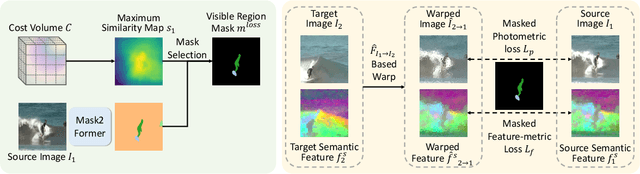
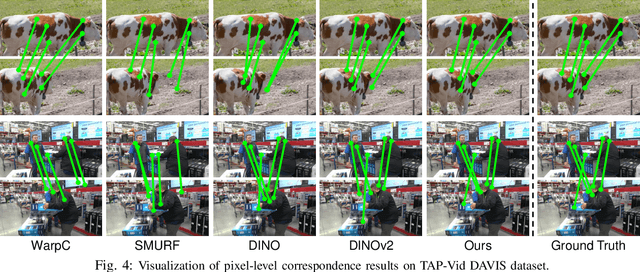
Dense visual correspondence plays a vital role in robotic perception. This work focuses on establishing the dense correspondence between a pair of images that captures dynamic scenes undergoing substantial transformations. We introduce Doduo to learn general dense visual correspondence from in-the-wild images and videos without ground truth supervision. Given a pair of images, it estimates the dense flow field encoding the displacement of each pixel in one image to its corresponding pixel in the other image. Doduo uses flow-based warping to acquire supervisory signals for the training. Incorporating semantic priors with self-supervised flow training, Doduo produces accurate dense correspondence robust to the dynamic changes of the scenes. Trained on an in-the-wild video dataset, Doduo illustrates superior performance on point-level correspondence estimation over existing self-supervised correspondence learning baselines. We also apply Doduo to articulation estimation and zero-shot goal-conditioned manipulation, underlining its practical applications in robotics. Code and additional visualizations are available at https://ut-austin-rpl.github.io/Doduo
MUTEX: Learning Unified Policies from Multimodal Task Specifications
Sep 25, 2023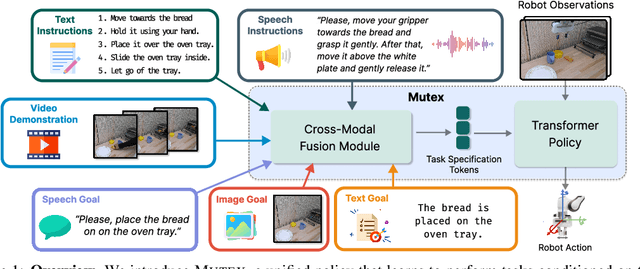
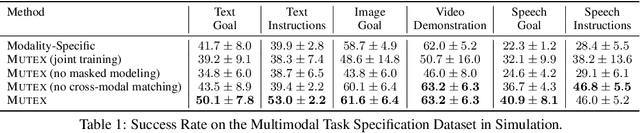
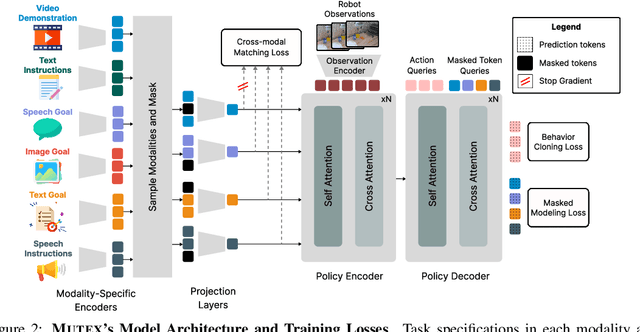
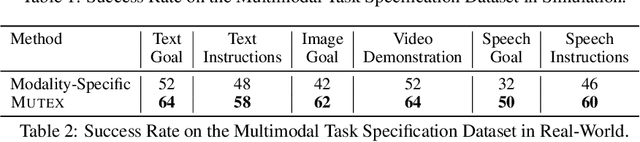
Humans use different modalities, such as speech, text, images, videos, etc., to communicate their intent and goals with teammates. For robots to become better assistants, we aim to endow them with the ability to follow instructions and understand tasks specified by their human partners. Most robotic policy learning methods have focused on one single modality of task specification while ignoring the rich cross-modal information. We present MUTEX, a unified approach to policy learning from multimodal task specifications. It trains a transformer-based architecture to facilitate cross-modal reasoning, combining masked modeling and cross-modal matching objectives in a two-stage training procedure. After training, MUTEX can follow a task specification in any of the six learned modalities (video demonstrations, goal images, text goal descriptions, text instructions, speech goal descriptions, and speech instructions) or a combination of them. We systematically evaluate the benefits of MUTEX in a newly designed dataset with 100 tasks in simulation and 50 tasks in the real world, annotated with multiple instances of task specifications in different modalities, and observe improved performance over methods trained specifically for any single modality. More information at https://ut-austin-rpl.github.io/MUTEX/