 Add to Chrome
 Add to Firefox
 Add to Edge
Unpacking Positional Encoding in Transformers: A Spectral Analysis of Content-Position Coupling
May 19, 2025
Positional encoding (PE) is essential for enabling Transformers to model sequential structure. However, the mechanisms by which different PE schemes couple token content and positional information-and how these mechanisms influence model dynamics-remain theoretically underexplored. In this work, we present a unified framework that analyzes PE through the spectral properties of Toeplitz and related matrices derived from attention logits. We show that multiplicative content-position coupling-exemplified by Rotary Positional Encoding (RoPE) via a Hadamard product with a Toeplitz matrix-induces spectral contraction, which theoretically improves optimization stability and efficiency. Guided by this theory, we construct synthetic tasks that contrast content-position dependent and content-position independent settings, and evaluate a range of PE methods. Our experiments reveal strong alignment with theory: RoPE consistently outperforms other methods on position-sensitive tasks and induces "single-head deposit" patterns in early layers, indicating localized positional processing. Further analyses show that modifying the method and timing of PE coupling, such as MLA in Deepseek-V3, can effectively mitigate this concentration. These results establish explicit content-relative mixing with relative-position Toeplitz signals as a key principle for effective PE design and provide new insight into how positional structure is integrated in Transformer architectures.

Towards Autonomous UAV Visual Object Search in City Space: Benchmark and Agentic Methodology
May 14, 2025Aerial Visual Object Search (AVOS) tasks in urban environments require Unmanned Aerial Vehicles (UAVs) to autonomously search for and identify target objects using visual and textual cues without external guidance. Existing approaches struggle in complex urban environments due to redundant semantic processing, similar object distinction, and the exploration-exploitation dilemma. To bridge this gap and support the AVOS task, we introduce CityAVOS, the first benchmark dataset for autonomous search of common urban objects. This dataset comprises 2,420 tasks across six object categories with varying difficulty levels, enabling comprehensive evaluation of UAV agents' search capabilities. To solve the AVOS tasks, we also propose PRPSearcher (Perception-Reasoning-Planning Searcher), a novel agentic method powered by multi-modal large language models (MLLMs) that mimics human three-tier cognition. Specifically, PRPSearcher constructs three specialized maps: an object-centric dynamic semantic map enhancing spatial perception, a 3D cognitive map based on semantic attraction values for target reasoning, and a 3D uncertainty map for balanced exploration-exploitation search. Also, our approach incorporates a denoising mechanism to mitigate interference from similar objects and utilizes an Inspiration Promote Thought (IPT) prompting mechanism for adaptive action planning. Experimental results on CityAVOS demonstrate that PRPSearcher surpasses existing baselines in both success rate and search efficiency (on average: +37.69% SR, +28.96% SPL, -30.69% MSS, and -46.40% NE). While promising, the performance gap compared to humans highlights the need for better semantic reasoning and spatial exploration capabilities in AVOS tasks. This work establishes a foundation for future advances in embodied target search. Dataset and source code are available at https://anonymous.4open.science/r/CityAVOS-3DF8.
GeoNav: Empowering MLLMs with Explicit Geospatial Reasoning Abilities for Language-Goal Aerial Navigation
Apr 13, 2025Language-goal aerial navigation is a critical challenge in embodied AI, requiring UAVs to localize targets in complex environments such as urban blocks based on textual specification. Existing methods, often adapted from indoor navigation, struggle to scale due to limited field of view, semantic ambiguity among objects, and lack of structured spatial reasoning. In this work, we propose GeoNav, a geospatially aware multimodal agent to enable long-range navigation. GeoNav operates in three phases-landmark navigation, target search, and precise localization-mimicking human coarse-to-fine spatial strategies. To support such reasoning, it dynamically builds two different types of spatial memory. The first is a global but schematic cognitive map, which fuses prior textual geographic knowledge and embodied visual cues into a top-down, annotated form for fast navigation to the landmark region. The second is a local but delicate scene graph representing hierarchical spatial relationships between blocks, landmarks, and objects, which is used for definite target localization. On top of this structured representation, GeoNav employs a spatially aware, multimodal chain-of-thought prompting mechanism to enable multimodal large language models with efficient and interpretable decision-making across stages. On the CityNav urban navigation benchmark, GeoNav surpasses the current state-of-the-art by up to 12.53% in success rate and significantly improves navigation efficiency, even in hard-level tasks. Ablation studies highlight the importance of each module, showcasing how geospatial representations and coarse-to-fine reasoning enhance UAV navigation.
Leveraging GCN-based Action Recognition for Teleoperation in Daily Activity Assistance
Apr 09, 2025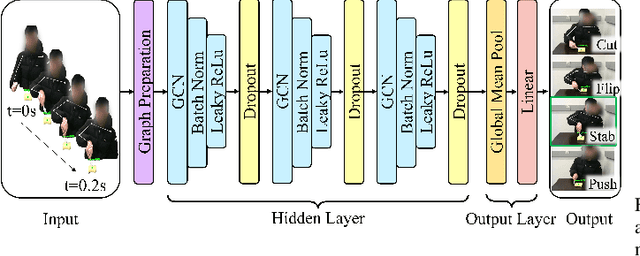
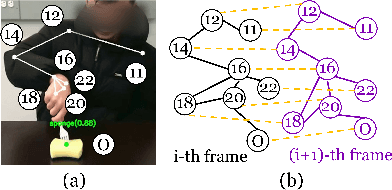
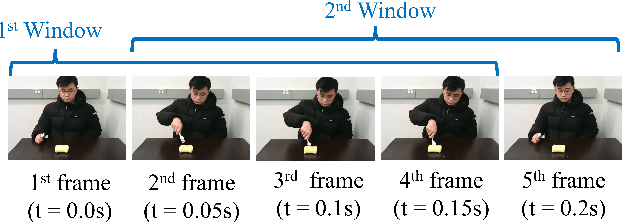
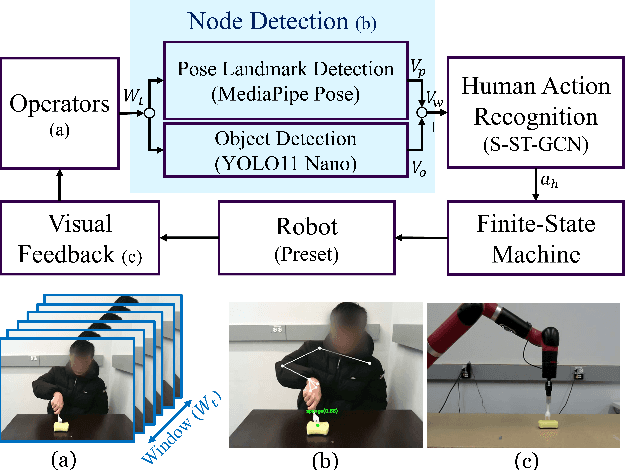
Caregiving of older adults is an urgent global challenge, with many older adults preferring to age in place rather than enter residential care. However, providing adequate home-based assistance remains difficult, particularly in geographically vast regions. Teleoperated robots offer a promising solution, but conventional motion-mapping teleoperation imposes unnatural movement constraints on operators, leading to muscle fatigue and reduced usability. This paper presents a novel teleoperation framework that leverages action recognition to enable intuitive remote robot control. Using our simplified Spatio-Temporal Graph Convolutional Network (S-ST-GCN), the system recognizes human actions and executes corresponding preset robot trajectories, eliminating the need for direct motion synchronization. A finite-state machine (FSM) is integrated to enhance reliability by filtering out misclassified actions. Our experiments demonstrate that the proposed framework enables effortless operator movement while ensuring accurate robot execution. This proof-of-concept study highlights the potential of teleoperation with action recognition for enabling caregivers to remotely assist older adults during activities of daily living (ADLs). Future work will focus on improving the S-ST-GCN's recognition accuracy and generalization, integrating advanced motion planning techniques to further enhance robotic autonomy in older adult care, and conducting a user study to evaluate the system's telepresence and ease of control.
Beyond Progress Measures: Theoretical Insights into the Mechanism of Grokking
Apr 04, 2025Grokking, referring to the abrupt improvement in test accuracy after extended overfitting, offers valuable insights into the mechanisms of model generalization. Existing researches based on progress measures imply that grokking relies on understanding the optimization dynamics when the loss function is dominated solely by the weight decay term. However, we find that this optimization merely leads to token uniformity, which is not a sufficient condition for grokking. In this work, we investigate the grokking mechanism underlying the Transformer in the task of prime number operations. Based on theoretical analysis and experimental validation, we present the following insights: (i) The weight decay term encourages uniformity across all tokens in the embedding space when it is minimized. (ii) The occurrence of grokking is jointly determined by the uniformity of the embedding space and the distribution of the training dataset. Building on these insights, we provide a unified perspective for understanding various previously proposed progress measures and introduce a novel, concise, and effective progress measure that could trace the changes in test loss more accurately. Finally, to demonstrate the versatility of our theoretical framework, we design a dedicated dataset to validate our theory on ResNet-18, successfully showcasing the occurrence of grokking.
A Novel Channel Boosted Residual CNN-Transformer with Regional-Boundary Learning for Breast Cancer Detection
Mar 19, 2025Recent advancements in detecting tumors using deep learning on breast ultrasound images (BUSI) have demonstrated significant success. Deep CNNs and vision-transformers (ViTs) have demonstrated individually promising initial performance. However, challenges related to model complexity and contrast, texture, and tumor morphology variations introduce uncertainties that hinder the effectiveness of current methods. This study introduces a novel hybrid framework, CB-Res-RBCMT, combining customized residual CNNs and new ViT components for detailed BUSI cancer analysis. The proposed RBCMT uses stem convolution blocks with CNN Meet Transformer (CMT) blocks, followed by new Regional and boundary (RB) feature extraction operations for capturing contrast and morphological variations. Moreover, the CMT block incorporates global contextual interactions through multi-head attention, enhancing computational efficiency with a lightweight design. Additionally, the customized inverse residual and stem CNNs within the CMT effectively extract local texture information and handle vanishing gradients. Finally, the new channel-boosted (CB) strategy enriches the feature diversity of the limited dataset by combining the original RBCMT channels with transfer learning-based residual CNN-generated maps. These diverse channels are processed through a spatial attention block for optimal pixel selection, reducing redundancy and improving the discrimination of minor contrast and texture variations. The proposed CB-Res-RBCMT achieves an F1-score of 95.57%, accuracy of 95.63%, sensitivity of 96.42%, and precision of 94.79% on the standard harmonized stringent BUSI dataset, outperforming existing ViT and CNN methods. These results demonstrate the versatility of our integrated CNN-Transformer framework in capturing diverse features and delivering superior performance in BUSI cancer diagnosis.
SwimVG: Step-wise Multimodal Fusion and Adaption for Visual Grounding
Feb 24, 2025


Visual grounding aims to ground an image region through natural language, which heavily relies on cross-modal alignment. Most existing methods transfer visual/linguistic knowledge separately by fully fine-tuning uni-modal pre-trained models, followed by a simple stack of visual-language transformers for multimodal fusion. However, these approaches not only limit adequate interaction between visual and linguistic contexts, but also incur significant computational costs. Therefore, to address these issues, we explore a step-wise multimodal fusion and adaption framework, namely SwimVG. Specifically, SwimVG proposes step-wise multimodal prompts (Swip) and cross-modal interactive adapters (CIA) for visual grounding, replacing the cumbersome transformer stacks for multimodal fusion. Swip can improve {the} alignment between the vision and language representations step by step, in a token-level fusion manner. In addition, weight-level CIA further promotes multimodal fusion by cross-modal interaction. Swip and CIA are both parameter-efficient paradigms, and they fuse the cross-modal features from shallow to deep layers gradually. Experimental results on four widely-used benchmarks demonstrate that SwimVG achieves remarkable abilities and considerable benefits in terms of efficiency. Our code is available at https://github.com/liuting20/SwimVG.
CityEQA: A Hierarchical LLM Agent on Embodied Question Answering Benchmark in City Space
Feb 20, 2025Embodied Question Answering (EQA) has primarily focused on indoor environments, leaving the complexities of urban settings - spanning environment, action, and perception - largely unexplored. To bridge this gap, we introduce CityEQA, a new task where an embodied agent answers open-vocabulary questions through active exploration in dynamic city spaces. To support this task, we present CityEQA-EC, the first benchmark dataset featuring 1,412 human-annotated tasks across six categories, grounded in a realistic 3D urban simulator. Moreover, we propose Planner-Manager-Actor (PMA), a novel agent tailored for CityEQA. PMA enables long-horizon planning and hierarchical task execution: the Planner breaks down the question answering into sub-tasks, the Manager maintains an object-centric cognitive map for spatial reasoning during the process control, and the specialized Actors handle navigation, exploration, and collection sub-tasks. Experiments demonstrate that PMA achieves 60.7% of human-level answering accuracy, significantly outperforming frontier-based baselines. While promising, the performance gap compared to humans highlights the need for enhanced visual reasoning in CityEQA. This work paves the way for future advancements in urban spatial intelligence. Dataset and code are available at https://github.com/BiluYong/CityEQA.git.
JotlasNet: Joint Tensor Low-Rank and Attention-based Sparse Unrolling Network for Accelerating Dynamic MRI
Feb 17, 2025


Joint low-rank and sparse unrolling networks have shown superior performance in dynamic MRI reconstruction. However, existing works mainly utilized matrix low-rank priors, neglecting the tensor characteristics of dynamic MRI images, and only a global threshold is applied for the sparse constraint to the multi-channel data, limiting the flexibility of the network. Additionally, most of them have inherently complex network structure, with intricate interactions among variables. In this paper, we propose a novel deep unrolling network, JotlasNet, for dynamic MRI reconstruction by jointly utilizing tensor low-rank and attention-based sparse priors. Specifically, we utilize tensor low-rank prior to exploit the structural correlations in high-dimensional data. Convolutional neural networks are used to adaptively learn the low-rank and sparse transform domains. A novel attention-based soft thresholding operator is proposed to assign a unique learnable threshold to each channel of the data in the CNN-learned sparse domain. The network is unrolled from the elaborately designed composite splitting algorithm and thus features a simple yet efficient parallel structure. Extensive experiments on two datasets (OCMR, CMRxRecon) demonstrate the superior performance of JotlasNet in dynamic MRI reconstruction.
* 13 pages, 7 figures, accepted by Magnetic Resonance Imaging
SplatMAP: Online Dense Monocular SLAM with 3D Gaussian Splatting
Jan 14, 2025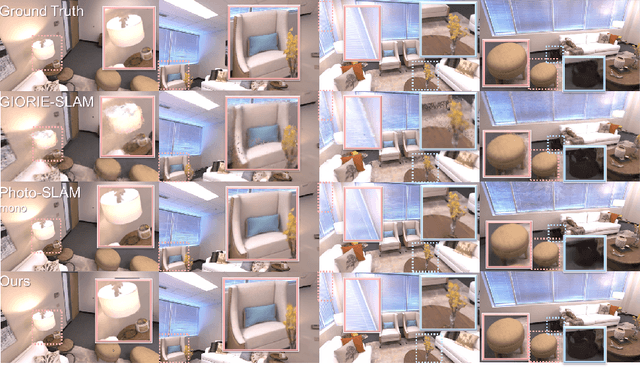
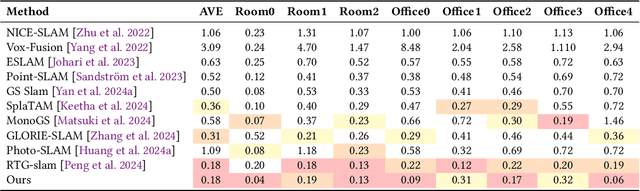
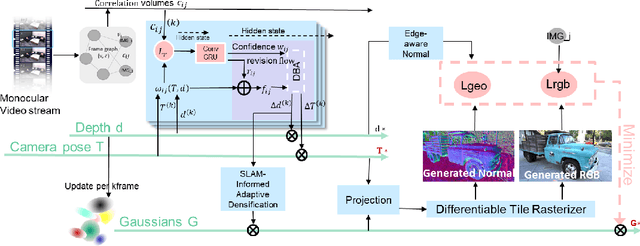
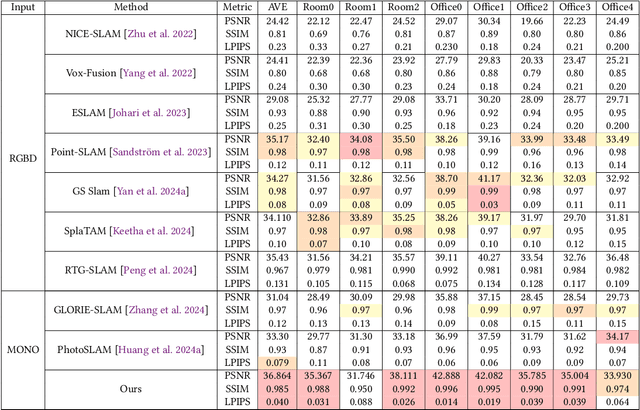
Achieving high-fidelity 3D reconstruction from monocular video remains challenging due to the inherent limitations of traditional methods like Structure-from-Motion (SfM) and monocular SLAM in accurately capturing scene details. While differentiable rendering techniques such as Neural Radiance Fields (NeRF) address some of these challenges, their high computational costs make them unsuitable for real-time applications. Additionally, existing 3D Gaussian Splatting (3DGS) methods often focus on photometric consistency, neglecting geometric accuracy and failing to exploit SLAM's dynamic depth and pose updates for scene refinement. We propose a framework integrating dense SLAM with 3DGS for real-time, high-fidelity dense reconstruction. Our approach introduces SLAM-Informed Adaptive Densification, which dynamically updates and densifies the Gaussian model by leveraging dense point clouds from SLAM. Additionally, we incorporate Geometry-Guided Optimization, which combines edge-aware geometric constraints and photometric consistency to jointly optimize the appearance and geometry of the 3DGS scene representation, enabling detailed and accurate SLAM mapping reconstruction. Experiments on the Replica and TUM-RGBD datasets demonstrate the effectiveness of our approach, achieving state-of-the-art results among monocular systems. Specifically, our method achieves a PSNR of 36.864, SSIM of 0.985, and LPIPS of 0.040 on Replica, representing improvements of 10.7%, 6.4%, and 49.4%, respectively, over the previous SOTA. On TUM-RGBD, our method outperforms the closest baseline by 10.2%, 6.6%, and 34.7% in the same metrics. These results highlight the potential of our framework in bridging the gap between photometric and geometric dense 3D scene representations, paving the way for practical and efficient monocular dense reconstruction.