 Add to Chrome
 Add to Firefox
 Add to Edge
Direct Dynamic Retargeting for Humanoid Imitation Learning from Videos
May 22, 2026
Imitation Learning from monocular video demonstrations provides a scalable approach for teaching complex skills to humanoid robots. However, translating human motion to humanoids requires overcoming significant morphological mismatches. Standard approaches rely on Geometric Retargeting or Indirect Dynamic Retargeting pipelines. We identify that these intermediate kinematic projections introduce a geometric bias, restricting the search space and yielding suboptimal dynamic behaviors. In this paper, we propose Direct Dynamic Retargeting (DDR), a novel single-stage framework that generates high-fidelity, dynamically feasible trajectories directly from expert videos. By formulating the problem in the task space and leveraging a sampling-based Model Predictive Control solver within a physics simulator, DDR natively optimizes over complex contact sequences while mitigating input drift. Our experiments demonstrate that bypassing the geometric bias allows DDR to outperform state-of-the-art baselines in demonstration tracking accuracy. Furthermore, we establish that providing such physically viable references to RL agents accelerates training convergence and enhances the final execution of agile and balancing behaviors. Source code will be made publicly available.

COSMIK-MPPI: Scaling Constrained Model Predictive Control to Collision Avoidance in Close-Proximity Dynamic Human Environments
Apr 11, 2026Ensuring safe physical interaction between torque-controlled manipulators and humans is essential for deploying robots in everyday environments. Model Predictive Control (MPC) has emerged as a suitable framework thanks to its capacity to handle hard constraints, provide strong guarantees and zero-shot adaptability through predictive reasoning. However, Gradient-Based MPC (GB-MPC) solvers have demonstrated limited performance for collision avoidance in complex environments. Sampling-based approaches such as Model Predictive Path Integral (MPPI) control offer an alternative via stochastic rollouts, but enforcing safety via additive penalties is inherently fragile, as it provides no formal constraint satisfaction guarantees. We propose a collision avoidance framework called COSMIK-MPPI combining MPPI with the toolbox for human motion estimation RT-COSMIK and the Constraints-as-Terminations transcription, which enforces safety by treating constraint violations as terminal events, without relying on large penalty terms or explicit human motion prediction. The proposed approach is evaluated against state-of-the-art GB-MPC and vanilla MPPI in simulation and on a real manipulator arm. Results show that COSMIK-MPPI achieves a 100% task success rate with a constant computation time (22 ms), largely outperforming GB-MPC. In simulated infeasible scenarios, COSMIK-MPPI consistently generates collision-free trajectories, contrary to vanilla MPPI. These properties enabled safe execution of complex real-world human-robot interaction tasks in shared workspaces using an affordable markerless human motion estimator, demonstrating a robust, compliant, and practical solution for predictive collision avoidance (cf. results showcased at https://exquisite-parfait-ffa925.netlify.app)
Learning-Guided Force-Feedback Model Predictive Control with Obstacle Avoidance for Robotic Deburring
Apr 07, 2026Model Predictive Control (MPC) is widely used for torque-controlled robots, but classical formulations often neglect real-time force feedback and struggle with contact-rich industrial tasks under collision constraints. Deburring in particular requires precise tool insertion, stable force regulation, and collision-free circular motions in challenging configurations, which exceeds the capability of standard MPC pipelines. We propose a framework that integrates force-feedback MPC with diffusion-based motion priors to address these challenges. The diffusion model serves as a memory of motion strategies, providing robust initialization and adaptation across multiple task instances, while MPC ensures safe execution with explicit force tracking, torque feasibility, and collision avoidance. We validate our approach on a torque-controlled manipulator performing industrial deburring tasks. Experiments demonstrate reliable tool insertion, accurate normal force tracking, and circular deburring motions even in hard-to-reach configurations and under obstacle constraints. To our knowledge, this is the first integration of diffusion motion priors with force-feedback MPC for collision-aware, contact-rich industrial tasks.
Coupled Local and Global World Models for Efficient First Order RL
Feb 05, 2026World models offer a promising avenue for more faithfully capturing complex dynamics, including contacts and non-rigidity, as well as complex sensory information, such as visual perception, in situations where standard simulators struggle. However, these models are computationally complex to evaluate, posing a challenge for popular RL approaches that have been successfully used with simulators to solve complex locomotion tasks but yet struggle with manipulation. This paper introduces a method that bypasses simulators entirely, training RL policies inside world models learned from robots' interactions with real environments. At its core, our approach enables policy training with large-scale diffusion models via a novel decoupled first-order gradient (FoG) method: a full-scale world model generates accurate forward trajectories, while a lightweight latent-space surrogate approximates its local dynamics for efficient gradient computation. This coupling of a local and global world model ensures high-fidelity unrolling alongside computationally tractable differentiation. We demonstrate the efficacy of our method on the Push-T manipulation task, where it significantly outperforms PPO in sample efficiency. We further evaluate our approach through an ego-centric object manipulation task with a quadruped. Together, these results demonstrate that learning inside data-driven world models is a promising pathway for solving hard-to-model RL tasks in image space without reliance on hand-crafted physics simulators.
Warm-Starting Collision-Free Model Predictive Control With Object-Centric Diffusion
Jan 06, 2026Acting in cluttered environments requires predicting and avoiding collisions while still achieving precise control. Conventional optimization-based controllers can enforce physical constraints, but they struggle to produce feasible solutions quickly when many obstacles are present. Diffusion models can generate diverse trajectories around obstacles, yet prior approaches lacked a general and efficient way to condition them on scene structure. In this paper, we show that combining diffusion-based warm-starting conditioned with a latent object-centric representation of the scene and with a collision-aware model predictive controller (MPC) yields reliable and efficient motion generation under strict time limits. Our approach conditions a diffusion transformer on the system state, task, and surroundings, using an object-centric slot attention mechanism to provide a compact obstacle representation suitable for control. The sampled trajectories are refined by an optimal control problem that enforces rigid-body dynamics and signed-distance collision constraints, producing feasible motions in real time. On benchmark tasks, this hybrid method achieved markedly higher success rates and lower latency than sampling-based planners or either component alone. Real-robot experiments with a torque-controlled Panda confirm reliable and safe execution with MPC.
Multi-step manipulation task and motion planning guided by video demonstration
May 13, 2025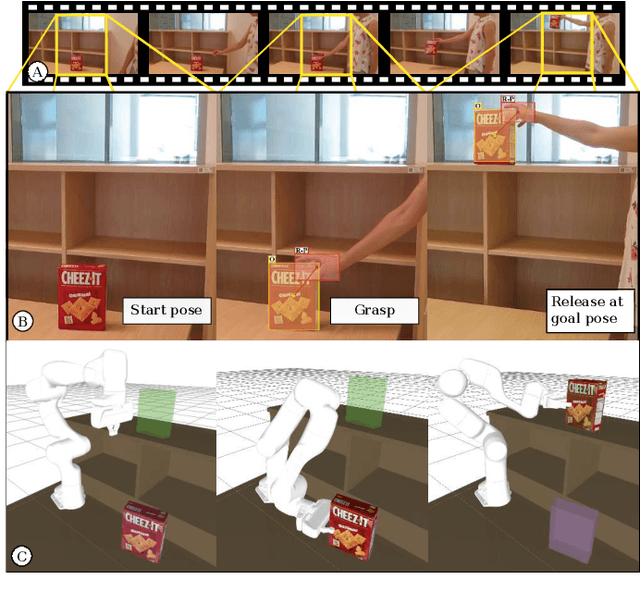
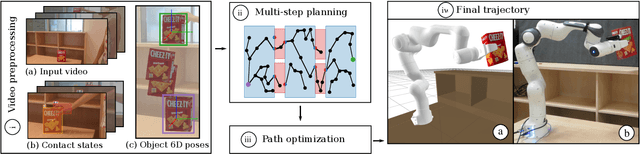
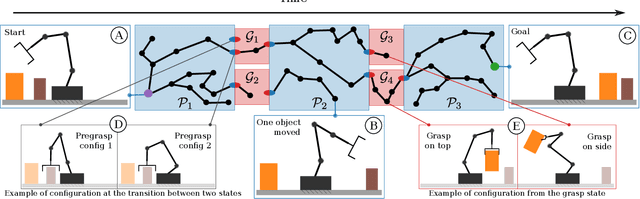
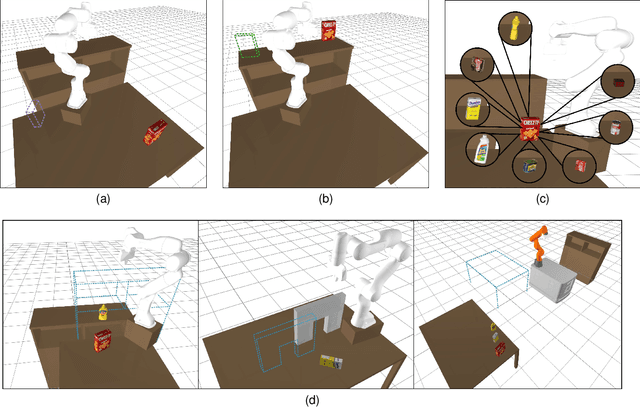
This work aims to leverage instructional video to solve complex multi-step task-and-motion planning tasks in robotics. Towards this goal, we propose an extension of the well-established Rapidly-Exploring Random Tree (RRT) planner, which simultaneously grows multiple trees around grasp and release states extracted from the guiding video. Our key novelty lies in combining contact states and 3D object poses extracted from the guiding video with a traditional planning algorithm that allows us to solve tasks with sequential dependencies, for example, if an object needs to be placed at a specific location to be grasped later. We also investigate the generalization capabilities of our approach to go beyond the scene depicted in the instructional video. To demonstrate the benefits of the proposed video-guided planning approach, we design a new benchmark with three challenging tasks: (I) 3D re-arrangement of multiple objects between a table and a shelf, (ii) multi-step transfer of an object through a tunnel, and (iii) transferring objects using a tray similar to a waiter transfers dishes. We demonstrate the effectiveness of our planning algorithm on several robots, including the Franka Emika Panda and the KUKA KMR iiwa. For a seamless transfer of the obtained plans to the real robot, we develop a trajectory refinement approach formulated as an optimal control problem (OCP).
Extended URDF: Accounting for parallel mechanism in robot description
Apr 10, 2025Robotic designs played an important role in recent advances by providing powerful robots with complex mechanics. Many recent systems rely on parallel actuation to provide lighter limbs and allow more complex motion. However, these emerging architectures fall outside the scope of most used description formats, leading to difficulties when designing, storing, and sharing the models of these systems. This paper introduces an extension to the widely used Unified Robot Description Format (URDF) to support closed-loop kinematic structures. Our approach relies on augmenting URDF with minimal additional information to allow more efficient modeling of complex robotic systems while maintaining compatibility with existing design and simulation frameworks. This method sets the basic requirement for a description format to handle parallel mechanisms efficiently. We demonstrate the applicability of our approach by providing an open-source collection of parallel robots, along with tools for generating and parsing this extended description format. The proposed extension simplifies robot modeling, reduces redundancy, and improves usability for advanced robotic applications.
Optimal Control of Walkers with Parallel Actuation
Apr 01, 2025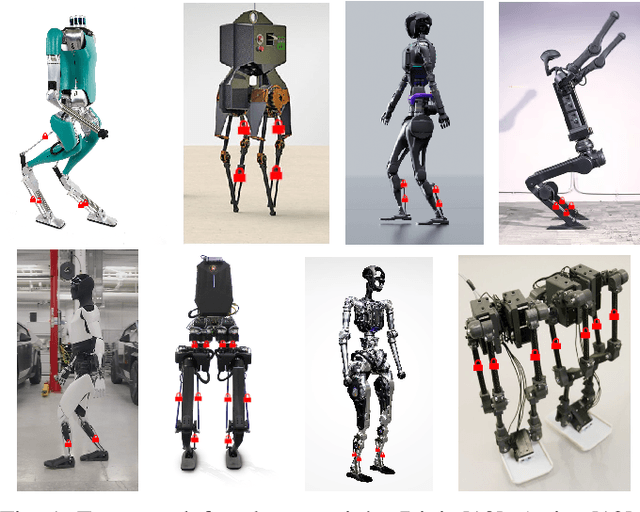

Legged robots with closed-loop kinematic chains are increasingly prevalent due to their increased mobility and efficiency. Yet, most motion generation methods rely on serial-chain approximations, sidestepping their specific constraints and dynamics. This leads to suboptimal motions and limits the adaptability of these methods to diverse kinematic structures. We propose a comprehensive motion generation method that explicitly incorporates closed-loop kinematics and their associated constraints in an optimal control problem, integrating kinematic closure conditions and their analytical derivatives. This allows the solver to leverage the non-linear transmission effects inherent to closed-chain mechanisms, reducing peak actuator efforts and expanding their effective operating range. Unlike previous methods, our framework does not require serial approximations, enabling more accurate and efficient motion strategies. We also are able to generate the motion of more complex robots for which an approximate serial chain does not exist. We validate our approach through simulations and experiments, demonstrating superior performance in complex tasks such as rapid locomotion and stair negotiation. This method enhances the capabilities of current closed-loop robots and broadens the design space for future kinematic architectures.
Control of Humanoid Robots with Parallel Mechanisms using Kinematic Actuation Models
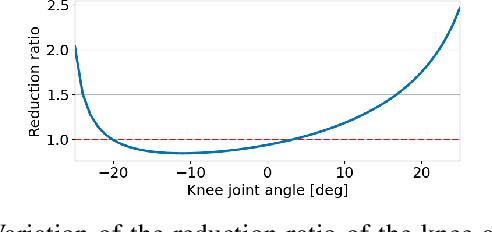
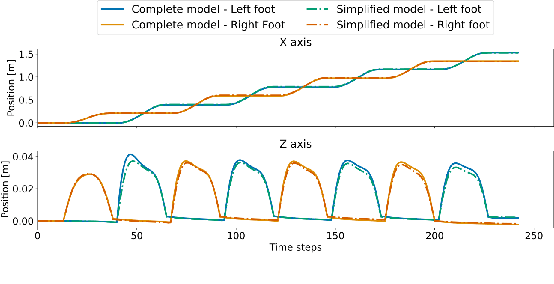
Mar 28, 2025Inspired by the mechanical design of Cassie, several recently released humanoid robots are using actuator configuration in which the motor is displaced from the joint location to optimize the leg inertia. This in turn induces a non linearity in the reduction ratio of the transmission which is often neglected when computing the robot motion (e.g. by trajectory optimization or reinforcement learning) and only accounted for at control time. This paper proposes an analytical method to efficiently handle this non-linearity. Using this actuation model, we demonstrate that we can leverage the dynamic abilities of the non-linear transmission while only modeling the inertia of the main serial chain of the leg, without approximating the motor capabilities nor the joint range. Based on analytical inverse kinematics, our method does not need any numerical routines dedicated to the closed-kinematics actuation, hence leading to very efficient computations. Our study focuses on two mechanisms widely used in recent humanoid robots; the four bar knee linkage as well as a parallel 2 DoF ankle mechanism. We integrate these models inside optimization based (DDP) and learning (PPO) control approaches. A comparison of our model against a simplified model that completely neglects closed chains is then shown in simulation.
Infinite-Horizon Value Function Approximation for Model Predictive Control
Feb 10, 2025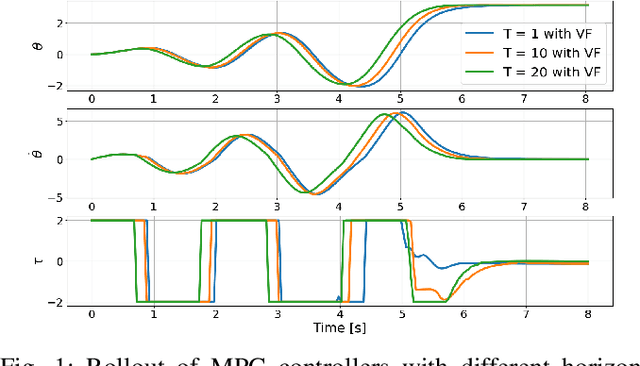
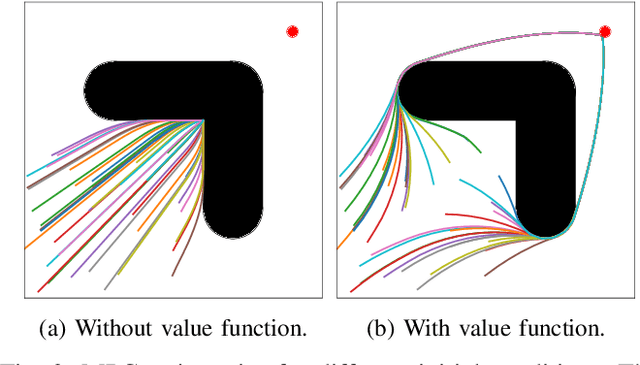
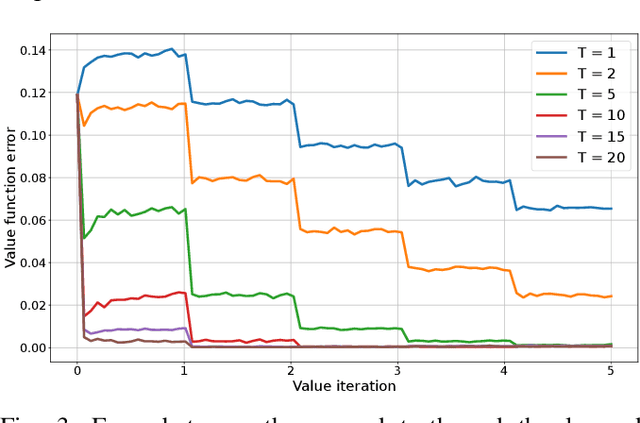
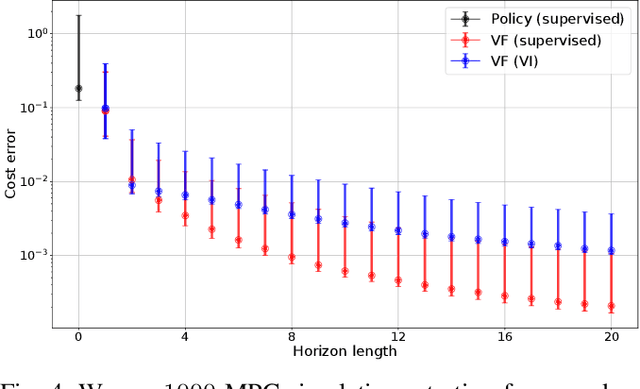
Model Predictive Control has emerged as a popular tool for robots to generate complex motions. However, the real-time requirement has limited the use of hard constraints and large preview horizons, which are necessary to ensure safety and stability. In practice, practitioners have to carefully design cost functions that can imitate an infinite horizon formulation, which is tedious and often results in local minima. In this work, we study how to approximate the infinite horizon value function of constrained optimal control problems with neural networks using value iteration and trajectory optimization. Furthermore, we demonstrate how using this value function approximation as a terminal cost provides global stability to the model predictive controller. The approach is validated on two toy problems and a real-world scenario with online obstacle avoidance on an industrial manipulator where the value function is conditioned to the goal and obstacle.