 Add to Chrome
 Add to Firefox
 Add to Edge
DEP: A Decentralized Large Language Model Evaluation Protocol
Mar 01, 2026
With the rapid development of Large Language Models (LLMs), a large number of benchmarks have been proposed. However, most benchmarks lack unified evaluation standard and require the manual implementation of custom scripts, making results hard to ensure consistency and reproducibility. Furthermore, mainstream evaluation frameworks are centralized, with datasets and answers, which increases the risk of benchmark leakage. To address these issues, we propose a Decentralized Evaluation Protocol (DEP), a decentralized yet unified and standardized evaluation framework through a matching server without constraining benchmarks. The server can be mounted locally or deployed remotely, and once adapted, it can be reused over the long term. By decoupling users, LLMs, and benchmarks, DEP enables modular, plug-and-play evaluation: benchmark files and evaluation logic stay exclusively on the server side. In remote setting, users cannot access the ground truth, thereby achieving data isolation and leak-proof evaluation. To facilitate practical adoption, we develop DEP Toolkit, a protocol-compatible toolkit that supports features such as breakpoint resume, concurrent requests, and congestion control. We also provide detailed documentation for adapting new benchmarks to DEP. Using DEP toolkit, we evaluate multiple LLMs across benchmarks. Experimental results verify the effectiveness of DEP and show that it reduces the cost of deploying benchmark evaluations. As of February 2026, we have adapted over 60 benchmarks and continue to promote community co-construction to support unified evaluation across various tasks and domains.

CLM-Bench: Benchmarking and Analyzing Cross-lingual Misalignment of LLMs in Knowledge Editing
Jan 24, 2026Knowledge Editing (KE) has emerged as a promising paradigm for updating facts in Large Language Models (LLMs) without retraining. However, progress in Multilingual Knowledge Editing (MKE) is currently hindered by biased evaluation frameworks. We observe that existing MKE benchmarks are typically constructed by mechanically translating English-centric datasets into target languages (e.g., English-to-Chinese). This approach introduces translation artifacts and neglects culturally specific entities native to the target language, failing to reflect the true knowledge distribution of LLMs. To address this, we propose CLM-Bench, a culture-aware benchmark constructed using a native Chinese-first methodology. We curate 1,010 high-quality CounterFact pairs rooted in Chinese cultural contexts and align them with English counterparts. Using CLM-Bench, we conduct extensive experiments on representative LLMs (e.g., Llama-3, Qwen2) and reveal a significant Cross-lingual Misalignment: edits in one language function independently and fail to propagate to the other. We further provide a geometric explanation via layer-wise representation analysis, demonstrating that edit vectors for Chinese and English are nearly orthogonal -- residing in disjoint subspaces -- while mixed-lingual editing exhibits linear additivity of these vectors. Our findings challenge the effectiveness of current methods in cross-lingual transfer and underscore the importance of culturally native benchmarks.
FuxiTranyu: A Multilingual Large Language Model Trained with Balanced Data
Aug 13, 2024

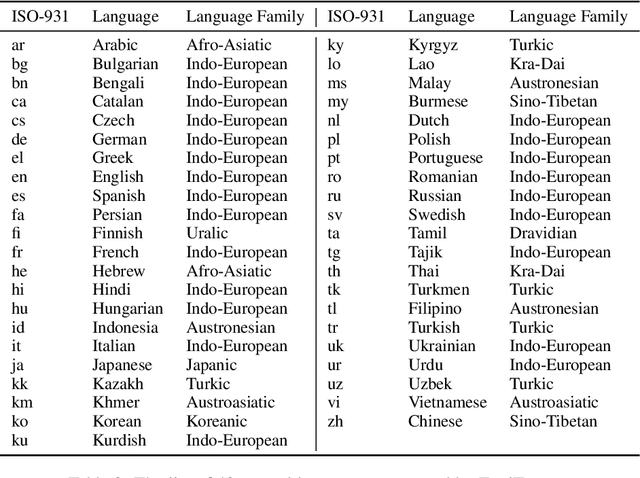

Large language models (LLMs) have demonstrated prowess in a wide range of tasks. However, many LLMs exhibit significant performance discrepancies between high- and low-resource languages. To mitigate this challenge, we present FuxiTranyu, an open-source multilingual LLM, which is designed to satisfy the need of the research community for balanced and high-performing multilingual capabilities. FuxiTranyu-8B, the base model with 8 billion parameters, is trained from scratch on a meticulously balanced multilingual data repository that contains 600 billion tokens covering 43 natural languages and 16 programming languages. In addition to the base model, we also develop two instruction-tuned models: FuxiTranyu-8B-SFT that is fine-tuned on a diverse multilingual instruction dataset, and FuxiTranyu-8B-DPO that is further refined with DPO on a preference dataset for enhanced alignment ability. Extensive experiments on a wide range of multilingual benchmarks demonstrate the competitive performance of FuxiTranyu against existing multilingual LLMs, e.g., BLOOM-7B, PolyLM-13B, Llama-2-Chat-7B and Mistral-7B-Instruct. Interpretability analyses at both the neuron and representation level suggest that FuxiTranyu is able to learn consistent multilingual representations across different languages. To promote further research into multilingual LLMs and their working mechanisms, we release both the base and instruction-tuned FuxiTranyu models together with 58 pretraining checkpoints at HuggingFace and Github.