 Add to Chrome
 Add to Firefox
 Add to Edge
Realtime-VLA V2: Learning to Run VLAs Fast, Smooth, and Accurate
Mar 27, 2026
In deployment of the VLA models to real-world robotic tasks, execution speed matters. In previous work arXiv:2510.26742 we analyze how to make neural computation of VLAs on GPU fast. However, we leave the question of how to actually deploy the VLA system on the real robots open. In this report we describe a set of practical techniques to achieve the end-to-end result of running a VLA-driven robot at an impressive speed in real world tasks that require both accuracy and dexterity. The stack of technology ranges across calibration, planning & control, and learning based method to identify optimal execution speed. In the tasks we show, the robot even executes in a speed on par with casual human operation and approaching the hardware limit of our lightweight arm. The unaccelerated videos and inference traces are provided in https://dexmal.github.io/realtime-vla-v2/.

DM0: An Embodied-Native Vision-Language-Action Model towards Physical AI
Feb 16, 2026Moving beyond the traditional paradigm of adapting internet-pretrained models to physical tasks, we present DM0, an Embodied-Native Vision-Language-Action (VLA) framework designed for Physical AI. Unlike approaches that treat physical grounding as a fine-tuning afterthought, DM0 unifies embodied manipulation and navigation by learning from heterogeneous data sources from the onset. Our methodology follows a comprehensive three-stage pipeline: Pretraining, Mid-Training, and Post-Training. First, we conduct large-scale unified pretraining on the Vision-Language Model (VLM) using diverse corpora--seamlessly integrating web text, autonomous driving scenarios, and embodied interaction logs-to jointly acquire semantic knowledge and physical priors. Subsequently, we build a flow-matching action expert atop the VLM. To reconcile high-level reasoning with low-level control, DM0 employs a hybrid training strategy: for embodied data, gradients from the action expert are not backpropagated to the VLM to preserve generalized representations, while the VLM remains trainable on non-embodied data. Furthermore, we introduce an Embodied Spatial Scaffolding strategy to construct spatial Chain-of-Thought (CoT) reasoning, effectively constraining the action solution space. Experiments on the RoboChallenge benchmark demonstrate that DM0 achieves state-of-the-art performance in both Specialist and Generalist settings on Table30.
Running VLAs at Real-time Speed
Oct 30, 2025In this paper, we show how to run pi0-level multi-view VLA at 30Hz frame rate and at most 480Hz trajectory frequency using a single consumer GPU. This enables dynamic and real-time tasks that were previously believed to be unattainable by large VLA models. To achieve it, we introduce a bag of strategies to eliminate the overheads in model inference. The real-world experiment shows that the pi0 policy with our strategy achieves a 100% success rate in grasping a falling pen task. Based on the results, we further propose a full streaming inference framework for real-time robot control of VLA. Code is available at https://github.com/Dexmal/realtime-vla.
MIPI 2023 Challenge on RGB+ToF Depth Completion: Methods and Results
Apr 27, 2023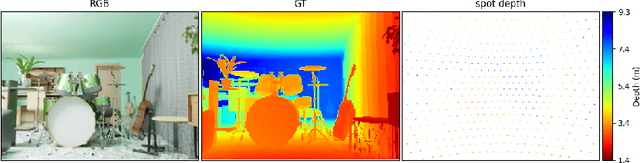

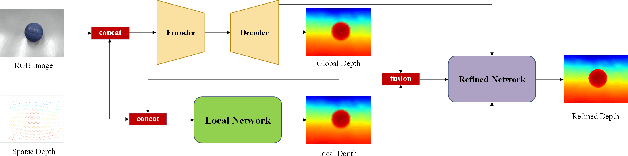
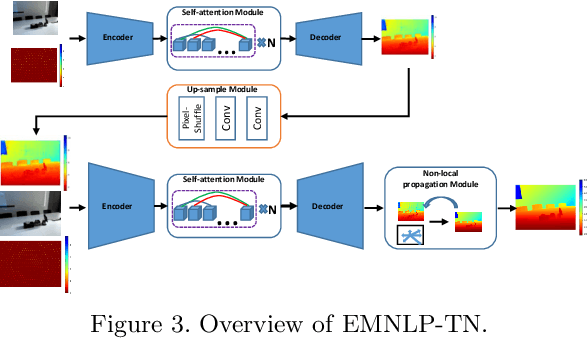
Depth completion from RGB images and sparse Time-of-Flight (ToF) measurements is an important problem in computer vision and robotics. While traditional methods for depth completion have relied on stereo vision or structured light techniques, recent advances in deep learning have enabled more accurate and efficient completion of depth maps from RGB images and sparse ToF measurements. To evaluate the performance of different depth completion methods, we organized an RGB+sparse ToF depth completion competition. The competition aimed to encourage research in this area by providing a standardized dataset and evaluation metrics to compare the accuracy of different approaches. In this report, we present the results of the competition and analyze the strengths and weaknesses of the top-performing methods. We also discuss the implications of our findings for future research in RGB+sparse ToF depth completion. We hope that this competition and report will help to advance the state-of-the-art in this important area of research. More details of this challenge and the link to the dataset can be found at https://mipi-challenge.org/MIPI2023.