 Add to Chrome
 Add to Firefox
 Add to Edge
ZipLoRA: Any Subject in Any Style by Effectively Merging LoRAs
Nov 22, 2023

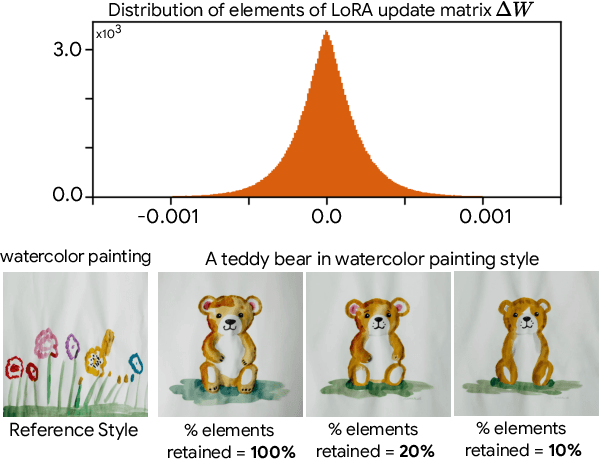


Methods for finetuning generative models for concept-driven personalization generally achieve strong results for subject-driven or style-driven generation. Recently, low-rank adaptations (LoRA) have been proposed as a parameter-efficient way of achieving concept-driven personalization. While recent work explores the combination of separate LoRAs to achieve joint generation of learned styles and subjects, existing techniques do not reliably address the problem; they often compromise either subject fidelity or style fidelity. We propose ZipLoRA, a method to cheaply and effectively merge independently trained style and subject LoRAs in order to achieve generation of any user-provided subject in any user-provided style. Experiments on a wide range of subject and style combinations show that ZipLoRA can generate compelling results with meaningful improvements over baselines in subject and style fidelity while preserving the ability to recontextualize. Project page: https://ziplora.github.io

RealFill: Reference-Driven Generation for Authentic Image Completion
Sep 28, 2023Recent advances in generative imagery have brought forth outpainting and inpainting models that can produce high-quality, plausible image content in unknown regions, but the content these models hallucinate is necessarily inauthentic, since the models lack sufficient context about the true scene. In this work, we propose RealFill, a novel generative approach for image completion that fills in missing regions of an image with the content that should have been there. RealFill is a generative inpainting model that is personalized using only a few reference images of a scene. These reference images do not have to be aligned with the target image, and can be taken with drastically varying viewpoints, lighting conditions, camera apertures, or image styles. Once personalized, RealFill is able to complete a target image with visually compelling contents that are faithful to the original scene. We evaluate RealFill on a new image completion benchmark that covers a set of diverse and challenging scenarios, and find that it outperforms existing approaches by a large margin. See more results on our project page: https://realfill.github.io
HyperDreamBooth: HyperNetworks for Fast Personalization of Text-to-Image Models
Jul 13, 2023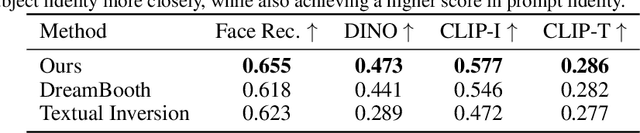
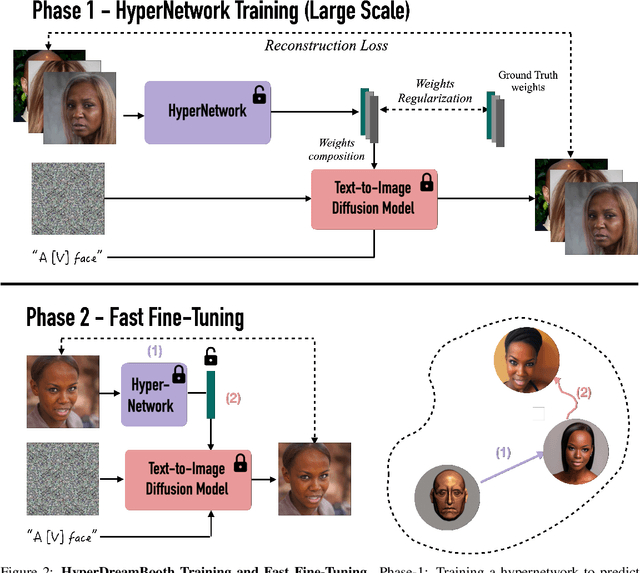
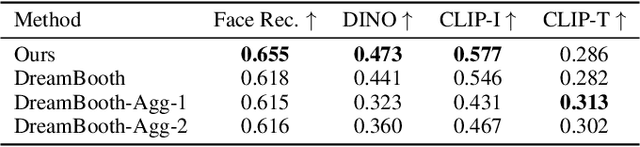
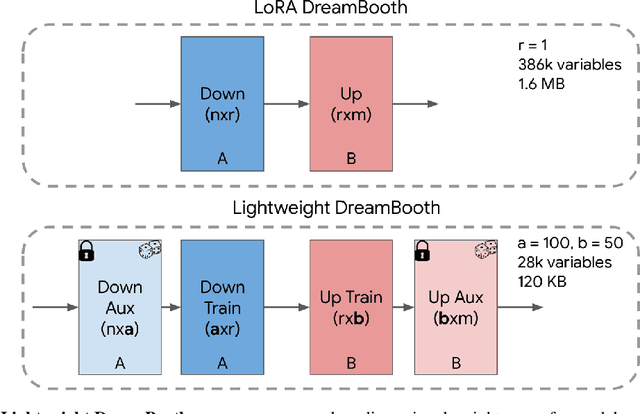
Personalization has emerged as a prominent aspect within the field of generative AI, enabling the synthesis of individuals in diverse contexts and styles, while retaining high-fidelity to their identities. However, the process of personalization presents inherent challenges in terms of time and memory requirements. Fine-tuning each personalized model needs considerable GPU time investment, and storing a personalized model per subject can be demanding in terms of storage capacity. To overcome these challenges, we propose HyperDreamBooth-a hypernetwork capable of efficiently generating a small set of personalized weights from a single image of a person. By composing these weights into the diffusion model, coupled with fast finetuning, HyperDreamBooth can generate a person's face in various contexts and styles, with high subject details while also preserving the model's crucial knowledge of diverse styles and semantic modifications. Our method achieves personalization on faces in roughly 20 seconds, 25x faster than DreamBooth and 125x faster than Textual Inversion, using as few as one reference image, with the same quality and style diversity as DreamBooth. Also our method yields a model that is 10000x smaller than a normal DreamBooth model. Project page: https://hyperdreambooth.github.io
NAVI: Category-Agnostic Image Collections with High-Quality 3D Shape and Pose Annotations
Jun 15, 2023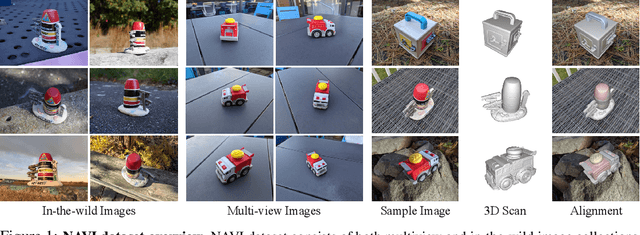


Recent advances in neural reconstruction enable high-quality 3D object reconstruction from casually captured image collections. Current techniques mostly analyze their progress on relatively simple image collections where Structure-from-Motion (SfM) techniques can provide ground-truth (GT) camera poses. We note that SfM techniques tend to fail on in-the-wild image collections such as image search results with varying backgrounds and illuminations. To enable systematic research progress on 3D reconstruction from casual image captures, we propose NAVI: a new dataset of category-agnostic image collections of objects with high-quality 3D scans along with per-image 2D-3D alignments providing near-perfect GT camera parameters. These 2D-3D alignments allow us to extract accurate derivative annotations such as dense pixel correspondences, depth and segmentation maps. We demonstrate the use of NAVI image collections on different problem settings and show that NAVI enables more thorough evaluations that were not possible with existing datasets. We believe NAVI is beneficial for systematic research progress on 3D reconstruction and correspondence estimation. Project page: https://navidataset.github.io
Background Prompting for Improved Object Depth
Jun 08, 2023Estimating the depth of objects from a single image is a valuable task for many vision, robotics, and graphics applications. However, current methods often fail to produce accurate depth for objects in diverse scenes. In this work, we propose a simple yet effective Background Prompting strategy that adapts the input object image with a learned background. We learn the background prompts only using small-scale synthetic object datasets. To infer object depth on a real image, we place the segmented object into the learned background prompt and run off-the-shelf depth networks. Background Prompting helps the depth networks focus on the foreground object, as they are made invariant to background variations. Moreover, Background Prompting minimizes the domain gap between synthetic and real object images, leading to better sim2real generalization than simple finetuning. Results on multiple synthetic and real datasets demonstrate consistent improvements in real object depths for a variety of existing depth networks. Code and optimized background prompts can be found at: https://mbaradad.github.io/depth_prompt.
ARTIC3D: Learning Robust Articulated 3D Shapes from Noisy Web Image Collections
Jun 07, 2023


Estimating 3D articulated shapes like animal bodies from monocular images is inherently challenging due to the ambiguities of camera viewpoint, pose, texture, lighting, etc. We propose ARTIC3D, a self-supervised framework to reconstruct per-instance 3D shapes from a sparse image collection in-the-wild. Specifically, ARTIC3D is built upon a skeleton-based surface representation and is further guided by 2D diffusion priors from Stable Diffusion. First, we enhance the input images with occlusions/truncation via 2D diffusion to obtain cleaner mask estimates and semantic features. Second, we perform diffusion-guided 3D optimization to estimate shape and texture that are of high-fidelity and faithful to input images. We also propose a novel technique to calculate more stable image-level gradients via diffusion models compared to existing alternatives. Finally, we produce realistic animations by fine-tuning the rendered shape and texture under rigid part transformations. Extensive evaluations on multiple existing datasets as well as newly introduced noisy web image collections with occlusions and truncation demonstrate that ARTIC3D outputs are more robust to noisy images, higher quality in terms of shape and texture details, and more realistic when animated. Project page: https://chhankyao.github.io/artic3d/
StyleDrop: Text-to-Image Generation in Any Style
Jun 01, 2023


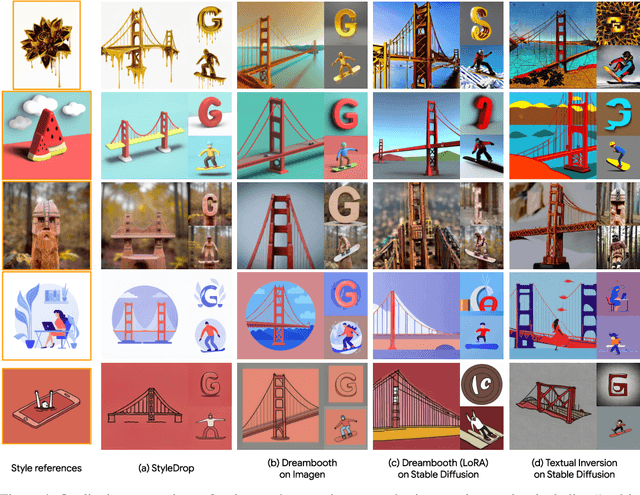
Pre-trained large text-to-image models synthesize impressive images with an appropriate use of text prompts. However, ambiguities inherent in natural language and out-of-distribution effects make it hard to synthesize image styles, that leverage a specific design pattern, texture or material. In this paper, we introduce StyleDrop, a method that enables the synthesis of images that faithfully follow a specific style using a text-to-image model. The proposed method is extremely versatile and captures nuances and details of a user-provided style, such as color schemes, shading, design patterns, and local and global effects. It efficiently learns a new style by fine-tuning very few trainable parameters (less than $1\%$ of total model parameters) and improving the quality via iterative training with either human or automated feedback. Better yet, StyleDrop is able to deliver impressive results even when the user supplies only a single image that specifies the desired style. An extensive study shows that, for the task of style tuning text-to-image models, StyleDrop implemented on Muse convincingly outperforms other methods, including DreamBooth and textual inversion on Imagen or Stable Diffusion. More results are available at our project website: https://styledrop.github.io
ShapeClipper: Scalable 3D Shape Learning from Single-View Images via Geometric and CLIP-based Consistency
Apr 13, 2023
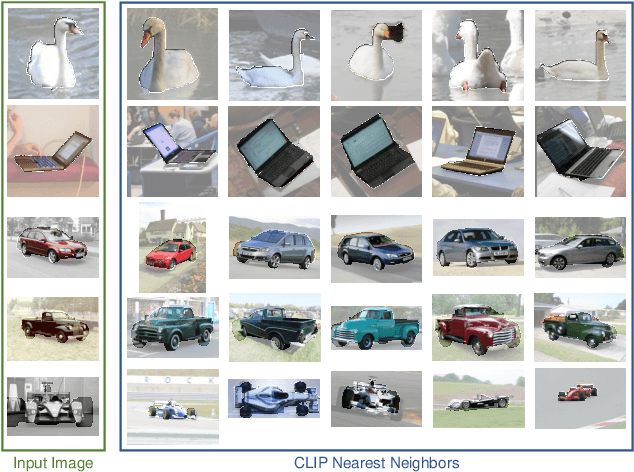


We present ShapeClipper, a novel method that reconstructs 3D object shapes from real-world single-view RGB images. Instead of relying on laborious 3D, multi-view or camera pose annotation, ShapeClipper learns shape reconstruction from a set of single-view segmented images. The key idea is to facilitate shape learning via CLIP-based shape consistency, where we encourage objects with similar CLIP encodings to share similar shapes. We also leverage off-the-shelf normals as an additional geometric constraint so the model can learn better bottom-up reasoning of detailed surface geometry. These two novel consistency constraints, when used to regularize our model, improve its ability to learn both global shape structure and local geometric details. We evaluate our method over three challenging real-world datasets, Pix3D, Pascal3D+, and OpenImages, where we achieve superior performance over state-of-the-art methods.
DreamBooth3D: Subject-Driven Text-to-3D Generation
Mar 27, 2023We present DreamBooth3D, an approach to personalize text-to-3D generative models from as few as 3-6 casually captured images of a subject. Our approach combines recent advances in personalizing text-to-image models (DreamBooth) with text-to-3D generation (DreamFusion). We find that naively combining these methods fails to yield satisfactory subject-specific 3D assets due to personalized text-to-image models overfitting to the input viewpoints of the subject. We overcome this through a 3-stage optimization strategy where we jointly leverage the 3D consistency of neural radiance fields together with the personalization capability of text-to-image models. Our method can produce high-quality, subject-specific 3D assets with text-driven modifications such as novel poses, colors and attributes that are not seen in any of the input images of the subject.
StraIT: Non-autoregressive Generation with Stratified Image Transformer
Mar 01, 2023We propose Stratified Image Transformer(StraIT), a pure non-autoregressive(NAR) generative model that demonstrates superiority in high-quality image synthesis over existing autoregressive(AR) and diffusion models(DMs). In contrast to the under-exploitation of visual characteristics in existing vision tokenizer, we leverage the hierarchical nature of images to encode visual tokens into stratified levels with emergent properties. Through the proposed image stratification that obtains an interlinked token pair, we alleviate the modeling difficulty and lift the generative power of NAR models. Our experiments demonstrate that StraIT significantly improves NAR generation and out-performs existing DMs and AR methods while being order-of-magnitude faster, achieving FID scores of 3.96 at 256*256 resolution on ImageNet without leveraging any guidance in sampling or auxiliary image classifiers. When equipped with classifier-free guidance, our method achieves an FID of 3.36 and IS of 259.3. In addition, we illustrate the decoupled modeling process of StraIT generation, showing its compelling properties on applications including domain transfer.