 Add to Chrome
 Add to Firefox
 Add to Edge
Image Generators are Generalist Vision Learners
Apr 22, 2026
Recent works show that image and video generators exhibit zero-shot visual understanding behaviors, in a way reminiscent of how LLMs develop emergent capabilities of language understanding and reasoning from generative pretraining. While it has long been conjectured that the ability to create visual content implies an ability to understand it, there has been limited evidence that generative vision models have developed strong understanding capabilities. In this work, we demonstrate that image generation training serves a role similar to LLM pretraining, and lets models learn powerful and general visual representations that enable SOTA performance on various vision tasks. We introduce Vision Banana, a generalist model built by instruction-tuning Nano Banana Pro (NBP) on a mixture of its original training data alongside a small amount of vision task data. By parameterizing the output space of vision tasks as RGB images, we seamlessly reframe perception as image generation. Our generalist model, Vision Banana, achieves SOTA results on a variety of vision tasks involving both 2D and 3D understanding, beating or rivaling zero-shot domain-specialists, including Segment Anything Model 3 on segmentation tasks, and the Depth Anything series on metric depth estimation. We show that these results can be achieved with lightweight instruction-tuning without sacrificing the base model's image generation capabilities. The superior results suggest that image generation pretraining is a generalist vision learner. It also shows that image generation serves as a unified and universal interface for vision tasks, similar to text generation's role in language understanding and reasoning. We could be witnessing a major paradigm shift for computer vision, where generative vision pretraining takes a central role in building Foundational Vision Models for both generation and understanding.

FirePlace: Geometric Refinements of LLM Common Sense Reasoning for 3D Object Placement
Mar 06, 2025Scene generation with 3D assets presents a complex challenge, requiring both high-level semantic understanding and low-level geometric reasoning. While Multimodal Large Language Models (MLLMs) excel at semantic tasks, their application to 3D scene generation is hindered by their limited grounding on 3D geometry. In this paper, we investigate how to best work with MLLMs in an object placement task. Towards this goal, we introduce a novel framework, FirePlace, that applies existing MLLMs in (1) 3D geometric reasoning and the extraction of relevant geometric details from the 3D scene, (2) constructing and solving geometric constraints on the extracted low-level geometry, and (3) pruning for final placements that conform to common sense. By combining geometric reasoning with real-world understanding of MLLMs, our method can propose object placements that satisfy both geometric constraints as well as high-level semantic common-sense considerations. Our experiments show that these capabilities allow our method to place objects more effectively in complex scenes with intricate geometry, surpassing the quality of prior work.
NAVI: Category-Agnostic Image Collections with High-Quality 3D Shape and Pose Annotations
Jun 15, 2023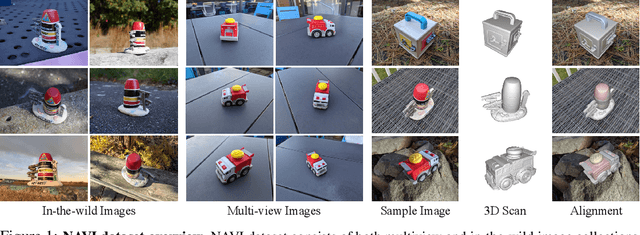


Recent advances in neural reconstruction enable high-quality 3D object reconstruction from casually captured image collections. Current techniques mostly analyze their progress on relatively simple image collections where Structure-from-Motion (SfM) techniques can provide ground-truth (GT) camera poses. We note that SfM techniques tend to fail on in-the-wild image collections such as image search results with varying backgrounds and illuminations. To enable systematic research progress on 3D reconstruction from casual image captures, we propose NAVI: a new dataset of category-agnostic image collections of objects with high-quality 3D scans along with per-image 2D-3D alignments providing near-perfect GT camera parameters. These 2D-3D alignments allow us to extract accurate derivative annotations such as dense pixel correspondences, depth and segmentation maps. We demonstrate the use of NAVI image collections on different problem settings and show that NAVI enables more thorough evaluations that were not possible with existing datasets. We believe NAVI is beneficial for systematic research progress on 3D reconstruction and correspondence estimation. Project page: https://navidataset.github.io