 Add to Chrome
 Add to Firefox
 Add to Edge
RethinkMCTS: Refining Erroneous Thoughts in Monte Carlo Tree Search for Code Generation
Sep 15, 2024
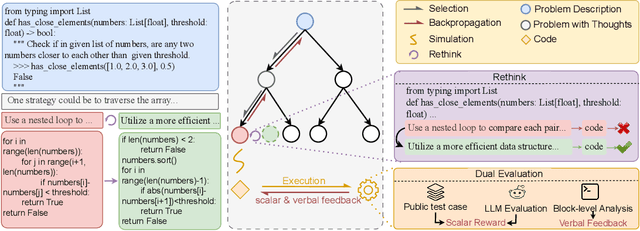
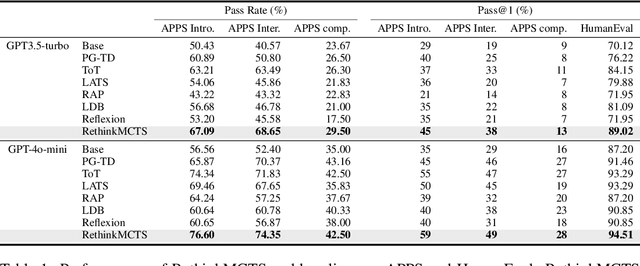
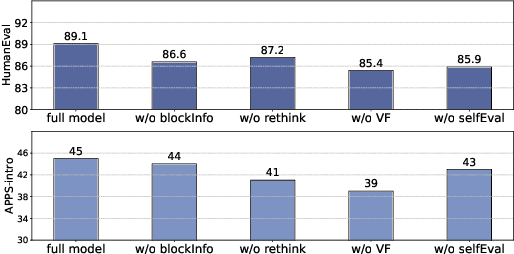

LLM agents enhanced by tree search algorithms have yielded notable performances in code generation. However, current search algorithms in this domain suffer from low search quality due to several reasons: 1) Ineffective design of the search space for the high-reasoning demands of code generation tasks, 2) Inadequate integration of code feedback with the search algorithm, and 3) Poor handling of negative feedback during the search, leading to reduced search efficiency and quality. To address these challenges, we propose to search for the reasoning process of the code and use the detailed feedback of code execution to refine erroneous thoughts during the search. In this paper, we introduce RethinkMCTS, which employs the Monte Carlo Tree Search (MCTS) algorithm to conduct thought-level searches before generating code, thereby exploring a wider range of strategies. More importantly, we construct verbal feedback from fine-grained code execution feedback to refine erroneous thoughts during the search. This ensures that the search progresses along the correct reasoning paths, thus improving the overall search quality of the tree by leveraging execution feedback. Through extensive experiments, we demonstrate that RethinkMCTS outperforms previous search-based and feedback-based code generation baselines. On the HumanEval dataset, it improves the pass@1 of GPT-3.5-turbo from 70.12 to 89.02 and GPT-4o-mini from 87.20 to 94.51. It effectively conducts more thorough exploration through thought-level searches and enhances the search quality of the entire tree by incorporating rethink operation.

A Survey on Diffusion Models for Recommender Systems
Sep 08, 2024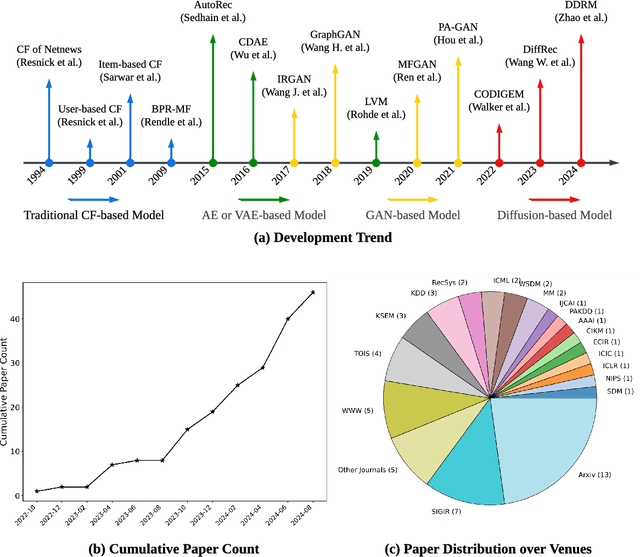
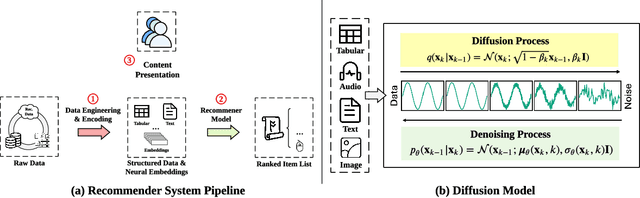
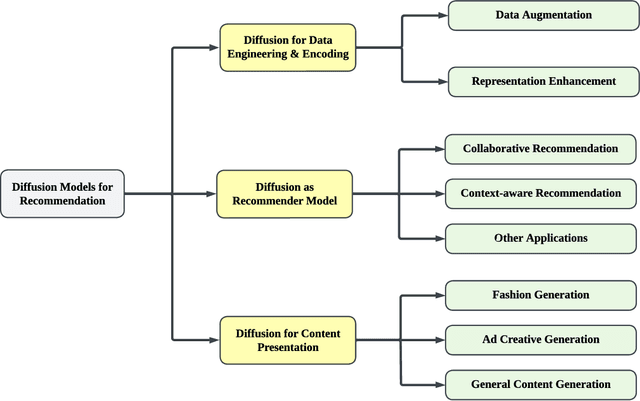
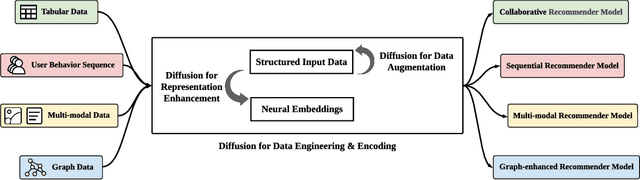
While traditional recommendation techniques have made significant strides in the past decades, they still suffer from limited generalization performance caused by factors like inadequate collaborative signals, weak latent representations, and noisy data. In response, diffusion models (DMs) have emerged as promising solutions for recommender systems due to their robust generative capabilities, solid theoretical foundations, and improved training stability. To this end, in this paper, we present the first comprehensive survey on diffusion models for recommendation, and draw a bird's-eye view from the perspective of the whole pipeline in real-world recommender systems. We systematically categorize existing research works into three primary domains: (1) diffusion for data engineering & encoding, focusing on data augmentation and representation enhancement; (2) diffusion as recommender models, employing diffusion models to directly estimate user preferences and rank items; and (3) diffusion for content presentation, utilizing diffusion models to generate personalized content such as fashion and advertisement creatives. Our taxonomy highlights the unique strengths of diffusion models in capturing complex data distributions and generating high-quality, diverse samples that closely align with user preferences. We also summarize the core characteristics of the adapting diffusion models for recommendation, and further identify key areas for future exploration, which helps establish a roadmap for researchers and practitioners seeking to advance recommender systems through the innovative application of diffusion models. To further facilitate the research community of recommender systems based on diffusion models, we actively maintain a GitHub repository for papers and other related resources in this rising direction https://github.com/CHIANGEL/Awesome-Diffusion-for-RecSys.
Efficient and Deployable Knowledge Infusion for Open-World Recommendations via Large Language Models
Aug 20, 2024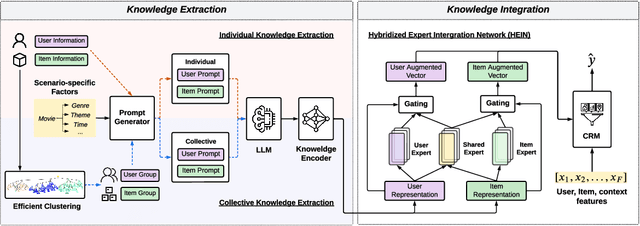


Recommender systems (RSs) play a pervasive role in today's online services, yet their closed-loop nature constrains their access to open-world knowledge. Recently, large language models (LLMs) have shown promise in bridging this gap. However, previous attempts to directly implement LLMs as recommenders fall short in meeting the requirements of industrial RSs, particularly in terms of online inference latency and offline resource efficiency. Thus, we propose REKI to acquire two types of external knowledge about users and items from LLMs. Specifically, we introduce factorization prompting to elicit accurate knowledge reasoning on user preferences and items. We develop individual knowledge extraction and collective knowledge extraction tailored for different scales of scenarios, effectively reducing offline resource consumption. Subsequently, generated knowledge undergoes efficient transformation and condensation into augmented vectors through a hybridized expert-integrated network, ensuring compatibility. The obtained vectors can then be used to enhance any conventional recommendation model. We also ensure efficient inference by preprocessing and prestoring the knowledge from LLMs. Experiments demonstrate that REKI outperforms state-of-the-art baselines and is compatible with lots of recommendation algorithms and tasks. Now, REKI has been deployed to Huawei's news and music recommendation platforms and gained a 7% and 1.99% improvement during the online A/B test.
A Decoding Acceleration Framework for Industrial Deployable LLM-based Recommender Systems
Aug 11, 2024Recently, increasing attention has been paid to LLM-based recommender systems, but their deployment is still under exploration in the industry. Most deployments utilize LLMs as feature enhancers, generating augmentation knowledge in the offline stage. However, in recommendation scenarios, involving numerous users and items, even offline generation with LLMs consumes considerable time and resources. This generation inefficiency stems from the autoregressive nature of LLMs, and a promising direction for acceleration is speculative decoding, a Draft-then-Verify paradigm that increases the number of generated tokens per decoding step. In this paper, we first identify that recommendation knowledge generation is suitable for retrieval-based speculative decoding. Then, we discern two characteristics: (1) extensive items and users in RSs bring retrieval inefficiency, and (2) RSs exhibit high diversity tolerance for text generated by LLMs. Based on the above insights, we propose a Decoding Acceleration Framework for LLM-based Recommendation (dubbed DARE), with Customized Retrieval Pool to improve retrieval efficiency and Relaxed Verification to increase the acceptance rate of draft tokens, respectively. Extensive experiments demonstrate that DARE achieves a 3-5x speedup and is compatible with various frameworks and backbone LLMs. DARE has also been deployed to online advertising scenarios within a large-scale commercial environment, achieving a 3.45x speedup while maintaining the downstream performance.
Lifelong Personalized Low-Rank Adaptation of Large Language Models for Recommendation
Aug 07, 2024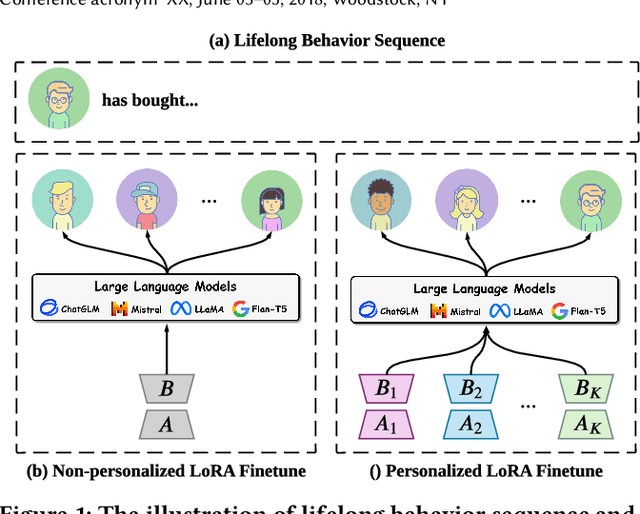
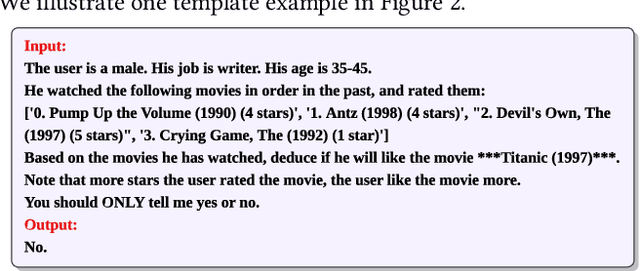
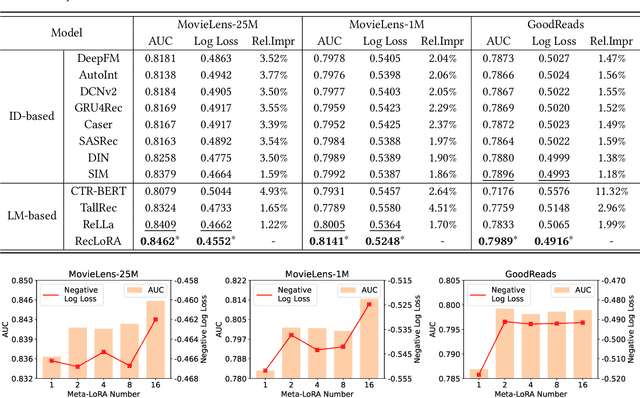
We primarily focus on the field of large language models (LLMs) for recommendation, which has been actively explored recently and poses a significant challenge in effectively enhancing recommender systems with logical reasoning abilities and open-world knowledge. Current mainstream efforts mainly center around injecting personalized information from recommendation models into LLMs by customizing input templates or aligning representations between semantic and recommendation spaces at the prediction layer. However, they face three significant limitations: (1) LoRA is mostly used as a core component in existing works, but personalization is not well established in LoRA parameters as the LoRA matrix shared by every user may not cater to different users' characteristics, leading to suboptimal performance. (2) Although lifelong personalized behavior sequences are ideal for personalization, their use raises effectiveness and efficiency issues since LLMs require escalating training and inference time to extend text lengths. (3) Existing approaches aren't scalable for large datasets due to training efficiency constraints. Thus, LLMs only see a small fraction of the datasets (e.g., less than 10%) instead of the whole datasets, limiting their exposure to the full training space. To address these problems, we propose RecLoRA. This model incorporates a Personalized LoRA module that maintains independent LoRAs for different users and a Long-Short Modality Retriever that retrieves different history lengths for different modalities, significantly improving performance while adding minimal time cost. Furthermore, we design a Few2Many Learning Strategy, using a conventional recommendation model as a lens to magnify small training spaces to full spaces. Extensive experiments on public datasets demonstrate the efficacy of our RecLoRA compared to existing baseline models.
MemoCRS: Memory-enhanced Sequential Conversational Recommender Systems with Large Language Models
Jul 06, 2024


Conversational recommender systems (CRSs) aim to capture user preferences and provide personalized recommendations through multi-round natural language dialogues. However, most existing CRS models mainly focus on dialogue comprehension and preferences mining from the current dialogue session, overlooking user preferences in historical dialogue sessions. The preferences embedded in the user's historical dialogue sessions and the current session exhibit continuity and sequentiality, and we refer to CRSs with this characteristic as sequential CRSs. In this work, we leverage memory-enhanced LLMs to model the preference continuity, primarily focusing on addressing two key issues: (1) redundancy and noise in historical dialogue sessions, and (2) the cold-start users problem. To this end, we propose a Memory-enhanced Conversational Recommender System Framework with Large Language Models (dubbed MemoCRS) consisting of user-specific memory and general memory. User-specific memory is tailored to each user for their personalized interests and implemented by an entity-based memory bank to refine preferences and retrieve relevant memory, thereby reducing the redundancy and noise of historical sessions. The general memory, encapsulating collaborative knowledge and reasoning guidelines, can provide shared knowledge for users, especially cold-start users. With the two kinds of memory, LLMs are empowered to deliver more precise and tailored recommendations for each user. Extensive experiments on both Chinese and English datasets demonstrate the effectiveness of MemoCRS.
Cloud-Edge-Terminal Collaborative AIGC for Autonomous Driving
Jul 02, 2024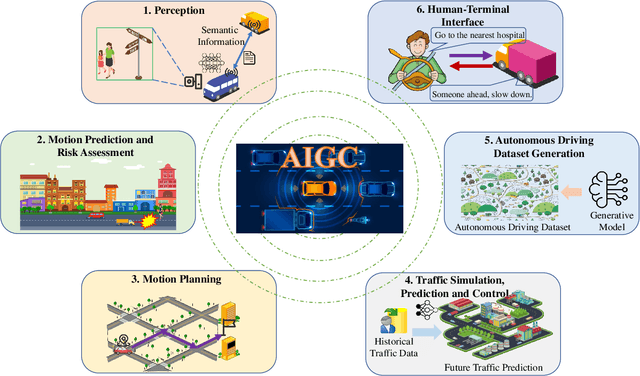
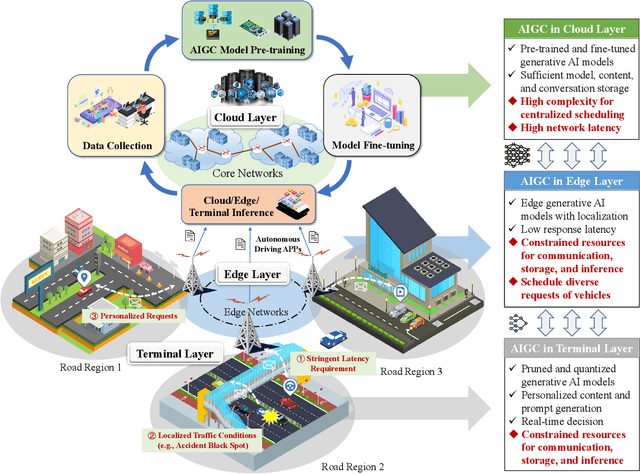
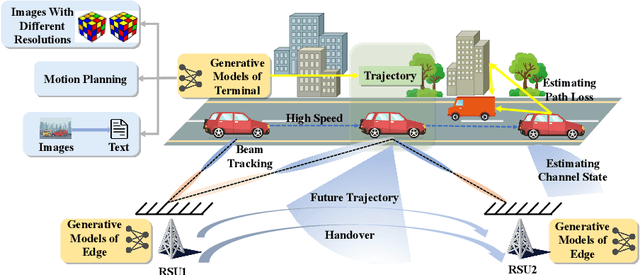
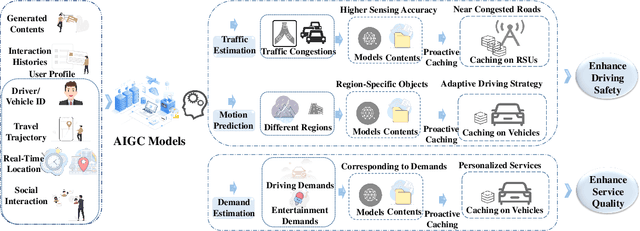
In dynamic autonomous driving environment, Artificial Intelligence-Generated Content (AIGC) technology can supplement vehicle perception and decision making by leveraging models' generative and predictive capabilities, and has the potential to enhance motion planning, trajectory prediction and traffic simulation. This article proposes a cloud-edge-terminal collaborative architecture to support AIGC for autonomous driving. By delving into the unique properties of AIGC services, this article initiates the attempts to construct mutually supportive AIGC and network systems for autonomous driving, including communication, storage and computation resource allocation schemes to support AIGC services, and leveraging AIGC to assist system design and resource management.
SINKT: A Structure-Aware Inductive Knowledge Tracing Model with Large Language Model
Jul 01, 2024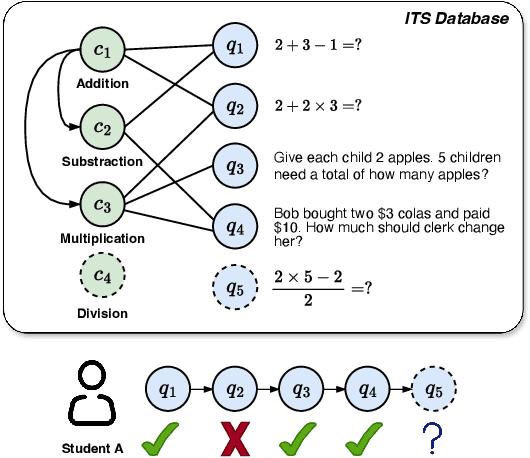

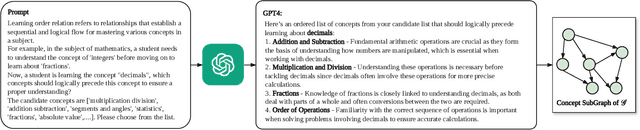

Knowledge Tracing (KT) aims to determine whether students will respond correctly to the next question, which is a crucial task in intelligent tutoring systems (ITS). In educational KT scenarios, transductive ID-based methods often face severe data sparsity and cold start problems, where interactions between individual students and questions are sparse, and new questions and concepts consistently arrive in the database. In addition, existing KT models only implicitly consider the correlation between concepts and questions, lacking direct modeling of the more complex relationships in the heterogeneous graph of concepts and questions. In this paper, we propose a Structure-aware Inductive Knowledge Tracing model with large language model (dubbed SINKT), which, for the first time, introduces large language models (LLMs) and realizes inductive knowledge tracing. Firstly, SINKT utilizes LLMs to introduce structural relationships between concepts and constructs a heterogeneous graph for concepts and questions. Secondly, by encoding concepts and questions with LLMs, SINKT incorporates semantic information to aid prediction. Finally, SINKT predicts the student's response to the target question by interacting with the student's knowledge state and the question representation. Experiments on four real-world datasets demonstrate that SINKT achieves state-of-the-art performance among 12 existing transductive KT models. Additionally, we explore the performance of SINKT on the inductive KT task and provide insights into various modules.
Long-Horizon Rollout via Dynamics Diffusion for Offline Reinforcement Learning
Jun 09, 2024
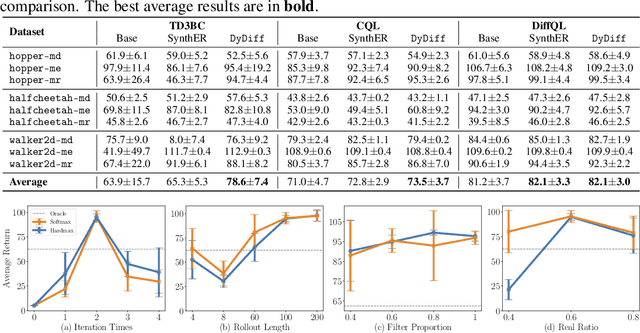
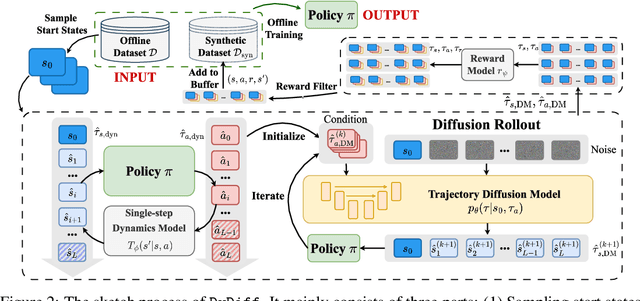
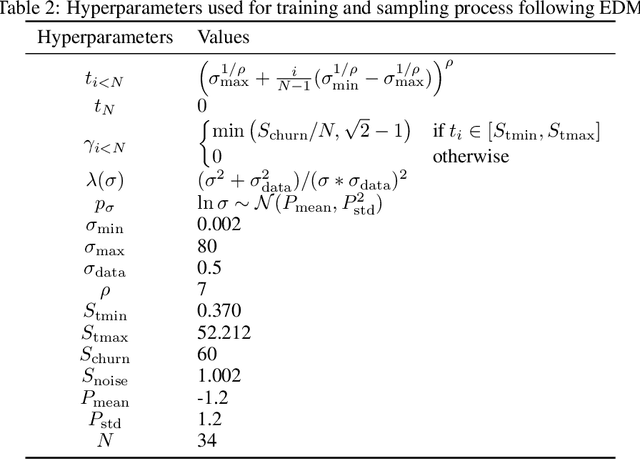
With the great success of diffusion models (DMs) in generating realistic synthetic vision data, many researchers have investigated their potential in decision-making and control. Most of these works utilized DMs to sample directly from the trajectory space, where DMs can be viewed as a combination of dynamics models and policies. In this work, we explore how to decouple DMs' ability as dynamics models in fully offline settings, allowing the learning policy to roll out trajectories. As DMs learn the data distribution from the dataset, their intrinsic policy is actually the behavior policy induced from the dataset, which results in a mismatch between the behavior policy and the learning policy. We propose Dynamics Diffusion, short as DyDiff, which can inject information from the learning policy to DMs iteratively. DyDiff ensures long-horizon rollout accuracy while maintaining policy consistency and can be easily deployed on model-free algorithms. We provide theoretical analysis to show the advantage of DMs on long-horizon rollout over models and demonstrate the effectiveness of DyDiff in the context of offline reinforcement learning, where the rollout dataset is provided but no online environment for interaction. Our code is at https://github.com/FineArtz/DyDiff.
Large Language Models Make Sample-Efficient Recommender Systems
Jun 04, 2024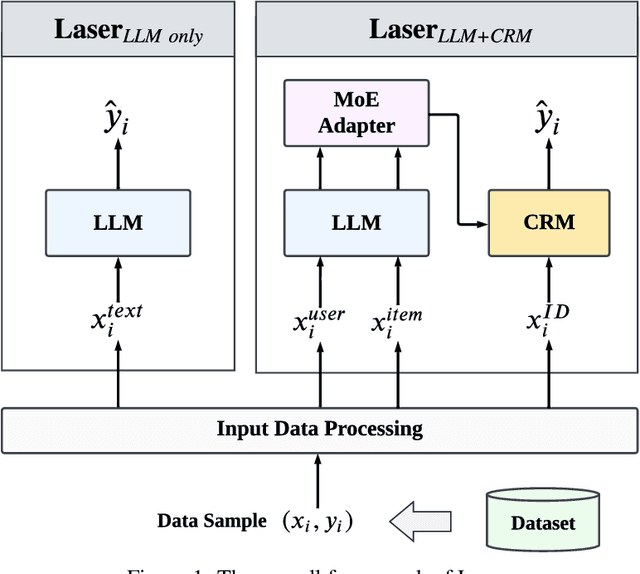
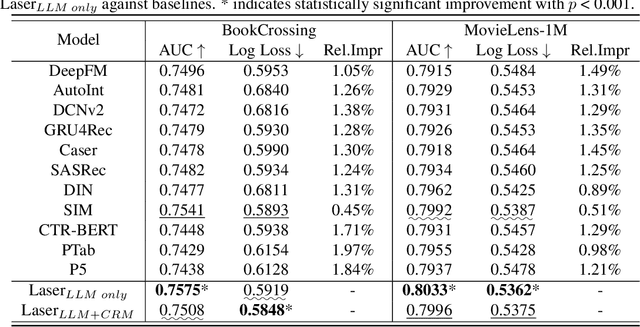

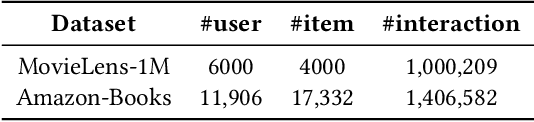
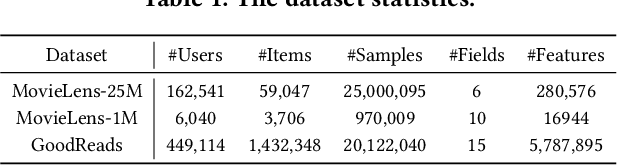
Large language models (LLMs) have achieved remarkable progress in the field of natural language processing (NLP), demonstrating remarkable abilities in producing text that resembles human language for various tasks. This opens up new opportunities for employing them in recommender systems (RSs). In this paper, we specifically examine the sample efficiency of LLM-enhanced recommender systems, which pertains to the model's capacity to attain superior performance with a limited quantity of training data. Conventional recommendation models (CRMs) often need a large amount of training data because of the sparsity of features and interactions. Hence, we propose and verify our core viewpoint: Large Language Models Make Sample-Efficient Recommender Systems. We propose a simple yet effective framework (i.e., Laser) to validate the viewpoint from two aspects: (1) LLMs themselves are sample-efficient recommenders; and (2) LLMs, as feature generators and encoders, make CRMs more sample-efficient. Extensive experiments on two public datasets show that Laser requires only a small fraction of training samples to match or even surpass CRMs that are trained on the entire training set, demonstrating superior sample efficiency.