 Add to Chrome
 Add to Firefox
 Add to Edge
Fine-Tuning Qwen3-27B for C-to-Rust Code Translation: A Three-Stage Curriculum of Pretraining, Debugging-Aware SFT, and Task-Specific SFT
Aug 13, 2026
Translating C code into safe, idiomatic Rust is a longstanding software-engineering goal because it can eliminate entire classes of memory-safety vulnerabilities while preserving the functional behavior of legacy systems. Large language models (LLMs) have shown promise for this task but typically underperform when applied off-the-shelf, since general-purpose pretraining rarely emphasizes idiomatic Rust generation, cross-language semantic equivalence, or the ability to reason about and repair compiler/runtime feedback. In this report we describe a three-stage fine-tuning curriculum applied to Qwen3-27B that is designed to progressively specialize the model for the C-to-Rust (C2Rust) translation task: (1) continued pretraining on Rust-centric corpora to strengthen the model's prior over idiomatic Rust syntax and standard-library usage; (2) supervised fine-tuning (SFT) on the microsoft/Verus_Training_Data dataset to instill debugging and self-repair behavior over Rust code; and (3) task-specific SFT on paired C/Rust solutions derived from LeetCode problems to teach direct semantic translation. We evaluate the resulting model using the agentic, static-analysis-guided verification framework of SACTOR, which performs structure-aware, two-phase (unidiomatic to idiomatic) translation with foreign-function-interface (FFI)-based end-to-end (E2E) testing. We report success rate, idiomaticity (Clippy lint counts, unsafe-code fraction), and failure-mode analyses, and compare our fine-tuned model against baseline Qwen3-27B and other LLMs evaluated under the same framework.

Post-Training in End-to-End Autonomous Driving
Jul 09, 2026End-to-end models that map multimodal inputs directly to future trajectories/maneuvers have emerged as an increasingly prominent research paradigm in autonomous driving. This class of models includes both Vision-Language-Action models and trajectory-generative planners. Unlike classic machine learning applications, autonomous vehicles operate in safety-critical and interaction-intensive environments where traditional open-loop imitation of expert demonstrations is not sufficient to ensure reliability. In particular, small execution errors can accumulate over time, while recovery behaviors are scarce in training data. In addition, long-horizon objectives such as safety and driving comfort are not captured by pointwise labels either. These limitations have motivated a shift toward post-training techniques, which further refine driving policies beyond pure imitation. This survey presents a unified view of post-training for autonomous driving by defining its scope and organizing the existing literature into four major families based on the form of supervision they use. For each family, we discuss its capabilities, limitations, and open challenges. We aim to facilitate a systematic understanding of this emerging area and stimulate future research on reliable and efficient post-training for autonomous driving.
Flash-WAM: Modality-Aware Distillation for World Action Models
Jun 03, 2026World-action models (WAMs) jointly generate future video and robot actions through iterative diffusion, achieving strong performance on manipulation benchmarks but requiring tens of denoising steps, a cost that precludes real-time control. Step distillation has emerged as the natural remedy, but off-the-shelf methods break down in the joint video-action setting because video and action streams use different SNR-shifted noise schedules and reach training with substantially different marginal noise distributions, an asymmetry that single-modality distillation methods cannot accommodate. We introduce \textbf{Flash-WAM}, a modality-aware step-distillation framework inspired by consistency distillation that selects the consistency function for each modality to match its noise regime: a linear-gradient-scaling parametrization for the action stream's low-noise regime, paired with a variance-preserving parametrization for the video stream's high-noise regime, grounded in a structural analysis of the consistency-function family that characterizes the achievable gradient scaling under the consistency boundary condition. Instantiated on LingBot-VA, Flash-WAM compresses inference to a single step in each modality. On RoboTwin 2.0, this reduces per-chunk latency from $8.1$ seconds to $348$ ms on NVIDIA L40S, a $23{\times}$ speedup that enables real-time inference. Flash-WAM preserves task success on simulation benchmarks ($85.5\%$ RoboTwin 2.0, $95.7\%$ LIBERO) and substantially recovers real-world performance ($60\%$ average on a Unitree G1 humanoid robot), while naive consistency distillation drops to $24\%$ at the same step budget.
STORM: Internalized Modeling for Spatial-Temporal Reasoning in Video-Language Models
May 25, 2026Many video reasoning tasks require tracking motion, temporal order, and evolving visual states across frames. Existing methods built on large vision-language models (LVLMs) often address this challenge by externalizing reasoning through textual chain-of-thought (CoT), keyframe selection, repeated frame reinsertion, or external tool use. While effective, such pipelines increase inference-time latency and engineering complexity, and they force temporal-visual evidence to be serialized into text or repeatedly re-encoded from frames. Inspired by the intuition that visual reasoning can occur implicitly before verbalization, we propose STORMS (Spatial-Temporal reasOning via inteRnalized Modeling), a two-stage framework that teaches LVLMs to reason through bounded continuous latent trajectories instead of explicit textual CoT. In Stage I, STORMS aligns latent tokens with thought-video representations derived from generated videos, grounding the latent states in dynamic visual evidence. In Stage II, the model is further trained with answer-only supervision, encouraging the reasoning process to be internalized without step-by-step annotations. Generated thought videos are used only during training; at inference, STORMS performs a bounded latent rollout without regenerating videos, reinserting frames, or invoking external visual tools. Experiments on VideoMME, MVBench, TempCompass, and MMVU show that STORMS improves video reasoning accuracy while substantially reducing inference overhead compared with tool or video-generation-based reasoning pipelines.
From Complex Dynamics to DynFormer: Rethinking Transformers for PDEs
Mar 03, 2026Partial differential equations (PDEs) are fundamental for modeling complex physical systems, yet classical numerical solvers face prohibitive computational costs in high-dimensional and multi-scale regimes. While Transformer-based neural operators have emerged as powerful data-driven alternatives, they conventionally treat all discretized spatial points as uniform, independent tokens. This monolithic approach ignores the intrinsic scale separation of physical fields, applying computationally prohibitive global attention that redundantly mixes smooth large-scale dynamics with high-frequency fluctuations. Rethinking Transformers through the lens of complex dynamics, we propose DynFormer, a novel dynamics-informed neural operator. Rather than applying a uniform attention mechanism across all scales, DynFormer explicitly assigns specialized network modules to distinct physical scales. It leverages a Spectral Embedding to isolate low-frequency modes, enabling a Kronecker-structured attention mechanism to efficiently capture large-scale global interactions with reduced complexity. Concurrently, we introduce a Local-Global-Mixing transformation. This module utilizes nonlinear multiplicative frequency mixing to implicitly reconstruct the small-scale, fast-varying turbulent cascades that are slaved to the macroscopic state, without incurring the cost of global attention. Integrating these modules into a hybrid evolutionary architecture ensures robust long-term temporal stability. Extensive memory-aligned evaluations across four PDE benchmarks demonstrate that DynFormer achieves up to a 95% reduction in relative error compared to state-of-the-art baselines, while significantly reducing GPU memory consumption. Our results establish that embedding first-principles physical dynamics into Transformer architectures yields a highly scalable, theoretically grounded blueprint for PDE surrogate modeling.
Recurrent Preference Memory for Efficient Long-Sequence Generative Recommendation
Feb 13, 2026Generative recommendation (GenRec) models typically model user behavior via full attention, but scaling to lifelong sequences is hindered by prohibitive computational costs and noise accumulation from stochastic interactions. To address these challenges, we introduce Rec2PM, a framework that compresses long user interaction histories into compact Preference Memory tokens. Unlike traditional recurrent methods that suffer from serial training, Rec2PM employs a novel self-referential teacher-forcing strategy: it leverages a global view of the history to generate reference memories, which serve as supervision targets for parallelized recurrent updates. This allows for fully parallel training while maintaining the capability for iterative updates during inference. Additionally, by representing memory as token embeddings rather than extensive KV caches, Rec2PM achieves extreme storage efficiency. Experiments on large-scale benchmarks show that Rec2PM significantly reduces inference latency and memory footprint while achieving superior accuracy compared to full-sequence models. Analysis reveals that the Preference Memory functions as a denoising Information Bottleneck, effectively filtering interaction noise to capture robust long-term interests.
Effective MoE-based LLM Compression by Exploiting Heterogeneous Inter-Group Experts Routing Frequency and Information Density
Feb 11, 2026Mixture-of-Experts (MoE) based Large Language Models (LLMs) have achieved superior performance, yet the massive memory overhead caused by storing multiple expert networks severely hinders their practical deployment. Singular Value Decomposition (SVD)-based compression has emerged as a promising post-training technique; however, most existing methods apply uniform rank allocation or rely solely on static weight properties. This overlooks the substantial heterogeneity in expert utilization observed in MoE models, where frequent routing patterns and intrinsic information density vary significantly across experts. In this work, we propose RFID-MoE, an effective framework for MoE compression by exploiting heterogeneous Routing Frequency and Information Density. We first introduce a fused metric that combines expert activation frequency with effective rank to measure expert importance, adaptively allocating higher ranks to critical expert groups under a fixed budget. Moreover, instead of discarding compression residuals, we reconstruct them via a parameter-efficient sparse projection mechanism to recover lost information with minimal parameter overhead. Extensive experiments on representative MoE LLMs (e.g., Qwen3, DeepSeekMoE) across multiple compression ratios demonstrate that RFID-MoE consistently outperforms state-of-the-art methods like MoBE and D2-MoE. Notably, RFID-MoE achieves a perplexity of 16.92 on PTB with the Qwen3-30B model at a 60% compression ratio, reducing perplexity by over 8.0 compared to baselines, and improves zero-shot accuracy on HellaSwag by approximately 8%.
AInsteinBench: Benchmarking Coding Agents on Scientific Repositories
Dec 24, 2025We introduce AInsteinBench, a large-scale benchmark for evaluating whether large language model (LLM) agents can operate as scientific computing development agents within real research software ecosystems. Unlike existing scientific reasoning benchmarks which focus on conceptual knowledge, or software engineering benchmarks that emphasize generic feature implementation and issue resolving, AInsteinBench evaluates models in end-to-end scientific development settings grounded in production-grade scientific repositories. The benchmark consists of tasks derived from maintainer-authored pull requests across six widely used scientific codebases, spanning quantum chemistry, quantum computing, molecular dynamics, numerical relativity, fluid dynamics, and cheminformatics. All benchmark tasks are carefully curated through multi-stage filtering and expert review to ensure scientific challenge, adequate test coverage, and well-calibrated difficulty. By leveraging evaluation in executable environments, scientifically meaningful failure modes, and test-driven verification, AInsteinBench measures a model's ability to move beyond surface-level code generation toward the core competencies required for computational scientific research.
Context-Aware Autoregressive Models for Multi-Conditional Image Generation
May 18, 2025Autoregressive transformers have recently shown impressive image generation quality and efficiency on par with state-of-the-art diffusion models. Unlike diffusion architectures, autoregressive models can naturally incorporate arbitrary modalities into a single, unified token sequence--offering a concise solution for multi-conditional image generation tasks. In this work, we propose $\textbf{ContextAR}$, a flexible and effective framework for multi-conditional image generation. ContextAR embeds diverse conditions (e.g., canny edges, depth maps, poses) directly into the token sequence, preserving modality-specific semantics. To maintain spatial alignment while enhancing discrimination among different condition types, we introduce hybrid positional encodings that fuse Rotary Position Embedding with Learnable Positional Embedding. We design Conditional Context-aware Attention to reduces computational complexity while preserving effective intra-condition perception. Without any fine-tuning, ContextAR supports arbitrary combinations of conditions during inference time. Experimental results demonstrate the powerful controllability and versatility of our approach, and show that the competitive perpormance than diffusion-based multi-conditional control approaches the existing autoregressive baseline across diverse multi-condition driven scenarios. Project page: $\href{https://context-ar.github.io/}{https://context-ar.github.io/.}$
Performance Analysis of Deep Learning Models for Femur Segmentation in MRI Scan
Apr 05, 2025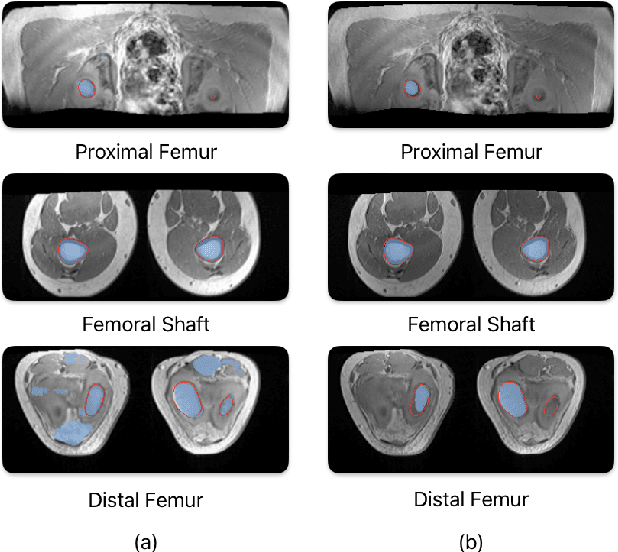
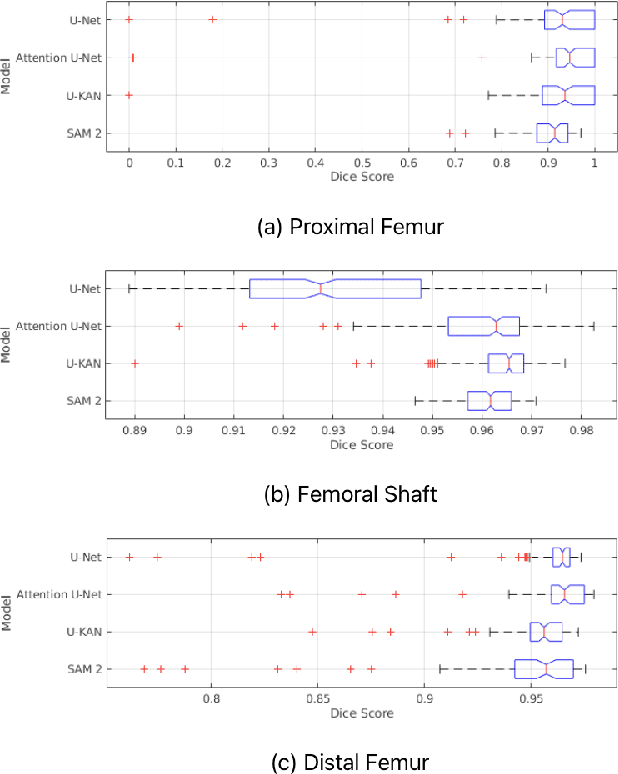
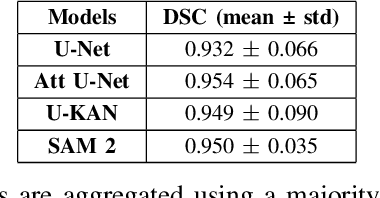
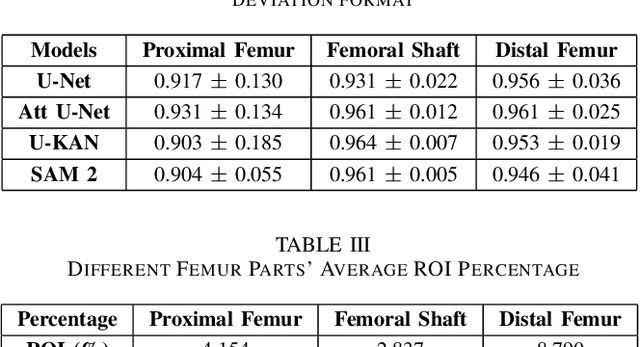
Convolutional neural networks like U-Net excel in medical image segmentation, while attention mechanisms and KAN enhance feature extraction. Meta's SAM 2 uses Vision Transformers for prompt-based segmentation without fine-tuning. However, biases in these models impact generalization with limited data. In this study, we systematically evaluate and compare the performance of three CNN-based models, i.e., U-Net, Attention U-Net, and U-KAN, and one transformer-based model, i.e., SAM 2 for segmenting femur bone structures in MRI scan. The dataset comprises 11,164 MRI scans with detailed annotations of femoral regions. Performance is assessed using the Dice Similarity Coefficient, which ranges from 0.932 to 0.954. Attention U-Net achieves the highest overall scores, while U-KAN demonstrated superior performance in anatomical regions with a smaller region of interest, leveraging its enhanced learning capacity to improve segmentation accuracy.