 Add to Chrome
 Add to Firefox
 Add to Edge
A Utility-preserving De-identification Pipeline for Cross-hospital Radiology Data Sharing
Apr 08, 2026
Large-scale radiology data are critical for developing robust medical AI systems. However, sharing such data across hospitals remains heavily constrained by privacy concerns. Existing de-identification research in radiology mainly focus on removing identifiable information to enable compliant data release. Yet whether de-identified radiology data can still preserve sufficient utility for large-scale vision-language model training and cross-hospital transfer remains underexplored. In this paper, we introduce a utility-preserving de-identification pipeline (UPDP) for cross-hospital radiology data sharing. Specifically, we compile a blacklist of privacy-sensitive terms and a whitelist of pathology-related terms. For radiology images, we use a generative filtering mechanism that synthesis a privacy-filtered and pathology-reserved counterparts of the original images. These synthetic image counterparts, together with ID-filtered reports, can then be securely shared across hospitals for downstream model development and evaluation. Experiments on public chest X-ray benchmarks demonstrate that our method effectively removes privacy-sensitive information while preserving diagnostically relevant pathology cues. Models trained on the de-identified data maintain competitive diagnostic accuracy compared with those trained on the original data, while exhibiting a marked decline in identity-related accuracy, confirming effective privacy protection. In the cross-hospital setting, we further show that de-identified data can be combined with local data to yield better performance.

Unsupervised Search for Ethnic Minorities' Medical Segmentation Training Set
Jan 05, 2025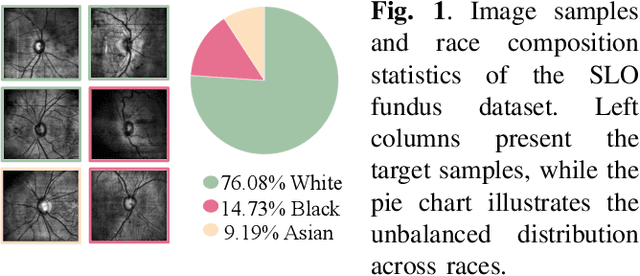
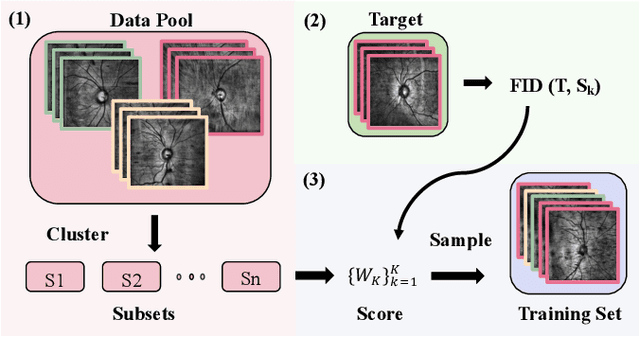
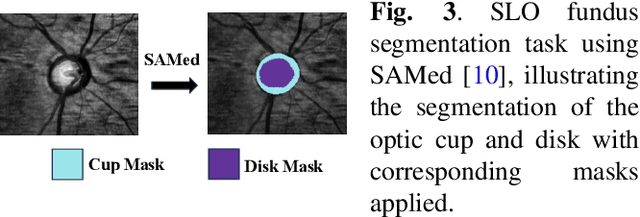
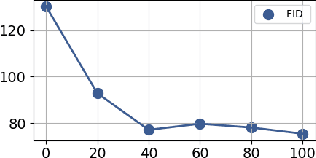
This article investigates the critical issue of dataset bias in medical imaging, with a particular emphasis on racial disparities caused by uneven population distribution in dataset collection. Our analysis reveals that medical segmentation datasets are significantly biased, primarily influenced by the demographic composition of their collection sites. For instance, Scanning Laser Ophthalmoscopy (SLO) fundus datasets collected in the United States predominantly feature images of White individuals, with minority racial groups underrepresented. This imbalance can result in biased model performance and inequitable clinical outcomes, particularly for minority populations. To address this challenge, we propose a novel training set search strategy aimed at reducing these biases by focusing on underrepresented racial groups. Our approach utilizes existing datasets and employs a simple greedy algorithm to identify source images that closely match the target domain distribution. By selecting training data that aligns more closely with the characteristics of minority populations, our strategy improves the accuracy of medical segmentation models on specific minorities, i.e., Black. Our experimental results demonstrate the effectiveness of this approach in mitigating bias. We also discuss the broader societal implications, highlighting how addressing these disparities can contribute to more equitable healthcare outcomes.