 Add to Chrome
 Add to Firefox
 Add to Edge
Harness VLA: Steering Frozen VLAs into Reliable Manipulation Primitives via Memory-Guided Agents
Jul 09, 2026
Language-conditioned manipulation requires both precise contact-rich control and robust reasoning over language, scenes, and long horizons. End-to-end Vision-Language-Action (VLA) models provide strong local visuomotor skills, but they are trained on in-distribution task trajectories and often fail under deployment perturbations such as semantic retargeting, goal re-binding, spatial-layout shifts, and unstable local contacts. LLM coding agents provide complementary semantic and compositional reasoning, but purely analytic primitives struggle with irregular grasping, constrained placement, and articulated-object interaction. We present Harness VLA, a memory-augmented agentic framework that exposes a frozen VLA as a retryable contact-rich primitive and composes it with a small fixed library of analytic primitives for grounding, staging, transport, navigation, and release. Rather than expanding the skill library, the harness learns the operating range of these fixed primitives from task-specific execution traces, global success rules, and failure models. By lifting semantic re-grounding, non-contact execution, and VLA re-staging to the planner while reserving the frozen VLA for local contact-rich phases, Harness VLA extends pretrained VLAs beyond their original trajectory distribution without finetuning. Across perturbed tabletop, household kitchen, and clean-to-randomized bimanual manipulation, Harness VLA improves over the strongest relevant baselines by 38.6 and 25.4 percentage points on LIBERO-Pro and RoboCasa365, respectively, and reaches 58.4% on RoboTwin C2R.

STEAM: Self-Supervised Temporal Ensemble Advantage Modeling for Real-World Robot Learning
Jun 29, 2026Real-world robot learning increasingly relies on heterogeneous data, but demonstrations and rollouts often mix useful progress with stalls, corrections, and suboptimal behavior. Effective policy learning therefore requires frame-level advantages that distinguish reliable local progress from failures and regressions. We propose Self-supervised Temporal Ensemble Advantage Modeling (STEAM), a label-free method that learns such advantages from expert demonstrations. STEAM trains an ensemble of temporal-offset predictors on frame pairs within expert trajectories, using the normalized temporal offset between two frames as a self-supervised signal. Each predictor maps a frame pair to a distribution over temporal offsets, which is converted into a scalar advantage. STEAM then takes the minimum advantage across the ensemble to score mixed-quality rollout data conservatively. Across real-world bimanual towel folding, chip checkout, cola restocking, and single-arm pick-and-place tasks, STEAM identifies stalls, failures, and recoveries. When combined with CFGRL, STEAM further improves policy success rate by 59%, 54.3%, 23% and 16.2% over baselines, respectively.
CXR-ContraBench: Benchmarking Negated-Option Attraction in Medical VLMs
May 07, 2026When a chest X-ray shows consolidation but the question asks which finding is present, a medical vision-language model may answer "No consolidation." This is more than an incorrect choice: it is a polarity reversal that emits a clinical statement contradicting the image. We study this failure as negated-option attraction, where a model is drawn to a negated answer option even when it conflicts with both the visual evidence and the question. We introduce CXR-ContraBench (Chest X-Ray Contradiction Benchmark), a diagnostic benchmark spanning internal ReXVQA slices and external OpenI and CheXpert protocols. The benchmark centers on present-finding questions, where selecting "No X" despite visible X creates the main clinical risk, and uses absent-finding questions as secondary tests of whether models copy negated wording. Across CheXpert protocols, the failure is substantial and persistent. On a strict direct presence probe, MedGemma and Qwen2.5-VL reach only 31.49% and 30.21% accuracy, respectively; on a matched 135,754-record CheXpert training-split protocol, both models select negated options on over 62% of presence questions. Chain-of-thought prompting reduces some presence-side reversals but does not eliminate them and can amplify absence-side contradictions. Finally, QCCV-Neg (Question-Conditioned Consistency Verifier for Negation) deterministically repairs the measured polarity-confused subset without retraining, raising MedGemma and Qwen2.5-VL to 96.60% and 95.32% accuracy on the direct presence probe. These results show that standard accuracy can hide a clinically meaningful inference-time polarity failure. Source code and benchmark construction scripts are available at https://github.com/fangzr/cxr-contrabench-code.
Attention: Large Multimodal Model is Watching your Geo-privacy
Nov 21, 2023

Geographic privacy, a crucial aspect of personal security, often goes unnoticed in daily activities. This paper addresses the underestimation of this privacy in the context of increasing online data sharing and the advancements in information gathering technologies. With the surge in the use of Large Multimodal Models, such as GPT-4, for Open Source Intelligence (OSINT), the potential risks associated with geographic privacy breaches have intensified. This study highlights the criticality of these developments, focusing on their implications for individual privacy. The primary objective is to demonstrate the capabilities of advanced AI tools, specifically a GPT-4 based model named "Dr. Watson," in identifying and potentially compromising geographic privacy through online shared content. We developed "Dr. Watson" to analyze and extract geographic information from publicly available data sources. The study involved five experimental cases, each offering different perspectives on the tool's application in extracting precise location data from partial images and social media content. The experiments revealed that "Dr. Watson" could successfully identify specific geographic details, thereby exposing the vulnerabilities in current geo-privacy measures. These findings underscore the ease with which geographic information can be unintentionally disclosed. The paper concludes with a discussion on the broader implications of these findings for individuals and the community at large. It emphasizes the urgency for enhanced awareness and protective measures against geo-privacy leakage in the era of advanced AI and widespread social media usage.
Experiments of Federated Learning for COVID-19 Chest X-ray Images
Jul 05, 2020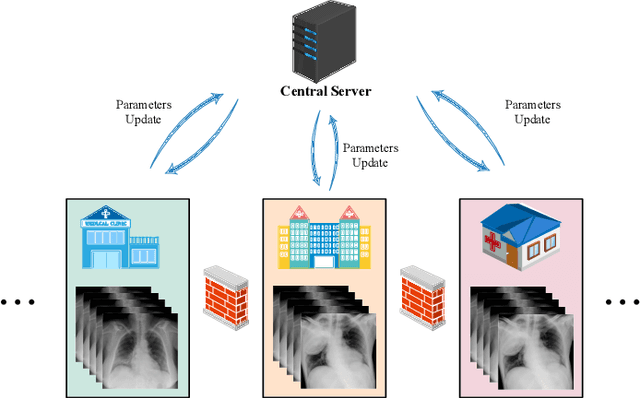
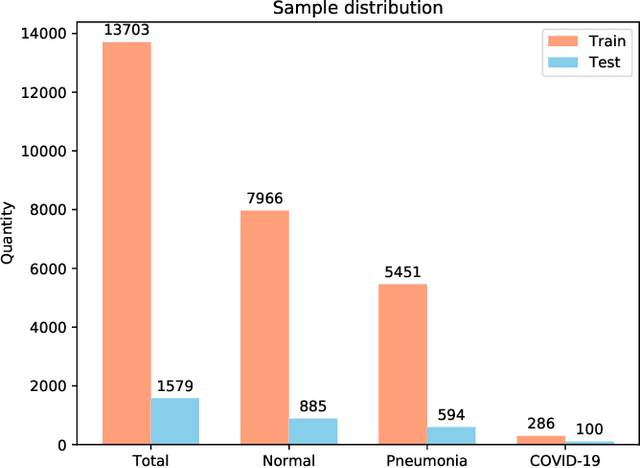
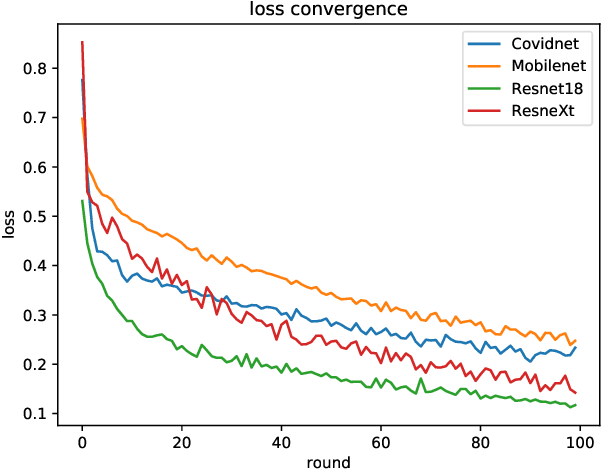
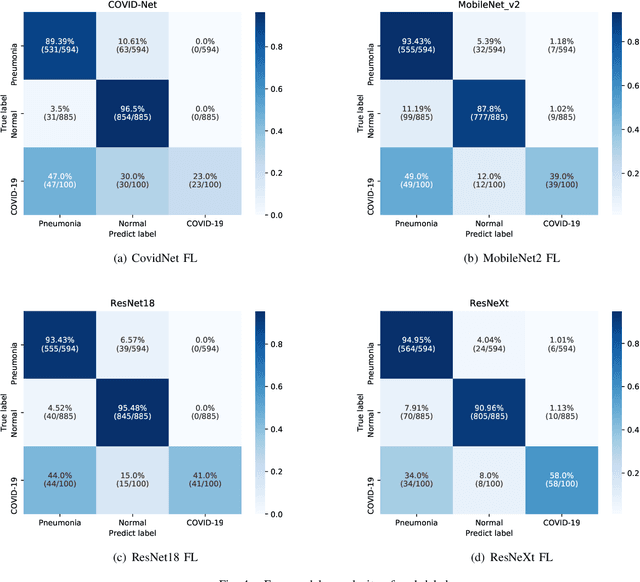
AI plays an important role in COVID-19 identification. Computer vision and deep learning techniques can assist in determining COVID-19 infection with Chest X-ray Images. However, for the protection and respect of the privacy of patients, the hospital's specific medical-related data did not allow leakage and sharing without permission. Collecting such training data was a major challenge. To a certain extent, this has caused a lack of sufficient data samples when performing deep learning approaches to detect COVID-19. Federated Learning is an available way to address this issue. It can effectively address the issue of data silos and get a shared model without obtaining local data. In the work, we propose the use of federated learning for COVID-19 data training and deploy experiments to verify the effectiveness. And we also compare performances of four popular models (MobileNet, ResNet18, MoblieNet, and COVID-Net) with the federated learning framework and without the framework. This work aims to inspire more researches on federated learning about COVID-19.
COVID-19 Public Opinion and Emotion Monitoring System Based on Time Series Thermal New Word Mining
May 23, 2020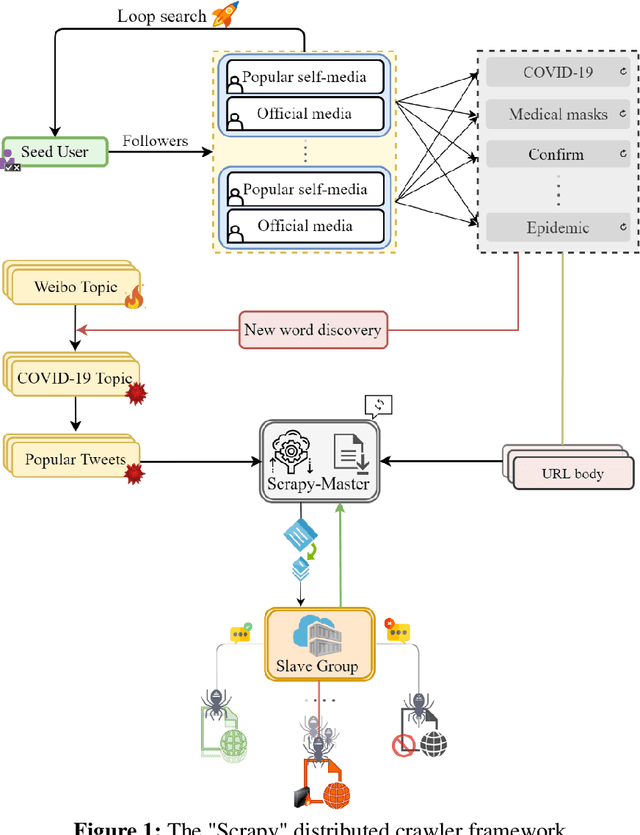
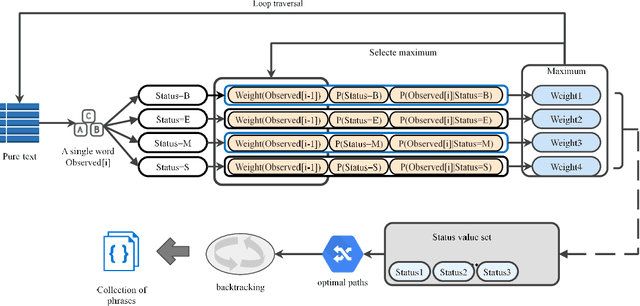
With the spread and development of new epidemics, it is of great reference value to identify the changing trends of epidemics in public emotions. We designed and implemented the COVID-19 public opinion monitoring system based on time series thermal new word mining. A new word structure discovery scheme based on the timing explosion of network topics and a Chinese sentiment analysis method for the COVID-19 public opinion environment is proposed. Establish a "Scrapy-Redis-Bloomfilter" distributed crawler framework to collect data. The system can judge the positive and negative emotions of the reviewer based on the comments, and can also reflect the depth of the seven emotions such as Hopeful, Happy, and Depressed. Finally, we improved the sentiment discriminant model of this system and compared the sentiment discriminant error of COVID-19 related comments with the Jiagu deep learning model. The results show that our model has better generalization ability and smaller discriminant error. We designed a large data visualization screen, which can clearly show the trend of public emotions, the proportion of various emotion categories, keywords, hot topics, etc., and fully and intuitively reflect the development of public opinion.