 Add to Chrome
 Add to Firefox
 Add to Edge
STEAM: Self-Supervised Temporal Ensemble Advantage Modeling for Real-World Robot Learning
Jun 29, 2026
Real-world robot learning increasingly relies on heterogeneous data, but demonstrations and rollouts often mix useful progress with stalls, corrections, and suboptimal behavior. Effective policy learning therefore requires frame-level advantages that distinguish reliable local progress from failures and regressions. We propose Self-supervised Temporal Ensemble Advantage Modeling (STEAM), a label-free method that learns such advantages from expert demonstrations. STEAM trains an ensemble of temporal-offset predictors on frame pairs within expert trajectories, using the normalized temporal offset between two frames as a self-supervised signal. Each predictor maps a frame pair to a distribution over temporal offsets, which is converted into a scalar advantage. STEAM then takes the minimum advantage across the ensemble to score mixed-quality rollout data conservatively. Across real-world bimanual towel folding, chip checkout, cola restocking, and single-arm pick-and-place tasks, STEAM identifies stalls, failures, and recoveries. When combined with CFGRL, STEAM further improves policy success rate by 59%, 54.3%, 23% and 16.2% over baselines, respectively.

LaWAM: Latent World Action Models for Efficient Dynamics-Aware Robot Policies
Jun 14, 2026Vision-Language-Action models (VLAs) leverage large-scale vision-language pretraining for semantic robot control, but often lack explicit foresight into how robot actions change the scene. World-Action Models (WAMs) address this limitation by conditioning policies on predicted futures, yet existing approaches typically rely on computationally expensive video generation with substantial pixel-level redundancy. We present LaWAM, a Latent World Action Model that exposes predictive dynamics to robot policies through compact latent visual subgoals instead of reconstructed future video. At the core of LaWAM is a latent-action-conditioned Latent World Model (LaWM). We obtain LaWM by training a latent action model in the latent space of a pretrained vision foundation model and repurposing its forward decoder to predict future observation features for scene evolution. LaWAM then conditions action generation on these predicted latent visual subgoals to enable dynamics-aware robot control. LaWAM achieves state-of-the-art or competitive success rates (SRs) across LIBERO (98.6% SR), RoboTwin (91.22% SR), and real-world manipulation tasks while retaining low-latency inference. LaWAM runs in 187 ms per action-chunk prediction and achieves up to 24x lower wall-clock latency than pixel-space WAMs.
Tex3D: Objects as Attack Surfaces via Adversarial 3D Textures for Vision-Language-Action Models
Apr 02, 2026Vision-language-action (VLA) models have shown strong performance in robotic manipulation, yet their robustness to physically realizable adversarial attacks remains underexplored. Existing studies reveal vulnerabilities through language perturbations and 2D visual attacks, but these attack surfaces are either less representative of real deployment or limited in physical realism. In contrast, adversarial 3D textures pose a more physically plausible and damaging threat, as they are naturally attached to manipulated objects and are easier to deploy in physical environments. Bringing adversarial 3D textures to VLA systems is nevertheless nontrivial. A central obstacle is that standard 3D simulators do not provide a differentiable optimization path from the VLA objective function back to object appearance, making it difficult to optimize through an end-to-end manner. To address this, we introduce Foreground-Background Decoupling (FBD), which enables differentiable texture optimization through dual-renderer alignment while preserving the original simulation environment. To further ensure that the attack remains effective across long-horizon and diverse viewpoints in the physical world, we propose Trajectory-Aware Adversarial Optimization (TAAO), which prioritizes behaviorally critical frames and stabilizes optimization with a vertex-based parameterization. Built on these designs, we present Tex3D, the first framework for end-to-end optimization of 3D adversarial textures directly within the VLA simulation environment. Experiments in both simulation and real-robot settings show that Tex3D significantly degrades VLA performance across multiple manipulation tasks, achieving task failure rates of up to 96.7\%. Our empirical results expose critical vulnerabilities of VLA systems to physically grounded 3D adversarial attacks and highlight the need for robustness-aware training.
Beyond Imitation: Reinforcement Learning-Based Sim-Real Co-Training for VLA Models
Feb 16, 2026Simulation offers a scalable and low-cost way to enrich vision-language-action (VLA) training, reducing reliance on expensive real-robot demonstrations. However, most sim-real co-training methods rely on supervised fine-tuning (SFT), which treats simulation as a static source of demonstrations and does not exploit large-scale closed-loop interaction. Consequently, real-world gains and generalization are often limited. In this paper, we propose an \underline{\textit{RL}}-based sim-real \underline{\textit{Co}}-training \modify{(RL-Co)} framework that leverages interactive simulation while preserving real-world capabilities. Our method follows a generic two-stage design: we first warm-start the policy with SFT on a mixture of real and simulated demonstrations, then fine-tune it with reinforcement learning in simulation while adding an auxiliary supervised loss on real-world data to anchor the policy and mitigate catastrophic forgetting. We evaluate our framework on four real-world tabletop manipulation tasks using two representative VLA architectures, OpenVLA and $π_{0.5}$, and observe consistent improvements over real-only fine-tuning and SFT-based co-training, including +24% real-world success on OpenVLA and +20% on $π_{0.5}$. Beyond higher success rates, RL co-training yields stronger generalization to unseen task variations and substantially improved real-world data efficiency, providing a practical and scalable pathway for leveraging simulation to enhance real-robot deployment.
A Survey on Multi-Generative Agent System: Recent Advances and New Frontiers
Dec 23, 2024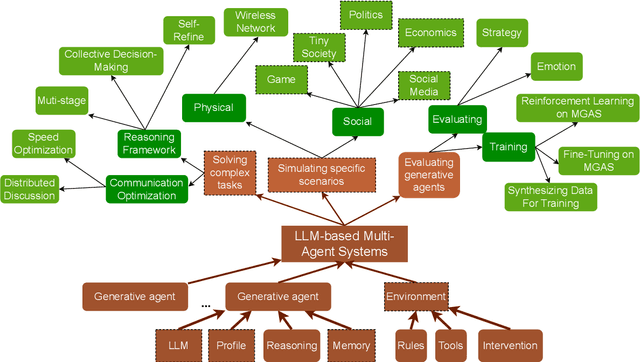
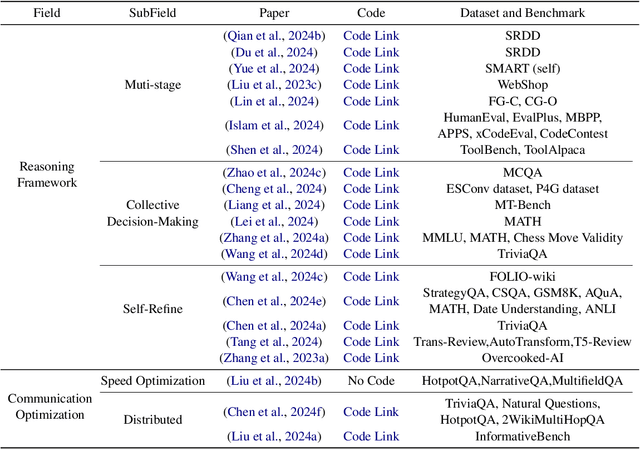
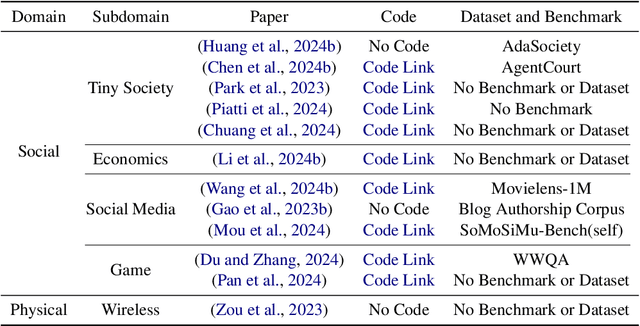
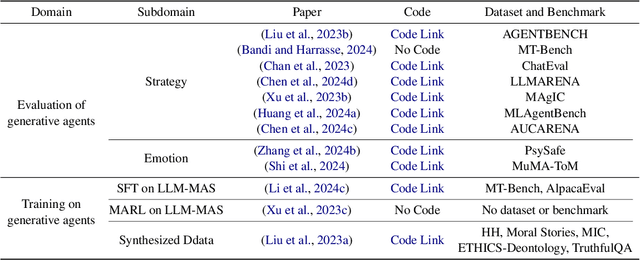
Multi-generative agent systems (MGASs) have become a research hotspot since the rise of large language models (LLMs). However, with the continuous influx of new related works, the existing reviews struggle to capture them comprehensively. This paper presents a comprehensive survey of these studies. We first discuss the definition of MGAS, a framework encompassing much of previous work. We provide an overview of the various applications of MGAS in (i) solving complex tasks, (ii) simulating specific scenarios, and (iii) evaluating generative agents. Building on previous studies, we also highlight several challenges and propose future directions for research in this field.