 Add to Chrome
 Add to Firefox
 Add to Edge
STEAM: Self-Supervised Temporal Ensemble Advantage Modeling for Real-World Robot Learning
Jun 29, 2026
Real-world robot learning increasingly relies on heterogeneous data, but demonstrations and rollouts often mix useful progress with stalls, corrections, and suboptimal behavior. Effective policy learning therefore requires frame-level advantages that distinguish reliable local progress from failures and regressions. We propose Self-supervised Temporal Ensemble Advantage Modeling (STEAM), a label-free method that learns such advantages from expert demonstrations. STEAM trains an ensemble of temporal-offset predictors on frame pairs within expert trajectories, using the normalized temporal offset between two frames as a self-supervised signal. Each predictor maps a frame pair to a distribution over temporal offsets, which is converted into a scalar advantage. STEAM then takes the minimum advantage across the ensemble to score mixed-quality rollout data conservatively. Across real-world bimanual towel folding, chip checkout, cola restocking, and single-arm pick-and-place tasks, STEAM identifies stalls, failures, and recoveries. When combined with CFGRL, STEAM further improves policy success rate by 59%, 54.3%, 23% and 16.2% over baselines, respectively.

StreamingVLA: Streaming Vision-Language-Action Model with Action Flow Matching and Adaptive Early Observation
Mar 30, 2026Vision-language-action (VLA) models have demonstrated exceptional performance in natural language-driven perception and control. However, the high computational cost of VLA models poses significant efficiency challenges, particularly for resource-constrained edge platforms in real-world deployments. However, since different stages of VLA (observation, action generation and execution) must proceed sequentially, and wait for the completion of the preceding stage, the system suffers from frequent halting and high latency. To address this, We conduct a systematic analysis to identify the challenges for fast and fluent generation, and propose enabling VLAs with the ability to asynchronously parallelize across VLA stages in a "streaming" manner. First, we eliminate the reliance on action chunking and adopt action flow matching, which learns the trajectory of action flows rather than denoising chunk-wise actions. It overlaps the latency of action generation and execution. Second, we design an action saliency-aware adaptive observation mechanism, thereby overlapping the latency of execution and observation. Without sacrificing performance, StreamingVLA achieves substantial speedup and improves the fluency of execution. It achieves a 2.4 $\times$ latency speedup and reduces execution halting by 6.5 $\times$.
Beyond Imitation: Reinforcement Learning-Based Sim-Real Co-Training for VLA Models
Feb 16, 2026Simulation offers a scalable and low-cost way to enrich vision-language-action (VLA) training, reducing reliance on expensive real-robot demonstrations. However, most sim-real co-training methods rely on supervised fine-tuning (SFT), which treats simulation as a static source of demonstrations and does not exploit large-scale closed-loop interaction. Consequently, real-world gains and generalization are often limited. In this paper, we propose an \underline{\textit{RL}}-based sim-real \underline{\textit{Co}}-training \modify{(RL-Co)} framework that leverages interactive simulation while preserving real-world capabilities. Our method follows a generic two-stage design: we first warm-start the policy with SFT on a mixture of real and simulated demonstrations, then fine-tune it with reinforcement learning in simulation while adding an auxiliary supervised loss on real-world data to anchor the policy and mitigate catastrophic forgetting. We evaluate our framework on four real-world tabletop manipulation tasks using two representative VLA architectures, OpenVLA and $π_{0.5}$, and observe consistent improvements over real-only fine-tuning and SFT-based co-training, including +24% real-world success on OpenVLA and +20% on $π_{0.5}$. Beyond higher success rates, RL co-training yields stronger generalization to unseen task variations and substantially improved real-world data efficiency, providing a practical and scalable pathway for leveraging simulation to enhance real-robot deployment.
Learning Adaptive Dexterous Grasping from Single Demonstrations
Mar 26, 2025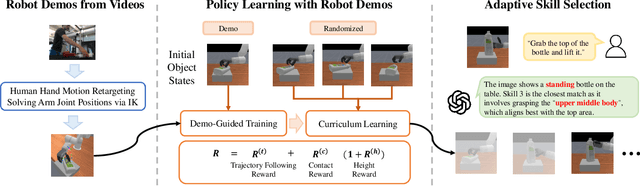
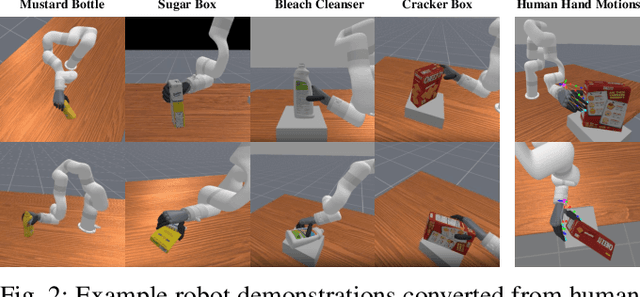
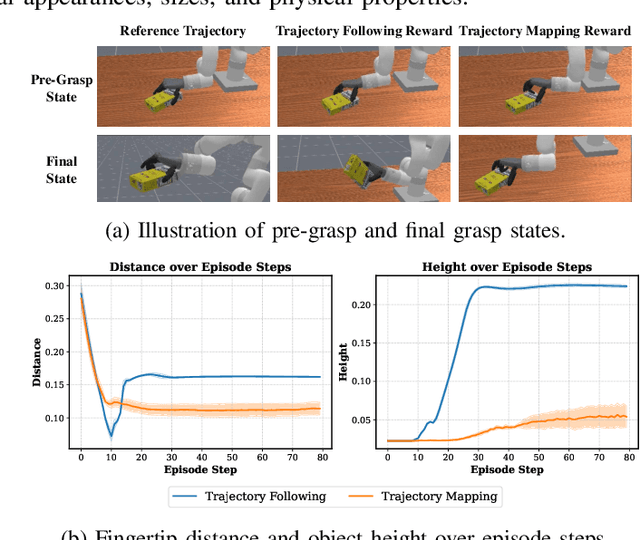
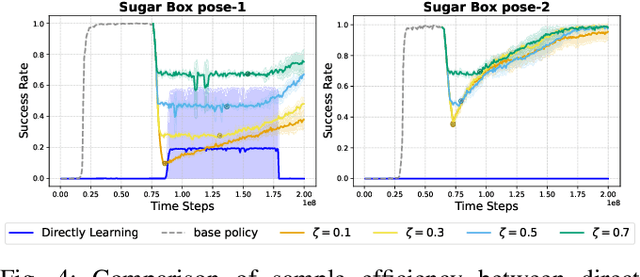
How can robots learn dexterous grasping skills efficiently and apply them adaptively based on user instructions? This work tackles two key challenges: efficient skill acquisition from limited human demonstrations and context-driven skill selection. We introduce AdaDexGrasp, a framework that learns a library of grasping skills from a single human demonstration per skill and selects the most suitable one using a vision-language model (VLM). To improve sample efficiency, we propose a trajectory following reward that guides reinforcement learning (RL) toward states close to a human demonstration while allowing flexibility in exploration. To learn beyond the single demonstration, we employ curriculum learning, progressively increasing object pose variations to enhance robustness. At deployment, a VLM retrieves the appropriate skill based on user instructions, bridging low-level learned skills with high-level intent. We evaluate AdaDexGrasp in both simulation and real-world settings, showing that our approach significantly improves RL efficiency and enables learning human-like grasp strategies across varied object configurations. Finally, we demonstrate zero-shot transfer of our learned policies to a real-world PSYONIC Ability Hand, with a 90% success rate across objects, significantly outperforming the baseline.