 Add to Chrome
 Add to Firefox
 Add to Edge
Harness VLA: Steering Frozen VLAs into Reliable Manipulation Primitives via Memory-Guided Agents
Jul 09, 2026
Language-conditioned manipulation requires both precise contact-rich control and robust reasoning over language, scenes, and long horizons. End-to-end Vision-Language-Action (VLA) models provide strong local visuomotor skills, but they are trained on in-distribution task trajectories and often fail under deployment perturbations such as semantic retargeting, goal re-binding, spatial-layout shifts, and unstable local contacts. LLM coding agents provide complementary semantic and compositional reasoning, but purely analytic primitives struggle with irregular grasping, constrained placement, and articulated-object interaction. We present Harness VLA, a memory-augmented agentic framework that exposes a frozen VLA as a retryable contact-rich primitive and composes it with a small fixed library of analytic primitives for grounding, staging, transport, navigation, and release. Rather than expanding the skill library, the harness learns the operating range of these fixed primitives from task-specific execution traces, global success rules, and failure models. By lifting semantic re-grounding, non-contact execution, and VLA re-staging to the planner while reserving the frozen VLA for local contact-rich phases, Harness VLA extends pretrained VLAs beyond their original trajectory distribution without finetuning. Across perturbed tabletop, household kitchen, and clean-to-randomized bimanual manipulation, Harness VLA improves over the strongest relevant baselines by 38.6 and 25.4 percentage points on LIBERO-Pro and RoboCasa365, respectively, and reaches 58.4% on RoboTwin C2R.

RecGURU: Adversarial Learning of Generalized User Representations for Cross-Domain Recommendation
Nov 19, 2021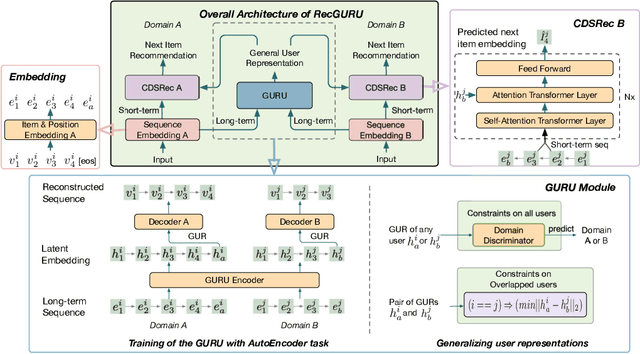
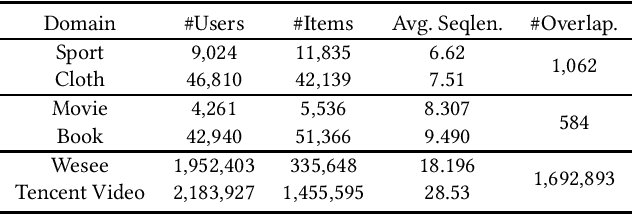
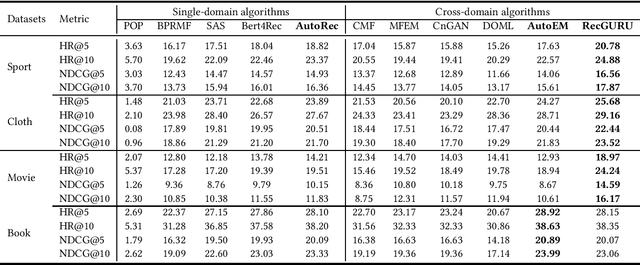
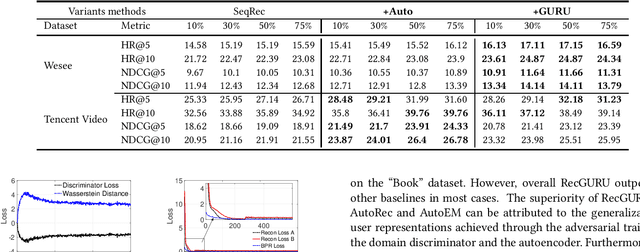
Cross-domain recommendation can help alleviate the data sparsity issue in traditional sequential recommender systems. In this paper, we propose the RecGURU algorithm framework to generate a Generalized User Representation (GUR) incorporating user information across domains in sequential recommendation, even when there is minimum or no common users in the two domains. We propose a self-attentive autoencoder to derive latent user representations, and a domain discriminator, which aims to predict the origin domain of a generated latent representation. We propose a novel adversarial learning method to train the two modules to unify user embeddings generated from different domains into a single global GUR for each user. The learned GUR captures the overall preferences and characteristics of a user and thus can be used to augment the behavior data and improve recommendations in any single domain in which the user is involved. Extensive experiments have been conducted on two public cross-domain recommendation datasets as well as a large dataset collected from real-world applications. The results demonstrate that RecGURU boosts performance and outperforms various state-of-the-art sequential recommendation and cross-domain recommendation methods. The collected data will be released to facilitate future research.
A Deep Deterministic Policy Gradient-based Strategy for Stocks Portfolio Management
Mar 21, 2021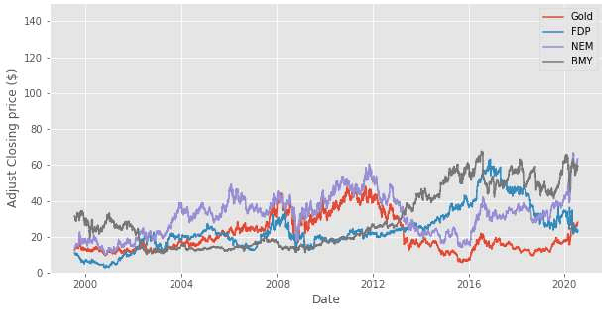
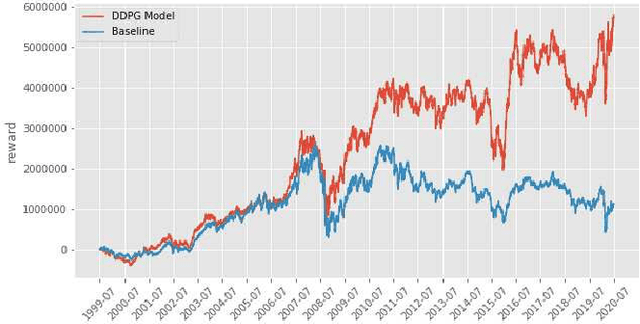
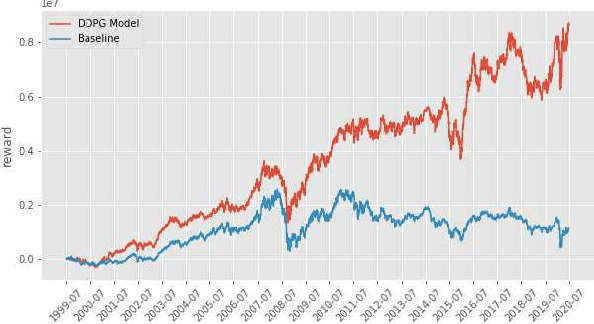
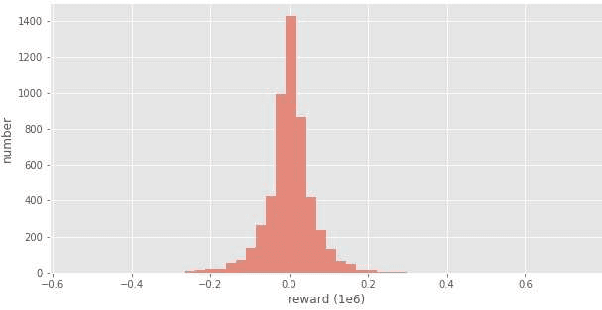
With the improvement of computer performance and the development of GPU-accelerated technology, trading with machine learning algorithms has attracted the attention of many researchers and practitioners. In this research, we propose a novel portfolio management strategy based on the framework of Deep Deterministic Policy Gradient, a policy-based reinforcement learning framework, and compare its performance to that of other trading strategies. In our framework, two Long Short-Term Memory neural networks and two fully connected neural networks are constructed. We also investigate the performance of our strategy with and without transaction costs. Experimentally, we choose eight US stocks consisting of four low-volatility stocks and four high-volatility stocks. We compare the compound annual return rate of our strategy against seven other strategies, e.g., Uniform Buy and Hold, Exponential Gradient and Universal Portfolios. In our case, the compound annual return rate is 14.12%, outperforming all other strategies. Furthermore, in terms of Sharpe Ratio (0.5988), our strategy is nearly 33% higher than that of the second-best performing strategy.