 Add to Chrome
 Add to Firefox
 Add to Edge
JUSTICE: Judicial Unified Synthesis Through Intermediate Conclusion Emulation for Automated Judgment Document Generation
Feb 09, 2026
Automated judgment document generation is a significant yet challenging legal AI task. As the conclusive written instrument issued by a court, a judgment document embodies complex legal reasoning. However, existing methods often oversimplify this complex process, particularly by omitting the ``Pre-Judge'' phase, a crucial step where human judges form a preliminary conclusion. This omission leads to two core challenges: 1) the ineffective acquisition of foundational judicial elements, and 2) the inadequate modeling of the Pre-Judge process, which collectively undermine the final document's legal soundness. To address these challenges, we propose \textit{\textbf{J}udicial \textbf{U}nified \textbf{S}ynthesis \textbf{T}hrough \textbf{I}ntermediate \textbf{C}onclusion \textbf{E}mulation} (JUSTICE), a novel framework that emulates the ``Search $\rightarrow$ Pre-Judge $\rightarrow$ Write'' cognitive workflow of human judges. Specifically, it introduces the Pre-Judge stage through three dedicated components: Referential Judicial Element Retriever (RJER), Intermediate Conclusion Emulator (ICE), and Judicial Unified Synthesizer (JUS). RJER first retrieves legal articles and a precedent case to establish a referential foundation. ICE then operationalizes the Pre-Judge phase by generating a verifiable intermediate conclusion. Finally, JUS synthesizes these inputs to craft the final judgment. Experiments on both an in-domain legal benchmark and an out-of-distribution dataset show that JUSTICE significantly outperforms strong baselines, with substantial gains in legal accuracy, including a 4.6\% improvement in prison term prediction. Our findings underscore the importance of explicitly modeling the Pre-Judge process to enhance the legal coherence and accuracy of generated judgment documents.

Constraint-Aware Generative Auto-bidding via Pareto-Prioritized Regret Optimization
Feb 09, 2026Auto-bidding systems aim to maximize marketing value while satisfying strict efficiency constraints such as Target Cost-Per-Action (CPA). Although Decision Transformers provide powerful sequence modeling capabilities, applying them to this constrained setting encounters two challenges: 1) standard Return-to-Go conditioning causes state aliasing by neglecting the cost dimension, preventing precise resource pacing; and 2) standard regression forces the policy to mimic average historical behaviors, thereby limiting the capacity to optimize performance toward the constraint boundary. To address these challenges, we propose PRO-Bid, a constraint-aware generative auto-bidding framework based on two synergistic mechanisms: 1) Constraint-Decoupled Pareto Representation (CDPR) decomposes global constraints into recursive cost and value contexts to restore resource perception, while reweighting trajectories based on the Pareto frontier to focus on high-efficiency data; and 2) Counterfactual Regret Optimization (CRO) facilitates active improvement by utilizing a global outcome predictor to identify superior counterfactual actions. By treating these high-utility outcomes as weighted regression targets, the model transcends historical averages to approach the optimal constraint boundary. Extensive experiments on two public benchmarks and online A/B tests demonstrate that PRO-Bid achieves superior constraint satisfaction and value acquisition compared to state-of-the-art baselines.
To Search or Not to Search: Aligning the Decision Boundary of Deep Search Agents via Causal Intervention
Feb 03, 2026Deep search agents, which autonomously iterate through multi-turn web-based reasoning, represent a promising paradigm for complex information-seeking tasks. However, current agents suffer from critical inefficiency: they conduct excessive searches as they cannot accurately judge when to stop searching and start answering. This stems from outcome-centric training that prioritize final results over the search process itself. We identify the root cause as misaligned decision boundaries, the threshold determining when accumulated information suffices to answer. This causes over-search (redundant searching despite sufficient knowledge) and under-search (premature termination yielding incorrect answers). To address these errors, we propose a comprehensive framework comprising two key components. First, we introduce causal intervention-based diagnosis that identifies boundary errors by comparing factual and counterfactual trajectories at each decision point. Second, we develop Decision Boundary Alignment for Deep Search agents (DAS), which constructs preference datasets from causal feedback and aligns policies via preference optimization. Experiments on public datasets demonstrate that decision boundary errors are pervasive across state-of-the-art agents. Our DAS method effectively calibrates these boundaries, mitigating both over-search and under-search to achieve substantial gains in accuracy and efficiency. Our code and data are publicly available at: https://github.com/Applied-Machine-Learning-Lab/WWW2026_DAS.
Causality-aware Graph Aggregation Weight Estimator for Popularity Debiasing in Top-K Recommendation
Oct 06, 2025Graph-based recommender systems leverage neighborhood aggregation to generate node representations, which is highly sensitive to popularity bias, resulting in an echo effect during information propagation. Existing graph-based debiasing solutions refine the aggregation process with attempts such as edge reconstruction or weight adjustment. However, these methods remain inadequate in fully alleviating popularity bias. Specifically, this is because 1) they provide no insights into graph aggregation rationality, thus lacking an optimality guarantee; 2) they fail to well balance the training and debiasing process, which undermines the effectiveness. In this paper, we propose a novel approach to mitigate popularity bias through rational modeling of the graph aggregation process. We reveal that graph aggregation is a special form of backdoor adjustment in causal inference, where the aggregation weight corresponds to the historical interaction likelihood distribution. Based on this insight, we devise an encoder-decoder architecture, namely Causality-aware Graph Aggregation Weight Estimator for Debiasing (CAGED), to approximate the unbiased aggregation weight by optimizing the evidence lower bound of the interaction likelihood. In order to enhance the debiasing effectiveness during early training stages, we further design a momentum update strategy that incrementally refines the aggregation weight matrix. Extensive experiments on three datasets demonstrate that CAGED outperforms existing graph-based debiasing methods. Our implementation is available at https://github.com/QueYork/CAGED.
SciNLP: A Domain-Specific Benchmark for Full-Text Scientific Entity and Relation Extraction in NLP
Sep 10, 2025Structured information extraction from scientific literature is crucial for capturing core concepts and emerging trends in specialized fields. While existing datasets aid model development, most focus on specific publication sections due to domain complexity and the high cost of annotating scientific texts. To address this limitation, we introduce SciNLP - a specialized benchmark for full-text entity and relation extraction in the Natural Language Processing (NLP) domain. The dataset comprises 60 manually annotated full-text NLP publications, covering 7,072 entities and 1,826 relations. Compared to existing research, SciNLP is the first dataset providing full-text annotations of entities and their relationships in the NLP domain. To validate the effectiveness of SciNLP, we conducted comparative experiments with similar datasets and evaluated the performance of state-of-the-art supervised models on this dataset. Results reveal varying extraction capabilities of existing models across academic texts of different lengths. Cross-comparisons with existing datasets show that SciNLP achieves significant performance improvements on certain baseline models. Using models trained on SciNLP, we implemented automatic construction of a fine-grained knowledge graph for the NLP domain. Our KG has an average node degree of 3.2 per entity, indicating rich semantic topological information that enhances downstream applications. The dataset is publicly available at https://github.com/AKADDC/SciNLP.
GeoArena: An Open Platform for Benchmarking Large Vision-language Models on WorldWide Image Geolocalization
Sep 04, 2025

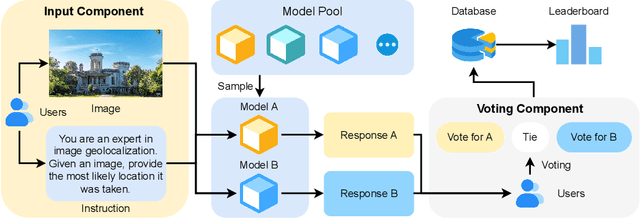
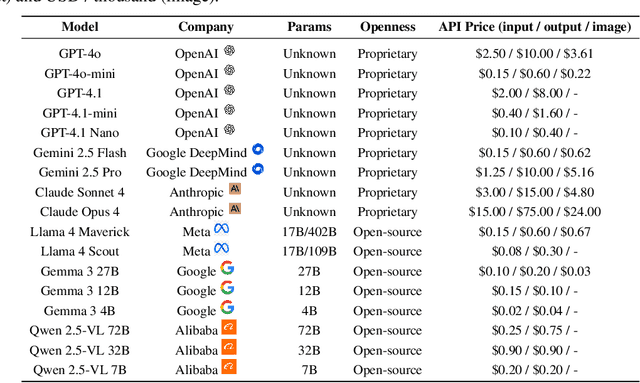
Image geolocalization aims to predict the geographic location of images captured anywhere on Earth, but its global nature presents significant challenges. Current evaluation methodologies suffer from two major limitations. First, data leakage: advanced approaches often rely on large vision-language models (LVLMs) to predict image locations, yet these models are frequently pretrained on the test datasets, compromising the accuracy of evaluating a model's actual geolocalization capability. Second, existing metrics primarily rely on exact geographic coordinates to assess predictions, which not only neglects the reasoning process but also raises privacy concerns when user-level location data is required. To address these issues, we propose GeoArena, a first open platform for evaluating LVLMs on worldwide image geolocalization tasks, offering true in-the-wild and human-centered benchmarking. GeoArena enables users to upload in-the-wild images for a more diverse evaluation corpus, and it leverages pairwise human judgments to determine which model output better aligns with human expectations. Our platform has been deployed online for two months, during which we collected over thousands voting records. Based on this data, we conduct a detailed analysis and establish a leaderboard of different LVLMs on the image geolocalization task.
Towards Multi-Granularity Memory Association and Selection for Long-Term Conversational Agents
May 26, 2025Large Language Models (LLMs) have recently been widely adopted in conversational agents. However, the increasingly long interactions between users and agents accumulate extensive dialogue records, making it difficult for LLMs with limited context windows to maintain a coherent long-term dialogue memory and deliver personalized responses. While retrieval-augmented memory systems have emerged to address this issue, existing methods often depend on single-granularity memory segmentation and retrieval. This approach falls short in capturing deep memory connections, leading to partial retrieval of useful information or substantial noise, resulting in suboptimal performance. To tackle these limits, we propose MemGAS, a framework that enhances memory consolidation by constructing multi-granularity association, adaptive selection, and retrieval. MemGAS is based on multi-granularity memory units and employs Gaussian Mixture Models to cluster and associate new memories with historical ones. An entropy-based router adaptively selects optimal granularity by evaluating query relevance distributions and balancing information completeness and noise. Retrieved memories are further refined via LLM-based filtering. Experiments on four long-term memory benchmarks demonstrate that MemGAS outperforms state-of-the-art methods on both question answer and retrieval tasks, achieving superior performance across different query types and top-K settings.
Align-GRAG: Reasoning-Guided Dual Alignment for Graph Retrieval-Augmented Generation
May 22, 2025Large language models (LLMs) have demonstrated remarkable capabilities, but still struggle with issues like hallucinations and outdated information. Retrieval-augmented generation (RAG) addresses these issues by grounding LLM outputs in external knowledge with an Information Retrieval (IR) system. Building on this foundation, graph-based RAG systems go a step further by retrieving subgraphs, which preserve the relationships between knowledge entities and provide more comprehensive context. However, graph RAG faces two challenges: (1) Retrieving relevant information introduces irrelevant nodes (especially in dense graph databases, where retrieval usually extends to adjacent nodes), and leads to overly lengthy inputs that hinder efficiency; (2) The representation gap between graph and language during generation with LLMs limits the ability to fully leverage graph structures for enhanced understanding. To address these limitations, we propose Align-GRAG, a novel reasoning-guided dual alignment framework in post-retrieval phrase. It first formulates a subgraph by retrieving nodes and edges. Then an Aligner is proposed to jointly optimizes a graph encoder with LLM-summarized reasoning. It achieves dual alignment of graph node and representation by leveraging KL divergence loss and contrastive loss, facilitating efficient pruning of irrelevant knowledge and establishing a unified semantic space. The Generator integrates the aligned graph data with LLM to produce coherent and accurate answers. Experiments on GraphQA benchmark across three tasks (including common sense reasoning, scene graph understanding, and knowledge graph reasoning) validate the effectiveness of our method. The code will be available upon accepted.
Process vs. Outcome Reward: Which is Better for Agentic RAG Reinforcement Learning
May 20, 2025Retrieval-augmented generation (RAG) enhances the text generation capabilities of large language models (LLMs) by integrating external knowledge and up-to-date information. However, traditional RAG systems are limited by static workflows and lack the adaptability required for multistep reasoning and complex task management. To address these limitations, agentic RAG systems (e.g., DeepResearch) have been proposed, enabling dynamic retrieval strategies, iterative context refinement, and adaptive workflows for handling complex search queries beyond the capabilities of conventional RAG. Recent advances, such as Search-R1, have demonstrated promising gains using outcome-based reinforcement learning, where the correctness of the final answer serves as the reward signal. Nevertheless, such outcome-supervised agentic RAG methods face challenges including low exploration efficiency, gradient conflict, and sparse reward signals. To overcome these challenges, we propose to utilize fine-grained, process-level rewards to improve training stability, reduce computational costs, and enhance efficiency. Specifically, we introduce a novel method ReasonRAG that automatically constructs RAG-ProGuide, a high-quality dataset providing process-level rewards for (i) query generation, (ii) evidence extraction, and (iii) answer generation, thereby enhancing model inherent capabilities via process-supervised reinforcement learning. With the process-level policy optimization, the proposed framework empowers LLMs to autonomously invoke search, generate queries, extract relevant evidence, and produce final answers. Compared to existing approaches such as Search-R1 and traditional RAG systems, ReasonRAG, leveraging RAG-ProGuide, achieves superior performance on five benchmark datasets using only 5k training instances, significantly fewer than the 90k training instances required by Search-R1.
LSRP: A Leader-Subordinate Retrieval Framework for Privacy-Preserving Cloud-Device Collaboration
May 08, 2025Cloud-device collaboration leverages on-cloud Large Language Models (LLMs) for handling public user queries and on-device Small Language Models (SLMs) for processing private user data, collectively forming a powerful and privacy-preserving solution. However, existing approaches often fail to fully leverage the scalable problem-solving capabilities of on-cloud LLMs while underutilizing the advantage of on-device SLMs in accessing and processing personalized data. This leads to two interconnected issues: 1) Limited utilization of the problem-solving capabilities of on-cloud LLMs, which fail to align with personalized user-task needs, and 2) Inadequate integration of user data into on-device SLM responses, resulting in mismatches in contextual user information. In this paper, we propose a Leader-Subordinate Retrieval framework for Privacy-preserving cloud-device collaboration (LSRP), a novel solution that bridges these gaps by: 1) enhancing on-cloud LLM guidance to on-device SLM through a dynamic selection of task-specific leader strategies named as user-to-user retrieval-augmented generation (U-U-RAG), and 2) integrating the data advantages of on-device SLMs through small model feedback Direct Preference Optimization (SMFB-DPO) for aligning the on-cloud LLM with the on-device SLM. Experiments on two datasets demonstrate that LSRP consistently outperforms state-of-the-art baselines, significantly improving question-answer relevance and personalization, while preserving user privacy through efficient on-device retrieval. Our code is available at: https://github.com/Zhang-Yingyi/LSRP.