 Add to Chrome
 Add to Firefox
 Add to Edge
Beyond Single-Episode Optimization: Sliding-Window Aware Generative Auto-Bidding for Long-Term Advertising Effectiveness
Jul 28, 2026
Auto-bidding systems optimize bids to maximize value under efficiency constraints such as Cost-Per-Action (CPA). Existing methods treat each day as an independent episode. However, many advertisers produce value so sparsely that per-day efficiency ratios become statistically unreliable, undermining advertiser retention. Platforms therefore evaluate window-level efficiency over sliding windows of $W{=}7$ days, ensuring fair evaluation and long-term advertising effectiveness. This creates cross-episode coupling: each day's bidding decisions affect up to $W$ overlapping windows, so setting daily targets requires anticipating future market conditions. We propose SWAG-Bid (Sliding-Window Aware Generative Auto-Bidding), a hierarchical framework decomposing this challenge into episode-level planning and step-level execution. The planner uses a Masked Trajectory Model to forecast markets and generate candidate plans, scored across all overlapping windows by Multi-Window Model Predictive Control Sampling (MWMS) with exponential confidence decay. The controller adjusts reliance on this guidance through a state-adaptive gate, Per-Step Gated Adaptive Layer Normalization (PSG-AdaLN), complemented by Return-to-Go and Cost-to-Go channels carrying budget and constraint information. Experiments on AuctionNet-Sparse and online A/B tests on AliExpress show that SWAG-Bid achieves competitive constraint satisfaction and value acquisition under sliding-window evaluation.

Evoking User Memory: Personalizing LLM via Recollection-Familiarity Adaptive Retrieval
Mar 10, 2026Personalized large language models (LLMs) rely on memory retrieval to incorporate user-specific histories, preferences, and contexts. Existing approaches either overload the LLM by feeding all the user's past memory into the prompt, which is costly and unscalable, or simplify retrieval into a one-shot similarity search, which captures only surface matches. Cognitive science, however, shows that human memory operates through a dual process: Familiarity, offering fast but coarse recognition, and Recollection, enabling deliberate, chain-like reconstruction for deeply recovering episodic content. Current systems lack both the ability to perform recollection retrieval and mechanisms to adaptively switch between the dual retrieval paths, leading to either insufficient recall or the inclusion of noise. To address this, we propose RF-Mem (Recollection-Familiarity Memory Retrieval), a familiarity uncertainty-guided dual-path memory retriever. RF-Mem measures the familiarity signal through the mean score and entropy. High familiarity leads to the direct top-K Familiarity retrieval path, while low familiarity activates the Recollection path. In the Recollection path, the system clusters candidate memories and applies alpha-mix with the query to iteratively expand evidence in embedding space, simulating deliberate contextual reconstruction. This design embeds human-like dual-process recognition into the retriever, avoiding full-context overhead and enabling scalable, adaptive personalization. Experiments across three benchmarks and corpus scales demonstrate that RF-Mem consistently outperforms both one-shot retrieval and full-context reasoning under fixed budget and latency constraints. Our code can be found in the Reproducibility Statement.
Knowledge Augmented Entity and Relation Extraction for Legal Documents with Hypergraph Neural Network
Feb 09, 2026With the continuous progress of digitization in Chinese judicial institutions, a substantial amount of electronic legal document information has been accumulated. To unlock its potential value, entity and relation extraction for legal documents has emerged as a crucial task. However, existing methods often lack domain-specific knowledge and fail to account for the unique characteristics of the judicial domain. In this paper, we propose an entity and relation extraction algorithm based on hypergraph neural network (Legal-KAHRE) for drug-related judgment documents. Firstly, we design a candidate span generator based on neighbor-oriented packing strategy and biaffine mechanism, which identifies spans likely to contain entities. Secondly, we construct a legal dictionary with judicial domain knowledge and integrate it into text encoding representation using multi-head attention. Additionally, we incorporate domain-specific cases like joint crimes and combined punishment for multiple crimes into the hypergraph structure design. Finally, we employ a hypergraph neural network for higher-order inference via message passing. Experimental results on the CAIL2022 information extraction dataset demonstrate that our method significantly outperforms existing baseline models.
Constraint-Aware Generative Auto-bidding via Pareto-Prioritized Regret Optimization
Feb 09, 2026Auto-bidding systems aim to maximize marketing value while satisfying strict efficiency constraints such as Target Cost-Per-Action (CPA). Although Decision Transformers provide powerful sequence modeling capabilities, applying them to this constrained setting encounters two challenges: 1) standard Return-to-Go conditioning causes state aliasing by neglecting the cost dimension, preventing precise resource pacing; and 2) standard regression forces the policy to mimic average historical behaviors, thereby limiting the capacity to optimize performance toward the constraint boundary. To address these challenges, we propose PRO-Bid, a constraint-aware generative auto-bidding framework based on two synergistic mechanisms: 1) Constraint-Decoupled Pareto Representation (CDPR) decomposes global constraints into recursive cost and value contexts to restore resource perception, while reweighting trajectories based on the Pareto frontier to focus on high-efficiency data; and 2) Counterfactual Regret Optimization (CRO) facilitates active improvement by utilizing a global outcome predictor to identify superior counterfactual actions. By treating these high-utility outcomes as weighted regression targets, the model transcends historical averages to approach the optimal constraint boundary. Extensive experiments on two public benchmarks and online A/B tests demonstrate that PRO-Bid achieves superior constraint satisfaction and value acquisition compared to state-of-the-art baselines.
System Report for CCL25-Eval Task 10: Prompt-Driven Large Language Model Merge for Fine-Grained Chinese Hate Speech Detection
Dec 10, 2025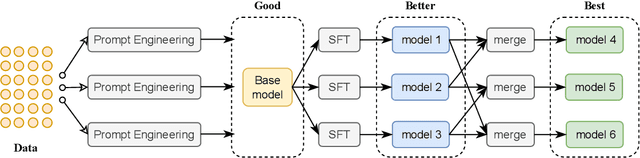
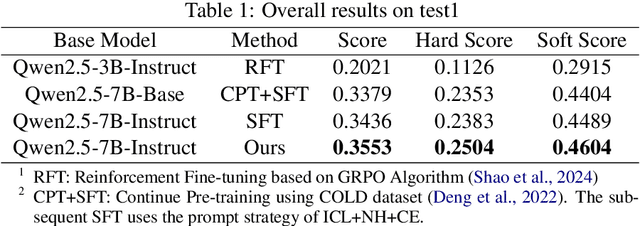
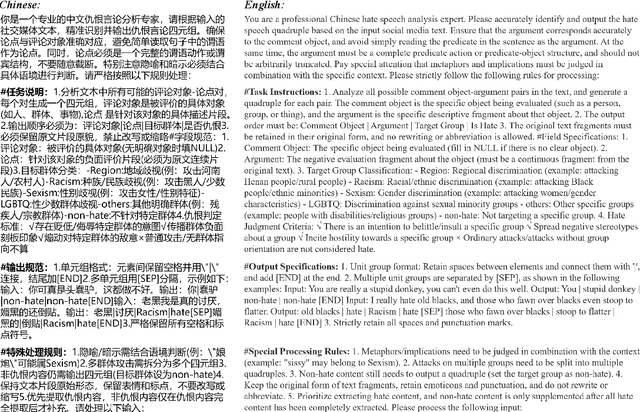
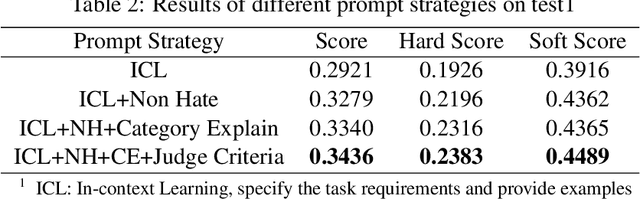
The proliferation of hate speech on Chinese social media poses urgent societal risks, yet traditional systems struggle to decode context-dependent rhetorical strategies and evolving slang. To bridge this gap, we propose a novel three-stage LLM-based framework: Prompt Engineering, Supervised Fine-tuning, and LLM Merging. First, context-aware prompts are designed to guide LLMs in extracting implicit hate patterns. Next, task-specific features are integrated during supervised fine-tuning to enhance domain adaptation. Finally, merging fine-tuned LLMs improves robustness against out-of-distribution cases. Evaluations on the STATE-ToxiCN benchmark validate the framework's effectiveness, demonstrating superior performance over baseline methods in detecting fine-grained hate speech.
LSRP: A Leader-Subordinate Retrieval Framework for Privacy-Preserving Cloud-Device Collaboration
May 08, 2025Cloud-device collaboration leverages on-cloud Large Language Models (LLMs) for handling public user queries and on-device Small Language Models (SLMs) for processing private user data, collectively forming a powerful and privacy-preserving solution. However, existing approaches often fail to fully leverage the scalable problem-solving capabilities of on-cloud LLMs while underutilizing the advantage of on-device SLMs in accessing and processing personalized data. This leads to two interconnected issues: 1) Limited utilization of the problem-solving capabilities of on-cloud LLMs, which fail to align with personalized user-task needs, and 2) Inadequate integration of user data into on-device SLM responses, resulting in mismatches in contextual user information. In this paper, we propose a Leader-Subordinate Retrieval framework for Privacy-preserving cloud-device collaboration (LSRP), a novel solution that bridges these gaps by: 1) enhancing on-cloud LLM guidance to on-device SLM through a dynamic selection of task-specific leader strategies named as user-to-user retrieval-augmented generation (U-U-RAG), and 2) integrating the data advantages of on-device SLMs through small model feedback Direct Preference Optimization (SMFB-DPO) for aligning the on-cloud LLM with the on-device SLM. Experiments on two datasets demonstrate that LSRP consistently outperforms state-of-the-art baselines, significantly improving question-answer relevance and personalization, while preserving user privacy through efficient on-device retrieval. Our code is available at: https://github.com/Zhang-Yingyi/LSRP.