 Add to Chrome
 Add to Firefox
 Add to Edge
Bootstrap Your Generator: Unpaired Visual Editing with Flow Matching
Jun 02, 2026
Modern generative models possess a deep understanding of visual content, yet training them for image editing typically requires massive datasets of paired examples. This limits scalability, especially for video editing where collecting paired data is prohibitively expensive. We propose Bootstrap Your Generator (ByG), a general framework for unpaired training of flow matching editing models. It leverages the base model's knowledge without any external signal. Our approach pairs instruction-following cues extracted from the frozen model with cycle-consistency for structure preservation. To make this tractable, we propose to route gradients from downstream losses over clean predictions to noisy training states. We demonstrate state-of-the-art results on challenging data-scarce image and video editing scenarios. Extensive evaluations and user studies show that our method effectively generalizes to unseen domains and outperforms supervised baselines trained on millions of samples. Analysis reveals that our gradient routing bridges the train-inference gap, and extracting semantic cues from a base model provides a robust training signal that obviates the need for external reward models.

Fast 4D Mesh Generation by Spatio-Temporal Attention Chains
May 19, 20264D mesh generation has recently emerged as a powerful paradigm for recovering dynamic 3D structure from videos, but existing methods remain slow, computationally expensive, and difficult to scale to longer sequences. We introduce a training-free approach that accelerates 4D mesh generation while improving temporal correspondence quality. Our key observation is that temporal correspondences emerge inside a 4D backbone long before its generated meshes become visually accurate. We exploit this with a general framework we call Spatio-Temporal Attention Chain which propagates information across space and time. Starting from vertices on an anchor mesh, the chain maps vertices to latent tokens. It then follows temporal correspondences in latent space, and recovers frame-specific vertices through latent-to-vertex attention. This design avoids expensive explicit matching while preserving anchor mesh details and thereby improving dynamic mesh geometry and temporal consistency. Compared to state-of-the-art, our method generates a 4D mesh in 9 seconds, achieving a $13\times$ speedup while producing higher-quality results. Moreover, our approach scales to videos up to $16\times$ longer without degrading mesh quality. Beyond generation, the improved correspondences enable competitive zero-shot performance on two downstream tasks: 2D object tracking and 4D tracking. We further show that our framework enables reliable camera estimation, a capability not supported by prior 4D mesh generation methods.
Multi-Shot Character Consistency for Text-to-Video Generation
Dec 10, 2024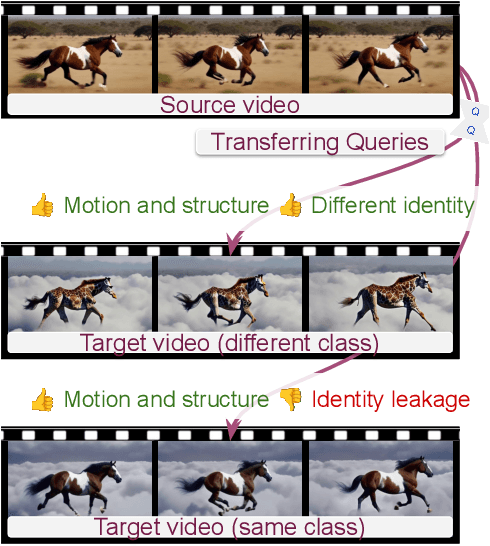
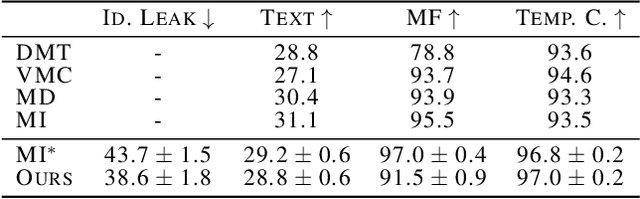
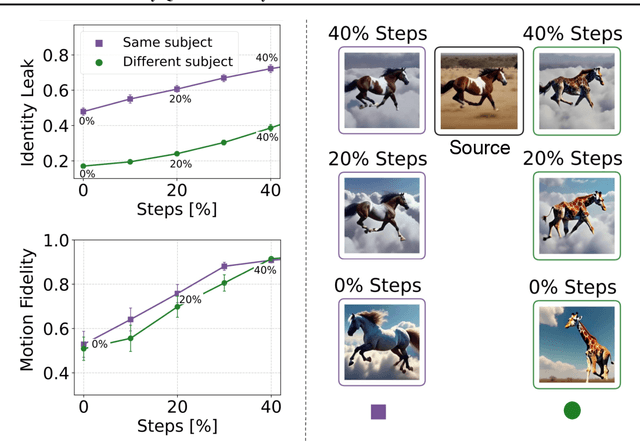
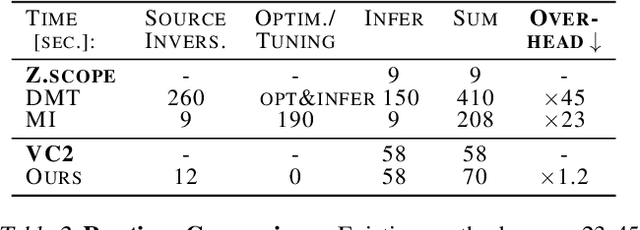
Text-to-video models have made significant strides in generating short video clips from textual descriptions. Yet, a significant challenge remains: generating several video shots of the same characters, preserving their identity without hurting video quality, dynamics, and responsiveness to text prompts. We present Video Storyboarding, a training-free method to enable pretrained text-to-video models to generate multiple shots with consistent characters, by sharing features between them. Our key insight is that self-attention query features (Q) encode both motion and identity. This creates a hard-to-avoid trade-off between preserving character identity and making videos dynamic, when features are shared. To address this issue, we introduce a novel query injection strategy that balances identity preservation and natural motion retention. This approach improves upon naive consistency techniques applied to videos, which often struggle to maintain this delicate equilibrium. Our experiments demonstrate significant improvements in character consistency across scenes while maintaining high-quality motion and text alignment. These results offer insights into critical stages of video generation and the interplay of structure and motion in video diffusion models.
Add-it: Training-Free Object Insertion in Images With Pretrained Diffusion Models
Nov 12, 2024

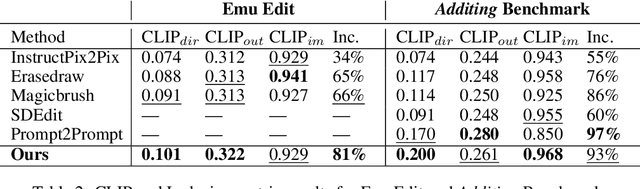
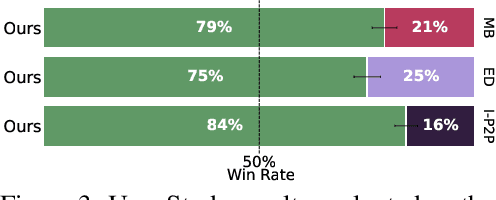
Adding Object into images based on text instructions is a challenging task in semantic image editing, requiring a balance between preserving the original scene and seamlessly integrating the new object in a fitting location. Despite extensive efforts, existing models often struggle with this balance, particularly with finding a natural location for adding an object in complex scenes. We introduce Add-it, a training-free approach that extends diffusion models' attention mechanisms to incorporate information from three key sources: the scene image, the text prompt, and the generated image itself. Our weighted extended-attention mechanism maintains structural consistency and fine details while ensuring natural object placement. Without task-specific fine-tuning, Add-it achieves state-of-the-art results on both real and generated image insertion benchmarks, including our newly constructed "Additing Affordance Benchmark" for evaluating object placement plausibility, outperforming supervised methods. Human evaluations show that Add-it is preferred in over 80% of cases, and it also demonstrates improvements in various automated metrics.
Edify Image: High-Quality Image Generation with Pixel Space Laplacian Diffusion Models
Nov 11, 2024We introduce Edify Image, a family of diffusion models capable of generating photorealistic image content with pixel-perfect accuracy. Edify Image utilizes cascaded pixel-space diffusion models trained using a novel Laplacian diffusion process, in which image signals at different frequency bands are attenuated at varying rates. Edify Image supports a wide range of applications, including text-to-image synthesis, 4K upsampling, ControlNets, 360 HDR panorama generation, and finetuning for image customization.
Lay-A-Scene: Personalized 3D Object Arrangement Using Text-to-Image Priors
Jun 04, 2024Generating 3D visual scenes is at the forefront of visual generative AI, but current 3D generation techniques struggle with generating scenes with multiple high-resolution objects. Here we introduce Lay-A-Scene, which solves the task of Open-set 3D Object Arrangement, effectively arranging unseen objects. Given a set of 3D objects, the task is to find a plausible arrangement of these objects in a scene. We address this task by leveraging pre-trained text-to-image models. We personalize the model and explain how to generate images of a scene that contains multiple predefined objects without neglecting any of them. Then, we describe how to infer the 3D poses and arrangement of objects from a 2D generated image by finding a consistent projection of objects onto the 2D scene. We evaluate the quality of Lay-A-Scene using 3D objects from Objaverse and human raters and find that it often generates coherent and feasible 3D object arrangements.
Training-Free Consistent Text-to-Image Generation
Feb 05, 2024Text-to-image models offer a new level of creative flexibility by allowing users to guide the image generation process through natural language. However, using these models to consistently portray the same subject across diverse prompts remains challenging. Existing approaches fine-tune the model to teach it new words that describe specific user-provided subjects or add image conditioning to the model. These methods require lengthy per-subject optimization or large-scale pre-training. Moreover, they struggle to align generated images with text prompts and face difficulties in portraying multiple subjects. Here, we present ConsiStory, a training-free approach that enables consistent subject generation by sharing the internal activations of the pretrained model. We introduce a subject-driven shared attention block and correspondence-based feature injection to promote subject consistency between images. Additionally, we develop strategies to encourage layout diversity while maintaining subject consistency. We compare ConsiStory to a range of baselines, and demonstrate state-of-the-art performance on subject consistency and text alignment, without requiring a single optimization step. Finally, ConsiStory can naturally extend to multi-subject scenarios, and even enable training-free personalization for common objects.
Domain-Agnostic Tuning-Encoder for Fast Personalization of Text-To-Image Models
Jul 13, 2023Text-to-image (T2I) personalization allows users to guide the creative image generation process by combining their own visual concepts in natural language prompts. Recently, encoder-based techniques have emerged as a new effective approach for T2I personalization, reducing the need for multiple images and long training times. However, most existing encoders are limited to a single-class domain, which hinders their ability to handle diverse concepts. In this work, we propose a domain-agnostic method that does not require any specialized dataset or prior information about the personalized concepts. We introduce a novel contrastive-based regularization technique to maintain high fidelity to the target concept characteristics while keeping the predicted embeddings close to editable regions of the latent space, by pushing the predicted tokens toward their nearest existing CLIP tokens. Our experimental results demonstrate the effectiveness of our approach and show how the learned tokens are more semantic than tokens predicted by unregularized models. This leads to a better representation that achieves state-of-the-art performance while being more flexible than previous methods.
Key-Locked Rank One Editing for Text-to-Image Personalization
May 02, 2023


Text-to-image models (T2I) offer a new level of flexibility by allowing users to guide the creative process through natural language. However, personalizing these models to align with user-provided visual concepts remains a challenging problem. The task of T2I personalization poses multiple hard challenges, such as maintaining high visual fidelity while allowing creative control, combining multiple personalized concepts in a single image, and keeping a small model size. We present Perfusion, a T2I personalization method that addresses these challenges using dynamic rank-1 updates to the underlying T2I model. Perfusion avoids overfitting by introducing a new mechanism that "locks" new concepts' cross-attention Keys to their superordinate category. Additionally, we develop a gated rank-1 approach that enables us to control the influence of a learned concept during inference time and to combine multiple concepts. This allows runtime-efficient balancing of visual-fidelity and textual-alignment with a single 100KB trained model, which is five orders of magnitude smaller than the current state of the art. Moreover, it can span different operating points across the Pareto front without additional training. Finally, we show that Perfusion outperforms strong baselines in both qualitative and quantitative terms. Importantly, key-locking leads to novel results compared to traditional approaches, allowing to portray personalized object interactions in unprecedented ways, even in one-shot settings.
Encoder-based Domain Tuning for Fast Personalization of Text-to-Image Models
Mar 05, 2023Text-to-image personalization aims to teach a pre-trained diffusion model to reason about novel, user provided concepts, embedding them into new scenes guided by natural language prompts. However, current personalization approaches struggle with lengthy training times, high storage requirements or loss of identity. To overcome these limitations, we propose an encoder-based domain-tuning approach. Our key insight is that by underfitting on a large set of concepts from a given domain, we can improve generalization and create a model that is more amenable to quickly adding novel concepts from the same domain. Specifically, we employ two components: First, an encoder that takes as an input a single image of a target concept from a given domain, e.g. a specific face, and learns to map it into a word-embedding representing the concept. Second, a set of regularized weight-offsets for the text-to-image model that learn how to effectively ingest additional concepts. Together, these components are used to guide the learning of unseen concepts, allowing us to personalize a model using only a single image and as few as 5 training steps - accelerating personalization from dozens of minutes to seconds, while preserving quality.