 Add to Chrome
 Add to Firefox
 Add to Edge
KeyID: Decoupled Drafting and Keyframe Editing for Identity-Preserving Video Generation
Aug 17, 2026
Identity-preserving video generation (IPVG) requires synthesizing videos that are faithful to both reference subjects and text prompts. Existing methods are often hindered by high tuning costs or limited input-level enhancements, struggling to maintain rigid identity consistency during complex, long-sequence actions. To address these limitations, we propose KeyID, a training-free IPVG framework that decouples the synthesis of video dynamics from the injection of identity. Specifically, KeyID comprises two components: (1) Reference-Aware Video Generation, which produces an identity-agnostic video draft aligned with multiple references, and (2) Identity-Preserved Keyframe Editing, which integrates the target identity via sparse keyframe correction and subsequent motion interpolation. By shifting from dense frame-level supervision to sparse keyframe-level refinement, KeyID effectively resolves the capacity conflict between prompt adherence and identity fidelity. Crucially, our modular design allows seamless extension to multi-subject references and complex sequential action generation without additional training. KeyID outperforms prior works and is validated by automatic and human evaluations on the official challenge benchmark, ultimately securing the runner-up position in the Track 2 (Sequential Action) of the ACM Multimedia 2026 IPVG Grand Challenge. Source code is available at https://github.com/WISLab-GDUT/KeyID.

Omni-Prune: Query-Aware Unified Token Pruning for Efficient Omnimodal Large Language Models
Jul 26, 2026Omnimodal large language models (OmniLLMs) are rapidly extending multimodal reasoning to cover synchronized audio and video. However, the resulting audio-video token sequences are long, leading to high prefill latency and GPU memory usage at inference time. Existing token pruning methods, designed mainly for vision-only inputs, miss both the cross-modal links between audio and video and the user query that decides which content matters. To bridge this gap, we present Omni-Prune, a training-free, query-aware audio-visual token pruning framework that jointly removes redundancy from both modalities while keeping task-relevant cross-modal evidence. Specifically, Omni-Prune first splits the token sequence into adaptive time windows placed at audio saliency peaks, then scores audio and video tokens on a single scale that combines encoder attention with text-query relevance, and pairs related audio-video tokens so that they are kept together. Within each window, a final K-medoids step then selects a few representative tokens, adding diverse cues that score-based selection alone would miss. Extensive experiments demonstrate that Omni-Prune outperforms established baseline methods, delivering up to 3.25x prefill speedup and 1.3x memory reduction while retaining over 99% of full-model performance.
Global Logic and Local Search: Dual-Stream Multimodal In-Context Learning for Verifiable Industrial Anomaly Detection
Jul 04, 2026Large Multimodal Models (LMMs) show strong few-shot generalization, but industrial anomaly detection remains difficult because defects are small, input resolution is limited, and textual standards are not always grounded in visual evidence. Recent optimization-based methods improve alignment through fine-tuning, but they often require many defective samples, which are unavailable in early deployment. We present Global Logic and Local Search (GLLS), a training-free framework for reference-guided multimodal in-context verification. GLLS uses a Part-Aware Visual-Logical Atlas to organize normal references and structured specifications in the inference context. It combines a Global & Logic Stream, where SAM 3 extracts partially checkable visual facts, with a Fine-Grained & Actions Stream, where MCTS selects local evidence crops under a fixed budget. Experiments on MMAD-QA and additional anomaly detection datasets show consistent gains over matched and general-purpose baselines, while keeping the final diagnostic decision traceable to explicit visual evidence throughout the inspection trace.
Implicit Drifting Policy: One-Step Action Generation via Conditional Expert Geometry
May 31, 2026Generative action policies based on diffusion or flow matching excel in behavior cloning, yet their iterative sampling is prohibitive for high-frequency robot control. While recent one-step formulations alleviate this latency, they inevitably discard the intermediate trajectory evolution that provides crucial action correction. Directly recovering this mechanism by explicitly estimating a training-time drifting field is mathematically ill-posed due to extreme conditional demonstration sparsity. We introduce Implicit Drifting Policy (IDP), a one-step imitation learning framework that brings the training-time correction of Drifting into policy learning without explicit vector field estimation. IDP extracts a conditional expert geometry from the local variation of observation-similar expert actions, and compares it against a global reference geometry to isolate condition-specific constraints. This local geometric structure adaptively weights a scalar potential objective. Combined with an expert-proximal terminal evaluation, IDP directly enforces manifold constraints on the one-step generator during training. Extensive evaluations across 2D, 3D, and real-world manipulation tasks show IDP effectively maintains adherence to valid action manifolds, improving upon explicit drifting methods and achieving competitive performance with strong one-step baselines.
From Noise to Intent: Anchoring Generative VLA Policies with Residual Bridges
Apr 23, 2026Bridging high-level semantic understanding with low-level physical control remains a persistent challenge in embodied intelligence, stemming from the fundamental spatiotemporal scale mismatch between cognition and action. Existing generative VLA policies typically adopt a "Generation-from-Noise" paradigm, which disregards this disparity, leading to representation inefficiency and weak condition alignment during optimization. In this work, we propose ResVLA, an architecture that shifts the paradigm to "Refinement-from-Intent." Recognizing that robotic motion naturally decomposes into global intent and local dynamics, ResVLA utilizes spectral analysis to decouple control into a deterministic low-frequency anchor and a stochastic high-frequency residual. By anchoring the generative process on the predicted intent, our model focuses strictly on refining local dynamics via a residual diffusion bridge. Extensive simulation experiments show that ResVLA achieves competitive performance, strong robustness to language and robot embodiment perturbations, and faster convergence than standard generative baselines. It also demonstrates strong performance in real-world robot experiments.
FastGrasp: Learning-based Whole-body Control method for Fast Dexterous Grasping with Mobile Manipulators
Apr 14, 2026Fast grasping is critical for mobile robots in logistics, manufacturing, and service applications. Existing methods face fundamental challenges in impact stabilization under high-speed motion, real-time whole-body coordination, and generalization across diverse objects and scenarios, limited by fixed bases, simple grippers, or slow tactile response capabilities. We propose \textbf{FastGrasp}, a learning-based framework that integrates grasp guidance, whole-body control, and tactile feedback for mobile fast grasping. Our two-stage reinforcement learning strategy first generates diverse grasp candidates via conditional variational autoencoder conditioned on object point clouds, then executes coordinated movements of mobile base, arm, and hand guided by optimal grasp selection. Tactile sensing enables real-time grasp adjustments to handle impact effects and object variations. Extensive experiments demonstrate superior grasping performance in both simulation and real-world scenarios, achieving robust manipulation across diverse object geometries through effective sim-to-real transfer.
VideoAfford: Grounding 3D Affordance from Human-Object-Interaction Videos via Multimodal Large Language Model
Feb 10, 20263D affordance grounding aims to highlight the actionable regions on 3D objects, which is crucial for robotic manipulation. Previous research primarily focused on learning affordance knowledge from static cues such as language and images, which struggle to provide sufficient dynamic interaction context that can reveal temporal and causal cues. To alleviate this predicament, we collect a comprehensive video-based 3D affordance dataset, \textit{VIDA}, which contains 38K human-object-interaction videos covering 16 affordance types, 38 object categories, and 22K point clouds. Based on \textit{VIDA}, we propose a strong baseline: VideoAfford, which activates multimodal large language models with additional affordance segmentation capabilities, enabling both world knowledge reasoning and fine-grained affordance grounding within a unified framework. To enhance action understanding capability, we leverage a latent action encoder to extract dynamic interaction priors from HOI videos. Moreover, we introduce a \textit{spatial-aware} loss function to enable VideoAfford to obtain comprehensive 3D spatial knowledge. Extensive experimental evaluations demonstrate that our model significantly outperforms well-established methods and exhibits strong open-world generalization with affordance reasoning abilities. All datasets and code will be publicly released to advance research in this area.
Affordance-R1: Reinforcement Learning for Generalizable Affordance Reasoning in Multimodal Large Language Model
Aug 08, 2025Affordance grounding focuses on predicting the specific regions of objects that are associated with the actions to be performed by robots. It plays a vital role in the fields of human-robot interaction, human-object interaction, embodied manipulation, and embodied perception. Existing models often neglect the affordance shared among different objects because they lack the Chain-of-Thought(CoT) reasoning abilities, limiting their out-of-domain (OOD) generalization and explicit reasoning capabilities. To address these challenges, we propose Affordance-R1, the first unified affordance grounding framework that integrates cognitive CoT guided Group Relative Policy Optimization (GRPO) within a reinforcement learning paradigm. Specifically, we designed a sophisticated affordance function, which contains format, perception, and cognition rewards to effectively guide optimization directions. Furthermore, we constructed a high-quality affordance-centric reasoning dataset, ReasonAff, to support training. Trained exclusively via reinforcement learning with GRPO and without explicit reasoning data, Affordance-R1 achieves robust zero-shot generalization and exhibits emergent test-time reasoning capabilities. Comprehensive experiments demonstrate that our model outperforms well-established methods and exhibits open-world generalization. To the best of our knowledge, Affordance-R1 is the first to integrate GRPO-based RL with reasoning into affordance reasoning. The code of our method and our dataset is released on https://github.com/hq-King/Affordance-R1.
AvatarMakeup: Realistic Makeup Transfer for 3D Animatable Head Avatars
Jul 03, 2025Similar to facial beautification in real life, 3D virtual avatars require personalized customization to enhance their visual appeal, yet this area remains insufficiently explored. Although current 3D Gaussian editing methods can be adapted for facial makeup purposes, these methods fail to meet the fundamental requirements for achieving realistic makeup effects: 1) ensuring a consistent appearance during drivable expressions, 2) preserving the identity throughout the makeup process, and 3) enabling precise control over fine details. To address these, we propose a specialized 3D makeup method named AvatarMakeup, leveraging a pretrained diffusion model to transfer makeup patterns from a single reference photo of any individual. We adopt a coarse-to-fine idea to first maintain the consistent appearance and identity, and then to refine the details. In particular, the diffusion model is employed to generate makeup images as supervision. Due to the uncertainties in diffusion process, the generated images are inconsistent across different viewpoints and expressions. Therefore, we propose a Coherent Duplication method to coarsely apply makeup to the target while ensuring consistency across dynamic and multiview effects. Coherent Duplication optimizes a global UV map by recoding the averaged facial attributes among the generated makeup images. By querying the global UV map, it easily synthesizes coherent makeup guidance from arbitrary views and expressions to optimize the target avatar. Given the coarse makeup avatar, we further enhance the makeup by incorporating a Refinement Module into the diffusion model to achieve high makeup quality. Experiments demonstrate that AvatarMakeup achieves state-of-the-art makeup transfer quality and consistency throughout animation.
EvolvingGrasp: Evolutionary Grasp Generation via Efficient Preference Alignment
Mar 19, 2025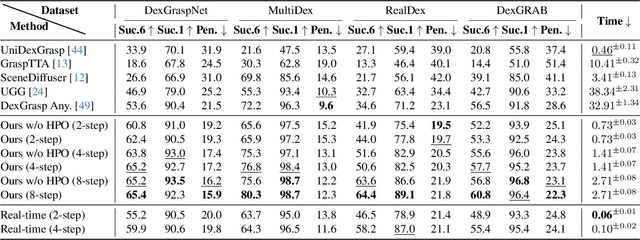
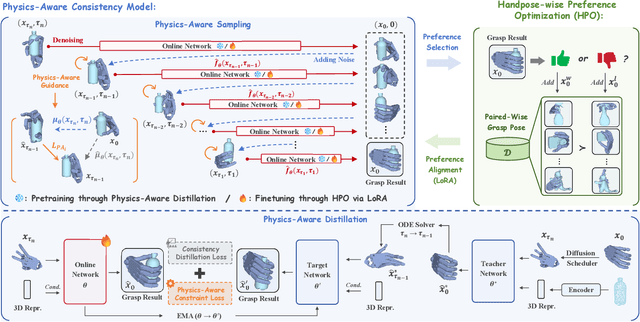
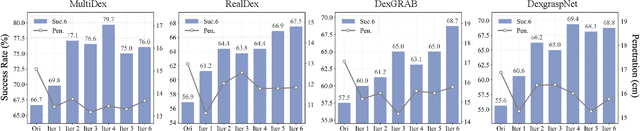

Dexterous robotic hands often struggle to generalize effectively in complex environments due to the limitations of models trained on low-diversity data. However, the real world presents an inherently unbounded range of scenarios, making it impractical to account for every possible variation. A natural solution is to enable robots learning from experience in complex environments, an approach akin to evolution, where systems improve through continuous feedback, learning from both failures and successes, and iterating toward optimal performance. Motivated by this, we propose EvolvingGrasp, an evolutionary grasp generation method that continuously enhances grasping performance through efficient preference alignment. Specifically, we introduce Handpose wise Preference Optimization (HPO), which allows the model to continuously align with preferences from both positive and negative feedback while progressively refining its grasping strategies. To further enhance efficiency and reliability during online adjustments, we incorporate a Physics-aware Consistency Model within HPO, which accelerates inference, reduces the number of timesteps needed for preference finetuning, and ensures physical plausibility throughout the process. Extensive experiments across four benchmark datasets demonstrate state of the art performance of our method in grasp success rate and sampling efficiency. Our results validate that EvolvingGrasp enables evolutionary grasp generation, ensuring robust, physically feasible, and preference-aligned grasping in both simulation and real scenarios.