 Add to Chrome
 Add to Firefox
 Add to Edge
SlotPi: Physics-informed Object-centric Reasoning Models
Jun 12, 2025
Understanding and reasoning about dynamics governed by physical laws through visual observation, akin to human capabilities in the real world, poses significant challenges. Currently, object-centric dynamic simulation methods, which emulate human behavior, have achieved notable progress but overlook two critical aspects: 1) the integration of physical knowledge into models. Humans gain physical insights by observing the world and apply this knowledge to accurately reason about various dynamic scenarios; 2) the validation of model adaptability across diverse scenarios. Real-world dynamics, especially those involving fluids and objects, demand models that not only capture object interactions but also simulate fluid flow characteristics. To address these gaps, we introduce SlotPi, a slot-based physics-informed object-centric reasoning model. SlotPi integrates a physical module based on Hamiltonian principles with a spatio-temporal prediction module for dynamic forecasting. Our experiments highlight the model's strengths in tasks such as prediction and Visual Question Answering (VQA) on benchmark and fluid datasets. Furthermore, we have created a real-world dataset encompassing object interactions, fluid dynamics, and fluid-object interactions, on which we validated our model's capabilities. The model's robust performance across all datasets underscores its strong adaptability, laying a foundation for developing more advanced world models.

3DGeoDet: General-purpose Geometry-aware Image-based 3D Object Detection
Jun 11, 2025This paper proposes 3DGeoDet, a novel geometry-aware 3D object detection approach that effectively handles single- and multi-view RGB images in indoor and outdoor environments, showcasing its general-purpose applicability. The key challenge for image-based 3D object detection tasks is the lack of 3D geometric cues, which leads to ambiguity in establishing correspondences between images and 3D representations. To tackle this problem, 3DGeoDet generates efficient 3D geometric representations in both explicit and implicit manners based on predicted depth information. Specifically, we utilize the predicted depth to learn voxel occupancy and optimize the voxelized 3D feature volume explicitly through the proposed voxel occupancy attention. To further enhance 3D awareness, the feature volume is integrated with an implicit 3D representation, the truncated signed distance function (TSDF). Without requiring supervision from 3D signals, we significantly improve the model's comprehension of 3D geometry by leveraging intermediate 3D representations and achieve end-to-end training. Our approach surpasses the performance of state-of-the-art image-based methods on both single- and multi-view benchmark datasets across diverse environments, achieving a 9.3 mAP@0.5 improvement on the SUN RGB-D dataset, a 3.3 mAP@0.5 improvement on the ScanNetV2 dataset, and a 0.19 AP3D@0.7 improvement on the KITTI dataset. The project page is available at: https://cindy0725.github.io/3DGeoDet/.
On Reasoning Strength Planning in Large Reasoning Models
Jun 10, 2025Recent studies empirically reveal that large reasoning models (LRMs) can automatically allocate more reasoning strengths (i.e., the number of reasoning tokens) for harder problems, exhibiting difficulty-awareness for better task performance. While this automatic reasoning strength allocation phenomenon has been widely observed, its underlying mechanism remains largely unexplored. To this end, we provide explanations for this phenomenon from the perspective of model activations. We find evidence that LRMs pre-plan the reasoning strengths in their activations even before generation, with this reasoning strength causally controlled by the magnitude of a pre-allocated directional vector. Specifically, we show that the number of reasoning tokens is predictable solely based on the question activations using linear probes, indicating that LRMs estimate the required reasoning strength in advance. We then uncover that LRMs encode this reasoning strength through a pre-allocated directional vector embedded in the activations of the model, where the vector's magnitude modulates the reasoning strength. Subtracting this vector can lead to reduced reasoning token number and performance, while adding this vector can lead to increased reasoning token number and even improved performance. We further reveal that this direction vector consistently yields positive reasoning length prediction, and it modifies the logits of end-of-reasoning token </think> to affect the reasoning length. Finally, we demonstrate two potential applications of our findings: overthinking behavior detection and enabling efficient reasoning on simple problems. Our work provides new insights into the internal mechanisms of reasoning in LRMs and offers practical tools for controlling their reasoning behaviors. Our code is available at https://github.com/AlphaLab-USTC/LRM-plans-CoT.
GenIR: Generative Visual Feedback for Mental Image Retrieval
Jun 06, 2025Vision-language models (VLMs) have shown strong performance on text-to-image retrieval benchmarks. However, bridging this success to real-world applications remains a challenge. In practice, human search behavior is rarely a one-shot action. Instead, it is often a multi-round process guided by clues in mind, that is, a mental image ranging from vague recollections to vivid mental representations of the target image. Motivated by this gap, we study the task of Mental Image Retrieval (MIR), which targets the realistic yet underexplored setting where users refine their search for a mentally envisioned image through multi-round interactions with an image search engine. Central to successful interactive retrieval is the capability of machines to provide users with clear, actionable feedback; however, existing methods rely on indirect or abstract verbal feedback, which can be ambiguous, misleading, or ineffective for users to refine the query. To overcome this, we propose GenIR, a generative multi-round retrieval paradigm leveraging diffusion-based image generation to explicitly reify the AI system's understanding at each round. These synthetic visual representations provide clear, interpretable feedback, enabling users to refine their queries intuitively and effectively. We further introduce a fully automated pipeline to generate a high-quality multi-round MIR dataset. Experimental results demonstrate that GenIR significantly outperforms existing interactive methods in the MIR scenario. This work establishes a new task with a dataset and an effective generative retrieval method, providing a foundation for future research in this direction.
Towards provable probabilistic safety for scalable embodied AI systems
Jun 05, 2025Embodied AI systems, comprising AI models and physical plants, are increasingly prevalent across various applications. Due to the rarity of system failures, ensuring their safety in complex operating environments remains a major challenge, which severely hinders their large-scale deployment in safety-critical domains, such as autonomous vehicles, medical devices, and robotics. While achieving provable deterministic safety--verifying system safety across all possible scenarios--remains theoretically ideal, the rarity and complexity of corner cases make this approach impractical for scalable embodied AI systems. To address this challenge, we introduce provable probabilistic safety, which aims to ensure that the residual risk of large-scale deployment remains below a predefined threshold. Instead of attempting exhaustive safety proof across all corner cases, this paradigm establishes a probabilistic safety boundary on overall system performance, leveraging statistical methods to enhance feasibility and scalability. A well-defined probabilistic safety boundary enables embodied AI systems to be deployed at scale while allowing for continuous refinement of safety guarantees. Our work focuses on three core questions: what is provable probabilistic safety, how to prove the probabilistic safety, and how to achieve the provable probabilistic safety. By bridging the gap between theoretical safety assurance and practical deployment, our work offers a pathway toward safer, large-scale adoption of embodied AI systems in safety-critical applications.
S3CE-Net: Spike-guided Spatiotemporal Semantic Coupling and Expansion Network for Long Sequence Event Re-Identification
May 30, 2025In this paper, we leverage the advantages of event cameras to resist harsh lighting conditions, reduce background interference, achieve high time resolution, and protect facial information to study the long-sequence event-based person re-identification (Re-ID) task. To this end, we propose a simple and efficient long-sequence event Re-ID model, namely the Spike-guided Spatiotemporal Semantic Coupling and Expansion Network (S3CE-Net). To better handle asynchronous event data, we build S3CE-Net based on spiking neural networks (SNNs). The S3CE-Net incorporates the Spike-guided Spatial-temporal Attention Mechanism (SSAM) and the Spatiotemporal Feature Sampling Strategy (STFS). The SSAM is designed to carry out semantic interaction and association in both spatial and temporal dimensions, leveraging the capabilities of SNNs. The STFS involves sampling spatial feature subsequences and temporal feature subsequences from the spatiotemporal dimensions, driving the Re-ID model to perceive broader and more robust effective semantics. Notably, the STFS introduces no additional parameters and is only utilized during the training stage. Therefore, S3CE-Net is a low-parameter and high-efficiency model for long-sequence event-based person Re-ID. Extensive experiments have verified that our S3CE-Net achieves outstanding performance on many mainstream long-sequence event-based person Re-ID datasets. Code is available at:https://github.com/Mhsunshine/SC3E_Net.
Beyond the LUMIR challenge: The pathway to foundational registration models
May 30, 2025
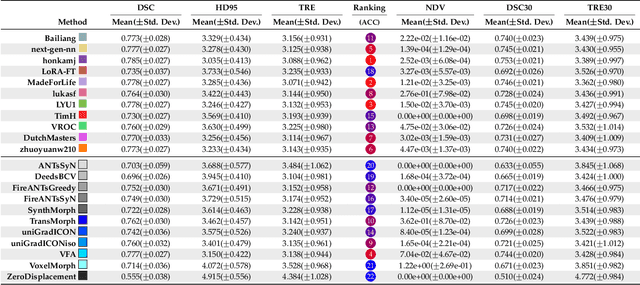
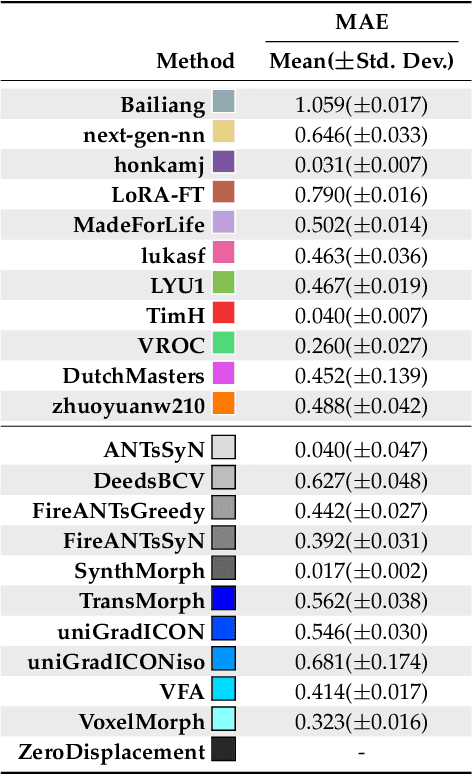
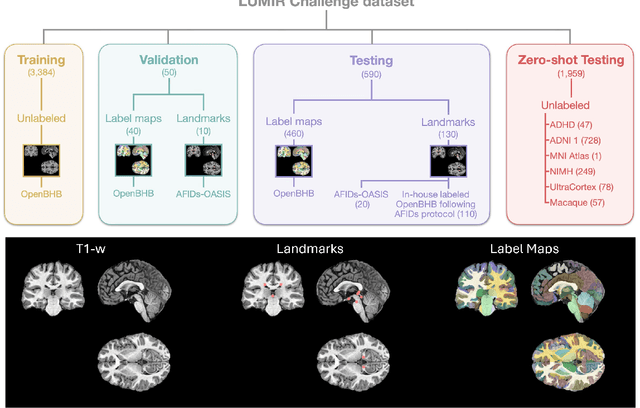
Medical image challenges have played a transformative role in advancing the field, catalyzing algorithmic innovation and establishing new performance standards across diverse clinical applications. Image registration, a foundational task in neuroimaging pipelines, has similarly benefited from the Learn2Reg initiative. Building on this foundation, we introduce the Large-scale Unsupervised Brain MRI Image Registration (LUMIR) challenge, a next-generation benchmark designed to assess and advance unsupervised brain MRI registration. Distinct from prior challenges that leveraged anatomical label maps for supervision, LUMIR removes this dependency by providing over 4,000 preprocessed T1-weighted brain MRIs for training without any label maps, encouraging biologically plausible deformation modeling through self-supervision. In addition to evaluating performance on 590 held-out test subjects, LUMIR introduces a rigorous suite of zero-shot generalization tasks, spanning out-of-domain imaging modalities (e.g., FLAIR, T2-weighted, T2*-weighted), disease populations (e.g., Alzheimer's disease), acquisition protocols (e.g., 9.4T MRI), and species (e.g., macaque brains). A total of 1,158 subjects and over 4,000 image pairs were included for evaluation. Performance was assessed using both segmentation-based metrics (Dice coefficient, 95th percentile Hausdorff distance) and landmark-based registration accuracy (target registration error). Across both in-domain and zero-shot tasks, deep learning-based methods consistently achieved state-of-the-art accuracy while producing anatomically plausible deformation fields. The top-performing deep learning-based models demonstrated diffeomorphic properties and inverse consistency, outperforming several leading optimization-based methods, and showing strong robustness to most domain shifts, the exception being a drop in performance on out-of-domain contrasts.
Physics-Informed Distillation of Diffusion Models for PDE-Constrained Generation
May 28, 2025Modeling physical systems in a generative manner offers several advantages, including the ability to handle partial observations, generate diverse solutions, and address both forward and inverse problems. Recently, diffusion models have gained increasing attention in the modeling of physical systems, particularly those governed by partial differential equations (PDEs). However, diffusion models only access noisy data $\boldsymbol{x}_t$ at intermediate steps, making it infeasible to directly enforce constraints on the clean sample $\boldsymbol{x}_0$ at each noisy level. As a workaround, constraints are typically applied to the expectation of clean samples $\mathbb{E}[\boldsymbol{x}_0|\boldsymbol{x}_t]$, which is estimated using the learned score network. However, imposing PDE constraints on the expectation does not strictly represent the one on the true clean data, known as Jensen's Gap. This gap creates a trade-off: enforcing PDE constraints may come at the cost of reduced accuracy in generative modeling. To address this, we propose a simple yet effective post-hoc distillation approach, where PDE constraints are not injected directly into the diffusion process, but instead enforced during a post-hoc distillation stage. We term our method as Physics-Informed Distillation of Diffusion Models (PIDDM). This distillation not only facilitates single-step generation with improved PDE satisfaction, but also support both forward and inverse problem solving and reconstruction from randomly partial observation. Extensive experiments across various PDE benchmarks demonstrate that PIDDM significantly improves PDE satisfaction over several recent and competitive baselines, such as PIDM, DiffusionPDE, and ECI-sampling, with less computation overhead. Our approach can shed light on more efficient and effective strategies for incorporating physical constraints into diffusion models.
Do Large Language Models Think Like the Brain? Sentence-Level Evidence from fMRI and Hierarchical Embeddings
May 28, 2025Understanding whether large language models (LLMs) and the human brain converge on similar computational principles remains a fundamental and important question in cognitive neuroscience and AI. Do the brain-like patterns observed in LLMs emerge simply from scaling, or do they reflect deeper alignment with the architecture of human language processing? This study focuses on the sentence-level neural mechanisms of language models, systematically investigating how hierarchical representations in LLMs align with the dynamic neural responses during human sentence comprehension. By comparing hierarchical embeddings from 14 publicly available LLMs with fMRI data collected from participants, who were exposed to a naturalistic narrative story, we constructed sentence-level neural prediction models to precisely identify the model layers most significantly correlated with brain region activations. Results show that improvements in model performance drive the evolution of representational architectures toward brain-like hierarchies, particularly achieving stronger functional and anatomical correspondence at higher semantic abstraction levels.
Revisiting Feature Interactions from the Perspective of Quadratic Neural Networks for Click-through Rate Prediction
May 23, 2025Hadamard Product (HP) has long been a cornerstone in click-through rate (CTR) prediction tasks due to its simplicity, effectiveness, and ability to capture feature interactions without additional parameters. However, the underlying reasons for its effectiveness remain unclear. In this paper, we revisit HP from the perspective of Quadratic Neural Networks (QNN), which leverage quadratic interaction terms to model complex feature relationships. We further reveal QNN's ability to expand the feature space and provide smooth nonlinear approximations without relying on activation functions. Meanwhile, we find that traditional post-activation does not further improve the performance of the QNN. Instead, mid-activation is a more suitable alternative. Through theoretical analysis and empirical evaluation of 25 QNN neuron formats, we identify a good-performing variant and make further enhancements on it. Specifically, we propose the Multi-Head Khatri-Rao Product as a superior alternative to HP and a Self-Ensemble Loss with dynamic ensemble capability within the same network to enhance computational efficiency and performance. Ultimately, we propose a novel neuron format, QNN-alpha, which is tailored for CTR prediction tasks. Experimental results show that QNN-alpha achieves new state-of-the-art performance on six public datasets while maintaining low inference latency, good scalability, and excellent compatibility. The code, running logs, and detailed hyperparameter configurations are available at: https://github.com/salmon1802/QNN.