 Add to Chrome
 Add to Firefox
 Add to Edge
STAR: Skeletal Token Alignment and Rearrangement for Interaction Recognition
Jul 19, 2026
Understanding physical human-robot and human-human interactions is a challenging yet emerging topic in 3D vision. While most existing methods rely on skeleton sequences--effective in low-light and privacy-sensitive environment--they face two major challenges: 1) learning and effectively exploiting interaction cues from skeletal data, and 2) compensating for the lack of visual information absent in skeletons alone. To address these challenges, we propose skeletal token alignment and rearrangement (STAR) for human-robot and human-human interaction recognition. It learns interaction-specific skeleton features and enriches them using visual cues by aligning skeleton and RGB video representations in a shared latent space. Specifically, STAR consists of three key components. First, we design a skeleton encoder that captures fine-grained interdependencies using Entity Rearrangement (ER) and Interactive Spatiotemporal Tokens (ISTs). Second, we present Visual Interaction Encoding that introduces a Focus on Interactions (FoI) strategy to attend to spatiotemporal regions relevant to interactions in RGB videos. Finally, these representations are aligned via a contrastive learning objective, with a refinement head further refines predictions. During training, STAR leverages both skeleton and RGB video data to learn robust, discriminative interaction representations. At inference time, it operates on skeletons alone, retaining visual-informed benefits while preserving skeleton-only efficiency. Extensive experiments on Chico, HARPER, NTU Mutual 11 and 26 datasets consistently validate our approach by demonstrating superior performance over state-of-the-art methods. Our code is publicly available at https://github.com/Necolizer/STAR.
* Accepted for publication in IEEE Transactions on Multimedia (IEEE TMM)

A Survey on Backbones for Deep Video Action Recognition
May 09, 2024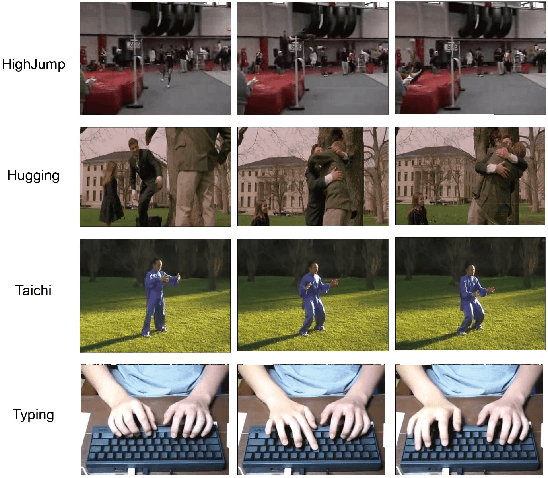
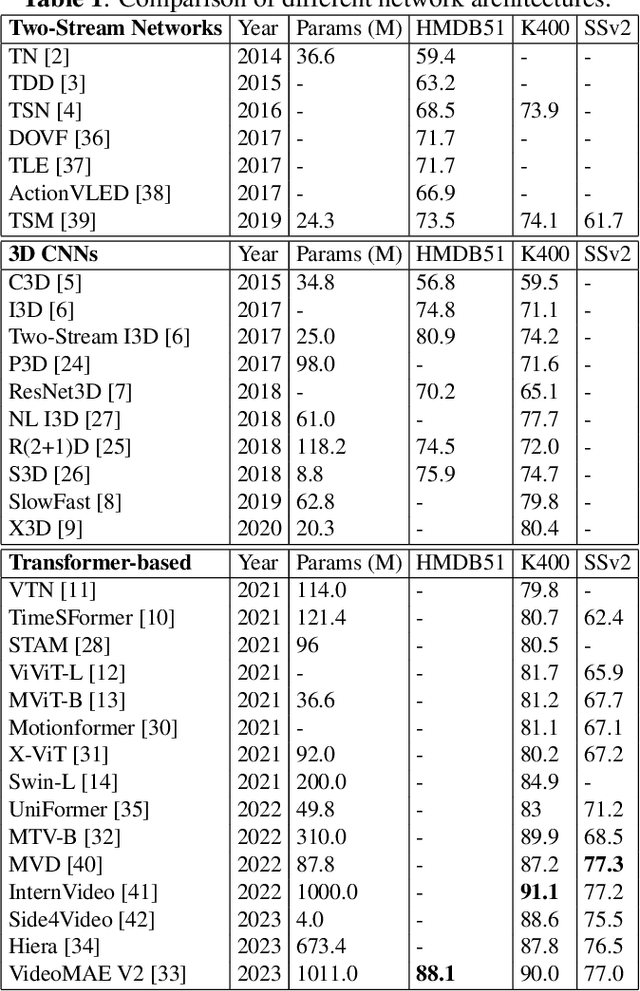
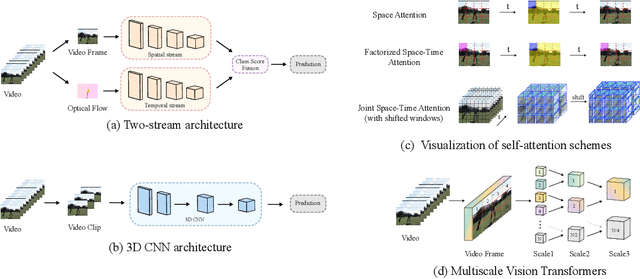
Action recognition is a key technology in building interactive metaverses. With the rapid development of deep learning, methods in action recognition have also achieved great advancement. Researchers design and implement the backbones referring to multiple standpoints, which leads to the diversity of methods and encountering new challenges. This paper reviews several action recognition methods based on deep neural networks. We introduce these methods in three parts: 1) Two-Streams networks and their variants, which, specifically in this paper, use RGB video frame and optical flow modality as input; 2) 3D convolutional networks, which make efforts in taking advantage of RGB modality directly while extracting different motion information is no longer necessary; 3) Transformer-based methods, which introduce the model from natural language processing into computer vision and video understanding. We offer objective sights in this review and hopefully provide a reference for future research.
Facial Prior Based First Order Motion Model for Micro-expression Generation
Aug 08, 2023
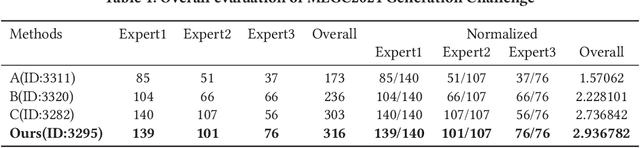
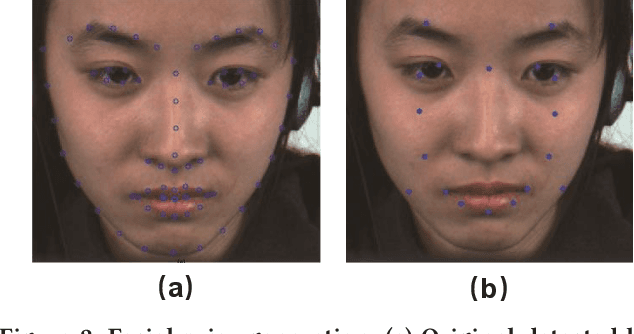
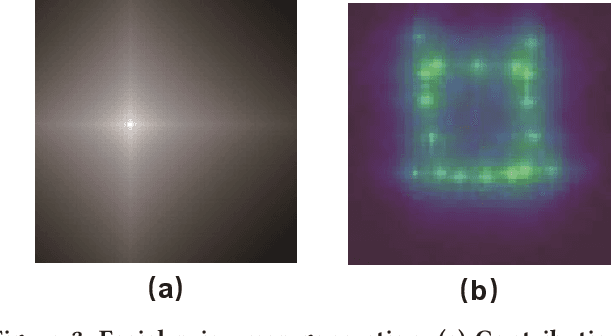
Spotting facial micro-expression from videos finds various potential applications in fields including clinical diagnosis and interrogation, meanwhile this task is still difficult due to the limited scale of training data. To solve this problem, this paper tries to formulate a new task called micro-expression generation and then presents a strong baseline which combines the first order motion model with facial prior knowledge. Given a target face, we intend to drive the face to generate micro-expression videos according to the motion patterns of source videos. Specifically, our new model involves three modules. First, we extract facial prior features from a region focusing module. Second, we estimate facial motion using key points and local affine transformations with a motion prediction module. Third, expression generation module is used to drive the target face to generate videos. We train our model on public CASME II, SAMM and SMIC datasets and then use the model to generate new micro-expression videos for evaluation. Our model achieves the first place in the Facial Micro-Expression Challenge 2021 (MEGC2021), where our superior performance is verified by three experts with Facial Action Coding System certification. Source code is provided in https://github.com/Necolizer/Facial-Prior-Based-FOMM.
Interactive Spatiotemporal Token Attention Network for Skeleton-based General Interactive Action Recognition
Jul 14, 2023Recognizing interactive action plays an important role in human-robot interaction and collaboration. Previous methods use late fusion and co-attention mechanism to capture interactive relations, which have limited learning capability or inefficiency to adapt to more interacting entities. With assumption that priors of each entity are already known, they also lack evaluations on a more general setting addressing the diversity of subjects. To address these problems, we propose an Interactive Spatiotemporal Token Attention Network (ISTA-Net), which simultaneously model spatial, temporal, and interactive relations. Specifically, our network contains a tokenizer to partition Interactive Spatiotemporal Tokens (ISTs), which is a unified way to represent motions of multiple diverse entities. By extending the entity dimension, ISTs provide better interactive representations. To jointly learn along three dimensions in ISTs, multi-head self-attention blocks integrated with 3D convolutions are designed to capture inter-token correlations. When modeling correlations, a strict entity ordering is usually irrelevant for recognizing interactive actions. To this end, Entity Rearrangement is proposed to eliminate the orderliness in ISTs for interchangeable entities. Extensive experiments on four datasets verify the effectiveness of ISTA-Net by outperforming state-of-the-art methods. Our code is publicly available at https://github.com/Necolizer/ISTA-Net