 Add to Chrome
 Add to Firefox
 Add to Edge
MS-Resampler: Multi-Scope Visual Resampling for Efficient Multimodal LLMs
Jun 30, 2026
Multimodal large language models (MLLMs) typically employ resampling-based projectors to transform dense visual features into a compact token sequence for language modeling. Most existing resamplers adopt a single, fixed aggregation scope via global cross-attention, which can blur fine-grained local evidence and limit the ability to capture both local details and global context within a fixed token budget. In this work, we propose MS-Resampler, a multi-scope visual resampling framework for MLLMs. MS-Resampler instantiates multiple scope-specific resamplers by injecting explicit spatial scope priors into the resampling attention, enabling each branch to aggregate visual information at a particular granularity from local to global. The outputs of these scope-specific resamplers are then adaptively fused to produce the final visual representations for language modeling. Extensive experiments on ten public multimodal benchmarks show that MS-Resampler consistently improves visual understanding and multimodal reasoning over conventional single-scope resamplers, while introducing only minimal computational overhead.

SMoES: Soft Modality-Guided Expert Specialization in MoE-VLMs
Apr 27, 2026Mixture-of-Experts (MoE) has become a prevalent backbone for large vision-language models (VLMs), yet how modality-specific signals should guide expert routing remains under-explored. Existing routing strategies are either hand-crafted or modality-agnostic, relying on idealized priors that ignore the layer-dependent modality fusion patterns in MoE-VLMs and provide little guidance for expert specialization. We propose Soft Modality-guided Expert Specialization (SMoES), which consists of dynamic soft modality scores that capture layer-dependent fusion patterns, an expert binning mechanism aligned with expert-parallel deployment, and an inter-bin mutual information regularization that encourages coherent modality specialization. Our method leverages attention-based or Gaussian-statistics modality scores to optimize mutual information regularization. Experiments across four MoE-based VLMs and 16 benchmarks demonstrate improvement on both effectiveness and efficiency: 0.9% and 4.2% average gain on multimodal and language-only tasks, 56.1% reduction in EP communication overhead, and 12.3% throughput improvement under realistic deployment. These results validate that aligning routing with modality-aware expert specialization unlocks MoE-VLM capacity and efficiency.
LearnPruner: Rethinking Attention-based Token Pruning in Vision Language Models
Apr 27, 2026Vision-Language Models (VLMs) have recently demonstrated remarkable capabilities in visual understanding and reasoning, but they also impose significant computational burdens due to long visual sequence inputs. Recent works address this issue by pruning unimportant visual tokens, achieving substantial computational reduction while maintaining model performance. The core of token pruning lies in determining token importance, with current approaches primarily relying on attention scores from vision encoders or Large Language Models (LLMs). In this paper, we analyze the effectiveness of attention mechanisms in both vision encoders and LLMs. We find that vision encoders suffer from attention sink, leading to poor focus on informative foreground regions, while in LLMs, although prior studies have identified attention bias toward token positions, text-to-vision attention demonstrates resistance to this bias and enables effective pruning guidance in middle layers. Based on these observations, we propose LearnPruner, a two-stage token pruning framework that first removes redundant vision tokens via a learnable pruning module after the vision encoder, then retains only task-relevant tokens in the LLM's middle layer. Experimental results show that our LearnPruner can preserve approximately 95% of the original performance while using only 5.5% of vision tokens, and achieve 3.2$\times$ inference acceleration, demonstrating a superior accuracy-efficiency trade-off.
QMoP: Query Guided Mixture-of-Projector for Efficient Visual Token Compression
Mar 22, 2026Multimodal large language models suffer from severe computational and memory bottlenecks, as the number of visual tokens far exceeds that of textual tokens. While recent methods employ projector modules to align and compress visual tokens into text-aligned features, they typically depend on fixed heuristics that limit adaptability across diverse scenarios. In this paper, we first propose Query Guided Mixture-of-Projector (QMoP), a novel and flexible framework that adaptively compresses visual tokens via three collaborative branches: (1) a pooling-based branch for coarse-grained global semantics, (2) a resampler branch for extracting high-level semantic representations, and (3) a pruning-based branch for fine-grained token selection to preserve critical visual detail. To adaptively coordinate these branches, we introduce the Query Guided Router (QGR), which dynamically selects and weights the outputs from different branches based on both visual input and textual queries. A Mixture-of-Experts-style fusion mechanism is designed to aggregate the outputs, harnessing the strengths of each strategy while suppressing noise. To systematically evaluate the effects of Visual Token Compression, we also develop VTCBench, a dedicated benchmark for evaluating the information loss induced by visual token compression. Extensive experiments demonstrate that despite relying on fundamental compression modules, QMoP outperforms strong baselines and delivers significant savings in memory, computation, and inference time.
Step-CoT: Stepwise Visual Chain-of-Thought for Medical Visual Question Answering
Mar 14, 2026Chain-of-thought (CoT) reasoning has advanced medical visual question answering (VQA), yet most existing CoT rationales are free-form and fail to capture the structured reasoning process clinicians actually follow. This work asks: Can traceable, multi-step reasoning supervision improve reasoning accuracy and the interpretability of Medical VQA? To this end, we introduce Step-CoT, a large-scale medical reasoning dataset with expert-curated, structured multi-step CoT aligned to clinical diagnostic workflows, implicitly grounding the model's reasoning in radiographic evidence. Step-CoT comprises more than 10K real clinical cases and 70K VQA pairs organized around diagnostic workflows, providing supervised intermediate steps that guide models to follow valid reasoning trajectories. To effectively learn from Step-CoT, we further introduce a teacher-student framework with a dynamic graph-structured focusing mechanism that prioritizes diagnostically informative steps while filtering out less relevant contexts. Our experiments show that using Step-CoT can improve reasoning accuracy and interpretability. Benchmark: github.com/hahaha111111/Step-CoT. Dataset Card: huggingface.co/datasets/fl-15o/Step-CoT
ITO: Images and Texts as One via Synergizing Multiple Alignment and Training-Time Fusion
Mar 04, 2026Image-text contrastive pretraining has become a dominant paradigm for visual representation learning, yet existing methods often yield representations that remain partially organized by modality. We propose ITO, a framework addressing this limitation through two synergistic mechanisms. Multimodal multiple alignment enriches supervision by mining diverse image-text correspondences, while a lightweight training-time multimodal fusion module enforces structured cross-modal interaction. Crucially, the fusion module is discarded at inference, preserving the efficiency of standard dual-encoder architectures. Extensive experiments show that ITO consistently outperforms strong baselines across classification, retrieval, and multimodal benchmarks. Our analysis reveals that while multiple alignment drives discriminative power, training-time fusion acts as a critical structural regularizer -- eliminating the modality gap and stabilizing training dynamics to prevent the early saturation often observed in aggressive contrastive learning.
iGVLM: Dynamic Instruction-Guided Vision Encoding for Question-Aware Multimodal Understanding
Mar 03, 2026Despite the success of Large Vision--Language Models (LVLMs), most existing architectures suffer from a representation bottleneck: they rely on static, instruction-agnostic vision encoders whose visual representations are utilized in an invariant manner across different textual tasks. This rigidity hinders fine-grained reasoning where task-specific visual cues are critical. To address this issue, we propose iGVLM, a general framework for instruction-guided visual modulation. iGVLM introduces a decoupled dual-branch architecture: a frozen representation branch that preserves task-agnostic visual representations learned during pre-training, and a dynamic conditioning branch that performs affine feature modulation via Adaptive Layer Normalization (AdaLN). This design enables a smooth transition from general-purpose perception to instruction-aware reasoning while maintaining the structural integrity and stability of pre-trained visual priors. Beyond standard benchmarks, we introduce MM4, a controlled diagnostic probe for quantifying logical consistency under multi-query, multi-instruction settings. Extensive results show that iGVLM consistently enhances instruction sensitivity across diverse language backbones, offering a plug-and-play paradigm for bridging passive perception and active reasoning.
Debiased Novel Category Discovering and Localization
Feb 29, 2024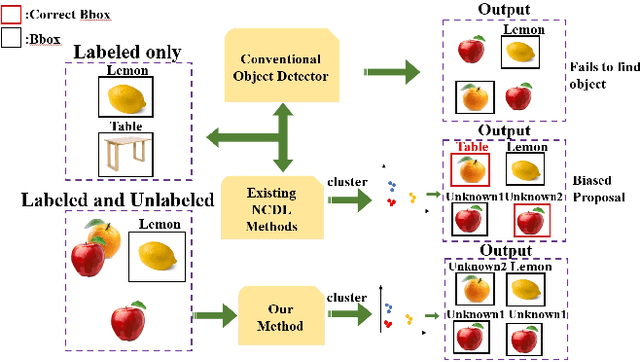

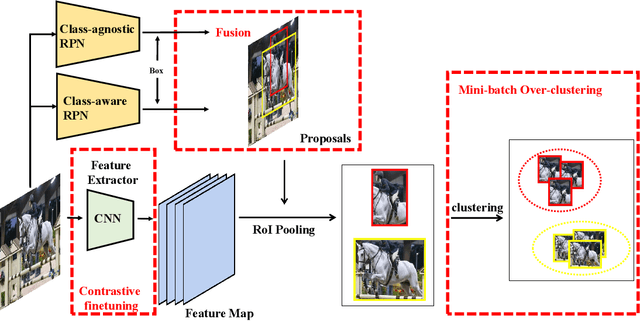
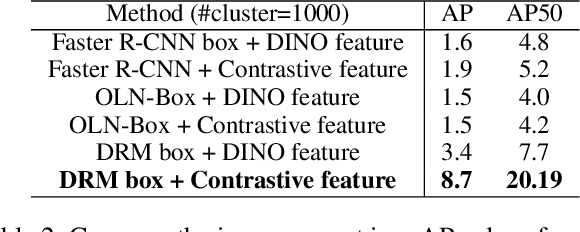
In recent years, object detection in deep learning has experienced rapid development. However, most existing object detection models perform well only on closed-set datasets, ignoring a large number of potential objects whose categories are not defined in the training set. These objects are often identified as background or incorrectly classified as pre-defined categories by the detectors. In this paper, we focus on the challenging problem of Novel Class Discovery and Localization (NCDL), aiming to train detectors that can detect the categories present in the training data, while also actively discover, localize, and cluster new categories. We analyze existing NCDL methods and identify the core issue: object detectors tend to be biased towards seen objects, and this leads to the neglect of unseen targets. To address this issue, we first propose an Debiased Region Mining (DRM) approach that combines class-agnostic Region Proposal Network (RPN) and class-aware RPN in a complementary manner. Additionally, we suggest to improve the representation network through semi-supervised contrastive learning by leveraging unlabeled data. Finally, we adopt a simple and efficient mini-batch K-means clustering method for novel class discovery. We conduct extensive experiments on the NCDL benchmark, and the results demonstrate that the proposed DRM approach significantly outperforms previous methods, establishing a new state-of-the-art.
A Survey for Foundation Models in Autonomous Driving
Feb 02, 2024The advent of foundation models has revolutionized the fields of natural language processing and computer vision, paving the way for their application in autonomous driving (AD). This survey presents a comprehensive review of more than 40 research papers, demonstrating the role of foundation models in enhancing AD. Large language models contribute to planning and simulation in AD, particularly through their proficiency in reasoning, code generation and translation. In parallel, vision foundation models are increasingly adapted for critical tasks such as 3D object detection and tracking, as well as creating realistic driving scenarios for simulation and testing. Multi-modal foundation models, integrating diverse inputs, exhibit exceptional visual understanding and spatial reasoning, crucial for end-to-end AD. This survey not only provides a structured taxonomy, categorizing foundation models based on their modalities and functionalities within the AD domain but also delves into the methods employed in current research. It identifies the gaps between existing foundation models and cutting-edge AD approaches, thereby charting future research directions and proposing a roadmap for bridging these gaps.
u-LLaVA: Unifying Multi-Modal Tasks via Large Language Model
Nov 09, 2023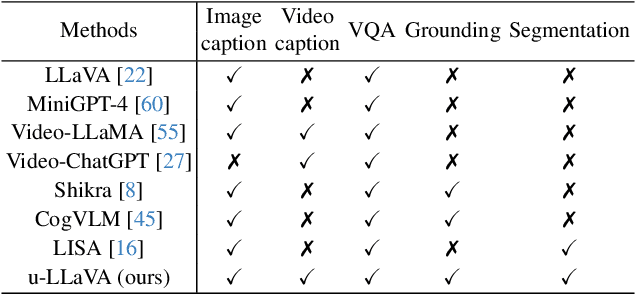
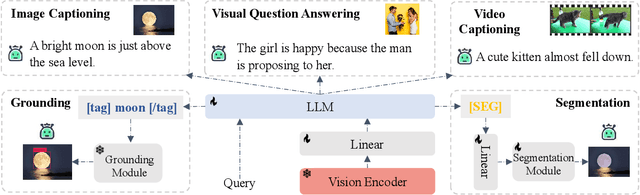
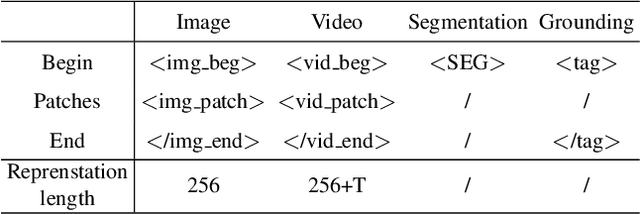
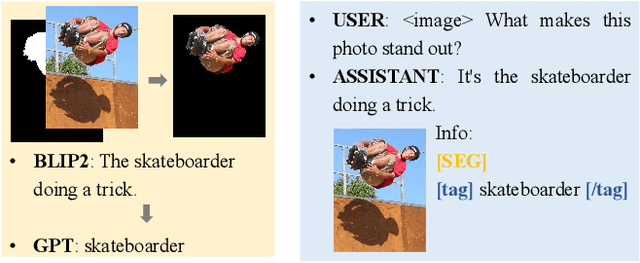
Recent advances such as LLaVA and Mini-GPT4 have successfully integrated visual information into LLMs, yielding inspiring outcomes and giving rise to a new generation of multi-modal LLMs, or MLLMs. Nevertheless, these methods struggle with hallucinations and the mutual interference between tasks. To tackle these problems, we propose an efficient and accurate approach to adapt to downstream tasks by utilizing LLM as a bridge to connect multiple expert models, namely u-LLaVA. Firstly, we incorporate the modality alignment module and multi-task modules into LLM. Then, we reorganize or rebuild multi-type public datasets to enable efficient modality alignment and instruction following. Finally, task-specific information is extracted from the trained LLM and provided to different modules for solving downstream tasks. The overall framework is simple, effective, and achieves state-of-the-art performance across multiple benchmarks. We also release our model, the generated data, and the code base publicly available.