 Add to Chrome
 Add to Firefox
 Add to Edge
TWLR: Text-Guided Weakly-Supervised Lesion Localization and Severity Regression for Explainable Diabetic Retinopathy Grading
Dec 15, 2025
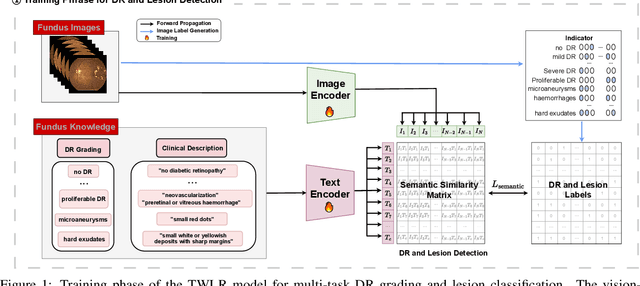

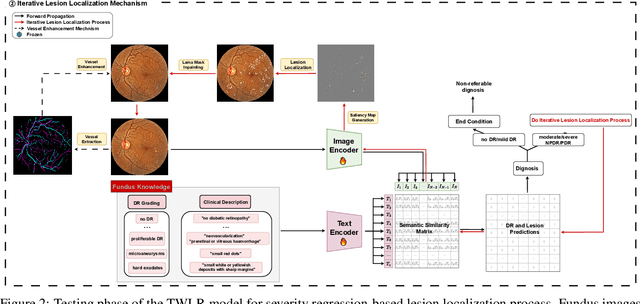
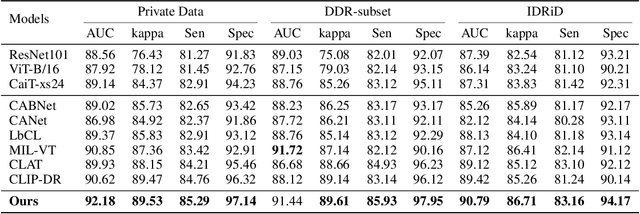
Accurate medical image analysis can greatly assist clinical diagnosis, but its effectiveness relies on high-quality expert annotations Obtaining pixel-level labels for medical images, particularly fundus images, remains costly and time-consuming. Meanwhile, despite the success of deep learning in medical imaging, the lack of interpretability limits its clinical adoption. To address these challenges, we propose TWLR, a two-stage framework for interpretable diabetic retinopathy (DR) assessment. In the first stage, a vision-language model integrates domain-specific ophthalmological knowledge into text embeddings to jointly perform DR grading and lesion classification, effectively linking semantic medical concepts with visual features. The second stage introduces an iterative severity regression framework based on weakly-supervised semantic segmentation. Lesion saliency maps generated through iterative refinement direct a progressive inpainting mechanism that systematically eliminates pathological features, effectively downgrading disease severity toward healthier fundus appearances. Critically, this severity regression approach achieves dual benefits: accurate lesion localization without pixel-level supervision and providing an interpretable visualization of disease-to-healthy transformations. Experimental results on the FGADR, DDR, and a private dataset demonstrate that TWLR achieves competitive performance in both DR classification and lesion segmentation, offering a more explainable and annotation-efficient solution for automated retinal image analysis.

Debiased Novel Category Discovering and Localization
Feb 29, 2024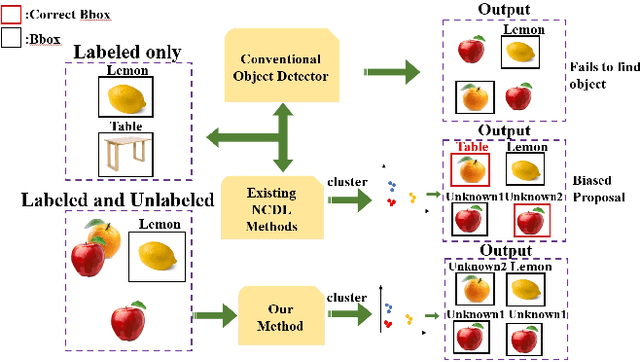

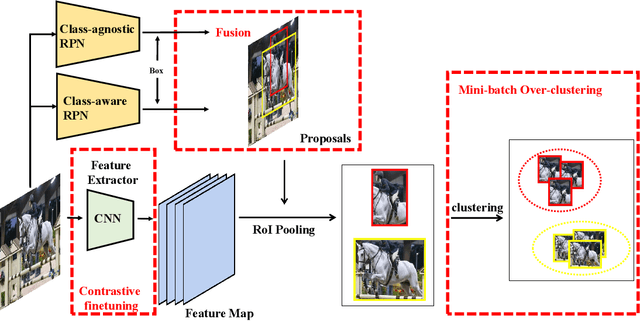
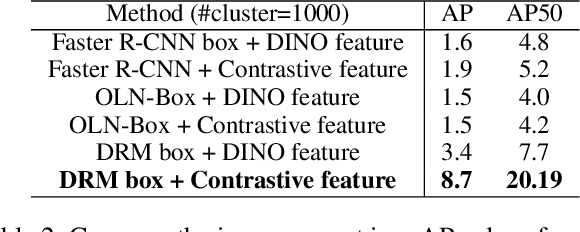
In recent years, object detection in deep learning has experienced rapid development. However, most existing object detection models perform well only on closed-set datasets, ignoring a large number of potential objects whose categories are not defined in the training set. These objects are often identified as background or incorrectly classified as pre-defined categories by the detectors. In this paper, we focus on the challenging problem of Novel Class Discovery and Localization (NCDL), aiming to train detectors that can detect the categories present in the training data, while also actively discover, localize, and cluster new categories. We analyze existing NCDL methods and identify the core issue: object detectors tend to be biased towards seen objects, and this leads to the neglect of unseen targets. To address this issue, we first propose an Debiased Region Mining (DRM) approach that combines class-agnostic Region Proposal Network (RPN) and class-aware RPN in a complementary manner. Additionally, we suggest to improve the representation network through semi-supervised contrastive learning by leveraging unlabeled data. Finally, we adopt a simple and efficient mini-batch K-means clustering method for novel class discovery. We conduct extensive experiments on the NCDL benchmark, and the results demonstrate that the proposed DRM approach significantly outperforms previous methods, establishing a new state-of-the-art.