 Add to Chrome
 Add to Firefox
 Add to Edge
Separators in Enhancing Autoregressive Pretraining for Vision Mamba
Mar 04, 2026
The state space model Mamba has recently emerged as a promising paradigm in computer vision, attracting significant attention due to its efficient processing of long sequence tasks. Mamba's inherent causal mechanism renders it particularly suitable for autoregressive pretraining. However, current autoregressive pretraining methods are constrained to short sequence tasks, failing to fully exploit Mamba's prowess in handling extended sequences. To address this limitation, we introduce an innovative autoregressive pretraining method for Vision Mamba that substantially extends the input sequence length. We introduce new \textbf{S}epara\textbf{T}ors for \textbf{A}uto\textbf{R}egressive pretraining to demarcate and differentiate between different images, known as \textbf{STAR}. Specifically, we insert identical separators before each image to demarcate its inception. This strategy enables us to quadruple the input sequence length of Vision Mamba while preserving the original dimensions of the dataset images. Employing this long sequence pretraining technique, our STAR-B model achieved an impressive accuracy of 83.5\% on ImageNet-1k, which is highly competitive in Vision Mamba. These results underscore the potential of our method in enhancing the performance of vision models through improved leveraging of long-range dependencies.

ITO: Images and Texts as One via Synergizing Multiple Alignment and Training-Time Fusion
Mar 04, 2026Image-text contrastive pretraining has become a dominant paradigm for visual representation learning, yet existing methods often yield representations that remain partially organized by modality. We propose ITO, a framework addressing this limitation through two synergistic mechanisms. Multimodal multiple alignment enriches supervision by mining diverse image-text correspondences, while a lightweight training-time multimodal fusion module enforces structured cross-modal interaction. Crucially, the fusion module is discarded at inference, preserving the efficiency of standard dual-encoder architectures. Extensive experiments show that ITO consistently outperforms strong baselines across classification, retrieval, and multimodal benchmarks. Our analysis reveals that while multiple alignment drives discriminative power, training-time fusion acts as a critical structural regularizer -- eliminating the modality gap and stabilizing training dynamics to prevent the early saturation often observed in aggressive contrastive learning.
iGVLM: Dynamic Instruction-Guided Vision Encoding for Question-Aware Multimodal Understanding
Mar 03, 2026Despite the success of Large Vision--Language Models (LVLMs), most existing architectures suffer from a representation bottleneck: they rely on static, instruction-agnostic vision encoders whose visual representations are utilized in an invariant manner across different textual tasks. This rigidity hinders fine-grained reasoning where task-specific visual cues are critical. To address this issue, we propose iGVLM, a general framework for instruction-guided visual modulation. iGVLM introduces a decoupled dual-branch architecture: a frozen representation branch that preserves task-agnostic visual representations learned during pre-training, and a dynamic conditioning branch that performs affine feature modulation via Adaptive Layer Normalization (AdaLN). This design enables a smooth transition from general-purpose perception to instruction-aware reasoning while maintaining the structural integrity and stability of pre-trained visual priors. Beyond standard benchmarks, we introduce MM4, a controlled diagnostic probe for quantifying logical consistency under multi-query, multi-instruction settings. Extensive results show that iGVLM consistently enhances instruction sensitivity across diverse language backbones, offering a plug-and-play paradigm for bridging passive perception and active reasoning.
Solving Robotics Problems in Zero-Shot with Vision-Language Models
Jul 26, 2024We introduce Wonderful Team, a multi-agent visual LLM (VLLM) framework for solving robotics problems in the zero-shot regime. By zero-shot we mean that, for a novel environment, we feed a VLLM an image of the robot's environment and a description of the task, and have the VLLM output the sequence of actions necessary for the robot to complete the task. Prior work on VLLMs in robotics has largely focused on settings where some part of the pipeline is fine-tuned, such as tuning an LLM on robot data or training a separate vision encoder for perception and action generation. Surprisingly, due to recent advances in the capabilities of VLLMs, this type of fine-tuning may no longer be necessary for many tasks. In this work, we show that with careful engineering, we can prompt a single off-the-shelf VLLM to handle all aspects of a robotics task, from high-level planning to low-level location-extraction and action-execution. Wonderful Team builds on recent advances in multi-agent LLMs to partition tasks across an agent hierarchy, making it self-corrective and able to effectively partition and solve even long-horizon tasks. Extensive experiments on VIMABench and real-world robotic environments demonstrate the system's capability to handle a variety of robotic tasks, including manipulation, visual goal-reaching, and visual reasoning, all in a zero-shot manner. These results underscore a key point: vision-language models have progressed rapidly in the past year, and should strongly be considered as a backbone for robotics problems going forward.
Cold Diffusion on the Replay Buffer: Learning to Plan from Known Good States
Oct 21, 2023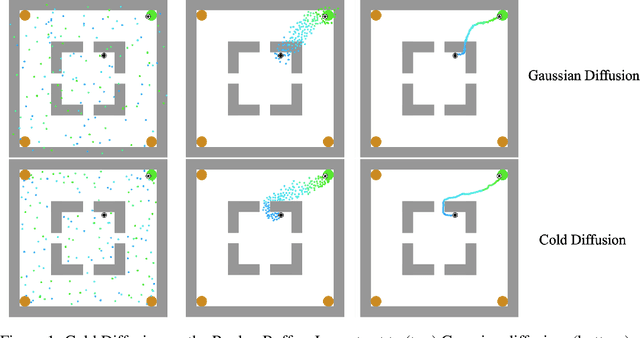
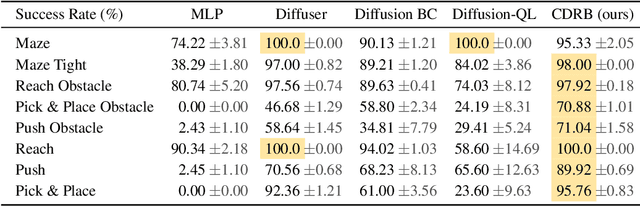
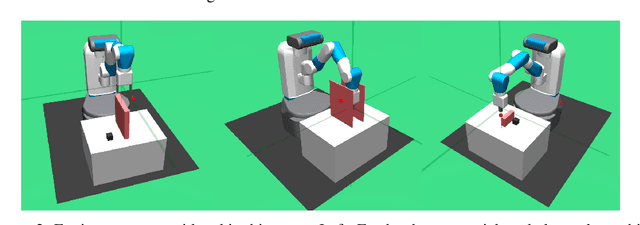

Learning from demonstrations (LfD) has successfully trained robots to exhibit remarkable generalization capabilities. However, many powerful imitation techniques do not prioritize the feasibility of the robot behaviors they generate. In this work, we explore the feasibility of plans produced by LfD. As in prior work, we employ a temporal diffusion model with fixed start and goal states to facilitate imitation through in-painting. Unlike previous studies, we apply cold diffusion to ensure the optimization process is directed through the agent's replay buffer of previously visited states. This routing approach increases the likelihood that the final trajectories will predominantly occupy the feasible region of the robot's state space. We test this method in simulated robotic environments with obstacles and observe a significant improvement in the agent's ability to avoid these obstacles during planning.