 Add to Chrome
 Add to Firefox
 Add to Edge
SPARE: Structural Parameter-Free Affinity Regularization for Flow Matching
Aug 03, 2026
Denoising diffusion transformers achieve strong generation quality but converge slowly during training. Regularizing their internal representations has emerged as an effective accelerator, yet existing methods split into two families with complementary costs. Target-based methods strengthen representations by aligning them to external features, which requires an external encoder and a learnable projection head to bridge feature spaces. Target-free methods hold no reference at all, and can only repel the model's own features across samples or layers, discarding whatever structure the data contains. Prior work suggests that spatial structure, rather than global semantics, drives the gains of alignment. We therefore ask whether such structure can serve as a target directly, and whether it exists not only within an image but across images. Our key insight is that the clean data latent already carries this structure in the relations among its tokens, where a relation is the similarity between two tokens, a single scalar comparable across feature spaces without a projection head. We propose Structural Parameter-free Affinity Regularization (SPARE), a regularizer that matches the pairwise affinities of intermediate tokens to those of the clean latents. To exploit this structure fully, SPARE extends the matching to token pairs across images, precisely the pairs that prior target-free methods repel by default, and calibrates both relation types with a single learning objective. On ImageNet $256 \times 256$ with SiT backbones under matched 400K-iteration budgets, SPARE adds no encoder, head, or parameters and only 0.08 GB of training memory, yet attains the lowest FID among parameter-free regularizers in every tested setting, recovers 37 to 54\% of REPA's FID reduction, and improves over REPA when combined with it, reaching FID 1.90 under classifier-free guidance at 1M iterations.

The Velocity Deficit: Initial Energy Injection for Flow Matching
May 14, 2026While Flow Matching theoretically guarantees constant-velocity trajectories, we identify a critical breakdown in high-dimensional practice: the Velocity Deficit. We show that the MSE objective systematically underestimates velocity magnitude, causing generated samples to fail to reach the data manifold-a phenomenon we term Integration Lag. To rectify this, we propose Initial Energy Injection, instantiated via two complementary methods: the training-based Magnitude-Aware Flow Matching (MAFM) and the training-free Scale Schedule Corrector (SSC). Both are grounded in our discovery of a crucial asymmetry: velocity contraction causes harmful kinetic stagnation at the trajectory's start, yet acts as a beneficial denoising mechanism at its end. Empirically, SSC yields significant efficiency gains with zero retraining and just one line of code. On ImageNet-1k (256x256), it improves FID by 44.6% (from 13.68 to 7.58) and achieves a 5x speedup, enabling a 50-step generator (FID 7.58) to beat a 250-step baseline (FID 8.65). Furthermore, our methods generalize to Text-to-Image tasks and high-resolution generation, improving FID on MS-COCO by ~22%.
RDPN6D: Residual-based Dense Point-wise Network for 6Dof Object Pose Estimation Based on RGB-D Images
May 14, 2024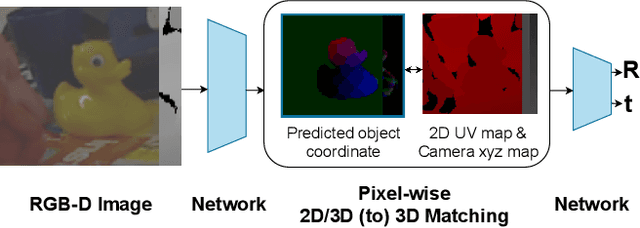
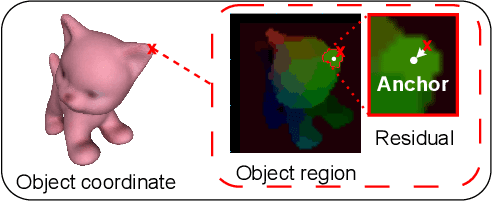
In this work, we introduce a novel method for calculating the 6DoF pose of an object using a single RGB-D image. Unlike existing methods that either directly predict objects' poses or rely on sparse keypoints for pose recovery, our approach addresses this challenging task using dense correspondence, i.e., we regress the object coordinates for each visible pixel. Our method leverages existing object detection methods. We incorporate a re-projection mechanism to adjust the camera's intrinsic matrix to accommodate cropping in RGB-D images. Moreover, we transform the 3D object coordinates into a residual representation, which can effectively reduce the output space and yield superior performance. We conducted extensive experiments to validate the efficacy of our approach for 6D pose estimation. Our approach outperforms most previous methods, especially in occlusion scenarios, and demonstrates notable improvements over the state-of-the-art methods. Our code is available on https://github.com/AI-Application-and-Integration-Lab/RDPN6D.
Improving Facial Landmark Detection Accuracy and Efficiency with Knowledge Distillation
Apr 09, 2024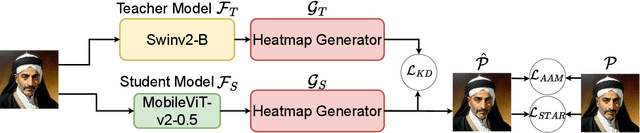

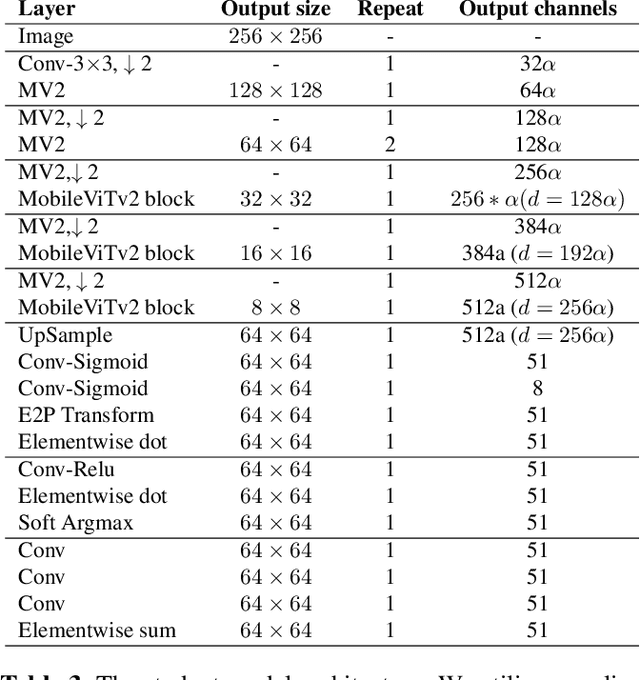
The domain of computer vision has experienced significant advancements in facial-landmark detection, becoming increasingly essential across various applications such as augmented reality, facial recognition, and emotion analysis. Unlike object detection or semantic segmentation, which focus on identifying objects and outlining boundaries, faciallandmark detection aims to precisely locate and track critical facial features. However, deploying deep learning-based facial-landmark detection models on embedded systems with limited computational resources poses challenges due to the complexity of facial features, especially in dynamic settings. Additionally, ensuring robustness across diverse ethnicities and expressions presents further obstacles. Existing datasets often lack comprehensive representation of facial nuances, particularly within populations like those in Taiwan. This paper introduces a novel approach to address these challenges through the development of a knowledge distillation method. By transferring knowledge from larger models to smaller ones, we aim to create lightweight yet powerful deep learning models tailored specifically for facial-landmark detection tasks. Our goal is to design models capable of accurately locating facial landmarks under varying conditions, including diverse expressions, orientations, and lighting environments. The ultimate objective is to achieve high accuracy and real-time performance suitable for deployment on embedded systems. This method was successfully implemented and achieved a top 6th place finish out of 165 participants in the IEEE ICME 2024 PAIR competition.
Domain-Generalized Face Anti-Spoofing with Unknown Attacks
Oct 18, 2023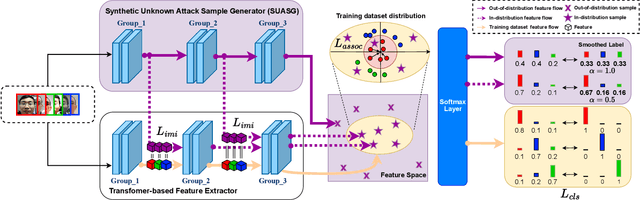
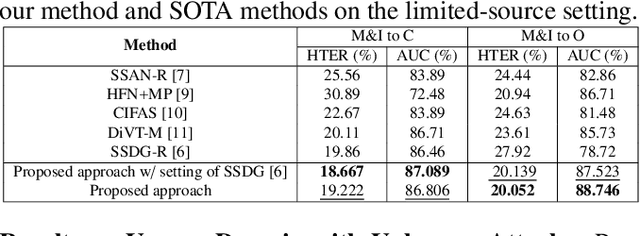
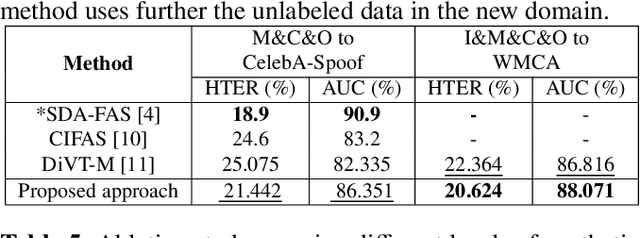
Although face anti-spoofing (FAS) methods have achieved remarkable performance on specific domains or attack types, few studies have focused on the simultaneous presence of domain changes and unknown attacks, which is closer to real application scenarios. To handle domain-generalized unknown attacks, we introduce a new method, DGUA-FAS, which consists of a Transformer-based feature extractor and a synthetic unknown attack sample generator (SUASG). The SUASG network simulates unknown attack samples to assist the training of the feature extractor. Experimental results show that our method achieves superior performance on domain generalization FAS with known or unknown attacks.